
Why Website Design Is Important for Your Business


Think of your website as your business’s digital handshake. It’s the very first, and often most powerful, introduction you make to a potential customer. In a fraction of a second, it communicates who you are and what you stand for, shaping perceptions before a single word is even read.
Good design builds instant trust. Bad design? It just creates doubt and sends people scrambling for the back button.
Your Website Is Your Digital Handshake
Let’s try a quick thought experiment. Picture yourself walking into two different stores. The first is bright, clean, and everything is easy to find. The second is cluttered, dimly lit, and you can't figure out where to go. Which one inspires confidence? Which one are you more likely to buy from?
Your website works exactly the same way online. It’s the first point of contact, setting the tone for the entire customer journey.
And this first impression happens fast. We're talking blink-of-an-eye fast. Research shows it takes a visitor just 50 milliseconds to form an opinion about your site. What's more, a massive 94% of those first impressions are based purely on design.
It doesn't stop there. A staggering 75% of people admit to judging a company's credibility based on its website design. A professional, polished site immediately signals that you're a trustworthy business that cares about the user experience.
The Psychology of Visual Appeal
This instant gut reaction isn't random; it's hardwired into our psychology. Our brains process visual cues almost instantly, long before we start reading text.
Several key elements play into this snap judgment:
- Layout and Composition: A clean, organized layout feels professional and makes information feel accessible. Clutter creates confusion and friction.
- Color Palette: Colors are emotional shortcuts. They trigger feelings and associations that can make or break a first impression. You can dive deeper into the impact of color psychology in branding to see just how much influence different shades can have.
- Typography: The fonts you choose do more than just display words. They convey personality—is your brand modern and sleek, classic and traditional, or fun and playful?
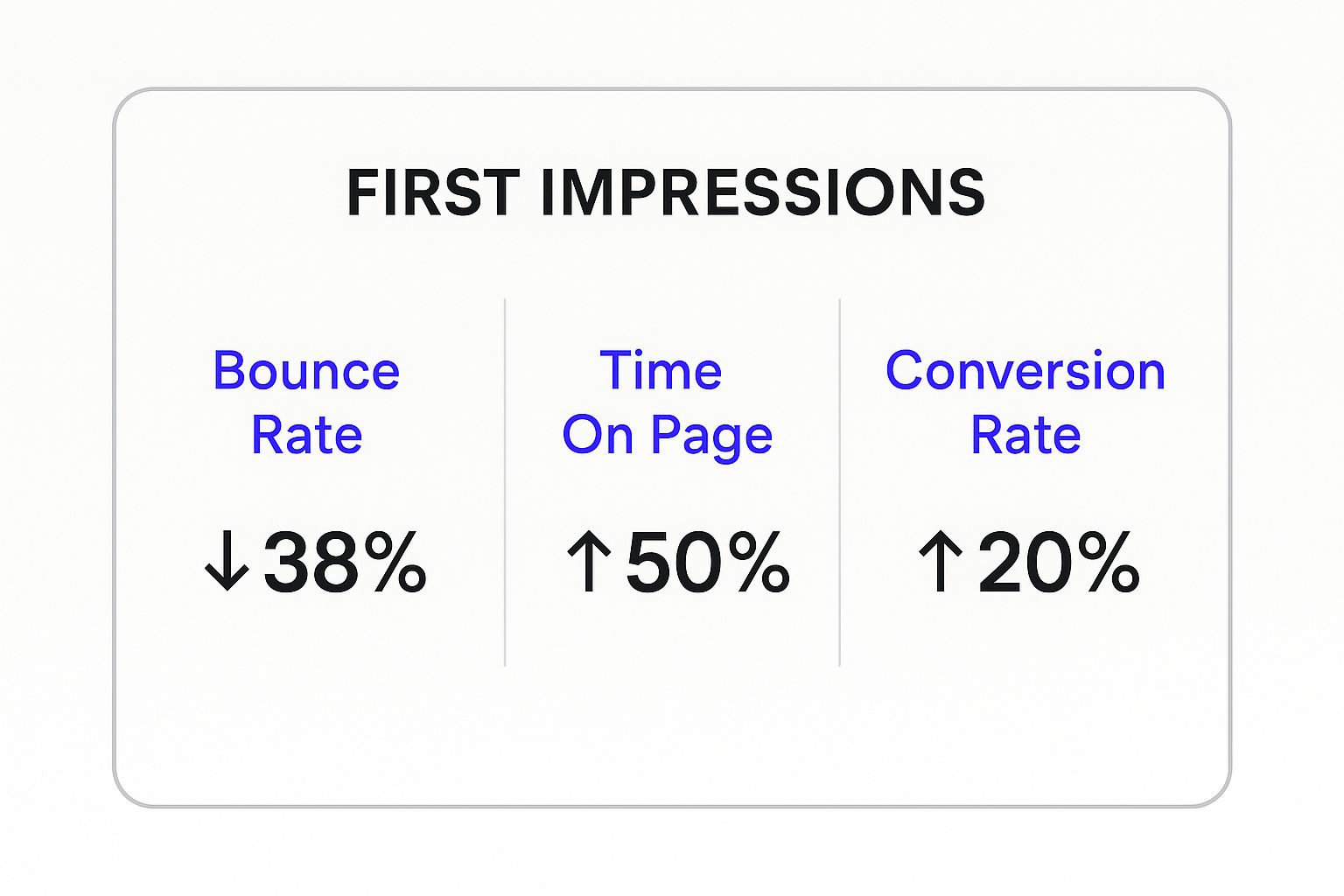
The image above really drives this point home, showing how a great first impression encourages people to stick around, explore, and ultimately take action.
To put it all together, here’s a quick summary of the design elements that are mission-critical for building that initial trust.
Key Elements of a Strong First Impression
Nailing these elements is the first step toward turning a casual visitor into a loyal customer. It all starts with that first, split-second impression.
How Great Design Supercharges Your SEO
It’s easy to think of SEO as a game of keywords. While keywords definitely matter, they're just one small part of a much bigger picture. These days, search engines like Google are laser-focused on one thing: user experience. This shift means your website's design isn't just about looking good—it's a direct, powerful factor in how well you rank.
Think about it this way: your website's design constantly sends signals to Google. A fast, intuitive, and mobile-friendly site sends all the right signals, telling the search engine that you’re providing a quality experience. On the other hand, a slow, confusing site sinks even the best keyword strategy. This is why getting a handle on website design is your secret weapon for climbing the search rankings.
Great design isn't just a perk for your visitors anymore; it's a technical must-have for modern SEO. It’s the very foundation you build all your other efforts on.
The Technical Side of a User-Friendly Design
When a search engine bot crawls your site, it isn't just reading the words on the page. It’s actively judging your site's structure and performance to guess how a human would feel using it. If the bot finds a well-organized, speedy, and accessible site, it assumes people will love it, too.
This is where the nuts and bolts of your design come into play:
- Mobile-Friendliness: With over 60% of all online searches now happening on mobile devices, a responsive design isn't optional. Google has fully embraced mobile-first indexing, which means it primarily looks at your site's mobile version to decide your ranking. If your site is a mess on a phone, your rankings will take a serious hit.
- Page Load Speed: We've all been there—clicking away from a site that takes forever to load. Your customers are no different. In fact, just a one-second delay in mobile load times can slash conversion rates by up to 20%. Google sees this and rewards faster websites with better rankings because they deliver a better experience.
- Intuitive Navigation and Structure: A logical site map with clear navigation helps both people and search engine bots find what they're looking for. Picture a well-organized library. A clear site structure and smart internal linking help Google understand the layout of your content and figure out which pages are the most important.
A positive user experience can boost engagement and improve rankings. Ensure your website is easy to navigate, loads quickly, and provides valuable content.
How Your Design Choices Hit Key SEO Metrics
Every single design choice you make, from font size to button placement, has a direct impact on the key SEO metrics that Google watches like a hawk. A sloppy design drags these numbers down, telling search engines your site just isn't giving users what they want.
Let's break down how design affects these critical metrics:
- Bounce Rate: If someone lands on your page and immediately clicks the "back" button because it’s confusing or just plain ugly, your bounce rate shoots up. A high bounce rate screams to Google that your page isn't relevant to what the user was searching for.
- Time on Page: An engaging, easy-to-read design makes people want to stick around. When they spend more time on your site, it signals to Google that you're offering something of real value.
- Click-Through Rate (CTR): Even the way your site looks in the search results is a design choice. A well-written title tag and meta description, designed to be compelling and clickable, can make a huge difference in your CTR.
At the end of the day, a smart, user-focused design doesn't just complement your SEO—it’s an essential part of it. The two work together to create a powerful engine that drives organic traffic by keeping both users and search engines happy.
Boosting Engagement with Better User Experience
Have you ever landed on a website, gotten frustrated trying to find something simple, and just clicked away? That’s a classic failure of user experience (UX). A truly great design is about so much more than just looking good; it's about making your site a genuinely pleasant and effective place for your visitors.
Think of it like this: a beautiful storefront is great, but if customers can't find the checkout counter or the aisles are a confusing mess, they’ll leave empty-handed. Your website is no different. A user-centric design creates a smooth, intuitive path that guides visitors exactly where they need to go, without any friction.
This thoughtful approach is key to keeping people on your site longer, encouraging them to explore more pages, and ultimately, building a real connection with your brand.
Making Your Website Effortless to Use
When a visitor shows up, they shouldn't have to think hard about how to use your site. The goal is to make every click and scroll feel natural and effortless. A design that prioritizes usability and clarity will always win out over one that’s merely stylish.
This really boils down to a few core principles:
- Findability: Can users easily find your products, contact info, or blog posts? A logical and clearly labeled navigation menu is absolutely non-negotiable.
- Readability: Are your fonts easy on the eyes, even on a phone? Clear typography with strong contrast ensures your message actually gets read, instead of causing eye strain.
- Usability: Is your site simple to get around, and are the tools intuitive? Everything from a smooth checkout process to easy-to-use search filters should be designed for simplicity.
By focusing on these elements, you're actively removing the frustrating roadblocks that make people leave.
The Business Impact of a Seamless Experience
Investing in a positive user experience isn't just about making people happy; it delivers real, measurable business results. When your site is easy and enjoyable to use, it directly boosts the key metrics that drive growth.
For example, an intuitive user interface built around visitor needs has been shown to increase conversion rates by up to 200%. Why? Because good design removes friction from the buying process, making it so much easier for customers to say "yes." For a deeper dive into this, check out this comprehensive guide to onboarding UX design for more ideas.
Ultimately, a seamless experience keeps people on your site longer, lowers your bounce rate, and encourages them to explore everything you have to offer. It's the difference between a visitor who leaves in seconds and one who becomes a loyal, returning customer.
Turning Visitors Into Customers Through Design
Let's be honest, a beautiful website is nice to look at, but a website that actually turns visitors into paying customers? That’s a powerhouse for your business. This is where smart design stops being about just looking pretty and starts directly driving sales and leads.
Think of your website as your best salesperson, working 24/7. Its whole job is to guide people, answer their questions before they even ask them, and make it incredibly easy to take that next step. Every little detail—from the color of a "Buy Now" button to how many fields are in your contact form—is part of that conversation.
The goal is simple: remove any friction that might make someone hesitate. When you get this right, you see why great design isn't just an expense; it's a direct investment in your bottom line.
Crafting the Path to Purchase
The most effective websites I've ever seen are all built with a crystal-clear goal in mind. They don’t just throw information at you. Instead, they create a carefully planned path that guides you right to where they want you to go, whether that’s making a purchase or filling out a form.
This whole process is called conversion rate optimization (CRO), and it's where your design choices can make or break your success.
Here are a few of the biggest players:
- Irresistible Calls-to-Action (CTAs): These are your "Shop Now," "Get a Quote," or "Sign Up" buttons. A great CTA uses strong, action-oriented words, pops off the page with a contrasting color, and is placed right where someone would naturally look for it.
- Painless Forms: Let's face it, nobody likes filling out a long, complicated form. Smart design means only asking for the absolute essentials, making the whole process quick and painless.
- Frictionless Checkout: If you run an e-commerce store, the checkout is your final, most important hurdle. A clean, step-by-step process with progress bars, a guest checkout option, and visible security badges can slash the number of abandoned carts.
Ultimately, good design isn't just about grabbing attention—it's about guiding that attention toward a specific goal. You can find more in-depth website conversion optimization tips to really dial in your site's performance.
The Staggering Impact of a Redesign
Sometimes, little tweaks here and there just won't cut it. When you take a step back and completely rethink your site based on how people actually use it, the results can be mind-blowing.
We're not talking small gains here. Strategic website redesigns can boost conversion rates by an average of 178% annually. When you design for user behavior, you turn your website into a finely-tuned conversion engine.
Take TYKMA Electrox, for example. They didn't just give their site a facelift; they redesigned it with their users and SEO in mind. The result? A jaw-dropping 314% monthly increase in leads. It just goes to show how powerful the combination of a user-centric design and a smart marketing strategy can be.
These aren't just flukes. They're proof that thoughtful, strategic web design is one of the best tools you have for growing your business. It builds trust, makes decisions easier, and smoothly turns a curious visitor into your next loyal customer.
Building Unshakeable Brand Trust and Consistency
Your website isn’t just a brochure; it’s the heart of your brand's digital world. Think of it like your company's virtual headquarters. When every room in that headquarters shares the same style, color palette, and vibe, it feels deliberate and professional. That's exactly what great design consistency does for your brand online.
It weaves together a single, unified experience that reinforces who you are at every click. Using the same fonts, colors, and tone of voice across your site makes your brand feel polished and, more importantly, dependable. This dependability is the bedrock of trust. Over time, people start to recognize you, remember you, and feel much more comfortable choosing to do business with you.
Creating a Cohesive Brand Identity
There's nothing more jarring than a website that feels stitched together from different parts. Imagine clicking from a clean, modern homepage to a product page that looks like it was built a decade ago. It creates instant confusion and makes a visitor wonder, "Wait, am I still on the same site? Can I trust this place?"
A consistent visual identity is the solution. It ensures that no matter how someone finds their way to your site, they know exactly where they are. This all comes down to a few key elements working in harmony:
- Consistent Color Palette: Your primary and secondary colors should show up on every page, acting as your brand's visual signature.
- Uniform Typography: Sticking to a specific set of fonts for headings and body text gives your site a clean, organized feel.
- Standardized Layouts: While the content itself will vary, the basic structure of your pages should remain familiar, making it easy for users to find their way around.
- Cohesive Imagery: The style of your photography and graphics should always match your brand's personality, whether it's playful, serious, or somewhere in between.
Getting these details right transforms your site from a random collection of pages into a powerful, branded destination.
When your logos, fonts, and colors look the same everywhere, you create a unified visual identity. This consistency is absolutely critical for building brand recognition and showing your audience that you’re professional and trustworthy.
How Consistency Builds Customer Confidence
This isn't just fluffy design talk; it has a real psychological effect on your visitors. When a user experiences that kind of consistency, their brain interprets it as reliability and stability. They start to feel more confident that your business is legitimate and that you pay attention to the details.
That confidence has a direct impact on what they do next. A customer who trusts your brand is far more likely to buy something, subscribe to your newsletter, or tell their friends about you. You're no longer just another faceless site on the internet—you're a name they recognize and rely on.
This is how you turn a first-time visitor into a loyal advocate who truly believes in what you do.
Standing Out in a Sea of Sameness
Let's be blunt: in today's market, your website is where you win or lose. A clunky, outdated site isn't just a missed opportunity; it’s like handing a potential customer a map to your competitor’s front door. This is precisely why getting a handle on website design is no longer optional—it's your biggest competitive advantage.
Picture two online stores selling the exact same thing. Store A is slow, confusing, and looks like it hasn’t been touched since 2010. Store B is zippy, intuitive, and makes buying feel effortless. Where does the customer spend their money? You know the answer. It’s always the one that cared enough to create a great experience.
A professional, easy-to-use site doesn't just get you in the game. It makes you the obvious choice.
Keeping Pace with Modern Expectations
What wowed a customer online two years ago can feel frustratingly dated today. Consumer expectations move fast. Investing in quality web design shows your audience that you’re paying attention—that your brand is current, relevant, and understands what they want right now.
This goes way beyond just chasing the latest design trends. It's about proving you respect your customers' time by giving them a smooth, hassle-free experience. When you get this right, your website becomes your most powerful asset, working 24/7 to pull people in and win them over.
When your website looks the part and works without a hitch, it instantly builds credibility. That trust, born from good design, directly translates into more sales because people feel confident hitting the “buy” button.
This commitment to a stellar online presence pays off in a few critical ways:
- Attracting Better Customers: A polished, professional site often signals a high-quality brand, which in turn attracts customers who are willing to spend more.
- Creating Raving Fans: A great experience is memorable. It makes people want to come back, turning first-time buyers into loyal customers.
- Setting Yourself Up for the Future: A well-built, modern website is far easier to update and scale as your business grows and technology evolves.
At the end of the day, fantastic design isn't just about making things look pretty. It's a strategic move that positions your business to win, turning your website into a powerful engine for real, sustainable growth.
Answering Your Top Web Design Questions
Alright, so you get that web design is a big deal. But when it comes to the nitty-gritty, a few practical questions always pop up. Let's dig into some of the most common ones I hear, so you can make smarter calls for your own site.
"Is a Simple Template Good Enough?"
This is probably the number one question I get. And look, templates can be a decent starting point if you're just getting off the ground. But are they "good enough" to really grow your business? Honestly, probably not.
A template often boxes you into a generic look that screams "cookie-cutter." It can be tough to weave your unique brand story and create a smooth, intuitive journey for your specific customer. Think of it this way: your website is your digital storefront. A custom design is like a bespoke suit—it fits your brand perfectly and shows everyone you mean business.
How Often Should I Redesign My Website?
This is another big one. There's no magic number, but a solid rule of thumb is to take a hard look at a major refresh every two to three years. Design trends and the tech behind websites move incredibly fast. What looked fresh and modern two years ago can feel clunky and dated today.
But here's the real secret: don't just watch the calendar. Watch your data.
Are your conversion rates starting to dip? Is your bounce rate creeping up? Those numbers are your audience telling you something is wrong. They’re waving a red flag that your site isn't giving them what they need anymore.
A proactive redesign isn't just a cosmetic touch-up. It's a strategic move to stay ahead of the curve and make sure your website keeps working for you. If you wait until your site feels ancient, you've already been losing business for a while.
At the end of the day, thinking about web design as a "one-and-done" project is a trap. It's an ongoing investment in your most important business asset. Keep an eye on its performance, listen to what your users are telling you (through their actions), and be ready to adapt. That’s what separates a business that just exists online from one that truly thrives.
Ready to transform your e-commerce store from a side hustle into a powerhouse? At Wand Websites, we build conversion-focused Shopify sites that turn your hard work into more traffic and bigger sales. Let us handle the technical details so you can focus on your amazing products. Find out how we can help you grow.
