
What Is a Conversion Funnel and How Does It Work?

Think of the last time you walked into a physical store. You probably browsed a bit, maybe picked something up, looked it over, and then decided whether to head to the checkout counter. A conversion funnel is basically the digital map of that exact journey, but for your website.
It tracks the path someone takes from the very first time they hear about your brand all the way to the moment they click "Buy Now" or sign up for your email list.
Understanding the Conversion Funnel Framework
Visualizing your customer's journey as a funnel helps you see the whole process in distinct stages. It’s a powerful way to understand how people actually interact with your site and, more importantly, pinpoint the exact spots where they might be losing interest and leaving.
This idea has been around for a while. It all started back in the early 1900s with a guy named E. St. Elmo Lewis and his classic AIDA model—Attention, Interest, Desire, and Action. Today, we have incredible analytics tools that let us see this journey with stunning clarity. If you're curious, you can explore the history of the sales funnel conversion rate to see how these core ideas have evolved for the digital age.
Why Does It Matter for Your Business?
Viewing your customer's path as a funnel forces you to be more strategic. Instead of just throwing money at ads to get more traffic, you start thinking about how to guide that traffic from one step to the next. Each stage is a chance to build a little more trust, answer a potential question, and remove any friction that stands in the way of a sale.
By truly understanding what a conversion funnel is, you can:
- Find the "leaks" in your process where potential customers are dropping off.
- Tailor your marketing to fit what a user needs at that specific moment.
- Create a better user experience that feels smooth and intuitive.
- Boost your conversion rate and, of course, your revenue.
Simply put, a conversion funnel gives you a roadmap for turning casual visitors into paying customers. It’s about being intentional, guiding people through a journey you’ve designed to help them take that final step.
This structured thinking is a game-changer for any e-commerce business, especially if you’re moving from a marketplace like Etsy to your own Shopify store. It provides the foundation you need to build a profitable online brand, allowing you to make smart, data-backed decisions that have a real impact on your bottom line.
Breaking Down Each Stage of the Funnel
A conversion funnel isn't a one-size-fits-all path. It's really a series of distinct stages a potential customer walks through, and to build a great funnel, you have to get inside their head at each step. Your marketing needs to meet them exactly where they are.
Think of it as a conversation that gets deeper and more specific over time.
A classic way to map this out is the AIDA model: Awareness, Interest, Desire, and Action. It's a simple framework that shows how you start with a massive audience at the top and gradually guide the most interested folks down to becoming committed customers at the bottom.
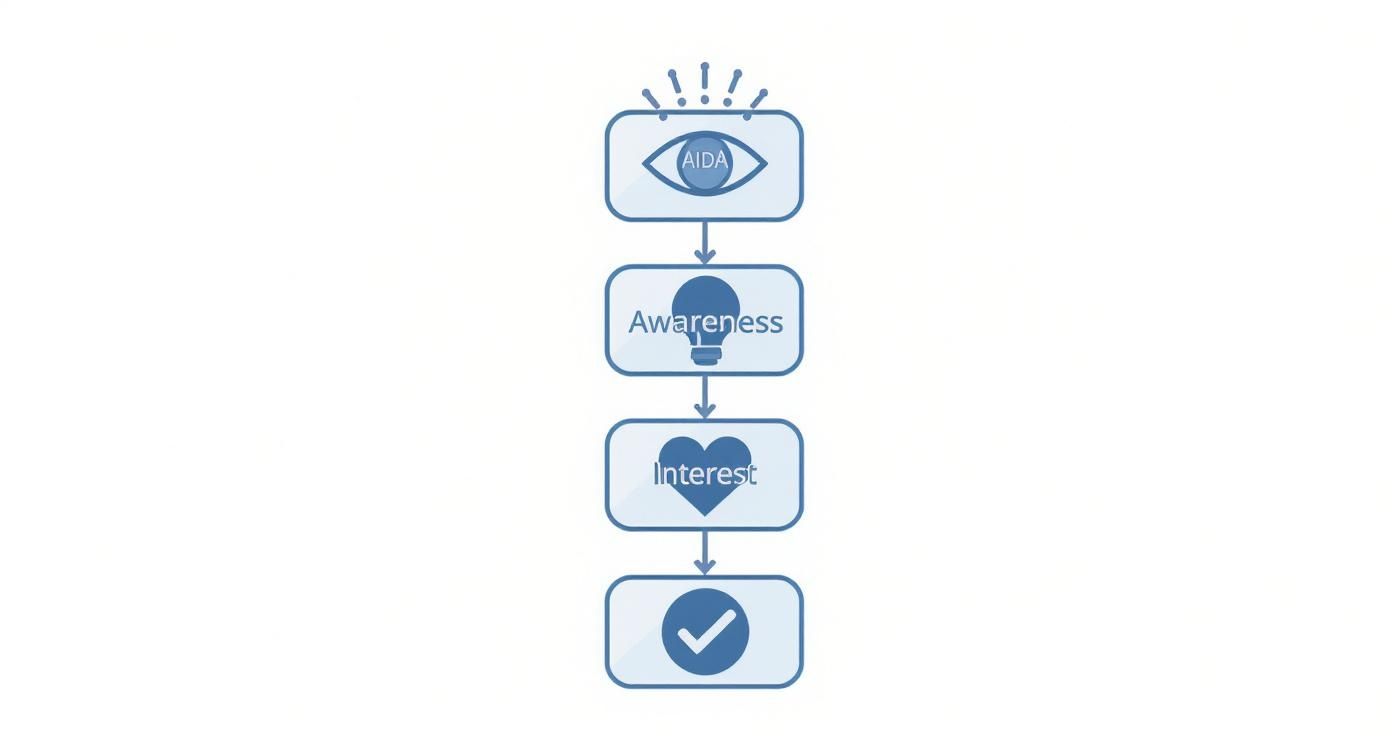
This model helps us see the journey from a stranger realizing they have a problem, to getting curious about solutions, to wanting your product specifically, and finally, clicking "buy." But for modern e-commerce, we need to add a crucial fifth stage to this classic model: Retention.
Let's break down all five.
Stage 1: The Awareness Stage
This is the very top of your funnel (often called TOFU), where someone first realizes they have a need or that your brand even exists. They aren't looking for you yet. They're just starting to search for answers.
At this point, they're in full-on exploration mode. They might be Googling things like, "how to organize a small living room" or "best gifts for new homeowners." They're craving information, not a sales pitch. Your job is to be the helpful resource that shows up with those answers.
Here’s how you grab their attention:
- Search Engine Optimization (SEO): Get your blog posts and pages to rank for those early-stage, informational questions.
- Social Media Ads: Run campaigns targeting users by their interests. Introduce your brand in a visual, low-pressure way that fits right into their feed.
- Content Marketing: Create genuinely useful blog posts, videos, or infographics that solve a problem for them, without a heavy sales angle.
The goal here is simple: get on their radar. You want to be the helpful guide they stumble upon at the very start of their journey. Go for the hard sell now, and you’ll just scare them away.
Stage 2: The Interest Stage
Okay, they clicked. Maybe they landed on your blog from a search result or a social media ad. Now they've moved into the Interest stage. They’re no longer just vaguely aware of a problem; they're actively digging in to find a solution.
Their mindset has shifted from broad discovery to focused research. They're reading your content, comparing different approaches, and starting to form opinions. This is your chance to start building a real relationship by proving you know your stuff.
To keep them engaged, you can:
- Write Engaging Blog Content: Create in-depth guides that naturally position your product as the perfect solution to their problem.
- Use Email Newsletters: Offer something valuable—like a free checklist or a design guide—in exchange for their email. This lets you keep the conversation going directly in their inbox.
- Launch Retargeting Campaigns: Show gentle reminder ads to people who've already visited your site, keeping your brand top of mind as they continue their research.
Stage 3: The Consideration Stage
Welcome to the middle of the funnel (MOFU). In the Consideration stage, potential customers are now seriously evaluating specific solutions, and yours is on the shortlist. They’ve narrowed their options and are now comparing products, features, and prices.
Their mindset is analytical. They're asking, "Is this product really worth the money?" or "Can I trust this brand?" They need solid proof that your product is the best choice they can make.
This is where you make your case.
- Build Detailed Product Pages: Don’t just list specs. Use high-quality photos, videos, and compelling copy to show off what makes your items special. Focus on the benefits, not just the features.
- Leverage Case Studies and Testimonials: Social proof is everything. Showcasing reviews and photos from happy customers builds instant credibility and eases any hesitation.
- Create Product Comparison Guides: Be the trusted resource that helps them decide. You can honestly compare your product to competitors or even help them choose between different options in your own store.
Stage 4: The Conversion Stage
This is it—the bottom of the funnel (BOFU). The Conversion stage is that moment of truth where a visitor decides to become a customer. They have every intention to buy and have probably even added an item to their cart.
At this point, your only job is to get out of their way. Make this final step as smooth and painless as possible.
Their mindset is laser-focused and task-oriented. Any tiny bit of friction—an unexpected fee, a confusing form—can make them leave. In fact, the average cart abandonment rate is a staggering 70%, and most of that is due to a clunky checkout process.
To get them across the finish line, focus on these details:
- Streamline Your Checkout: Get rid of unnecessary fields. Offer a guest checkout option and let them pay with familiar methods like PayPal or Apple Pay.
- Write Clear Calls to Action (CTAs): Use strong, action-focused text on your buttons. Think "Complete My Order" or "Buy Now."
- Show Off Trust Signals: Prominently display security badges, your return policy, and shipping info. These little things go a long way in reassuring a nervous buyer.
Stage 5: The Retention Stage
A sale isn't the end of the journey; it's the beginning of a new one. The Retention stage is all about turning that first-time buyer into a loyal, repeat customer who sings your praises. After all, it's way cheaper and easier to keep a customer you already have than to find a new one.
Here, the customer is in a post-purchase evaluation mode. They’re deciding if they love the product and what they think of your brand as a whole. A fantastic experience can turn them into an advocate who sends new people right back to the top of your funnel.
Strategies for this stage are all about building long-term loyalty:
- Smart Email Follow-ups: Send order confirmations, shipping updates, and a friendly email a week or two later asking for a review or offering tips on how to use their new item.
- Loyalty Programs: Reward your best customers with points, exclusive discounts, or early access to new collections.
- Personalized Offers: Use their purchase history to send them targeted promotions for other products they're likely to love.
By thinking through and fine-tuning each of these five stages, you can transform your website from a simple online store into a powerful engine for guiding visitors on a seamless journey—from stranger to your biggest fan.
How to Measure Your Funnel's Performance
Think of your conversion funnel like a waterslide—you want everyone who hops on at the top to splash into the pool at the bottom. But how can you tell if there are cracks or leaks along the way where people are falling out? The answers are hiding in your data.
Measuring your funnel’s health isn't about getting lost in a sea of spreadsheets. It’s about knowing exactly which numbers to watch at each step of the journey. When you connect the right metrics to the right stage, you get a crystal-clear picture of what’s working and, more importantly, what’s broken.
Metrics for the Awareness Stage
Right at the top, the goal is simple: get noticed. You're casting a wide net, trying to catch the attention of people who are just starting to realize they have a problem or a need. The big question here is, are you reaching them effectively?
These are the metrics that matter most:
- Traffic Sources: Where are people coming from? Are they finding you through a Google search, clicking over from Instagram, or responding to one of your ads? This tells you which of your marketing channels are actually pulling people in.
- Click-Through Rate (CTR): Of all the people who see your ad or search result, what percentage actually clicks it? A strong CTR is proof that your message is compelling enough to grab someone's attention and get them to take that first step.
Metrics for the Interest Stage
Okay, they've landed on your site. Now they've officially entered the Interest stage. They’re no longer just vaguely aware you exist; they’re actively digging into your content to see if you have the solution they’re looking for. Your job is to keep them hooked.
To see how engaged they really are, you'll want to track:
- Bounce Rate: This is the percentage of people who land on a page and leave without clicking anything else. Think of it as someone walking into a store, taking one look around, and immediately walking out. A high bounce rate is a red flag that your content isn't what they expected.
- Time on Page: How long are people actually sticking around? If they're spending a good amount of time reading your blog post or product description, it’s a great sign that they find your content genuinely valuable.
Metrics for the Consideration Stage
Now things are getting serious. In the Consideration stage, visitors are actively weighing their options and trying to decide if your product is the one for them. They've moved beyond casual browsing, and their intent to buy is getting much stronger.
The single most important metric to watch here is your Add-to-Cart Rate. It's the percentage of visitors who like a product enough to take that next step. This is a powerful signal of purchase intent and shows that your product pages are hitting the mark.
By tracking the Add-to-Cart rate, you're measuring the direct transition from browsing to serious consideration. A low rate at this stage often points to issues with product descriptions, pricing, or a lack of trust signals like customer reviews.
Metrics for the Conversion Stage
This is the moment of truth. Someone has put items in their cart and is heading to the checkout. Your only job now is to make this final step as smooth and painless as possible.
Here are the crucial numbers to watch:
- Conversion Rate: This is the ultimate scorecard for your funnel—the percentage of visitors who actually complete the purchase. Analyzing your conversion funnel is a cornerstone of e-commerce, and knowing the benchmarks helps. For example, the average funnel conversion rate hovers around 5%, though this can vary wildly by industry. You can explore the full breakdown of funnel conversion rates to see where you stand.
- Cart Abandonment Rate: What percentage of people add items to their cart but bail before paying? A high number here is almost always a sign of friction in your checkout process—things like surprise shipping costs or a clunky, confusing form.
This screenshot from Google Analytics shows a classic funnel visualization, tracking users from their first visit all the way to a completed transaction.
This kind of visual makes it painfully obvious where your biggest drop-offs are, so you know exactly where to focus your efforts first.
Metrics for the Retention Stage
The sale isn't the end of the story. The final stage is all about turning that first-time buyer into a loyal fan who comes back again and again. Remember, happy customers are your best asset because they are far more likely to buy from you in the future.
The key metric for tracking loyalty is Customer Lifetime Value (CLV). This number predicts the total amount of money you can expect to make from a single customer over their entire relationship with you. A rising CLV is a fantastic sign that your post-purchase experience—from your follow-up emails to your customer service—is building a loyal base that will fuel your growth for years to come.
Bringing Your Funnel to Life in Ecommerce
It’s one thing to talk about funnels in theory, but where the magic really happens is seeing it play out in the real world. So, let’s make this concrete. We'll follow the journey of 'Sarah,' a fictional craft business owner who’s making the leap from a crowded Etsy shop to her very own Shopify store.
Sarah's challenge is a big one. She isn't just launching a website; she’s creating a whole new customer journey from scratch. Without Etsy's built-in traffic, she has to build a complete funnel that can find new customers, earn their trust, and ultimately drive sales.
Building Awareness Beyond the Marketplace
On Etsy, discovery was pretty much handled for her. But on her own Shopify site, Sarah has to generate all her own buzz. This is the very top of her funnel, where the main goal is simply to get her brand in front of people who’ve never heard of her but are the perfect fit for her products.
She decides to tackle this with a two-part strategy:
- Targeted Social Media Ads: Sarah creates a series of gorgeous video ads for Instagram and Pinterest. These aren't pushy "buy now!" ads. Instead, they’re designed to be inspiring, showcasing her unique crafting process. She targets them specifically to users who follow handmade home decor accounts and have shown interest in personalized gifts.
- Content-Driven SEO: She launches a blog on her new site, writing helpful articles like "5 Creative Ways to Style Your Bookshelf" and "How to Choose the Perfect Handmade Wedding Gift." These posts are created to show up on Google when her ideal customers are looking for inspiration, not necessarily a product.
The goal here isn't an immediate sale. It’s about being the helpful, creative brand that people stumble upon right at the start of their search. Every click from an ad or a blog post is a new person entering the top of her funnel.
Sparking Interest with a Compelling Story
Once a visitor lands on her site, Sarah knows she needs to do more than just display her products. She has to hook them. This is the Interest stage, where a casual click needs to turn into genuine curiosity about her brand.
Her secret weapon? A fantastic "About Us" page. It’s not some stuffy corporate bio. It’s a heartfelt story about why she started her business, filled with photos of her studio and her passion for her craft. This is what builds an emotional connection that a generic Etsy page simply can’t match.
By sharing her personal story, Sarah isn't just selling a product; she's inviting customers to be a part of her creative journey. That authenticity is a powerful way to build the trust needed to guide visitors deeper into the funnel.
Easing Consideration with Proof and Detail
Now that visitors are genuinely interested, they're in the Consideration stage. They’re clicking through product pages, comparing a few items, and weighing whether they should make a purchase. Sarah's job is to answer every possible question and erase any doubt in their minds.
She dials in on two key elements for every single product page:
- High-Quality Visuals and Rich Descriptions: She doesn’t skimp here. Each product has multiple high-resolution photos from every angle, a short video showing it in use, and a detailed description that focuses on the craftsmanship and the feeling the item brings to a home.
- Glowing Customer Reviews: She uses an app to import her best reviews from her old Etsy shop. This instantly provides social proof, showing new visitors that real people have bought and loved her work. It’s a huge confidence booster for anyone on the fence.
For any business selling online, a detailed guide to improving ecommerce conversion rates can offer fantastic strategies for perfecting this crucial stage.
Sealing the Deal at Conversion
At last! A visitor has added an item to their cart and is ready to check out. They’ve hit the Conversion stage. Sarah knows her only job now is to make paying as smooth and painless as possible. Any friction at this point could lose her the sale.
To optimize her checkout, she implements a clean, single-page form, offers a guest checkout option (no forced account creation!), and prominently displays familiar payment logos like PayPal and Apple Pay. Best of all, there are no surprise shipping costs, and a link to her clear return policy is right there on the page.
By taking these thoughtful steps at every stage, Sarah has successfully built a complete ecommerce conversion funnel—a repeatable, measurable system for turning total strangers into happy, loyal customers.
Common Funnel Problems and How to Fix Them
Even the most thoughtfully built funnel will spring a leak sooner or later. Hitting a roadblock is just part of the game when you're growing an online business. The real trick is knowing how to spot the problem and patch the hole before it starts draining your revenue.
Think of it like being a detective for your own business. Your job is to follow the clues in your data, pinpoint exactly where potential customers are dropping off, and figure out why. Most of the time, the fix is much simpler than you might expect.
Let's walk through some of the most common issues we see and the straightforward ways you can get things flowing smoothly again.
High Traffic, But No One's Sticking Around
You're getting tons of clicks and your traffic numbers look great, but visitors just aren't engaging. They land on a page, take a quick peek, and hit the back button almost immediately. This is a classic top-of-funnel problem, often flagged by a sky-high bounce rate. It's a dead giveaway that there's a disconnect between what people expected and what they actually found.
How to Fix It:
- Align Your Messaging: Make sure your ads, social posts, and search results are an honest preview of your landing page. If you're advertising "hand-stitched leather journals," that page better be overflowing with them.
- Speed Things Up: Nobody waits for a slow-loading page anymore. Use a free tool to check your site speed and optimize your images to create a zippy, enjoyable experience. A couple of seconds can make all the difference.
- Give Them a Clear Path: Your website’s navigation should feel second nature. It needs to be crystal clear where a visitor should click next to explore your products or learn more about you.
A visitor should know what you sell and why they should care within three seconds of landing on your page. If your core value isn't immediately obvious, they won't stick around to figure it out.
The Dreaded Abandoned Cart
This is easily one of the most frustrating leaks to deal with. A customer likes your product enough to add it to their cart... but then they vanish without a trace. They get right to the finish line and just disappear. For any ecommerce store, this is a massive headache.
In fact, the global average cart abandonment rate is over 70%. This shows just how common it is for shoppers to bail before checking out. Digging into your analytics can help you see where people are getting stuck, which reveals key conversion barriers you can then fix.
How to Fix It:
- Simplify Your Checkout Form: Only ask for what you absolutely need. Every extra box to fill out is another opportunity for a potential customer to get annoyed and leave.
- Be Upfront About Costs: Surprise shipping fees are the #1 killer of conversions. Show all the costs, including shipping and taxes, right from the start. No one likes a nasty surprise at the final step.
- Use Abandoned Cart Emails: Set up a simple, automated email to send a friendly reminder to anyone who left items behind. A small discount code included in that email is often all it takes to bring them back to complete the purchase.
One and Done: The Lack of Repeat Business
You're making sales, which is great, but customers only seem to buy from you once. This means you're missing out on the most valuable part of the entire funnel: retention. Keeping an existing customer is so much cheaper and easier than constantly having to find new ones.
How to Fix It:
- Nail the Post-Purchase Experience: Don't let the conversation end at the sale. Send friendly follow-up emails with order updates, a genuine thank-you note, and maybe a gentle request for a review a week later.
- Create a Loyalty Program: Make your customers feel special. Reward your repeat buyers with points, exclusive discounts, or a sneak peek at new products.
- Personalize Your Marketing: Use what you know about their past purchases to send them tailored recommendations for other products you think they’ll love. Show them you get their style.
Common Conversion Funnel Leaks and Their Fixes
Sometimes, seeing the problem and solution side-by-side makes it all click. Here's a quick-reference table to help you diagnose and treat some of the most common funnel leaks.
Think of this table as your first-aid kit for funnel optimization. By keeping an eye out for these leaks and acting quickly, you can ensure your funnel stays healthy and keeps converting for you.
Answering Your Top Conversion Funnel Questions
Even after you've mapped everything out, a few practical questions always pop up when it's time to build your own funnel. Knowing the theory is one thing, but actually putting it into practice is a whole different ballgame.
Let's clear up some of the most common questions I hear so you can start moving forward with real confidence.
How Long Does It Take to See Results?
This is the big one, isn't it? The honest answer is, it's a mix. Some tweaks can give you a boost almost overnight, while other, bigger strategies need time to pay off.
Think of it like gardening. Quick wins are like giving your plants a good watering—you see the positive effects almost immediately. These are things like:
- Simplifying your checkout form: Cutting down the number of fields can increase your sales literally within days.
- Improving your CTA buttons: A simple change to the text or color can get you more clicks right away.
On the other hand, long-term strategies are like enriching the soil. Things like SEO and content marketing build your authority and trust over time. You probably won't see a huge traffic spike from one blog post in its first week, but after six months? That consistent effort can become your most powerful and reliable source of new customers.
Do Funnels Work for Service-Based Businesses?
Absolutely. We've used a lot of e-commerce examples, but the conversion funnel concept works just as well for service businesses. The final "conversion" just looks a little different. Instead of buying a product, the goal might be getting a new lead or having someone book a call.
For a service business, the funnel could look something like this:
- Awareness: A potential client finds your blog post about "How to Choose a Web Designer."
- Interest: They download your free "Website Planning Checklist" and give you their email.
- Consideration: You send them a few automated emails that show off your portfolio and share some glowing client testimonials.
- Conversion: They finally click the link in an email to book a free 15-minute consultation call with you.
See? The principle is exactly the same: guide a potential client through a series of steps that build trust and lead them toward taking a valuable action.
A conversion funnel isn't just for a shopping cart. It's a universal model for mapping out any customer journey, whether the final step is a purchase, a phone call, or a form submission.
If you're looking for a deeper dive on how to really nail those final, critical stages of the journey, you might want to explore some advanced bottom-of-funnel marketing and conversion strategies.
What Are the Best Free Tools for Funnel Tracking?
You don't need to break the bank on fancy software just to start understanding your funnel. Some of the most powerful and insightful tools out there are completely free.
Google Analytics 4 (GA4) is non-negotiable. It's the industry standard for a reason. You can use it to see where your visitors come from, which pages they look at, and where they tend to leave. Setting up a "Funnel exploration" report in GA4 will give you a super clear visual of how people are moving through the specific steps you've defined, all the way from your landing page to your thank-you page.
With these answers, you’re in a much better spot to not just understand what a conversion funnel is but to actually start building and improving one for your own business.
Ready to stop relying on Etsy's rules and build a website designed for growth? At Wand Websites, we craft high-performing, conversion-focused Shopify stores that turn your hard work into more traffic and loyal customers. Let us handle the heavy lifting so you can focus on creating. Learn how we can help you grow.
