
Your Guide to the Website Development Process

So, you've built a fantastic business on a marketplace like Etsy, and now you're wondering what's next. If you're ready to take a major leap in growth, building your own website is the answer. It can seem like a tangled mess of tech-speak and confusing steps, but think of it as your direct path to truly owning your brand. This guide is your friendly roadmap, designed specifically for sellers like you.
From Marketplace Seller to Brand Owner
Welcome! If you're reading this, you're likely an ambitious entrepreneur ready to break free from the limits of a shared marketplace and build a real home for your brand online. This isn't just about putting up a website; it's about taking complete control of your customer's journey, opening up new ways to make money, and building a valuable, long-term asset.
Think of this process as your blueprint for graduating from a marketplace seller to a full-fledged brand owner. We're going to pull back the curtain on the entire journey, breaking it down into six clear, manageable stages. The goal is to make your move to a platform like Shopify smooth, smart, and seriously profitable.
Understanding the 6 Core Stages
To get where you're going, you need a map. The good news is that website development follows a pretty logical path, starting with a solid plan and ending with continuous growth. Each phase stacks on top of the one before it, making sure no stone is left unturned and your finished website is a well-oiled sales machine.
This infographic gives you a bird's-eye view of the entire process.
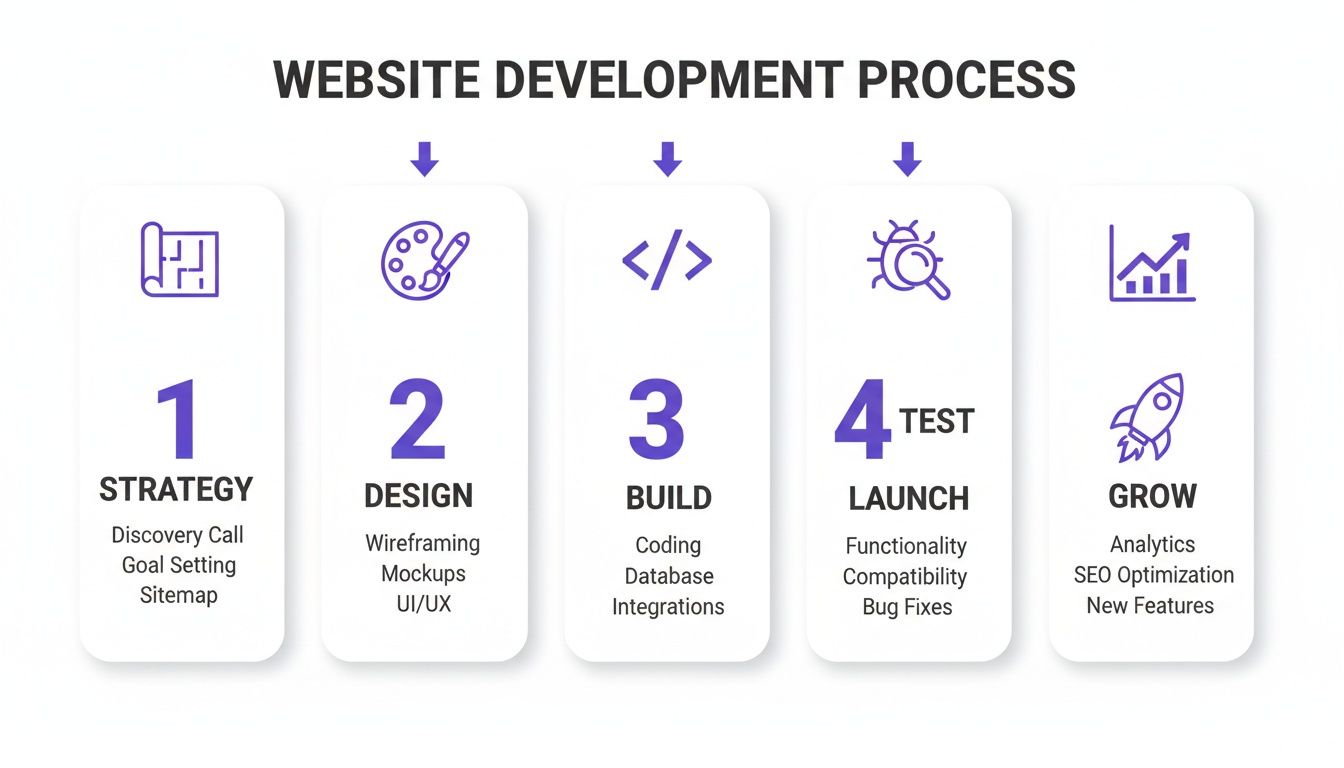
As you can see, the actual "coding" or building is just one part of a much bigger picture. The planning you do upfront and the effort you put in after launch are just as vital to your success.
To give you a clearer picture of the journey ahead, here's a quick breakdown of what to expect at each stage.
The 6 Core Stages of Your Website Development Journey
This table acts as your high-level checklist. As we dive into each stage in the sections below, you’ll see exactly how these deliverables come to life.
Why Your Own Website Matters Right Now
Putting money into a professional website isn't just another business cost; it's a direct investment in your future. The global web development market has absolutely skyrocketed, which tells you just how essential a good website is for any modern business.
The market size is already at an impressive USD 74.69 billion and is expected to climb to USD 104.31 billion by 2030. For small businesses, a professional site isn't a "nice-to-have"—it's a revenue multiplier.
This massive growth highlights a simple truth: customers today expect a direct, branded shopping experience. Having your own e-commerce platform gives you the power to:
- Build Direct Customer Relationships: Stop "renting" your customers from a marketplace. It’s time to build your own email list and create a community of loyal fans who love your brand.
- Control Your Brand Identity: Your website is a blank canvas. You can finally tell your unique brand story, show off your values, and create a look that's 100% you, with zero marketplace restrictions.
- Increase Your Profit Margins: Those hefty marketplace fees can finally be a thing of the past. By selling direct, you keep more of the revenue you've worked so hard to earn.
- Unlock Powerful Marketing Tools: You can finally use sophisticated marketing tactics like abandoned cart recovery emails, personalized shopping experiences, and loyalty programs that just aren't possible on platforms like Etsy.
Ready to get started? Let's begin building your e-commerce empire, one smart step at a time.
Building Your Strategic Foundation
Before a single pixel is placed or a line of code is written, every great e-commerce website starts with a rock-solid plan. This first phase is all about discovery and strategy. Think of it like creating the blueprint for your dream home; you wouldn’t just start nailing boards together without knowing the layout, the number of rooms, or what you want the house to feel like.
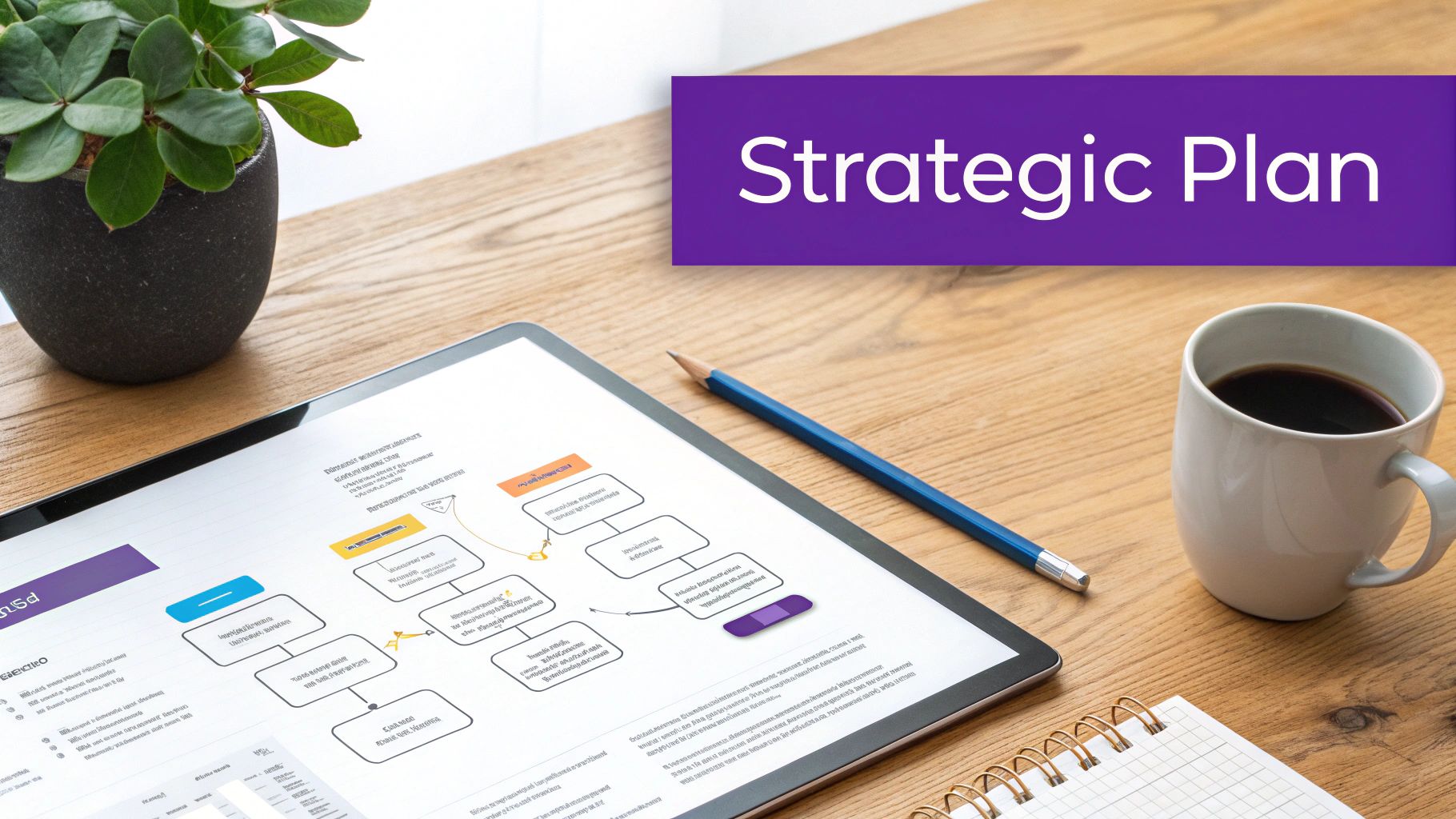
Honestly, this groundwork is the most critical part of the whole process. It ensures every decision made later—from the color palette to the checkout flow—is deliberate and directly tied to your business goals. Getting this right from the start saves you from costly headaches and redesigns down the road.
Defining Your Core Objectives
First things first: you need to nail down your “why.” What, specifically, do you want this new website to accomplish? A fuzzy goal like "sell more products" just won't cut it. We need to get specific and measurable.
Are you trying to bump up your average order value by 15%? Maybe the big goal is launching a subscription service to build a recurring revenue stream. Or perhaps you're finally ready to expand internationally and need multi-currency and language support baked in.
Here are the key questions you need to answer:
- Primary Business Goals: What are your top 1-3 objectives? Think in terms of increasing conversion rates, growing your email list, or slashing cart abandonment.
- Target Audience: Who are you really selling to? Get into their heads—what are their pain points, what motivates them, and how do they like to shop?
- Unique Selling Proposition (USP): What makes you different and better than the competition? This is the core of your messaging and design.
Answering these questions turns your website from a simple online catalog into a powerful, goal-oriented business tool. This initial planning can take anywhere from one to two weeks, but the clarity you gain is priceless.
The discovery and research phase determines the trajectory of the entire project. A detailed plan based on this data protects you from spending extra resources on solving unexpected issues later on.
Mapping the Customer Journey
Once your objectives are clear, it's time to walk in your customer's shoes. The goal here is to map out their ideal path through your site, and that starts with two key deliverables: a sitemap and wireframes.
A sitemap is a simple flowchart of your website. It shows all the pages and how they connect, ensuring the navigation feels logical and intuitive so people can find exactly what they're looking for without getting frustrated.
Next up are wireframes. These are basic, black-and-white layouts of your most important pages. We're not worried about colors or fonts yet—this is all about structure, hierarchy, and function. Wireframing helps us answer critical user experience questions before any design work begins:
- Where is the best place to put the "Add to Cart" button for maximum impact?
- How should product filters look and work on a smartphone?
- What information is absolutely essential on the checkout page (and what's just noise)?
As you get into the thick of it, it helps to follow a good guide to project management for website development to keep all these moving parts organized and on track.
Outlining Technical Needs and Scope
Finally, this strategy phase wraps up with a detailed project scope document. This is where we translate all those goals and user journey maps into a concrete list of features and technical requirements.
Think of it as the ultimate to-do list for the project. It gets everyone—you, your designer, your developer—on the same page.
Common E-commerce Features to Consider:
- Product Bundling: Letting customers buy related items together, often for a small discount.
- Subscription Services: Setting up recurring orders for your most popular products.
- Customer Reviews & Ratings: Building trust and social proof right on the product page.
- Advanced Search & Filtering: Helping shoppers quickly narrow down your catalog to find the perfect item.
- Payment Gateway Integration: Securely accepting payments from all the major players, like credit cards, PayPal, and Apple Pay.
With this strategic foundation locked in, you’re ready to move into the design phase with confidence. You know your new site is being built for one purpose: growth.
Designing an Unforgettable User Experience
Alright, with our strategic blueprint in hand, it's time for the fun part: bringing your brand’s personality to life. This design phase is so much more than just picking pretty colors and cool fonts. It’s about building an intuitive, persuasive, and genuinely memorable experience that guides visitors smoothly from "just browsing" to becoming loyal fans.
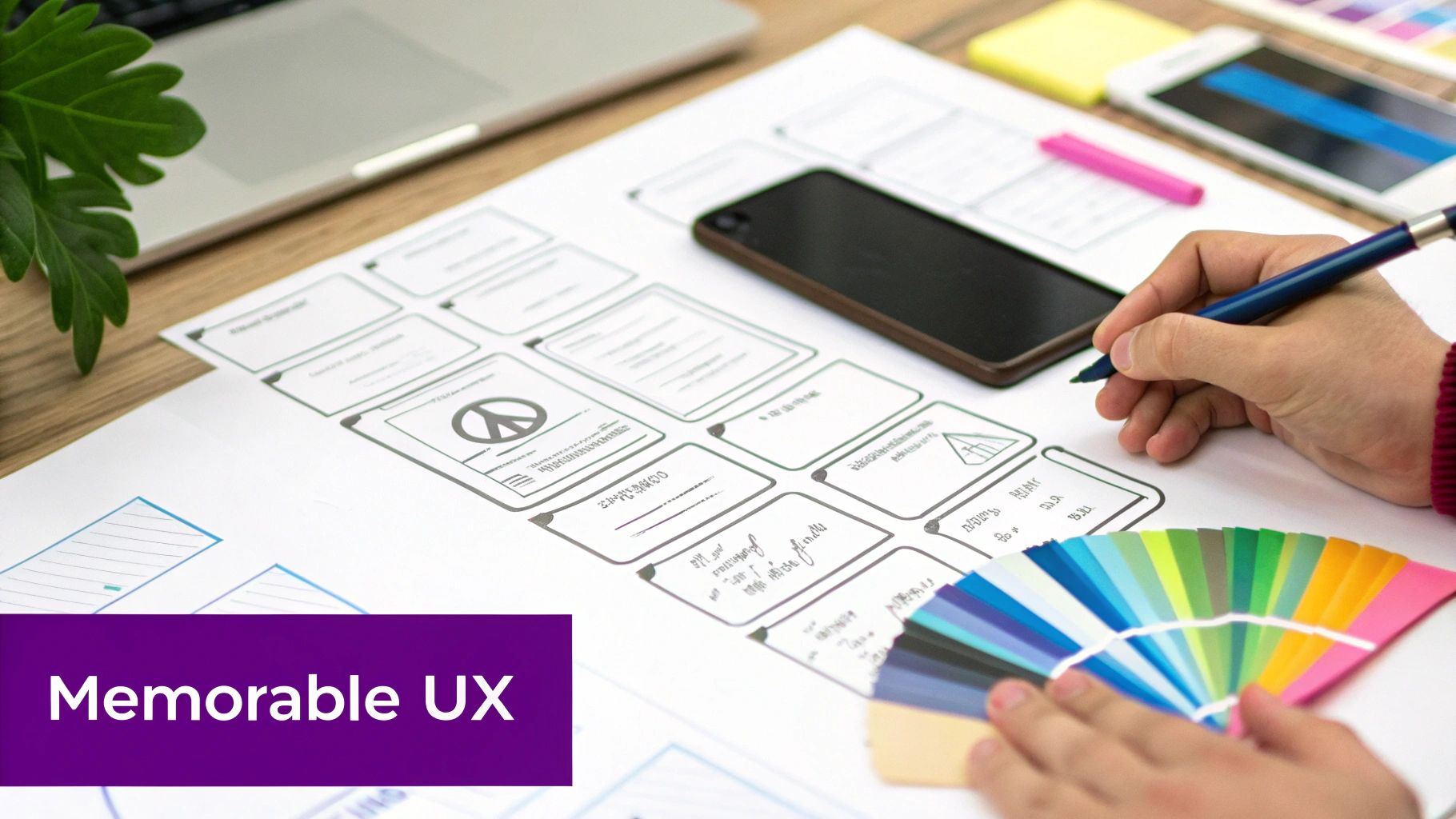
Think of it like designing your dream physical store. You wouldn't just throw products on shelves. You’d obsess over the layout, the lighting, and the flow to create a space that feels effortless and inviting. Online, that means designing high-converting product pages, a checkout process that’s an absolute breeze, and layouts that look fantastic on any screen, big or small.
From Blueprint to Visual Reality
The journey from a plan on paper to a visual masterpiece starts with something called a wireframe. These are the simple, unglamorous architectural blueprints of your website. They focus purely on structure, layout, and function—no colors, no branding, just the bare bones. Wireframing lets us nail down the user's path before we get distracted by all the shiny visual stuff.
Once everyone’s happy with the blueprint, we dive into the user interface (UI) design. This is where we splash on the paint and bring in the personality. We’ll apply your brand’s visual identity—the logo, color palette, typography, and imagery—to the structure we just built. The goal is to create a digital storefront that feels uniquely you.
Here’s what you can expect to see during this stage:
- High-Fidelity Mockups: Detailed, full-color visuals of what key pages (homepage, product pages, checkout) will actually look like.
- A Visual Style Guide: Think of this as your brand’s rulebook for the web. It documents your fonts, colors, button styles, and more to keep everything consistent.
- Interactive Prototypes: These are clickable mockups that let you feel how the website will work before a single line of code is written.
This step-by-step process ensures we get both the underlying structure (the UX) and the visual appeal (the UI) just right for your business goals.
The design phase is where strategy meets creativity. It's about making sure your site doesn’t just look good, but that it works hard for your business by making the shopping experience effortless and enjoyable.
The Role of a CMS in Modern Design
Behind every great design is a powerful tool that makes it all work: the Content Management System (CMS). For an e-commerce brand, a CMS like Shopify is the engine running the whole show. It’s what allows you to easily add products, update your homepage, and process orders without ever having to call a developer.
CMS platforms dominate modern web development for a reason—they simplify the build and put you, the business owner, in control. In fact, over 76 million websites run on a CMS, which is a staggering 68% of all sites. This is especially liberating for sellers moving from a marketplace like Etsy, as a good CMS makes managing huge product catalogs, subscriptions, and product bundles a walk in the park. You can even explore more website statistics to see how these trends can inform your strategy.
Designing for Conversions and Trust
Let's be honest: for an e-commerce brand, every design choice has to serve one main purpose—driving sales and building customer loyalty. A beautiful website that doesn't convert is just a very expensive digital brochure.
That's why our design process is relentlessly focused on these core conversion principles:
- Clear Calls-to-Action (CTAs): We make buttons like "Add to Cart" and "Buy Now" pop with contrasting colors and compelling text that tells users exactly what to do next.
- High-Quality Visuals: Your products are the star of the show. We showcase them with professional photography and video that build desire and trust.
- Intuitive Navigation: We make it ridiculously easy for shoppers to find what they're looking for, check their cart, and complete their purchase without a single moment of confusion.
- Social Proof Elements: We strategically sprinkle in customer reviews, testimonials, and trust badges to build credibility and ease any pre-purchase jitters.
By blending stunning aesthetics with smart, data-driven design, we create an online experience that doesn’t just grab attention—it builds the trust needed to turn casual visitors into customers for life. This thoughtful design work paves the way for the next big step: development, where we bring this entire vision to life.
Bringing Your E-Commerce Vision to Life
Alright, this is where the rubber meets the road. All that planning, strategy, and design work? It all leads to this moment. We're now in the most hands-on stage of the entire website development process, where we take those beautiful, approved designs and turn them into a real, functional digital storefront.
Think of it like building a house. The blueprints are finalized, the materials are chosen, and now the construction crew gets to work framing the walls and bringing the structure to life.
For sellers moving onto a robust platform like Shopify, we’re not building every single wall from scratch. Instead, we’re expertly customizing a powerful foundation to fit your exact needs. We'll take a theme and mold it to match your brand's unique personality, then plug in the essential apps that transform a simple store into a sales machine—things like email marketing, customer reviews, and loyalty programs.
The Two Sides of Development
The actual "build" is split into two distinct but deeply connected parts: front-end and back-end development. Getting your head around both is crucial to understanding how your e-commerce machine really works under the hood.
Front-End Development (The Storefront): This is everything your customer sees, clicks on, and interacts with. It’s the "client-side" of your website, and its job is to bring that user experience we designed to life. Our developers use languages like HTML, CSS, and JavaScript to build out:
- The interactive product pages that make your items look irresistible.
- The slick, responsive layout that works beautifully on a phone, tablet, or desktop.
- The easy-to-use navigation and clickable buttons that guide shoppers from browsing to checkout.
Back-End Development (The Engine Room): If the front-end is the showroom, the back-end is the warehouse, office, and cash register all in one. It’s the "server-side" that works behind the scenes, powering everything the customer sees. This is where we handle the heavy lifting, like:
- Setting up your product catalog so you can easily manage inventory.
- Securely integrating payment gateways like Stripe and PayPal.
- Configuring all your shipping rules and tax calculations.
When these two sides work together seamlessly, you get a website that doesn't just look amazing but also runs flawlessly, processing orders and managing your business without a hitch.
Setting Up Your E-Commerce Foundation
A great e-commerce site is more than just code; it's a carefully assembled system of business tools. During this phase, our team gets down to the nitty-gritty of setting up the core functions that will make or break your store's performance and your customers' happiness.
We'll also implement any of the more advanced features we identified back in the planning stage—the kind of stuff that helps sellers truly scale.
Key Implementation Tasks:
- Product Catalog Configuration: We’ll get all your products loaded, organize them into smart collections, and set up all the variants for things like size and color.
- Payment and Shipping Integration: This is a critical step where we securely connect your payment processors and dial in the shipping zones and rates to match your business model perfectly.
- App and Plugin Installation: We'll install and configure the must-have apps for marketing automation, SEO, customer support, and anything else your specific business needs to thrive.
- Product Bundling: To encourage bigger cart sizes by grouping complementary items.
- Subscription Services: To create a reliable, recurring revenue stream from your best-selling products.
- Cross-Browser Compatibility: We test your site on all the big browsers—Chrome, Safari, Firefox, you name it. This way, we know it looks great and works perfectly for everyone, not just for people using the same browser as our developers.
- Mobile Responsiveness: Let’s face it, a huge chunk of your customers will be shopping on their phones. We test relentlessly on different smartphones and tablets to ensure the experience is intuitive and easy, no matter the screen size.
- Performance and Speed: Nothing kills a sale faster than a slow-loading page. We test how quickly your pages load and fine-tune everything to keep visitors from getting frustrated and bouncing off to a competitor.
- Site Performance and Speed: We’re on top of page load times. A fast, snappy site keeps customers happy and engaged.
- User Behavior Analysis: Using tools like Google Analytics, we dig into how visitors move through your site, what pages they love, and where they might be getting stuck.
- Conversion Rate Tracking: We measure the percentage of visitors who make a purchase, giving us a crucial baseline that we’ll work to improve week after week.
This development stage is where all the prior planning pays off. By building on a clean, secure, and scalable foundation, we ensure your new website is not just ready for launch day, but prepared for years of growth to come.
This methodical build process is what guarantees that when we're ready for testing, every single piece is in its place and working exactly as it should. It’s this technical precision that separates a basic online store from a high-performing e-commerce asset—the engine that will drive your brand forward and turn your vision into a profitable reality.
The Final Polish: Ensuring a Flawless Launch
Before your new website opens its digital doors to the world, it needs to go through a rigorous series of checks. Think of it as the final dress rehearsal before opening night or the last-minute inspection before a grand opening. Every single detail, from the tiniest button to the most crucial function, gets a thorough once-over to make sure your customers have a perfect, seamless experience from the get-go.
This quality assurance (QA) phase is an absolutely critical part of the website development process. Our team literally goes through every single link, form, function, and page on your site. This isn't just a quick scan; it's a deep dive to catch any little gremlins before they can mess with your sales or tarnish your brand's reputation.
A smooth user experience builds trust, and that trust is cemented right here, during this pre-launch testing.
The Ultimate Pre-Launch Checklist
We follow a pretty exhaustive checklist to make sure nothing slips through the cracks. This is way more than just clicking around a bit; it’s a structured process to verify every single piece of your site is working as it should.
Here’s what we focus on:
The single most important test for any ecommerce site is the checkout process, from start to finish. We run multiple fake transactions to make absolutely sure customers can add products to their cart, pop in a discount code, enter their shipping details, and pay without a single hiccup.
How This Stage Protects Your Revenue
Trying to save time by rushing or skipping this testing phase is one of the most expensive mistakes you can make. Seriously. One broken link or a glitch in the payment gateway can stop a sale dead in its tracks and instantly kill a customer's trust in your brand. Finding these problems before you go live is just smart business—it protects your revenue and your reputation.
The online shopping world is massive and incredibly competitive. With around 26.6 million e-commerce sites out there, a flawless website that’s built to convert isn't just a nice-to-have; it's a must for survival. This is especially true if you're moving over from a marketplace—a professional, bug-free site can be the ticket to doubling your revenue. And with 58% of designers now using AI to improve user engagement, the bar for what makes a great online experience is getting higher every day. You can check out more fascinating details in these powerful website statistics.
At the end of the day, this careful, detailed testing is what guarantees that on launch day, your website isn’t just a pretty digital storefront. It's a reliable, high-octane sales machine, ready to power your business forward. It's the final, crucial step that transforms a web project into a genuine business asset.
Launching and Optimizing for Growth
Launch day is a huge milestone, but it’s not the finish line—it’s the starting gun. A successful launch is a carefully planned event. We’re deploying the site, seamlessly pointing your domain to its new home, and firing up all the essential analytics to track what happens next.
This is a massive moment, especially for sellers moving off a marketplace like Etsy. You’re finally inviting your loyal followers to your very own branded space. Getting this transition right means having a clear communication plan to bring your audience with you, ensuring you don't lose the community you’ve worked so hard to build.
Your Post-Launch Growth Plan
Once the digital confetti settles, our focus pivots from building to growing. The real journey starts now as we enter a continuous cycle of optimization. A website isn't a "set it and forget it" project; it's a living part of your business that needs regular care to perform at its best.
This is where a true growth partnership really proves its worth. We immediately start watching the key performance indicators (KPIs) to see how your new storefront is holding up out in the wild.
Initial Post-Launch Monitoring Includes:
This data-first approach takes the guesswork out of the equation. We get clear, actionable insights that tell us exactly what to do next.
Launching your site is just the beginning. The continuous cycle of analyzing, testing, and optimizing is what transforms a good website into a powerful, revenue-generating machine that evolves right alongside your business.
From Data to Dollars
Looking at data is one thing, but turning those numbers into more revenue is where the magic happens. The optimization phase is all about finding opportunities to make your site work harder for you. We zoom in on two primary goals: improving your conversion rate and increasing your average order value (AOV).
What does that look like in practice? It could mean A/B testing two different product page layouts to see which one drives more sales. Or maybe we'll simplify the checkout process to remove any friction that causes people to abandon their carts. We might even suggest smart product bundles to encourage bigger purchases. Every single tweak is a calculated move designed to boost your bottom line.
After your e-commerce site is live, a robust, modern ecommerce content marketing strategy is also essential for driving sales and sustained growth. This is what brings new customers in from search engines and social media, turning your website into a magnet for your ideal audience. This ongoing support is what ensures your new platform becomes more than just a website—it becomes the central engine of your business growth.
Your Questions, Answered
Let's be honest, diving into a full website build can feel a little daunting. You've probably got a dozen questions swirling around.
Getting clear answers upfront is the key to setting a realistic budget, knowing what to expect, and making smart choices that will benefit your business for years to come. Here are a few of the most common questions we hear from entrepreneurs just like you.
How Long Does This Whole Website Thing Actually Take?
This is usually the first question on everyone's mind! While every project is different, a professionally built Shopify store for an established business typically takes between 4 to 8 weeks. That's from our very first strategy call all the way to launch day.
That schedule gives us enough time to do things right—thoughtful planning, custom design, and making sure every button and link works perfectly. We lay out a detailed timeline from the get-go so you always know what's happening and when. No surprises, no last-minute rush.
I'm Moving From Etsy. What's the Biggest Mistake I Could Make?
The single biggest pitfall we see is forgetting that you have to bring the customers. On Etsy, you have a built-in audience of millions of shoppers. On your own site, you are 100% in charge of marketing and traffic.
You can't just build a beautiful store and expect people to find it. A successful move from Etsy needs a real plan for SEO, email marketing, and social media to bring your loyal fans with you and attract new shoppers. It’s a classic "build it and they will come" mistake, but for e-commerce, you have to build it and then go get them.
The biggest shift from a marketplace to your own store isn't technical—it's marketing. You're no longer just a seller; you're the master of your own customer acquisition, and that requires a dedicated plan from day one.
So, How Much Does a Professional E-Commerce Website Cost?
The price for a new website can vary quite a bit, but it's important to think of it as an investment in a core business asset, not just another line item on a spreadsheet. Instead of dealing with confusing hourly rates that can spiral out of control, we use fixed-price packages built for businesses ready to scale.
This way, you get a high-performing site designed to convert visitors into customers, all without the anxiety of surprise bills. It ensures you get the best possible return on your investment and a solid foundation that will drive sales for years.
Ready to go from a marketplace seller to a brand that owns its future? At Wand Websites, we build high-performing Shopify stores that turn your hard work into more traffic and loyal customers. Let’s build your e-commerce future, together. Learn more at Wand Websites.
