
Top Affiliate Marketing Platforms for Brands in 2024


So, you're ready to jump into affiliate marketing and use partnerships to grow your brand. That's a great move. But as you've probably noticed, the sheer number of top affiliate marketing platforms can make your head spin.
For most e-commerce shops, a big network like ShareASale is a common starting point. If you're in the B2B software world, a specialized platform like PartnerStack is probably more your speed. And for massive brands needing global reach, a giant like CJ Affiliate often fits the bill. Picking the right one is the very first step in building a partnership program that actually works.
Why Your Platform Choice Is So Important

Choosing an affiliate platform isn’t just about picking some software. It's a strategic decision that will define how you find partners, track performance, handle payouts, and ultimately, grow your program.
Think of it like building a house. The platform is your foundation. A flimsy one will limit what you can build, but a solid one will support your growth for years to come. My goal here is to cut through the noise and help you find a partner that truly matches your business goals.
Setting The Stage For Success
The proof is in the numbers. Today, over 81% of brands have an affiliate program, and in the U.S. alone, spending is on track to hit nearly $12 billion in 2025. It’s clear that these platforms are central to how modern businesses grow.
I’m here to give you a friendly, no-fluff roadmap to making a smart decision. If you're just starting out and want the full A-to-Z blueprint, this complete step-by-step guide to affiliate marketing is an excellent resource to get you going.
The right platform does more than track clicks and sales. It becomes an extension of your marketing team, providing the tools, data, and support needed to build profitable, long-term relationships with your partners.
A Quick Look at Top Affiliate Marketing Platforms
Here's a high-level summary of the leading platforms, their core strengths, and the types of businesses they serve best. Think of this table as a quick cheat sheet to see which platforms might be a good fit before we dive into the nitty-gritty details.
This gives you a starting point. Now, let's get into what really makes each of these platforms tick.
Understanding Affiliate Networks vs SaaS Platforms
Diving into the world of affiliate marketing platforms can be a bit confusing at first. The key is understanding that they generally fall into two main camps: affiliate networks and SaaS platforms. Both are designed to help you manage partnerships, but they go about it in completely different ways, and the right choice really boils down to your specific business goals.
An affiliate network is essentially a giant public marketplace. It connects thousands of brands (that's you) with a ready-made army of publishers, or affiliates. Think of it as a huge digital hub where you list your products, and affiliates who are already on the platform can browse and find offers that are a good fit for their audience.
The biggest upside here is speed and scale. You get instant access to a massive pool of potential partners. The heavyweight champion in this space is Amazon Associates, which holds an incredible market share. In fact, nearly 95,000 companies use the platform, making up about 46.27% of the entire industry's usage. That stat alone shows the sheer reach a network can provide.
The infographic below really helps visualize the core differences between the two models.
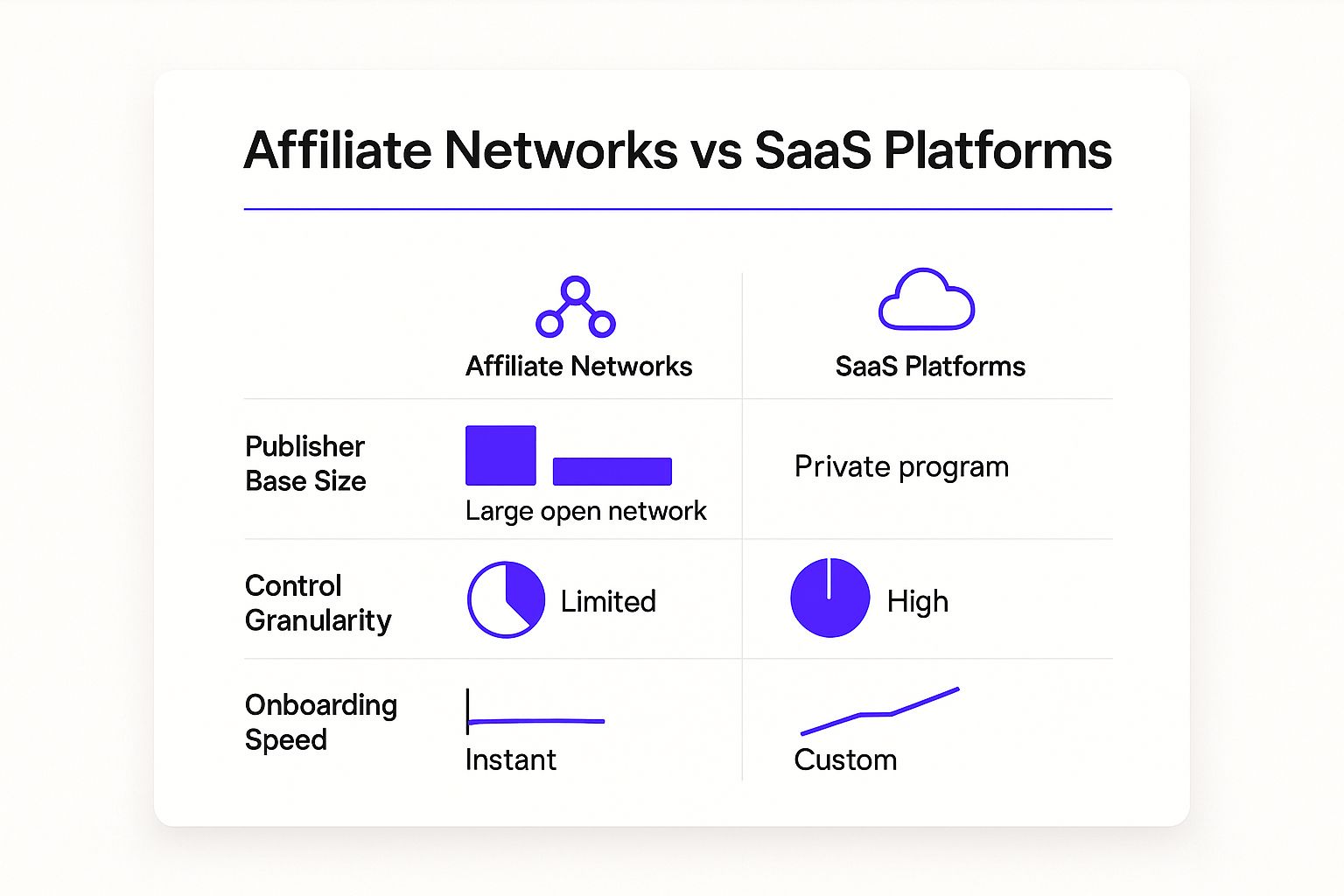
As you can see, the trade-off for that huge publisher base and quick start is often less direct control over your program’s fine details.
The SaaS Platform Approach
On the flip side, a SaaS (Software as a Service) platform gives you the tools to build and run your very own private, in-house affiliate program. You're not joining an open marketplace; instead, you're using the software to recruit, track, and pay your partners directly. It’s less about broad discovery and much more about deep relationship management.
This approach puts you firmly in the driver's seat. You get total control over everything—from commission rates and branding to the specific terms you negotiate with each partner. This is a fantastic option for businesses, especially in the B2B world, that want to build strong, high-value relationships with a handpicked group of partners rather than just casting the widest net possible.
The core decision comes down to this: Do you need a pre-built audience and speed-to-market (Network), or do you need granular control and the ability to build a private ecosystem of partners (SaaS)?
When you're weighing your options, looking at how the big networks operate can be really insightful. For a closer look at one of the giants, this detailed Commission Junction (CJ Affiliate) program review is a great resource. Getting a feel for how these established players work is a crucial step in figuring out if the network model aligns with your brand's growth plans.
Comparing the Top Affiliate Marketing Platforms
Picking the right affiliate marketing platform is a huge decision. Let's be real—it's the command center for your entire partnerships program. So, we're going to move past the high-level fluff and get into a real, head-to-head comparison of the big players: ShareASale, CJ Affiliate, Impact, and PartnerStack.
We’ll break them down based on what actually matters for your day-to-day work and long-term growth. Think affiliate discovery tools, the nitty-gritty of tracking tech, and how flexible their commission setups really are. It's in these details where you'll find the perfect fit for your business.
First, here's a quick look at the ShareASale merchant dashboard to give you a feel for its interface.
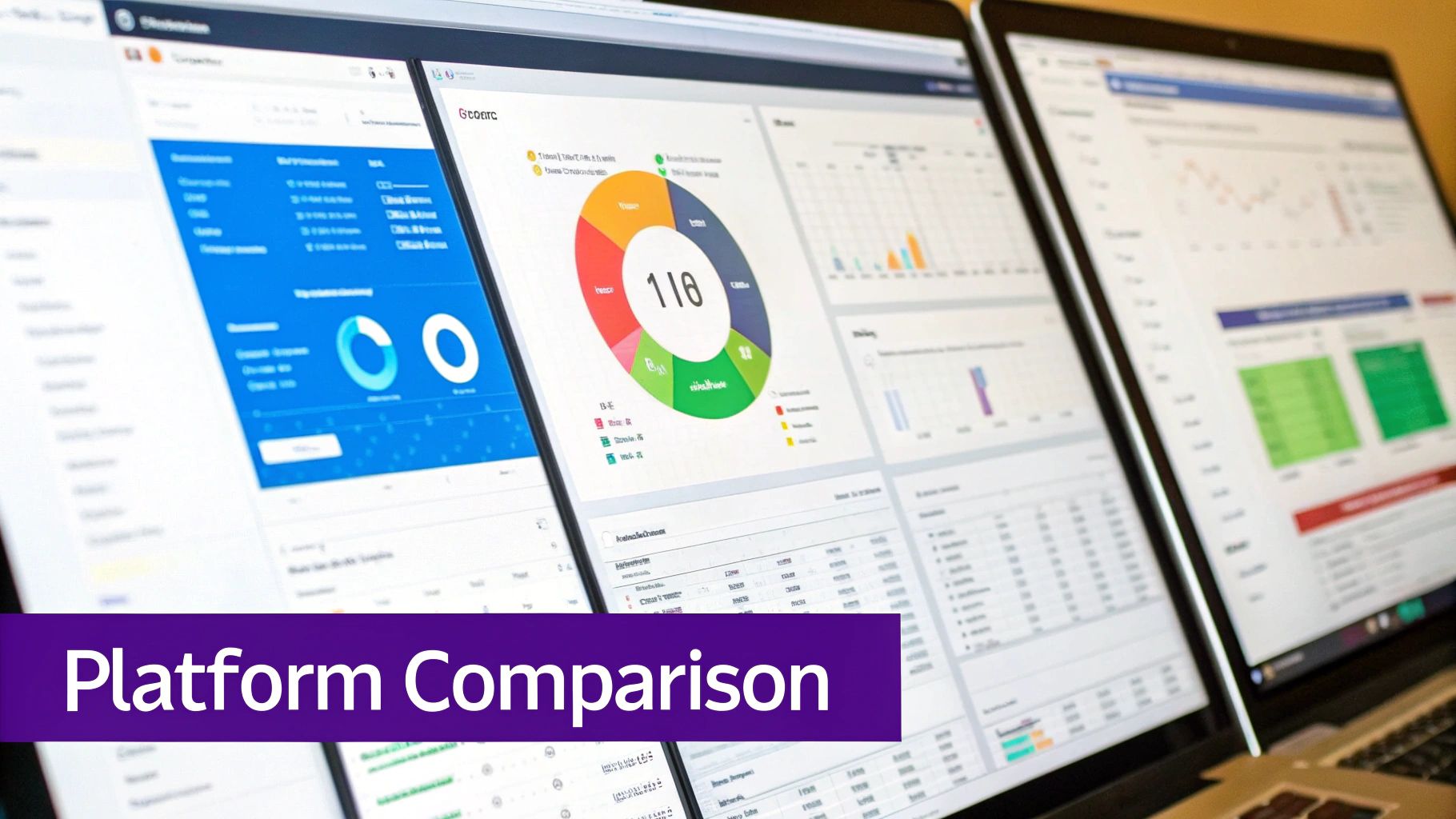
You can see right away that ShareASale is all about clear, easy-to-digest data. This makes it a go-to for small and medium-sized e-commerce brands that need solid reporting without a massive learning curve.
Affiliate Discovery and Recruitment Tools
Finding the right partners is everything. Get this wrong, and your program is dead in the water. Each platform has its own philosophy on how to help you connect with the best affiliates for your brand.
ShareASale is basically a massive, open marketplace. Its biggest asset is sheer volume and variety, which is fantastic if you're an e-commerce brand trying to connect with a wide net of bloggers, content creators, and coupon sites. The search tools are no-frills but get the job done, letting you filter partners by their stats and niche.
CJ Affiliate, on the other hand, feels much more curated. It’s built for bigger, enterprise-level brands that need to pinpoint high-impact publishers with a proven history of success. CJ’s "Recruit Partners" tool gives you a much deeper look into a publisher’s audience and performance, so you can be far more strategic in who you reach out to.
Key Differentiator: If ShareASale is about casting a wide net in a bustling sea of potential partners, CJ Affiliate is about precision fishing with a data-rich sonar.
Impact really shines when it comes to automating your recruitment. Its "Discover" marketplace is a powerhouse for finding not just traditional affiliates but also influencers and even strategic B2B partners. The best part? You can set up automated campaigns to invite partners that fit your exact criteria, which is a huge time-saver.
And then there's PartnerStack, which is in a league of its own for B2B SaaS. Its marketplace is hyper-focused on one thing: connecting software companies with partners who know how to sell software. We’re talking resellers, agencies, and referral partners. That sharp focus is its superpower.
Feature-by-Feature Platform Breakdown
To see how these platforms stack up on the core functions you'll use every day, let's put them side-by-side. This table breaks down everything from how they find new partners to how they handle payments, giving you a clear picture of their strengths and weaknesses.
Ultimately, the "best" platform truly depends on what you're trying to achieve. Impact offers incredible power and flexibility for almost any business model, while PartnerStack is the undisputed champion for B2B SaaS. ShareASale and CJ remain rock-solid choices for traditional e-commerce affiliate programs, with the former being more accessible and the latter more enterprise-focused.
Tracking Technology and Attribution Models
Let's be blunt: if you can't trust your tracking, you don't have a program. Partners need to know they’ll get paid for the sales they drive, and this is where the tech really starts to matter.
While all four platforms have solid tracking, they don't all work the same way:
- Server-to-Server Tracking: Impact and PartnerStack are leading the pack here. Their server-to-server tracking is far more reliable than old-school cookies, especially with all the browser privacy changes (like ITP) that can block traditional tracking.
- Cross-Device Tracking: CJ has long been known for its excellent cross-device tracking. This is huge for rewarding a partner when a customer discovers your product on their phone but waits to buy it on their laptop later.
- Coupon Code Attribution: If you work with coupon-focused partners, you'll love this. ShareASale and Impact make it incredibly simple to give an affiliate their own unique coupon code and guarantee they get credit for any sale using it, no matter what link was clicked last.
This level of control is what separates a good program from a great one. Imagine you're running a campaign with a top-tier content creator and a few coupon sites. With Impact's flexible attribution rules, you can set it up to always give the commission to the creator who introduced the new customer, not just the coupon site that they visited right before checkout.
It's also worth looking at the broader market. According to recent industry market share statistics at Optinmonster.com, Rakuten holds about 7.78% of the market, followed by Awin at 6.68% and ShareASale at 6.46%. CJ Affiliate isn't far behind with 6.24%. This shows a healthy, competitive ecosystem where no single platform totally dominates, giving brands plenty of great options to choose from.
Commission Structures and Payment Flexibility
How you pay your partners is one of the most powerful tools you have. A generic, one-size-fits-all commission is a rookie mistake that leaves money on the table.
For B2B SaaS, PartnerStack is the clear winner. Its entire platform was designed from the ground up to handle the headaches of recurring commissions and tiered rewards. It makes it easy to track monthly subscription payments and automatically bump up a partner’s commission rate when they hit a new performance level.
If you’re in e-commerce, Impact gives you an insane amount of flexibility. You can build out seriously sophisticated commission rules based on almost anything you can think of:
- Is the customer new or returning?
- What’s the product margin or SKU?
- What’s the customer’s Lifetime Value (LTV)?
- What type of partner is it (e.g., content, loyalty, or coupon)?
This means you could, for example, pay a much higher commission for a new customer who buys one of your most profitable products. It’s all about incentivizing your partners to drive the right kind of sales. While ShareASale and CJ Affiliate also offer flexible commissions, Impact’s rules engine is the most powerful and intuitive for creating these kinds of custom payout structures.
Breaking Down Platform Costs and Pricing Models
Figuring out what an affiliate platform really costs is one of the trickiest parts of picking the right one. The sticker price you see on a website is almost never the full story, and if you’re not careful, hidden fees and confusing pricing structures can blow up your budget.
To make a smart call, you have to look past the monthly fee and understand the two main ways these platforms charge: the performance-based models of traditional networks and the flat-rate subscriptions of modern SaaS platforms.
Navigating Performance-Based Network Fees
Big, old-school affiliate networks like ShareASale and CJ typically run on a performance-based model. It sounds appealing—you only pay when you make sales, right? Well, it's a bit more complicated than that.
This model is a classic for e-commerce brands wanting to cast a wide net, but it comes with a few layers of costs you need to anticipate:
- Initial Setup Fee: Just to get your program listed, you’ll often pay a one-time fee. This can be anywhere from $500 to over $3,000, depending on the network and how much help you need to get started.
- Monthly Minimums: Many networks have a "keep the lights on" fee you have to pay every month, even if your affiliates don't generate any sales. It’s their insurance policy.
- Commission Overrides: Here's the big one. The network takes a cut of every single commission you pay out. This "network fee" is usually between 20% and 30%. So, if you pay an affiliate a $100 commission, the network tacks on another $20-$30 for itself.
This structure can work well for established companies with a steady stream of affiliate sales. But for a startup or a smaller business, that upfront setup cost and the monthly minimums can be a tough pill to swallow.
The Predictability of SaaS Pricing Models
On the other side of the coin, you have SaaS platforms like PartnerStack. They favor a much more straightforward flat-rate subscription, an approach that’s become a favorite for B2B companies managing long-term, strategic partnerships.
With a SaaS model, it's simple: you pay a set monthly or annual fee for the software. Plans are usually tiered based on how many features you need, how many partners you have, or the revenue your program drives.
The core difference is simple: with a network, your costs scale directly with affiliate payouts. With a SaaS platform, your costs are fixed and predictable, making it much easier to budget for, especially in the early stages of your program.
That predictability is a huge win. You know exactly what your bill will be each month, without any surprises from fluctuating network fees. The only catch is that high-end SaaS plans can get pricey, so you’ll want to pick a tier that fits where you are now but gives you room to grow.
A Practical Cost-Benefit Scenario
Let’s play this out with a real-world example. Imagine you run a small e-commerce store, and you’re projecting $10,000 in affiliate sales next month with a 10% commission rate.
Network Model (like ShareASale):
- You owe your affiliates $1,000 (10% of $10,000).
- The network takes its 20% override on that, which is an extra $200.
- Your total platform cost for the month is $1,200 (plus any monthly minimums).
SaaS Model (a mid-tier plan):
- You still owe your affiliates that same $1,000.
- Your platform cost is a fixed subscription fee, let's call it $499 per month.
- Your total cost is $1,499.
At first glance, the network looks cheaper. But what happens if you have a great month and your sales double to $20,000? Your network fees also double to $400, while your SaaS fee stays locked at $499.
The right choice comes down to forecasting. You have to decide if you prefer variable costs that are tied directly to performance or the stability that comes with a fixed subscription.
Integrating Your Platform with Shopify
If your business runs on Shopify, getting your affiliate platform to play nice with your store isn't just a "nice-to-have"—it's a must. This connection is the backbone of your program, determining how accurately you can track sales and pay your partners without pulling your hair out.
The smoothest path is almost always through a dedicated app in the Shopify App Store. Think of these as "plug-and-play" solutions. They're built to sync up automatically, saving you from major setup headaches. The alternative? Manually embedding tracking scripts into your store’s code, which can feel like a high-wire act if you’re not a developer.
What Makes a Good Integration?
A truly solid integration goes way beyond just logging a sale. It creates a two-way street for data, giving you a crystal-clear view of what's actually working.
Here’s what you should be looking for:
- Real-Time Order Tracking: The moment a sale happens in Shopify, it should pop up on your affiliate dashboard. No lag, no guessing.
- Coupon Code Attribution: This is huge. It automatically credits the right affiliate when their unique discount code is used, even if the customer never clicked a referral link.
- Refund and Cancellation Syncing: This feature is a lifesaver. It automatically adjusts or reverses commissions when an order is returned, so you're not paying for sales that didn't stick.
Finding these apps is straightforward. A quick search in the Shopify App Store will show you which platforms are serious about supporting Shopify merchants.
This simple step helps you quickly filter out platforms that don’t prioritize a seamless experience.
Avoiding Common Integration Pitfalls
Let's be blunt: a bad integration can cause chaos. The most common nightmares are duplicate commissions (paying multiple affiliates for one sale) and lost sales data (legitimate referrals vanishing into thin air). Both issues can quickly erode trust with your partners.
A robust Shopify integration acts as a single source of truth for your affiliate program. Without it, you risk creating a frustrating experience for your partners and an accounting nightmare for your team.
For example, platforms like Impact and PartnerStack are well-known for their deep, reliable Shopify integrations that handle tricky situations like recurring subscription payments and SKU-level commissions without breaking a sweat. Networks like ShareASale also offer a simple Shopify app that's a great fit for stores with a more traditional affiliate setup.
Before you commit to any platform, do your homework. Dig into its Shopify app reviews, read the documentation, and see what other merchants are saying. A little due diligence upfront will save you from a world of tracking headaches down the road.
How to Choose the Right Affiliate Platform for You
Alright, let's get down to it. Picking an affiliate platform isn't just about features; it's about finding a true partner for your business. There's no one-size-fits-all answer here. The "best" platform is simply the one that fits your business model, budget, and where you see yourself in a few years.
If you're running a small but mighty e-commerce brand, especially one just dipping its toes into affiliate marketing, your path is pretty clear. You need something that’s easy to get started with, won't break the bank, and connects you with a ton of potential partners right away.
- Recommendation for SMB E-commerce: I'd point you straight to ShareASale. It's a fantastic starting point. Its massive network is packed with bloggers and content creators, and the pricing structure is built for businesses that need to scale smart.
Choosing for B2B and SaaS
Now, if you're in the B2B or SaaS world, the game completely changes. You aren't just chasing one-off sales. You're building long-term relationships with partners who bring in recurring revenue, which means you need a platform that understands things like tiered commissions and complex partner management.
- Recommendation for B2B SaaS: PartnerStack is the clear winner here. It was literally built for this. The entire platform is designed to manage channel partners—think resellers, agencies, and referral programs—making it the perfect fit.
Your choice has to match your reality. An e-commerce store doesn't need the heavy machinery of a B2B channel platform, and a SaaS business will quickly hit a wall with a network designed for simple affiliate links.
The Decision for Enterprises and Hybrid Models
What if you're a larger company or you're managing a bit of everything? Maybe you have traditional affiliates, big-name influencers, and strategic B2B partners all under one roof. In that case, you need pure power and flexibility. You need a system that can handle anything you can dream up.
- Recommendation for Enterprise/Hybrid: This is where Impact.com shines. Its tracking is rock-solid, the automation is incredible, and you can create just about any commission structure you want. It gives you that fine-tuned control you need for a complex, multi-layered program.
So, take a step back and look at what you truly need. Are you after a huge volume of publishers, specialized B2B tools, or the ultimate flexible powerhouse? Figure that out, and you’ll make a choice that will serve you well for years to come.
Got Questions? We've Got Answers
Let's tackle some of the most common questions brands have when they're trying to pick the right affiliate marketing platform.
What’s the Real Difference Between a Network and Software?
Think of an affiliate network like ShareASale as a giant, bustling marketplace. It’s a one-stop shop where you can find a massive, ready-made army of affiliates. They handle the introductions and the payments, but you'll pay network fees for that convenience.
On the other hand, affiliate software like PartnerStack gives you the tools to build your own private, exclusive club. You're in complete control, recruiting your own partners and building direct relationships. Here, you're typically paying a subscription for the tech, not a cut of every sale.
How Much Should I Expect to Pay for a Top-Tier Platform?
The price tag can swing wildly depending on the model you choose. It's definitely not a one-size-fits-all situation.
- Networks (like ShareASale or CJ): You're often looking at a one-time setup fee that can be anywhere from $500 to over $3,000. On top of that, expect monthly minimums and a network fee that's a percentage of every commission you pay out.
- SaaS Platforms (like PartnerStack or Impact): These usually run on a tiered monthly subscription. Costs can range from a few hundred to several thousand dollars a month, depending on the features you need or the revenue you're driving through the platform.
Before you sign on the dotted line, always ask about the less obvious costs. Dig into things like transaction fees or commission overrides. A little bit of homework upfront can save you a lot of financial headaches later.
Can I Juggle More Than One Affiliate Platform at a Time?
Technically, yes. But should you? For most businesses, the answer is a firm no.
Trying to manage multiple platforms at once can quickly turn into a logistical nightmare. You'll be drowning in separate tracking systems, fragmented affiliate communications, and complicated payment runs. It just creates a mountain of extra work.
It's far smarter to pick one platform that truly fits your business goals and master it. A multi-platform strategy is really only for huge companies with dedicated affiliate management teams who need to tap into completely different types of publishers.
Ready to build an e-commerce store that not only looks incredible but is also primed to power a killer affiliate program? At Wand Websites, we craft conversion-focused Shopify stores designed for growth. Let’s build a powerful foundation for your business together. Get started with Wand Websites today!
