
Social Media Marketing for Ecommerce: Grow Your Sales Today


When we talk about social media marketing for e-commerce, we're really talking about turning passive scrolling into active shopping. It’s about meeting your customers right where they are and giving them a smooth, easy path from "ooh, I like that" to "add to cart." In a marketplace this crowded, it's not just a nice-to-have; it's your key to growth.
Building Your Ecommerce Social Media Foundation
Just slapping up a profile on a few social platforms isn't a strategy. For an e-commerce brand, your social media is your digital storefront, your community hangout, and a massive sales channel all rolled into one. The first real step is to stop chasing vanity metrics like likes and follows and start building a foundation that actually grows your revenue and keeps customers coming back.
The opportunity here is huge. We're talking about 5.45 billion people on social media. More importantly, a huge chunk of them are ready to shop. In fact, 26.6% are using social media to get inspiration for things to buy, and another 25.9% are actively searching for products. Your job is to be there when they're looking. You can dig into more of this user behavior data over at Sonary.com.
Aligning Social Media With Business Goals
Before you even think about what to post, you need to ask yourself: what am I actually trying to achieve here? Tying your social media activity to real business goals is non-negotiable.
Are you trying to:
- Increase Website Traffic? Then your focus should be on crafting posts that get people to click through to your product pages.
- Generate Leads? Think about running contests, offering exclusive content, or promoting your newsletter to capture those valuable email addresses.
- Boost Direct Sales? This is where shoppable posts and other in-app commerce features become your best friends.
- Build Brand Loyalty? Your goal here is to create a community, spark conversations, and give people a reason to stick around for more than just a single purchase.
For a deeper dive into building that community aspect, it's worth reading up on mastering social media and community management. It perfectly blends the art of engagement with the science of a solid strategy.
The e-commerce brands that truly win on social media don't use it as a megaphone for promotions. They treat it like a living room where they can host conversations. It's always about building the relationship first, then selling.
Choosing The Right Platforms
Don't fall into the trap of trying to be everywhere at once. You'll just burn out. The smart move is to focus your energy where your ideal customers actually spend their time.
I often see brands get this wrong, spending months on a platform their audience barely uses. To avoid that, here's a quick comparison to help you figure out where you should start.
Which Social Platform Fits Your Ecommerce Brand
Choosing one or two platforms to dominate initially is far more effective than spreading yourself thin across five. Once you've mastered your core channels, you can then thoughtfully expand.
The infographic below really drives home where most e-commerce businesses are finding success right now.
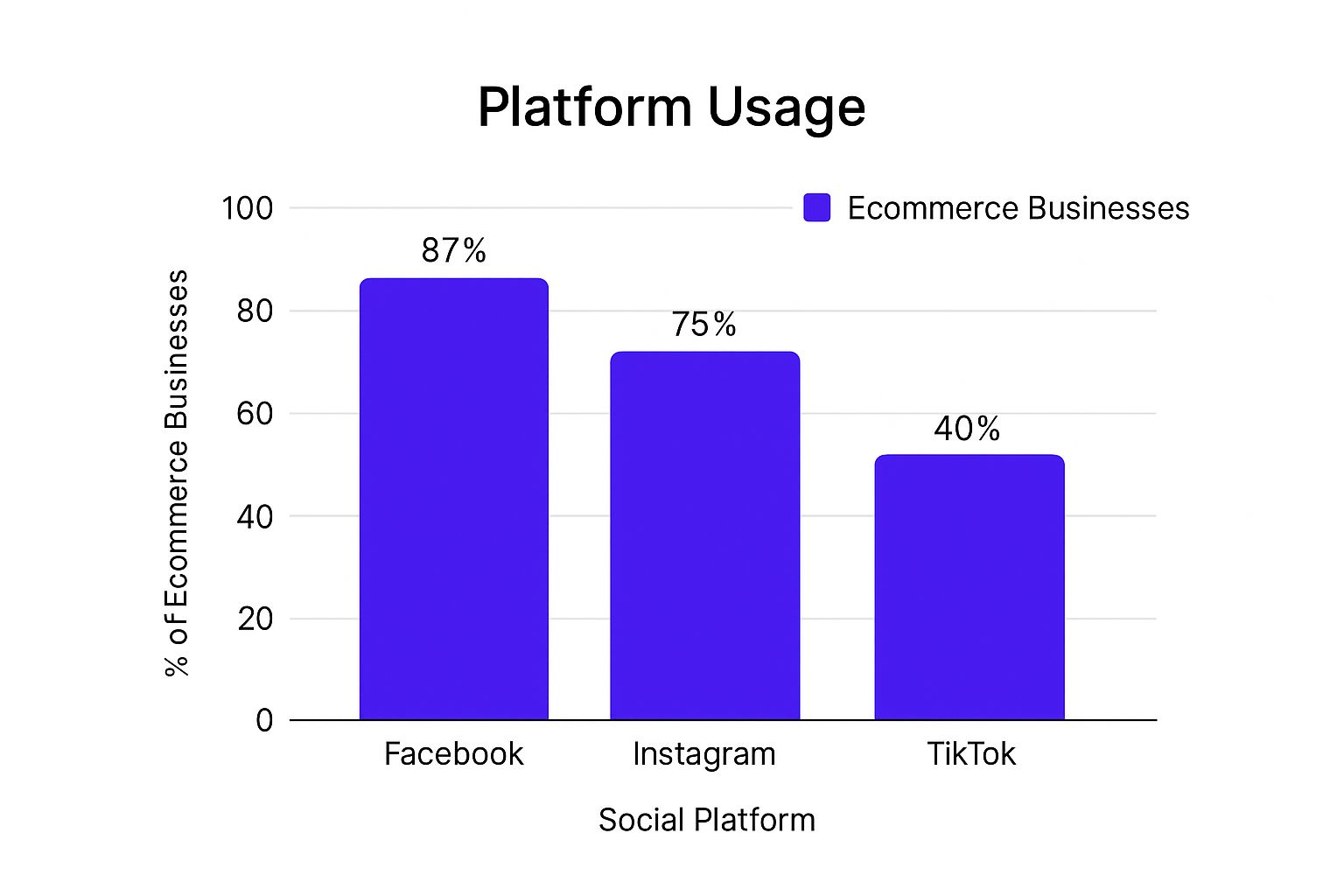
As you can see, Facebook and Instagram are still the heavy hitters. But the data also shows the undeniable rise of TikTok as a powerhouse for reaching shoppers who are ready to be entertained—and to buy.
Creating Content That Actually Sells Products

Think of your social media profile as your digital storefront. If that's the case, your content is the window display. It’s what makes people stop scrolling and want to come inside. But for e-commerce, your content has to do more than just look pretty—it has to sell. This means you’ve got to move past the sterile, white-background product shots and start creating posts that genuinely build desire and trust.
Your content should be a conversation starter. A simple product photo is a monologue; it just sits there and says, "Here's a thing." But dynamic, engaging content tells a story, solves a problem, or asks a question. That's how you turn passive followers into paying customers who are actually excited to buy from you.
Go Beyond the Basic Product Shot
Let's be honest, your audience is swimming in a sea of product photos every single day. To cut through that noise, you have to show your products in a way that feels real and adds value. You want your potential customers to look at your post and immediately picture your product in their own lives.
I've seen these content types consistently knock basic product images out of the park:
- Video Demos and How-Tos: Show your product in action. If you sell a non-stick pan, don't just post a picture of it. Post a quick Reel of an egg sliding right off. This proves its value instantly, something a static photo could never do.
- User-Generated Content (UGC): Sharing photos and videos from your happy customers is pure gold. It’s the ultimate social proof—a real, authentic endorsement that screams, "Hey, people just like you already love this!"
- A Peek Behind the Scenes: People buy from people, not faceless brands. Show the hands that make your product, introduce the team packing orders, or share a glimpse of your workspace. This builds a human connection that fosters real loyalty.
Research shows that consumers are 2.4 times more likely to see user-generated content as authentic compared to brand-created content. In today's market, that authenticity is everything.
Writing Captions That Convert
Your visuals hook them, but it's your caption that reels them in and prompts the action. A great caption does more than just describe the image; it pulls the reader in and gives them a clear next step. The goal is to sound less like an advertisement and more like a helpful tip from a trusted friend.
For example, don't just write: "New summer dress online now. Link in bio."
Try something with a bit more personality: "Finally, a summer dress that actually feels as good as it looks! We designed this with ultra-breathable cotton for those ridiculously hot days. Tap the link in our bio to find your perfect fit and see all the colors!"
See the difference? The second option tells a small story, highlights a key benefit, and ends with a friendly, clear call to action.
Balancing Promotion with Value
This is one of the biggest mistakes I see e-commerce brands make: turning their feed into a 24/7 sales pitch. It’s the fastest way to burn out your audience and get a wave of unfollows.
A much smarter approach is the 80/20 rule. Aim for 80% of your content to be valuable, entertaining, or educational, and only 20% to be directly promotional.
So, what does that "value-driven" content look like?
- Teach Something: A skincare brand could share a quick tutorial on building a morning routine.
- Entertain Them: A pet supply store could post funny, relatable videos of dogs being dogs.
- Inspire Them: A sustainable clothing brand could share the story of the artisans who weave their fabric.
When you follow this model, you build a genuine community around your brand. Then, when you do post something promotional, your audience is far more likely to listen because you've already earned their trust and attention.
Turn Your Social Profile Into a Sales Machine

Great content gets people's attention, but the real magic happens when you make it ridiculously easy for an inspired follower to become a customer. You want to shrink the distance between "Ooh, I love that!" and "Order confirmed." The goal is to make buying feel like a natural next step, not a chore.
This is exactly where native social commerce tools come into play.
Features like Instagram Shopping, Facebook Shops, and TikTok Shop basically turn your profile into a mini-storefront. It’s no longer just a gallery of pretty pictures; it’s an interactive sales channel built right into the apps your customers already use every single day. This completely removes the friction of them having to leave the app, find your website, and then search for the product they just saw.
The growth here is absolutely staggering. The global social commerce market is expected to rocket past $90 billion in sales this year alone. And get this—a whopping 82% of consumers now use social media to research products, making it a critical point of discovery.
Setting Up Your Social Storefront
First things first, you need to connect your e-commerce product catalog to your social profiles. Most modern platforms like Shopify or BigCommerce have direct integrations that make this pretty painless.
Once you’re connected, you can start tagging products directly in your posts, Reels, and Stories.
Imagine someone scrolling through their feed and stopping on a Reel of your new ceramic mug. With product tags, they can just tap the screen, see the price, and click straight to an in-app product page to buy it. It’s an impulse-friendly experience that captures sales right when their interest is at its peak.
The secret to social selling is immediacy. Your job is to slash the number of clicks it takes to get from seeing a product to buying it. Every extra step is another chance for them to get distracted and for you to lose a sale.
To really make your profile a sales engine, you've got to get creative with your presentation. Exploring some of the top Instagram feed ideas can make a huge difference in engagement and, ultimately, conversions.
Create Urgency with Live Shopping
Beyond your everyday posts, live shopping events are an incredible way to create a dynamic, urgent buying atmosphere. Think of it as hosting your own QVC-style show on Instagram Live or TikTok.
During a live stream, you can demo products in real-time, answer questions from the audience on the spot, and drop exclusive, limited-time offers that get people excited.
This format builds a genuine connection and generates serious hype. For instance, a fashion brand could host a live styling session showing off a new collection. As they feature each piece, they can pin the product right to the screen, letting viewers buy it instantly without ever leaving the broadcast. It’s an interactive, community-focused sales experience that a static product page could never match.
Scaling Your Sales with Smart Social Ads
Organic reach is a great place to start, but let's be honest: paid social ads are the real engine for e-commerce growth. Relying solely on your organic posts is like setting up a beautiful shop on a quiet side street. Ads, on the other hand, put your brand right on the digital main street where your best customers are already hanging out.
This isn't about blindly "boosting" a post and crossing your fingers. A smart social ad strategy is a calculated plan to get a solid return on ad spend (ROAS). It's all about showing the right product to the right person, right when they're in the mood to buy.
Mastering Ad Formats That Actually Sell
Your products deserve to be shown off in a way that stops the scroll. Different ad formats are good for different things, so mixing it up is the secret to keeping your campaigns from getting stale.
- Carousel Ads: Think of these as a mini-catalog that lives right in someone's feed. You can feature a few different products, zoom in on the best features of a single item, or even tell a quick story across the slides. They're a fantastic way to launch a new collection.
- Video Ads: Nothing beats motion for grabbing attention. Use short, snappy videos to show your product in action. A quick demo of how your gadget works is way more powerful than a static photo ever could be.
- Collection Ads: This is a mobile-only powerhouse. A user taps your ad and gets an instant, full-screen storefront where they can browse a curated set of products without ever leaving the app. It's a super smooth path from discovery to purchase.
The whole world of social media marketing for ecommerce is shifting to mobile. It's predicted that social media ad spend will hit a massive $276.7 billion in 2025, and an incredible 83% of that is expected to come from mobile devices. This just goes to show how essential video has become, especially when 78% of people say they'd rather learn about a product through a short video. You can dig into more of this data by exploring some great insights from Sprout Social.
Finding Your Next Best Customers
The true magic of social ads is in the targeting. You can get laser-focused on who sees your ads, making sure every dollar you spend is going toward people who are actually likely to buy from you.
If you're just starting out, focus on these two audiences first:
- Custom Audiences: These are folks who already know you. We're talking about your website visitors, your email subscribers, or people who've liked and commented on your posts. They're already "warm," which makes them way easier to convert into customers.
- Lookalike Audiences: This is where things get really exciting. Platforms like Facebook and Instagram can take one of your Custom Audiences (say, a list of your best customers) and find millions of new people who share similar traits and behaviors. It's hands-down the most powerful way to find your next wave of buyers.
Your customer data is pure gold. Building a Lookalike Audience from a list of your highest-spending customers is one of the quickest shortcuts to finding more high-value shoppers and seriously boosting your ad performance.
Winning Back Lost Sales with Retargeting
Get this: nearly 70% of all online shopping carts are abandoned. That's a staggering amount of money just sitting there. Retargeting ads are your secret weapon for clawing back a big chunk of that lost revenue.
You can set up campaigns that specifically target people who visited your site, added an item to their cart, but then bailed before checking out. You can even sweeten the deal by showing them an ad with a small discount code or a free shipping offer to give them that final nudge. Trust me, this one tactic can easily become one of the highest-ROAS activities in your entire marketing playbook.
Building A Community That Buys Again and Again

The best e-commerce brands I've worked with all get one thing right: they know the sale is just the start of the customer relationship, not the end of it. Sure, ads are fantastic for getting new people in the door. But a loyal community? That’s what turns a first-time buyer into a die-hard fan who comes back for more.
This is where your social media channels truly shine. It’s your digital storefront, your clubhouse, your town square. When someone drops a comment or slides into your DMs, they're not just engaging with a post—they're starting a conversation with you.
How you handle that interaction is everything. A quick, personal, and genuinely helpful reply makes someone feel seen. That simple act builds more loyalty than any slick ad campaign ever could.
Sparking Conversations, Not Just Broadcasting Content
Posting on a schedule is one thing, but actually getting people to talk back is the real goal. You need to create content that practically begs for a response, and then you have to be there to keep the chat going.
It’s easier than you think. Try some of these tactics:
- Ask great questions. Instead of just posting "Here's our new bag," try asking, "What’s the first thing you’d pack in this for a weekend trip?" The answers will be gold.
- Run polls and fun quizzes. Instagram Stories are perfect for this. Let your followers vote on the next t-shirt design or guess the inspiration behind a new product. It's fun, fast, and makes them feel involved.
- Host giveaways that feel special. A good giveaway can create a ton of buzz. The trick is to go beyond "like and follow." Ask people to tag a friend and share a memory or explain why they want to win. It gets people talking about your brand in a positive way.
This isn't just about fluff. It's about pulling people in and making them feel like they're co-creating the brand with you.
Don’t just talk at your audience; create a space where you can talk with them. True loyalty is built in the comments and DMs, not just in the feed.
Listening to What Your Community Is Really Saying
Beyond the comments you see, there are conversations happening about your brand all over the internet. You need to tune in. This is what we call social listening—monitoring mentions of your brand, products, and even your competitors, especially when you aren't tagged directly.
Tools like Hootsuite or Sprout Social are lifesavers here. They help you catch everything.
Why bother? Because social listening is like having a free, 24/7 focus group. You get raw, unfiltered feedback on what people genuinely love and, more importantly, where you're dropping the ball.
Let's say you see a dozen tweets from people asking when your best-selling candle will be available in a lavender scent. Boom. That's a direct signal from the market. Take that idea straight to your product team.
When you listen and then act on what you hear, you show your community that their voice matters. That's how you close the loop, build an unbreakable bond, and keep those customers coming back for years.
Answering Your Biggest E-commerce Social Media Questions
Jumping into social media for your online store can bring up a ton of questions. How much should I actually spend? Where do I even begin? It’s easy to feel overwhelmed. Let's tackle some of the most common hurdles with straightforward, no-fluff answers.
How Much Should I Budget for Social Media Ads?
When you're just starting out, the golden rule is to start small and double down on what works. You don't need a massive war chest right away.
A great starting point is to set aside 10-20% of your total marketing budget for social ads. Think of it as your testing fund. Kick things off with a modest daily budget, maybe $10-$20 per campaign, to see what sticks.
Don't make the classic mistake of spreading that budget too thin across five different platforms. You’ll just burn cash without getting any real data. Instead, focus that initial spend on the one or two channels where you're pretty sure your ideal customers are hanging out.
The most critical part? Obsessively track your Return on Ad Spend (ROAS). Once you find an ad set that’s clearly making you money—say, for every $1 you put in, you get $3 back—that’s your green light. Start pouring more fuel on that fire and scale that specific campaign.
Which Social Media Platform Is Best for Selling?
Honestly, there's no magic bullet here. The "best" platform is simply the one where your customers are most active. It all comes down to your product and your audience.
For physical products, here’s a quick cheat sheet based on what I've seen work:
- Instagram & Pinterest: These are visual playgrounds. If you sell anything that looks amazing in a photo—fashion, home décor, beauty products, artisanal food—these platforms are non-negotiable. Their shopping features are built for a seamless buying experience.
- Facebook: Think of Facebook as the reliable all-rounder. With its massive user base and ridiculously specific targeting options, it’s a powerhouse for almost any product you can imagine.
- TikTok: This is your direct line to younger shoppers, especially Gen Z and Millennials. It's all about creative, short-form video content that entertains first and sells second. Nail the vibe, and you could go viral overnight.
The key isn't just picking the platform with the most users. It's about finding the one where your target audience is genuinely engaged and open to discovering something new.
How Often Should I Post on Social Media?
This one's simple: consistency trumps frequency, every single time.
It's way better to post three amazing, high-quality pieces of content each week than to churn out seven rushed, uninspired ones. The goal is to create a rhythm you can actually stick to without burning out or letting your quality slide.
If you need a starting point, try this:
- Instagram: Aim for 3-5 feed posts per week, but get active on Stories daily.
- Facebook: 3-5 times a week is a solid target.
- TikTok: The feed moves fast here, so shooting for 4-6 times a week helps you stay top-of-mind.
But don't just set it and forget it. Keep a close eye on your analytics. If you see engagement dropping, you might be posting too much and annoying your followers. If they're loving everything you share, test out posting a little more. Let the data be your guide.
What Are the Most Important Metrics to Track?
Likes and follower counts feel good, but they're ultimately vanity metrics. They don't pay the bills. For successful social media marketing for ecommerce, you have to get laser-focused on the numbers that directly impact your revenue.
These are the metrics that really matter:
- Conversion Rate: This is your holy grail. What percentage of people who click from social media actually make a purchase?
- Click-Through Rate (CTR): This tells you if your creative and copy are compelling enough to make people stop scrolling and click.
- Cost Per Acquisition (CPA): How much are you spending, on average, to get one new customer through social media?
- Return on Ad Spend (ROAS): The ultimate bottom line—for every dollar you spend on ads, how many dollars are you getting back?
Set up Google Analytics to track where your website traffic is coming from. This will give you a crystal-clear picture of which platforms are sending you not just visitors, but actual paying customers.
Ready to turn these insights into a high-performing website that grows with your business? At Wand Websites, we build conversion-focused Shopify stores that help brands like yours thrive. Let us handle the technical details so you can focus on creating amazing products. Start your stress-free website build with us today!
