
Shopify vs Squarespace vs Wix for Small Business


Here’s the simple truth when you’re looking at Shopify vs Squarespace vs Wix: If you’re serious about building a scalable e-commerce business, Shopify is your powerhouse. If you're a creative who wants a stunning-looking site with solid commerce features baked in, Squarespace is your best bet. And if you want total design freedom for a small business site that also happens to sell things, Wix gives you that control.
Choosing Your E-Commerce Platform a Quick Guide
Picking where to build your online store feels like a huge decision, and honestly, it is. You're not just choosing a simple website builder. You're choosing a partner that’s going to manage your sales, track your inventory, and be the main way you connect with your customers.
Each of these platforms was built with a different person in mind. Matching your business goals to the right one from day one can save you a ton of headaches—and money—down the line. This guide skips the generic feature lists and gets straight to what actually matters, so you can see the real-world trade-offs for yourself.
Quick Decision Matrix Shopify vs Squarespace vs Wix
When you’re weighing your options, it always helps to look at further platform comparisons from different experts. But if you just need the highlights, this table breaks down the core differences at a glance.
Think of this decision as a fork in the road. What's your top priority? This quick visual guide can help you figure out which path makes the most sense for your business, whether you're all about powerful sales tools, beautiful design, or total creative control.
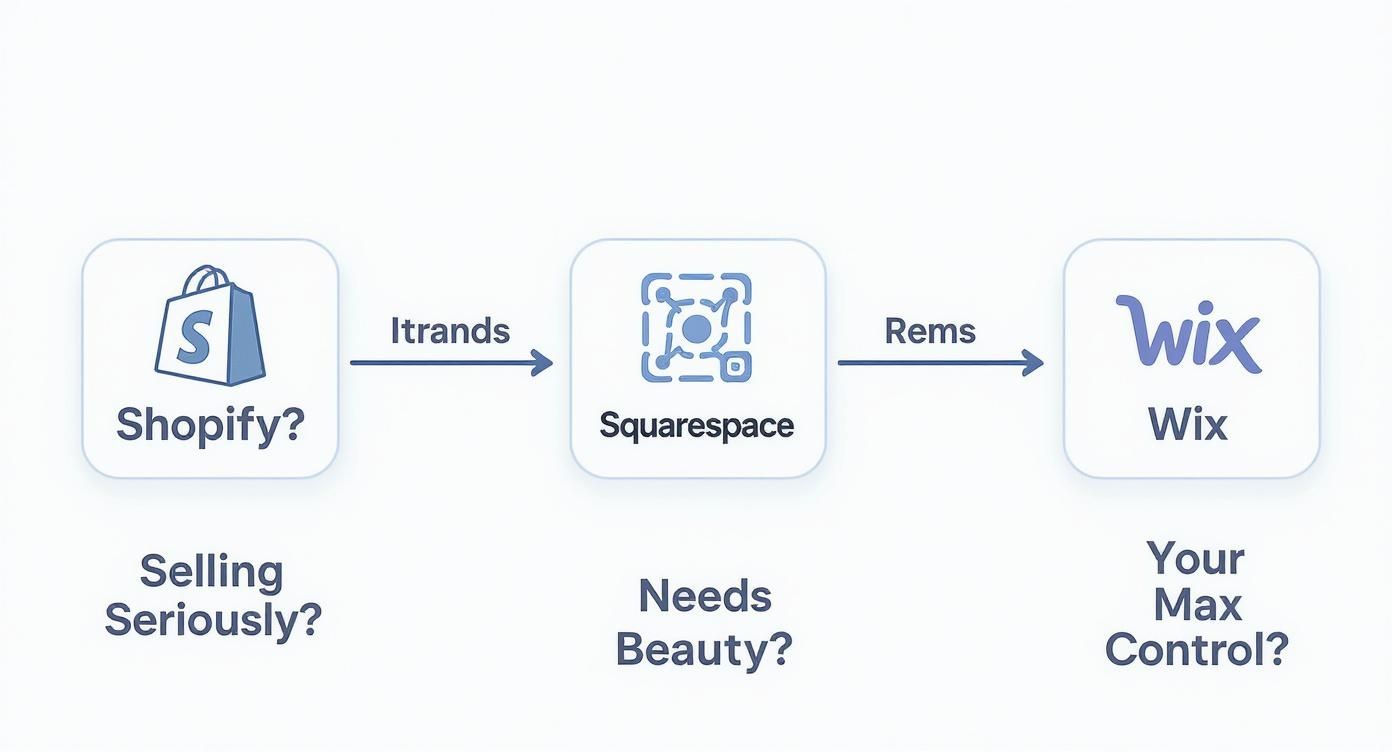
The image really simplifies it: your main goal should point you directly to the right platform. Once you know what matters most to you—hardcore commerce, stunning visuals, or complete customization—the choice becomes much clearer. With that in mind, let's dig into the details of each one.
Getting to Know the Big Three: What's Their Core Mission?
To really nail the Shopify vs. Squarespace vs. Wix decision, you've got to look at where each platform came from. They weren't all built for the same job, and that original DNA still shapes everything they do today, from features to pricing. Think of them less as three flavors of the same thing and more as three completely different business partners.
It helps to know their origin stories. Shopify was literally born from the need to sell snowboards online, so its soul is 100% commerce. Wix set out to let anyone build a custom website without touching code, making it a true jack-of-all-trades. And Squarespace started life as a premium blogging platform, which explains why it’s still obsessed with stunning design and content.
Shopify: The Dedicated Commerce Engine
Shopify's mission is crystal clear: to help people start, run, and grow a business. It's not a website builder that just happens to have a shopping cart bolted on; it is an e-commerce platform, through and through. Every single tool, from inventory tracking to its own payment processor, is built to make one thing easier: selling.
This laser focus on commerce is why it’s the top dog. In the world of e-commerce platforms, Shopify commands a huge 10.32% market share. It’s the platform serious sellers gravitate towards. You can dig into more of these stats in this e-commerce platform market share report.
Shopify is for the entrepreneur who sees their website primarily as a store. It puts function before form, giving you a powerful, dependable, and scalable machine that can grow with you from your first sale to your millionth.
Even a quick glance at Shopify’s homepage tells you the whole story—it's all about growth, powerful sales tools, and building a business.

As you can see, Shopify positions itself as the complete commerce command center for entrepreneurs who are ready to build a real brand.
Wix: The All-In-One Website Creator
Wix came onto the scene with a totally different goal: to give small business owners and everyday users total creative freedom online. Its drag-and-drop editor was a revelation, letting you design a site with pixel-perfect precision without needing any technical chops.
Because of this, e-commerce on Wix feels like a very capable feature inside a much bigger website-building universe. It’s a fantastic fit for a restaurant that needs online ordering, a photographer selling prints, or a consultant who needs to book appointments. The website is the star of the show, and the sales tools are there to support it.
Squarespace: The Design-First Storyteller
Squarespace made a name for itself by appealing to creatives—artists, designers, and bloggers who put aesthetics first. Its templates are legendary for being clean, modern, and just plain gorgeous. The whole platform is geared toward making your products and your story look incredible, right out of the box.
This design-first philosophy makes it the perfect choice for any business where the brand's visual identity is non-negotiable. If you're an artist selling limited edition prints, a maker of high-end furniture, or a blogger selling digital guides, Squarespace gives you a storefront that feels like a beautiful, curated gallery for your work. It strikes a great balance between stunning presentation and solid, easy-to-use e-commerce tools.
Diving Into the Nitty-Gritty: A Feature-by-Feature Comparison
When you're ready to move beyond the big picture, the real decision between Shopify, Squarespace, and Wix comes down to the tools you’ll be using every single day. For a small merchant, especially someone coming from a marketplace like Etsy, the right features can be the difference between smooth sailing and constant headaches.
Let’s get practical and break down the side-by-side differences in the areas that truly matter: e-commerce horsepower, design flexibility, and built-in marketing tools.
E-commerce Capabilities: The Engine of Your Store
This is where each platform really shows its true colors. The way they handle products, payments, and the entire sales process reveals who they were truly built for.
Shopify: All About Commerce
Let's be clear: Shopify is an e-commerce platform first and a website builder second. Its entire DNA is coded to help you sell more, and sell more effectively. You get incredibly robust inventory management that can handle thousands of products with all sorts of complex variations, seamless payment processing with competitive rates, and abandoned cart recovery even on its most basic plan.
For sellers with big ambitions, Shopify’s multi-channel selling is a total game-changer. You can easily sync your products and sell directly on Instagram, Facebook, and TikTok, all managed from one central dashboard. This isn't just a tacked-on feature; it’s a growth strategy baked right into the platform.
Wix: Capable, but with a Ceiling
Wix offers a respectable set of e-commerce tools that are perfect for businesses where selling online is just one piece of the puzzle. You can manage inventory, take payments, and set up basic shipping rules without a fuss. It’s a fantastic fit for a local bakery taking online orders or a consultant selling a few digital guides.
The moment your store starts to scale, though, you might start to feel the constraints. The inventory system isn't built for large catalogs, and while it supports selling on other channels, the integrations aren't nearly as deep or seamless as Shopify's. It’s a solid solution for smaller operations, but it lacks the heavy-duty machinery for high-volume sales.
Squarespace: Elegant and Effective for Curated Shops
Squarespace strikes a beautiful balance, wrapping strong e-commerce features in a stunning design package. It’s absolutely ideal for visually-driven brands selling a curated collection of products, whether they're physical or digital. You get gorgeous product pages, clean inventory management, and tools for selling subscriptions and gift cards.
One of its killer features is the built-in Acuity Scheduling for service-based businesses. This makes it a one-stop shop for entrepreneurs who sell both products and their time. The main limitation? The feature set is a bit lighter when it comes to complex shipping or tax calculations, and the lack of a dedicated POS system for in-person sales can be a deal-breaker for some.
The bottom line is this: Shopify gives you a powerful, scalable retail machine. Wix and Squarespace provide very capable storefronts attached to excellent website builders, but they just aren't built with the same singular, obsessive focus on commerce.
The Power of Apps and Integrations
A platform’s true potential is often unlocked by its app store. This is where you find specialized tools for everything from sophisticated email marketing to print-on-demand services.
The difference in scale here is massive and directly impacts what your store can ultimately do. Shopify has a clear competitive advantage with a sprawling app store boasting nearly 8,000 apps, compared to Wix's 300-or-so and Squarespace's tiny collection of just 31 extensions. When it comes to sales capabilities, Shopify supports unlimited products and has an entire ecosystem built for dropshipping and print-on-demand, with around 708 dropshipping apps and 646 print-on-demand apps. For comparison, Wix offers 48 for each, while Squarespace has only 2 and 5, respectively. You can dig into more details in this platform ecosystem comparison.
This isn't just a numbers game; it’s about capability. If you need a specific function—like a loyalty program, advanced product reviews, or a complex subscription model—you are far more likely to find a polished, well-supported solution on Shopify.
Design Flexibility and Customization
How your store looks is your digital handshake—it builds trust and creates a memorable brand. Each platform approaches design from a completely different angle.
Wix: Total Creative Freedom
Wix is the ultimate design playground. Its unstructured, drag-and-drop editor lets you place any element anywhere you want on the page, giving you pixel-perfect control. For a creative business owner with a very specific vision, this freedom is incredible.
The catch? It’s also incredibly easy to create a design that looks cluttered or breaks on mobile if you’re not careful. You are the designer, for better or for worse. It’s also critical to know that once you pick a Wix template, you’re stuck with it—you can't switch to another one without rebuilding your entire site from scratch.
Squarespace: Structured Elegance
Squarespace is famous for its award-winning templates for a reason. The platform uses a more structured, section-based editor that masterfully guides you toward creating a beautiful, cohesive design. Honestly, it's almost impossible to make a Squarespace site look bad.
This structure means you have less granular control than you do with Wix, but the trade-off is a professional, polished look right out of the box. For creatives and brands that live and die by their aesthetic, Squarespace is often the perfect match.
Shopify: Conversion-Focused Design
Shopify’s design philosophy is all about one thing: turning visitors into customers. Themes from the Shopify Theme Store are engineered with e-commerce best practices in mind, featuring clear calls-to-action, streamlined navigation, and layouts optimized to help people find and buy products.
While the theme editor is more restrictive than its counterparts, it’s designed that way to ensure your store stays fast, mobile-friendly, and functional. Customization is definitely possible, but it often means dipping into code or using apps to add new sections, reinforcing that its focus is on function over freeform design.
Built-In Marketing and SEO Tools
A beautiful store is useless if no one can find it. Good marketing and SEO tools are your engine for driving traffic and growing a loyal customer base.
All three platforms give you the SEO basics you need to get ranked on Google, like customizable page titles, meta descriptions, and image alt text. The real differences show up in their built-in marketing features.
- Squarespace really shines with its integrated email marketing platform, Squarespace Email Campaigns. It lets you build a mailing list and send beautiful newsletters without needing a separate tool.
- Wix bundles its marketing features into a comprehensive suite called Ascend by Wix, which includes email marketing, social post creation, and lead capture forms under one subscription.
- Shopify includes basic email marketing but truly flexes its muscles by integrating with a huge ecosystem of powerful marketing apps. It connects seamlessly with industry-leading tools like Klaviyo for advanced email automation and provides deep integrations with Google and Meta for running highly effective ad campaigns.
For a new merchant, the built-in simplicity of Squarespace’s tools offers a ton of value. But for a business laser-focused on scaling through targeted marketing, Shopify’s access to a whole world of specialized, powerful apps provides a much, much higher ceiling for growth.
Analyzing the True Cost of Each Platform
When you’re trying to decide between Shopify, Squarespace, and Wix, it's easy to get fixated on the monthly subscription price. But trust me, that sticker price is just the tip of the iceberg. The real cost—what you’ll actually spend to run your store—is a mix of transaction fees, app subscriptions, and other sneaky expenses that can really add up.
A lower monthly fee looks great on paper, but it might hide higher transaction fees that chip away at your profit with every single sale. On the flip side, a pricier platform might pack in more built-in features, saving you a small fortune on paid apps down the road. Let’s dig into the real-world numbers so you can make a smart financial decision for your business.

Unpacking Monthly Plans and Transaction Fees
The most obvious expense is your monthly plan, but it's the transaction fees that often have a much bigger impact on your bottom line, especially once you start making consistent sales.
Shopify might have a slightly higher starting price, but its fee structure is designed to scale. If you use their built-in processor, Shopify Payments, you pay zero extra transaction fees. This is a game-changer. You only pay the standard credit card processing rate, which actually gets lower as you upgrade to higher-tier plans.
On the other hand, Squarespace’s popular "Business" plan comes with a 3% transaction fee on top of the regular credit card processing fees. To get rid of that fee, you have to jump up to their more expensive "Commerce" plans. For a store with any real sales volume, that 3% fee becomes a significant cost very quickly, making the upgrade a necessity, not an option.
Wix takes a similar approach. While it offers its own payment gateway without extra transaction fees, its entry-level e-commerce plans are pretty bare-bones. To get the features you actually need to run a store, you'll almost certainly need their "Core" or "Business" plan, which brings its true cost right in line with the others.
The key takeaway is to calculate your break-even point. At what sales volume does Shopify's slightly higher monthly cost become cheaper than paying Squarespace's 3% transaction fee? For many growing stores, that point arrives faster than you’d think.
The Hidden Costs of Apps and Add-Ons
The second major cost to consider is the ecosystem of apps and extensions. This is where the platforms' core philosophies really clash, and it can have a big impact on your budget.
Shopify's biggest strength is its massive App Store, but this can also be a source of hidden costs. The core platform is incredibly robust, but you’ll probably want paid apps for things like advanced subscription models, loyalty programs, or unique product personalizations. These can easily add $10 to $50+ per month, per app, to your bill.
In contrast, Wix and Squarespace try to bundle more functionality into their platforms from the get-go. Features like appointment booking (Acuity Scheduling on Squarespace) or basic email marketing are often built right in, which can save you from needing separate paid tools. The downside? If you need a specific feature they don't offer, their smaller app markets mean you might be out of luck.
This financial strength also shows up in platform development. In Q2 2025, Shopify’s revenue hit $2.68 billion, a 31% increase year-over-year. For comparison, Wix reported $489.9 million and Squarespace earns around $1.01 billion annually. A platform's financial health is a good indicator of its ability to invest in new features, security, and support—a crucial long-term consideration. You can find more CMS market trends on Themeisle.com.
Cost Comparison for a Small Online Store
To make this all more tangible, let's compare the entry-level e-commerce plans a small merchant would realistically consider. This table breaks down what you get for your money with each platform's popular starting plan for anyone serious about selling online.
As you can see, once you factor in the transaction fees on Squarespace and the feature limitations on Wix's lower-tier plans, the costs start to even out. The best choice really depends on your sales volume and which specific features are non-negotiable for your business.
Which Platform Fits Your Business Best?
Picking between Shopify, Squarespace, and Wix isn't about finding the one with the most features. It's about finding the one that actually fits how you work and where you want your business to go.
Let's ditch the abstract comparisons and walk through a few real-world scenarios. See if you recognize your own business in one of these examples—it’s the best way to figure out which platform will feel less like a tool and more like a partner.
The Ambitious Brand Builder
Imagine you're an Etsy seller who's built an incredible following for your handmade home decor. You're crushing your sales goals, but you can feel the limits of the marketplace closing in. You're ready to own your customer list, run your own marketing campaigns, and maybe even expand into wholesale.
For this kind of entrepreneur, Shopify is the clear winner.
Shopify's entire world is built to fuel this kind of growth. It gives you the horsepower to handle:
- Serious Inventory Management: Easily track hundreds of products, each with its own variations, without breaking a sweat.
- Multi-Channel Sales: Sell on Instagram, TikTok, and even in a physical pop-up with Shopify POS, all managed from a single dashboard.
- Powerful Marketing: Plug in professional tools like Klaviyo for email automation that builds loyalty and keeps customers coming back.
Think of Shopify not just as a website, but as the command center for a real retail operation.
The Creative Entrepreneur
Now, picture a photographer selling fine art prints. They also need to book client sessions and maybe sell a few digital photography workshops. For them, the website is everything—it's a portfolio and a store, and it has to look stunning. The visual brand is non-negotiable.
This is where Squarespace truly shines.
Squarespace is built for businesses where presentation is just as important as the product. It delivers an elegant, all-in-one package that perfectly marries beautiful design with solid e-commerce.
- Design-First Templates: Its templates are famous for a reason; they make your work look incredible right out of the box.
- Integrated Scheduling: Acuity Scheduling is built right in, so clients can book shoots or consultations seamlessly.
- Digital Product Sales: Selling workshops, courses, or digital downloads is simple and looks just as polished as your physical prints.
Squarespace is for the business where the story and the visuals are the main event. It helps you build a credible, high-end online presence that attracts the right kind of client.
The Local Shop Owner
Finally, think about a local gift shop owner who needs to get online, and fast. Their main goals are offering local pickup, booking spots for in-store workshops, and managing a small, curated inventory. They need something straightforward without a huge learning curve.
The perfect fit here is Wix.
Wix offers incredible flexibility for small businesses that do more than just sell products online. Its famous drag-and-drop editor gives you total creative freedom to build a site that captures the unique personality of your physical shop.
Wix's homepage shows off its all-in-one approach, highlighting tools for service businesses, restaurants, and online stores all at once.
This is exactly what a local business owner needs:
- Appointment Booking: Wix Bookings makes it a breeze for customers to sign up for workshops or services.
- Flexible Design: Need a page for a special event or a community noticeboard? You can build it in minutes.
- Simple E-commerce: The sales tools are more than enough to handle a smaller product catalog for online orders and local delivery.
Once your store is live, the next big challenge is getting people to visit it. To get the most out of your new site, you’ll need to focus on driving traffic. For instance, a solid strategy for link building for e-commerce can dramatically boost your store's visibility and bring in new customers, no matter which platform you end up choosing.
Making Your Final Decision
Alright, we've broken down the features, dug into the costs, and looked at how these platforms play out in the real world. Now it's time to land the plane. The choice between Shopify, Squarespace, and Wix really comes down to one simple, but crucial, question: what are you really trying to build?

Think of it this way: are you building a store that has a website attached, or a website that happens to sell a few things? That one distinction changes everything.
Choosing Your Growth Partner
If your main goal is to build a serious retail business that can scale and sell everywhere, then Shopify is your workhorse. It's an e-commerce engine, first and foremost, designed to handle growth, complex inventories, and all the nitty-gritty sales tools you'll eventually need.
But, if your brand is built on stunning visuals—maybe you're a photographer, artist, or consultant—and you want a beautiful online portfolio where e-commerce is a key feature but not the entire story, then Squarespace is your match. It leads with elegance and makes your work the hero.
And what about Wix? It’s the ultimate all-rounder. If you need a website that does a bit of everything—bookings, blogs, a portfolio, and a store—and you want total drag-and-drop control over the design, Wix gives you that creative freedom.
Your platform isn't just a tool; it's the foundation for your future growth. Choose the one that aligns with where you want to be in two years, not just where you are today.
I know making this leap feels like a huge deal, especially if you're coming from the relative comfort of a marketplace like Etsy. But it's the most important step you can take to truly own your brand and your profits.
At Wand Websites, we live and breathe this stuff. We've helped countless sellers make this exact jump, building them conversion-focused Shopify stores that set them up for long-term success. If you're ready to build a brand you truly control, let us handle the technical heavy lifting. You focus on creating your incredible products—we'll build the store to sell them.
Frequently Asked Questions
Even with all the features and costs laid out, you might still have a few nagging questions holding you back. It’s a big decision! Let’s tackle some of the most common concerns I hear from merchants, so you can feel completely confident in your choice.
Can I Move My Store to Another Platform Later?
This is a big one. Nobody wants to feel trapped. The short answer is yes, you can always migrate your store, but it's never as simple as clicking a button. Moving your shop means exporting all your data—products, customer info, order history—and importing it into a new system.
It’s definitely doable, but the process can get technical and messy. Your products and customer lists usually come over okay, but things like your website design, blog posts, and any special data from apps often have to be rebuilt from the ground up.
Think of it like moving houses. You can pack up all your furniture and belongings (your data), but you can't just pick up the house itself (your theme and design). You have to start over with decorating and arranging everything in the new space.
Because of the hassle involved, it’s always better to pick the platform that feels right for your long-term goals. A little extra thought now can save you a huge headache down the road.
Which Platform Has the Best SEO Tools for a Beginner?
If you're just dipping your toes into the world of SEO (Search Engine Optimization), you'll be glad to know all three platforms have the basics covered. You can easily tweak page titles, meta descriptions, and image alt text on Shopify, Squarespace, and Wix, which is where you need to start.
That said, Squarespace and Wix often feel more approachable for total beginners. They have a more hand-holding approach, with built-in checklists and guides. Wix's "SEO Wiz" tool is a great example—it literally walks you through the essential steps, which is a lifesaver if you have no idea where to begin.
Shopify's SEO tools are just as powerful, if not more so, but they're presented in a way that assumes you have a bit more business savvy. It’s less of a guided tour and more of a professional toolkit.
Is Squarespace Only for Designers and Artists?
That’s a myth that’s been around for a while! While Squarespace earned its stripes with beautiful, design-focused templates that creatives love, the platform has grown into a serious contender for all kinds of businesses.
It's a fantastic choice for:
- Service-based businesses that need to book appointments right on their site.
- Restaurants and cafes that want to show off menus and take online orders.
- Consultants and coaches who sell digital products, courses, or memberships.
While it’s still the top dog for anyone with a strong visual brand, its clean feel and solid, built-in features make it a great option for any small business owner who wants a polished website without a major learning curve.
Ready to stop wondering and start building? At Wand Websites, we specialize in creating high-growth Shopify stores that turn your vision into a reality. We'll handle the entire setup, so you can focus on your products while we build the perfect platform to sell them. Learn more and get started at https://www.wandwebsites.com.
