
Shopify vs Etsy Which Is Best for Your Business

Thinking about Shopify vs. Etsy really boils down to one simple question: do you want to rent a booth in a massive, bustling market, or build your very own flagship store from the ground up?
It’s helpful to think of Etsy as the ultimate launchpad. It’s a vibrant marketplace teeming with millions of buyers actively looking for unique products, making it the perfect place to test your ideas and get those first sales rolling in. On the other hand, Shopify is your long-term growth engine—a robust platform that gives you the keys to build an independent brand you completely own and control.
Choosing Your E-commerce Home Base
The Shopify vs. Etsy debate isn't about which one is flat-out "better." It's about finding the right fit for where your business is right now and where you dream of taking it. Many of the most successful brands I've seen started their journey on Etsy, using its built-in audience to validate their products with very little initial risk.
Etsy's real magic is its community and discoverability. The platform has attracted a staggering 95.5 million active buyers, all searching for handmade items, vintage treasures, and one-of-a-kind goods. For a new seller, that's an incredible built-in advantage. It’s an ecosystem designed for small makers; a whopping 82% of its 8.1 million sellers are solo entrepreneurs, which speaks volumes about how accessible it is. You can dig deeper into these numbers with this great breakdown of Etsy sales statistics.
But as your business gains traction, the very things that make Etsy so appealing can start to feel like limitations. The lack of true branding control, being displayed next to thousands of direct competitors, and the various fees can put a ceiling on your growth. This is the natural point where successful sellers start eyeing Shopify—not necessarily as a replacement, but as the next logical step in their evolution. Shopify gives you the toolkit to forge a unique brand identity, own your customer relationships, and scale your operations without hitting a wall.
Quick Look Shopify vs Etsy Core Differences
To really put this choice into perspective, let's zoom out and look at the fundamental models. Think of this table as a quick cheat sheet to understand the core trade-offs between renting a spot in a market and building your own store.
Seeing it laid out like this makes the primary difference crystal clear: Etsy brings the customers to you, while Shopify gives you the freedom to build your own world, provided you can bring the customers there yourself.
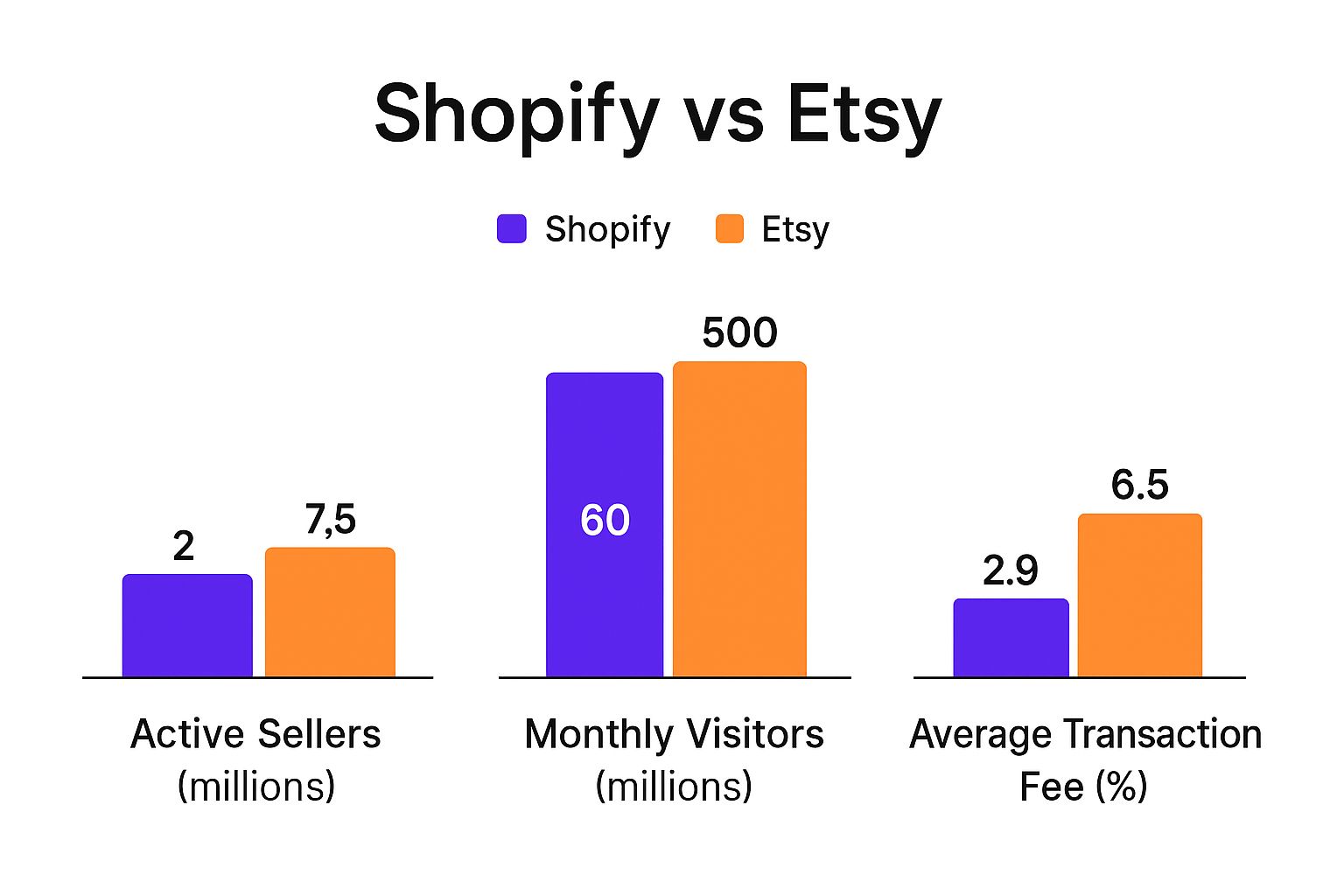
The numbers in this visual really tell the story. Etsy's colossal user base offers instant traffic, which is a massive win for beginners. Meanwhile, Shopify's model empowers a larger number of sellers, often with more favorable transaction fees, highlighting its strength as a scalable, long-term solution.
Analyzing the True Cost of Selling
Let's talk about the money. When you're comparing Shopify and Etsy, you have to get real about how each platform’s fees eat into your profits. It’s not about one simple percentage; it’s about how all the little costs stack up with every single sale, which can change drastically as your shop grows.
For many sellers who find success on Etsy, fees start out as a small, manageable part of doing business. But as you scale, they can quickly become a serious drain. Etsy's fee model is built on layers of transactional costs. You’ve got a listing fee, a transaction fee, a payment processing fee, and sometimes others sprinkled in.
The real game-changer for high-volume sellers is Etsy's Offsite Ads program. Once your shop clears $10,000 in sales over any 12-month period, you’re automatically and permanently enrolled. This means an extra 12% fee gets sliced off any sale that comes from those ads, on top of all the other fees you're already paying.
Suddenly, that mandatory ad fee can push your total cost on a single sale to over 25%. If you're running on tight margins, losing a quarter of your revenue on a growing number of sales is a huge blow. It can seriously handcuff your ability to grow any further.
The Financial Tipping Point for Etsy Sellers
So, when does it all become too much? Let’s walk through a real-world scenario. Imagine your shop brings in $5,000 a month by selling 100 items at an average price of $50.
Here's a simplified look at what you'd likely be paying on each platform for that month:
Etsy Cost Breakdown (Scenario):
- Listing & Renewal Fees: At $0.20 for each of your 100 listings, that's $20.
- Transaction Fees: The 6.5% fee on your total sales ($5,000) comes to $325.
- Payment Processing: This usually hovers around 4% + £0.20 per order (we'll use UK rates for this example). For 100 orders, that’s roughly $220.
- Offsite Ads Fee: Let’s be conservative and say 20% of your sales ($1,000) come from these mandatory ads. The 12% fee on that slice is another $120.
When you add it all up, your estimated monthly cost on Etsy is sitting around $685.
How Shopify's Costs Compare
Now, let's run that same $5,000 month through Shopify. The whole approach to fees is different here. Instead of getting nibbled to death by transactional fees, you have a predictable subscription model.
Shopify Cost Breakdown (Scenario):
- Monthly Subscription: The popular Basic Shopify plan, perfect for a growing business, is $29 per month if you pay annually.
- Payment Processing: If you use Shopify Payments, their standard online rate is 2.9% + 30¢ per transaction. On your 100 orders, this would be about $175.
In this scenario, your total monthly cost on Shopify is only about $204.
The Bottom Line: A Side-by-Side Look
Seeing the numbers side-by-side really puts it into perspective. In our example, moving from Etsy to Shopify could put nearly $500 back in your pocket every month—that's almost $6,000 a year. Think about what that money could do: you could pour it back into marketing, develop new products, or just take it home as the profit you've earned.
Sure, Shopify means you have to drive your own traffic. But for a business that's ready to grow beyond the confines of a marketplace, the financial control and potential for scale are massive. This kind of financial freedom is often the main reason successful Etsy sellers decide it's time to make the switch.
Building Your Brand Identity and Experience
When it comes to branding, the Shopify vs. Etsy debate isn't just a comparison—it's a fundamental difference in philosophy. Think of it this way: on Etsy, you're renting a pre-built booth inside a massive, bustling market. On Shopify, you're given the land and a full set of tools to build your brand’s forever home from the ground up. This one distinction is where the long-term potential of your business truly takes shape.
Etsy's branding is intentionally consistent. Every shop page follows the same layout, uses the same fonts, and fits within the strict visual guardrails of the Etsy platform. For buyers, this is fantastic because it creates a predictable and reliable shopping experience.
For a seller looking to scale, however, that same uniformity quickly becomes a major roadblock. Your unique brand story, your carefully chosen colors, and your personality all get watered down. More often than not, customers remember they "bought it on Etsy," not that they bought it from your specific brand. This makes building genuine brand loyalty and name recognition a serious uphill battle.
The Power of Owning Your Experience
Shopify completely flips this on its head. It gives you total creative control over every single pixel of your digital storefront. You aren't just moving products anymore; you're creating an entire experience that starts the moment a customer lands on your site and continues long after they've made a purchase.
This level of control is what allows you to build a powerful brand that can command higher prices and earn deep customer loyalty. You're no longer just competing on product and price inside a crowded marketplace—you're building an immersive world that your customers want to be a part of.
Here’s a quick look at how that control plays out in real terms:
- Custom Themes and Layouts: The Shopify theme store has thousands of professionally designed templates that are fully customizable. You can change everything from fonts and color palettes to page layouts and navigation to perfectly capture your brand’s vibe.
- A Unique Domain Name: Instead of a URL like
etsy.com/shop/yourbrand, you get to haveyourbrand.com. This simple change is a huge signal of professionalism and legitimacy to your customers. - Full Checkout Control: You control the entire checkout process. This means you can add trust badges, customer testimonials, or even last-minute special offers—all things that can seriously boost your conversion rates.
"Building brand loyalty on Etsy is hard. Most of the time, a customer’s loyalty is to Etsy, not to your brand." - Olivia Wang, Founder of Floral Neverland
This insight from a successful seller who made the switch gets right to the heart of the matter. On Etsy, your brand is a tenant. On Shopify, your brand is the landlord, the architect, and the main event.
From Craft Fair to Flagship Store
Let's use an analogy. An Etsy shop is like having a pop-up table at a really popular craft fair. You get tons of foot traffic, but you’re elbow-to-elbow with competitors, and your entire display is confined to that small table. A Shopify store, on the other hand, is your own flagship retail location in the best part of town. You get to design the window displays, choose the music, and create an atmosphere that makes people excited to come inside and connect with your brand.
Here’s a practical breakdown of what that means for a growing business:
For a high-revenue Etsy seller, the ability to build a memorable brand isn't a "nice-to-have"—it's the key that unlocks your next level of growth. It’s how you justify premium pricing, drive repeat purchases, and build a real asset that has value far beyond your individual product listings. When you look at it this way, the choice is clear: if you’ve outgrown the market stall, it’s time to build your own store.
How You Find and Attract Your Customers
How shoppers find you is probably the single biggest difference between running a shop on Etsy versus Shopify. It’s a fundamental shift in your entire marketing mindset, moving you from a mostly passive role to a very active one. Etsy gives you an incredible head start with a built-in audience, while Shopify hands you the keys to build your own customer-finding machine from the ground up.
Let's be clear: Etsy’s main draw is its massive, ready-made marketplace. It's a destination. Millions of buyers show up every day looking for the exact kinds of unique, handmade, or vintage items you sell. They already want to buy, and by listing on Etsy, you’re putting your products right in their line of sight.
This built-in audience is a game-changer, especially when you're just starting out. You don't need a huge marketing budget or deep SEO knowledge to get those first few sales. Instead, you focus on Etsy SEO—learning how to optimize your titles, tags, and descriptions with the keywords real shoppers are typing into that Etsy search bar.
Etsy: Tapping into a Built-In Traffic Source
Think of Etsy as its own little search engine. When someone searches for a "handmade leather wallet," Etsy's algorithm digs through millions of listings to find the best match. Winning on Etsy means mastering this internal game.
- Keyword Optimization: Your job is to fill out all 13 tags and write descriptive, keyword-packed titles. This is the bedrock of getting seen.
- Etsy Ads: You can pay a little extra to promote your listings within Etsy's search results. This gives you a nice bump over the organic competition without breaking the bank.
- Offsite Ads: Once you hit $10,000 in annual sales, Etsy automatically starts advertising your products on places like Google and Facebook. It’s a great way to expand your reach, but it’s mandatory and comes with a fee deducted from those sales.
This model is fantastic for getting your brand off the ground. The trade-off? You're operating in a sea of competitors. Your gorgeous product is often sitting right next to a dozen others just like it, making it a constant fight for every click.
Shopify: The Marketing Is All on You
The moment you launch a Shopify store, the world flips upside down. That built-in audience vanishes. On day one, you'll have zero visitors, and it's 100% your job to bring people to your site. That might sound terrifying, but it's also where you gain complete control and unlock your true growth potential.
With Shopify, you have to be more than just a creator—you have to become a marketer. You get to build direct relationships with your customers and lead them to a storefront that is entirely yours, with zero competitors lurking in the sidebar.
Your marketing efforts on Shopify are an investment in a long-term asset: your brand. Unlike on Etsy, where traffic is borrowed, the audience you build on Shopify is yours to keep, nurture, and market to for years to come.
This strategic pivot is clear when you look at the numbers. Etsy's marketplace model has fostered a massive community of 95.5 million active buyers and 8.1 million sellers, all centered around creative discovery. Shopify, on the other hand, focuses on empowering individual merchants with tools, which has led to a much higher overall Gross Merchandise Value (GMV) across its platform. You can dig into more e-commerce platform statistics to see these differing growth models and market potentials in action.
Making the leap from Etsy to Shopify means learning how to generate your own traffic. The good news is, Shopify gives you an incredible toolkit to make it happen.
Your New Marketing Toolkit on Shopify:
- Search Engine Optimization (SEO): You get full control over your site’s Google-facing SEO—from the blog and page content to URL structures and meta descriptions. This lets you attract high-value shoppers directly from search engines, not just from within a crowded marketplace.
- Email and SMS Marketing: You finally own your customer list. You can integrate powerful tools like Klaviyo or Omnisend to set up automated emails for abandoned carts, welcome new subscribers, and run promotions that drive repeat business, practically on autopilot.
- Social Media Integrations: You can connect your Shopify store directly to Facebook and Instagram Shops. This creates a seamless shopping experience where customers can browse and buy your products without ever leaving their social feed—a direct and powerful sales channel.
- Content Marketing: A blog is one of your most powerful tools. Use it to tell your brand story, share your process, and offer value that attracts your ideal customer. Over time, a good blog can become a reliable source of free, organic traffic and the heart of your brand's identity.
Thinking about the long run? If you've got big plans for your business, you need to look at the Shopify vs. Etsy question through a growth-focused lens. Etsy is a fantastic place to start—it lets you test your products, find your first customers, and get some real momentum going. But you have to be honest about what it is: a platform built for solo creators and small teams, not for businesses getting ready to scale up in a major way.
Etsy's marketplace model, with its standardized shop pages and ready-made audience, eventually becomes a ceiling. The very things that helped you get off the ground can start to hold you back as you grow. The lack of deep customer data, the restrictive branding, and the inability to build a truly independent customer list are massive roadblocks when you're ready to take things to the next level.
Built to Grow With You
This is where Shopify’s entire reason for being comes into play. It’s not just another sales channel; it's the core infrastructure for your brand. Shopify was designed from day one to be the engine that powers your growth, no matter how big you want to get.
The platform is rock-solid, built to handle the intense pressure of Black Friday sales or a viral product launch without skipping a beat. Even better, it plugs you into a massive ecosystem of tools specifically made for running a complex, high-volume e-commerce business.
For sellers who are serious about building a brand, the goal isn't just to sell more stuff. It's to build a valuable, sustainable business asset. Shopify gives you the foundation for that asset, while Etsy offers a temporary—though often very effective—place to sell.
You can see this difference clearly in how they operate in the larger e-commerce world. Both platforms serve their audiences well, but Shopify’s mission is to empower independent business owners to build their own powerful brands. Its growth is driven by merchant-first services like Shop Pay, which handles billions in sales volume every quarter. That's a testament to its ability to manage a massive scale. You can find more stats on Shopify’s role in global e-commerce on their site.
Critical Features for Scaling Your Business
Once your business is ready to graduate from the digital craft fair model, there are certain features you simply can't live without. Shopify offers a whole suite of advanced tools that are either completely missing or severely limited on Etsy.
- Advanced Inventory Management: Shopify lets you track inventory across multiple locations. This is a game-changer if you start using a third-party logistics (3PL) partner or hold stock in different warehouses.
- Wholesale and B2B Channels: With Shopify, you can set up a password-protected wholesale storefront for bulk buyers. This lets you offer different pricing without confusing your regular retail customers.
- Subscription Models: The Shopify App Store is loaded with powerful apps that let you offer product subscriptions. It's one of the best ways to create a reliable, recurring revenue stream.
- International Commerce Tools: Selling globally is a beast, but Shopify Markets tames it. It has built-in tools for currency conversion, local payment options, and managing international domains, making global expansion a whole lot easier.
Growth Features Shopify vs Etsy
Putting these features side-by-side really highlights the difference for a growing brand. Here’s a quick look at what’s available for scaling your business on each platform.
So many of today's biggest e-commerce brands got their start on Etsy. They proved their concept, built a following, and then moved to Shopify to build an empire. When your vision gets too big for the marketplace, Shopify is ready and waiting with the tools you need to make it happen.
Your Top Questions About Shopify and Etsy, Answered
As you're weighing your options between Shopify and Etsy, a few questions always pop up. It's totally normal. Getting straight answers to these is crucial before you make your next big move, so let's dive into what sellers like you are asking.
Can I Sell on Both Shopify and Etsy?
You absolutely can, and honestly, it's one of the smartest things you can do. Think of it as a "hub and spoke" strategy. Your Shopify store is the central hub—your brand's home base. Your Etsy shop then acts as a powerful spoke, reaching out to find new customers.
This setup lets you tap into Etsy's massive, ready-made audience to get discovered. Once someone buys from you on Etsy, you can gently guide them over to your Shopify site for future purchases, where you can offer more products, create a deeper brand experience, and build a real, lasting relationship. It’s the best of both worlds.
How Hard Is It to Move from Etsy to Shopify?
Moving from Etsy to Shopify is a well-worn path, and it's much more straightforward than you might think. Shopify has tools, and there are a bunch of third-party apps, built specifically to make this jump easier. They can pull your Etsy listings—titles, descriptions, photos, variations, you name it—right into your new Shopify store.
Of course, you'll still need to put in the time to design your store's look and get your settings just right. But these migration apps take care of the most mind-numbing part of the job, saving you from hours of manual copy-pasting.
The real work isn't moving your products; it's shifting your mindset from being a marketplace seller to a brand owner. The technical part is easy, but learning to drive your own traffic is the key to long-term success on Shopify.
When Should I Move to Shopify?
The right time to move is usually when you feel Etsy's rules are starting to box you in and stunt your growth. A few tell-tale signs will let you know it's time to build your own place on the web and graduate from the marketplace model.
You should seriously think about making the switch when:
- Mandatory Ads Eat Your Profits: Etsy's Offsite Ads are taking a 12-15% chunk out of more and more sales, and it's starting to hurt your bottom line.
- Your Brand Gets Lost: You realize customers say they "bought it on Etsy," not from your shop. Your brand is getting completely overshadowed.
- You Need Stronger Tools: You're hitting a wall and need better analytics, marketing automation, or customer management tools to keep growing.
- You've Outgrown the Niche: You want to sell things that don't quite fit into Etsy's strict "handmade" or "vintage" boxes anymore.
When your ambition gets bigger than the marketplace can handle, that's your cue. You're ready for the freedom and control that comes with your own Shopify store.
Ready to build a powerful brand and take control of your growth? At Wand Websites, we specialize in helping successful Etsy sellers make a seamless and profitable transition to Shopify. Let's build your brand's forever home together.
