
Shopify vs Amazon: Which Platform Fits Your Store Best? (shopify vs amazon)

When you get right down to it, the whole Shopify vs. Amazon conversation boils down to one simple question: do you want to build your own online store, or do you want to sell your products in someone else's? Think of Shopify as the toolkit for building your own branded headquarters, while Amazon is like renting a kiosk in the busiest mall on the planet.
Which path you take completely depends on what you're trying to achieve. Are you focused on building a long-term, independent brand that you own from top to bottom? Or is your main goal to get your products in front of a massive, ready-to-buy audience right now?
Your Path to Ecommerce Growth
Picking the right platform is a massive decision for any growing brand. It’s not about which one is "better" in a vacuum, but which one fits your specific business model and long-term vision. This guide is here to help you cut through the noise and figure out which engine will truly fuel your growth.
We're going to skip the generic pro/con list. Instead, we’ll dig into the real trade-offs you'll face. It's a classic case of owning your customer relationships versus renting customer attention. For ambitious sellers, especially those pulling in over $10,000 per month on a platform like Etsy, getting this right is the key to sustainable, profitable growth.
We’ll break down the factors that will actually determine your success:
- Brand Ownership: How much control do you really have over your brand’s look, feel, and customer experience?
- Customer Access: How do you get in front of buyers? Are you building an audience from scratch or tapping into an existing one?
- Cost Structure: What’s the real cost of selling? We're talking everything from monthly fees and commissions to what you'll have to spend on ads.
- Scalability: Can the platform grow with you, or will you hit a ceiling?
The core decision is simple: Do you want to build a house on land you own (Shopify), or rent a premium storefront in the world's busiest mall (Amazon)? Both can be incredibly profitable, but they require different strategies, mindsets, and investments.
To kick things off, let's look at the core philosophy behind each platform. This quick table sums it up nicely.
Shopify vs Amazon At a Glance
This table really highlights the fundamental difference in approach. With Shopify, you're the master of your own destiny, but that also means you're responsible for everything. With Amazon, you get instant access to a huge market, but you have to play by their rules.
Brand Ownership vs. Marketplace Access: What Are You Really Building?
When you boil it down, the whole Shopify vs. Amazon debate isn't about which platform has better features. It’s about a core philosophy: are you building a digital asset you truly own, or are you renting a stall in the world's biggest and busiest digital mall? That one decision changes everything, from your brand's look and feel to your long-term bottom line.

With a platform like Shopify, you're the architect of your brand's home on the web. You own the deed. Every pixel, from your homepage design to the thank-you email after a purchase, is yours to control. You aren’t just moving products; you're crafting an experience and building a direct, one-on-one relationship with every customer.
Amazon, on the other hand, gives you a premium spot in its unbelievably crowded marketplace. The upside is immediate access to its 310 million+ active customers, but you're playing in their sandbox, by their rules. You become a vendor among millions, all fighting for attention on product pages that look the same and are designed to promote Amazon's brand first, not yours.
The Real Value of Brand Equity
Think of your business like real estate. Building a Shopify store is like buying a plot of land and constructing your dream home. It takes more work upfront to build it and get people to visit, but every nail you hammer in, every bit of landscaping you do, increases its value. The brand equity you build—your customer list, brand recognition, and website authority—is an asset you own.
Selling on Amazon is more like leasing a kiosk in a high-end mall. Sure, you get incredible foot traffic from day one, but you can never change the mall’s layout, and the landlord (Amazon) owns the relationship with every single person who walks by your kiosk. If you decide to leave, you walk away with nothing but your leftover inventory.
For any seller thinking about long-term sustainability, the key question is: Are you building a business that can stand on its own two feet? Shopify is built for creating a standalone brand. Amazon is built for facilitating transactions within its brand.
This difference has a huge impact on how you connect with your people. On your Shopify site, you can tell your story, run a blog, and guide customers on a journey that feels uniquely you. On Amazon, your main way to stand out is often just price, which can quickly turn into a race to the bottom.
Why Customer Data is Your Most Valuable Asset
This might be the most important distinction of all: who owns the customer data? When someone buys from your Shopify store, you get their name, email, and purchase history. This information is pure gold in e-commerce, allowing you to:
- Create targeted email campaigns to bring customers back for more.
- Run retargeting ads on social media to people who left items in their cart.
- Analyze what people are buying to figure out what new products to launch.
On Amazon, the customer is Amazon's customer. They heavily restrict how you can communicate, limiting you to messages about the order itself. You can't send them a newsletter, invite them to follow you on Instagram, or build any kind of real relationship off the platform. This makes it almost impossible to build the brand loyalty that creates predictable revenue and long-term stability.
Ultimately, your choice here comes down to your primary goal. If you need sales right now and have a product that can compete in a structured, price-sensitive environment, Amazon offers an incredible launchpad. But if your dream is to build a lasting, valuable brand with a direct line to your community, Shopify gives you the foundation you need to own your future.
Analyzing Platform Costs and True Profit Margins
When you're trying to decide between Shopify and Amazon, it's tempting to just look at the monthly subscription fee and call it a day. But that's a huge mistake. To really understand which platform will make you more money, you have to dig into the entire cost structure and see how it hits your profit margins on every single sale.

The financial models here are polar opposites. With Amazon, you're essentially paying rent for access to their massive audience, and that rent comes in the form of a bunch of variable fees that chip away at your revenue. On Shopify, you're building your own business infrastructure—your costs are far more predictable, and you're the one in control.
Decoding the Amazon Fee Structure
Selling on Amazon is a "pay-to-play" game. Before you ever see a dime, Amazon takes its cut through a maze of fees. It’s a model that scales with your sales, but often not in a way that benefits you.
Here are the main costs you can expect to run into:
- Referral Fees: Think of this as Amazon's commission for every sale. It’s usually around 15%, but can swing anywhere from 8% to a staggering 45% depending on what you sell.
- Fulfillment by Amazon (FBA) Fees: If you use their FBA service, you’re paying for them to pick, pack, and ship your products. These fees are based on your product's size and weight, adding another hard-to-predict cost to each unit sold.
- Storage Fees: Amazon charges you to store your inventory in their warehouses. If your products don't sell quickly, these fees can get expensive, especially for items sitting for more than six months.
- Advertising Spend: With so much competition, running ads is pretty much non-negotiable if you want your products to be seen. It's not uncommon for this to add another 10% or more to your total costs.
These fees stack up fast. For a typical seller, the fees for referrals, fulfillment, and advertising can easily eat up 15%–40% of your gross selling price. In contrast, Shopify’s model charges a predictable subscription and a standard payment processing fee, but you get to keep the full retail margin. You own the customer relationship, which means you can run your own promotions and build a loyal following—something that's nearly impossible on Amazon. You can learn more about how these e-commerce statistics impact sellers.
Understanding Shopify’s Investment Model
Shopify’s cost structure feels more like building your own storefront. You have your fixed, foundational costs, and you decide when and where to invest more as your business grows. This gives you much tighter control over your profit margins.
Your main expenses on Shopify break down like this:
- Monthly Subscription: This is a fixed, predictable cost. Plans range from the $39/month Basic plan to the $399/month Advanced plan.
- Payment Processing Fees: If you use Shopify Payments, you’ll pay a standard transaction fee, which is typically around 2.9% + 30¢ for each online sale. This is a normal cost of doing business online.
- App Costs: Want to add cool features like a subscription service or a customer loyalty program? You can do that by adding third-party apps. These are optional investments you choose to make to improve your store and drive more sales.
On Amazon, a huge chunk of your costs are variable and tied directly to sales, which puts a hard ceiling on your profit potential. On Shopify, most of your costs are fixed. That means as you sell more, your profit margin on each new sale actually gets bigger.
For a growing brand, that difference is everything. With Shopify, you're building an asset that you truly own. While Amazon offers instant traffic, its fee structure is designed to benefit Amazon first, making it a tough place to build long-term, high-margin profitability as you scale.
Driving Traffic and Acquiring Customers
When you stack Shopify and Amazon against each other, how you get eyeballs on your products is one of the most glaring differences. This isn’t just a minor detail—it's a massive fork in the road that shapes your entire marketing and growth plan. The big question is: do you want to build an audience from scratch, or tap into one that’s already there?
With Shopify, you're the one in the driver's seat, responsible for bringing every single visitor to your store. Think of it like opening a beautiful new shop on a quiet side street. You have to put up the signs, run the ads, and create enough buzz to get people to walk through the door.
Amazon, on the other hand, is the world's biggest shopping mall. The foot traffic is already there, and it is immense. You aren't starting from a standstill; you're setting up your stall right in the middle of millions of shoppers who are already logged in with their credit cards saved, ready to buy.
Amazon: The Built-In Traffic Engine
You just can't argue with Amazon's power as a customer magnet. The entire business is designed to pull in shoppers. In the U.S. alone, Amazon consistently captures around 37–38% of all online retail sales. It’s a true behemoth.
Even more telling is how people start their shopping journeys. A solid 56% of consumers head straight to Amazon to search for a product, completely skipping over Google. This makes it an incredible place for discovery but also a fiercely competitive battleground where you’re constantly fighting to be seen.
Of course, all that built-in traffic comes with a catch: cutthroat competition. You're not just selling to a sea of customers; you're directly competing with thousands of other sellers—and often Amazon's own brands—for the same digital shelf space. Visibility is almost never free. To get noticed, you'll need to pour money into Amazon's pay-per-click (PPC) ads, making traffic a direct and ongoing cost.
Amazon gives you immediate access to a massive audience, but you are essentially renting their attention. You pay for visibility through ads and referral fees, but you never truly own the customer relationship, making it difficult to build long-term brand loyalty.
Shopify: Building Your Own Audience
Starting with a Shopify store means your traffic counter reads zero on day one. I know, that can sound terrifying. But what you get in return for that initial hustle is complete control and total ownership over every single person you attract. Your success is squarely on your shoulders, and it all comes down to building a smart, multi-channel marketing plan.
The go-to channels for driving traffic to a Shopify store usually include:
- Search Engine Optimization (SEO): This is your long game. By creating great content and fine-tuning your product pages, you can attract a steady stream of free, organic traffic from places like Google.
- Paid Advertising: Platforms like Facebook, Instagram, and Google let you run hyper-targeted ads to reach your perfect customer and send them straight to your website.
- Content Marketing: A blog, a YouTube channel, or even a podcast can position you as an expert in your niche. You'll build a loyal community that trusts your brand and wants to buy from you.
- Email Marketing: Capturing a visitor's email is like gold. It gives you a direct line to your audience, so you can nurture relationships and drive repeat sales without constantly paying for new ads.
No matter which platform you choose, following solid ecommerce SEO best practices is non-negotiable for getting found and making sales.
The crucial difference is that with Shopify, all that effort builds an asset you own. Every email you collect, every social media follower you gain, is yours. You can re-engage them and sell to them again and again at a tiny fraction of the cost of acquiring a new customer. This creates a powerful growth loop that is simply impossible inside Amazon’s walled garden.
When we talk about brand control, the Shopify vs. Amazon debate isn't just a comparison—it's a collision of two completely different philosophies. This isn't just about tweaking colors and fonts. It's about owning your customer's entire experience and building a business that can actually grow with you.
Think of it this way: Amazon gives you a pre-fabricated stall in the world's biggest flea market, while Shopify gives you the keys to build your own flagship store from the ground up.
Amazon: Playing by Someone Else's Rules
On Amazon, your brand lives in a world of templates. The product page, the checkout flow, the way customers even find you—it’s all Amazon’s way. Sure, you get A+ Content and a Brand Store, which helps a bit. But you're always, fundamentally, just another vendor inside Amazon's massive machine, a machine designed to make the sale, not to tell your story.
Shopify: Your Brand, Your Rules
Shopify is the polar opposite. It’s your digital headquarters, and you're in charge of everything. From the design of your homepage to the tone of your post-purchase emails, every single touchpoint is yours to control. This isn't about ego; it’s about unlocking growth strategies that are simply impossible on a marketplace.
With this control, you can do some really powerful things:
- Smart Upsells: “Oh, you’re buying our coffee beans? You’ll love this grinder.” You can build that logic right into your checkout.
- Subscription Boxes: Turn one-time buyers into a reliable, recurring revenue stream.
- Email Marketing that Works: Send personalized abandoned cart reminders or nurture new subscribers with a welcome series that actually feels like you.
On Shopify, you're not just selling a product; you're designing a customer journey. You're guiding visitors, building relationships, and turning them into loyal fans who come back again and again.
Here's the bottom line: Amazon is a channel for moving units. Shopify is a platform for building a brand. If your goal is long-term brand equity and customer loyalty, that's the only distinction that matters.
Growing Pains? Not with the Right Foundation
As your business takes off, things get more complicated. You need new tools, new features, new ways to manage it all. This is where Shopify's true power becomes obvious. Its massive app store, with over 8,000 apps, lets you plug in almost any feature you can dream of without hiring a developer.
Need a loyalty program? There’s an app for that. Want to set up a wholesale portal for B2B customers? There’s an app for that, too. This ecosystem lets you build a tech setup that fits your business perfectly and can evolve as you scale. You're never stuck. You’re just adding new tools to your toolkit to become more efficient and profitable.
It's no surprise that Shopify has become the go-to for brands that are serious about growth. While its overall e-commerce market share is around 10.3%, its grip on high-growth stores is much stronger. Shopify powers about 28.8% of the top 1 million e-commerce sites, a testament to its strength as a scalable foundation. You can dig into more of these stats on Shopify's position with scaling brands here.
So when you're weighing brand control and scalability, the choice is pretty stark. Amazon is a fantastic place for quick sales within a rigid system. But Shopify gives you the freedom and the toolbox to build a real, lasting brand that you actually own. For any seller with ambitions beyond the marketplace, that control isn't just a nice-to-have—it's everything.
Making the Right Choice for Your Business
Picking between Shopify and Amazon isn't just about choosing a piece of software; it’s about deciding what kind of business you want to build for the long haul. The right answer really depends on where you are today, where you want to go, and how you envision your relationship with your customers. There's no single "best" platform, only the one that's the best fit for you.
Think of it this way. If you're just starting out and need to get your first sales in the door, Amazon's massive, ready-to-buy audience is a huge advantage. It's an incredible launchpad for getting your products in front of millions of people and validating your ideas without a massive upfront marketing spend.
But if you’re an established brand looking to build something that lasts—an actual asset with healthy profit margins—the conversation changes entirely. That’s where a platform like Shopify really comes into its own, giving you the tools to build a business you truly own.
The Inflection Point for Growth
For so many successful sellers I've worked with, especially those hitting that $10k+/mo mark on Etsy or Amazon, a lightbulb moment happens. You start to feel hemmed in by the marketplace rules, you watch the fees creep up, and you realize you have no real way to connect with the people who are actually buying your stuff. That's your cue—it's time to invest in your own turf.
At this stage, your focus shifts from just chasing sales to building genuine brand equity, an asset that actually appreciates over time.
When your goal changes from making one-off transactions to building long-term customer relationships, Shopify becomes the obvious path forward. You’re no longer just renting an audience; you’re starting to own it.
This decision tree really gets to the heart of the brand control dilemma.
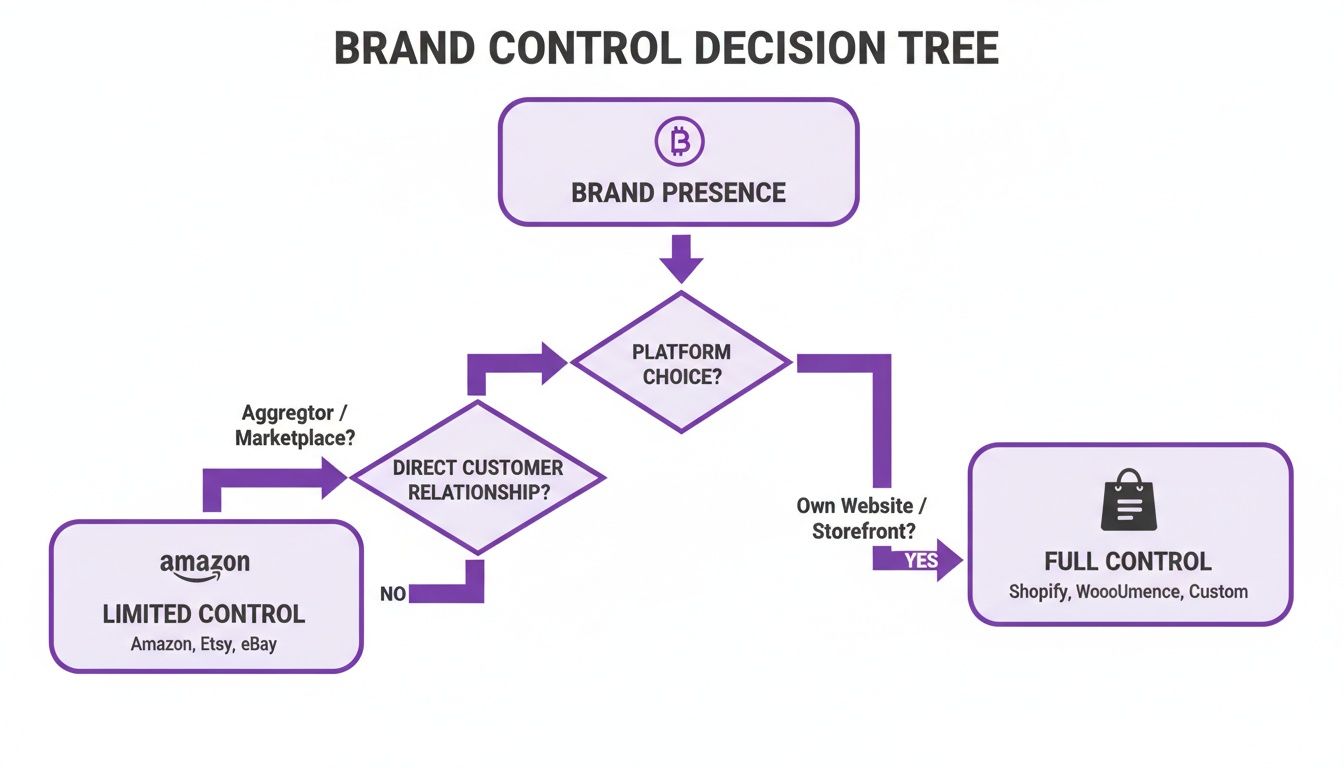
It perfectly illustrates the fundamental trade-off. Amazon gives you a pre-built house with lots of rules, while Shopify gives you the land and the tools to build your dream home from the ground up.
Your Verdict Based on Your Goals
Let's break it down to a simple choice. Your decision in the Shopify vs Amazon debate really comes down to what you're trying to accomplish.
Choose Amazon if: You're all about immediate sales volume. You want to test a product's potential without building a whole marketing engine, and you're okay with competing fiercely on price inside their ecosystem.
Choose Shopify if: Your primary focus is building a lasting, high-margin brand. You want total control over your customer experience and data, and you're ready to roll up your sleeves and drive your own traffic.
Of course, you don't always have to choose just one. For sellers wanting to tap into both channels, a solid guide on Shopify Amazon Integration can show you how to get the best of both worlds.
Ultimately, for serious merchants ready to scale, building your own Shopify store isn't just another option—it’s the essential next move to secure your brand's future and profitability. At Wand Websites, this is exactly what we do: help high-growth sellers make that jump, smoothly and successfully.
Your Top Questions Answered
When you're deciding between giants like Shopify and Amazon, a lot of questions pop up. It's a huge decision for your business. Let's tackle some of the most common ones we hear from sellers who are ready to scale.
Can I Sell on Both Shopify and Amazon at the Same Time?
Absolutely. In fact, for many growing brands, this isn't just possible—it's the smartest way to play the game.
Think of it this way: use Amazon's massive built-in audience to get new eyeballs on your products. It’s a powerful customer acquisition engine. Then, funnel those happy customers over to your Shopify store, where you control the experience, make more money on each sale, and can build a real, lasting relationship.
Shopify makes this easy with integrations that sync your inventory and let you manage your Amazon listings without leaving your dashboard. It's less about "either/or" and more about using Amazon as a sales channel to fuel the growth of your main brand hub on Shopify.
Is Shopify More Expensive to Start Than Amazon?
At first glance, setting up a beautiful, custom Shopify store might seem like a bigger upfront cost than just listing a product on Amazon. But that's a shortsighted view of what "cost" really means.
The real cost isn’t the one-time setup fee; it’s the slow, steady drain on your profits over time. Amazon's fee structure is designed to take a cut of every single thing you do, while Shopify is built to let you keep more of what you earn.
Amazon's fees—from referral percentages and FBA charges to the advertising you pretty much have to run—can easily eat up 15% to 40% of your revenue from every single sale. With Shopify, you have your predictable monthly plan and transaction fees, but the vast majority of your revenue is yours to keep. For a business that's scaling up, investing in your own platform pays for itself through healthier margins and customers who come back again and again.
Which Platform Is Better for SEO?
When it comes to building real, long-term brand equity with Google, Shopify is the clear winner. There's no contest.
On your own Shopify store, you have the keys to the kingdom for Search Engine Optimization (SEO).
- Custom URLs: You get to create clean, keyword-rich URLs that tell Google exactly what your pages are about.
- Content Marketing: You can build a blog, create guides, and publish content that attracts your ideal customers, establishing your authority and ranking for thousands of potential keywords.
- Site Structure: You control everything from the main navigation to how your pages link together, creating a seamless experience for both users and search engine crawlers.
Amazon, on the other hand, is a walled garden. Any "SEO" you do is focused entirely on ranking within Amazon's own search results (their A9 algorithm), not on the open web. If your goal is to build a reliable stream of organic traffic from Google—an asset you own—Shopify gives you all the tools you need to do it.
Ready to stop renting your customers and start building a brand you truly own? At Wand Websites, we specialize in helping successful sellers like you make the seamless and profitable transition to Shopify. Let’s build your e-commerce future together.
