
Guide to an SEO Technical Audit Service


Think of an SEO technical audit service as a comprehensive health check-up for your website, but from a search engine's point of view. It’s a deep dive into the nitty-gritty, behind-the-scenes structure that dictates whether Google can actually find, understand, and ultimately rank your site.
What Exactly Is an SEO Technical Audit Service?

Let's use an analogy. Imagine your website is a high-performance race car, engineered to win. Your fantastic content and products? That’s your star driver. But the engine, the wiring, the very chassis of the car—that's what determines if you even get off the starting line.
A technical SEO audit is like having a master mechanic pop the hood and meticulously inspect every single one of those critical components.
An SEO technical audit service is what provides that expert-level inspection. This isn't about the pretty design or the compelling words on the page. It's all about the hidden framework supporting everything else. The service is there to ensure your website's technical foundation is rock-solid, which is absolutely non-negotiable for getting seen online.
Without a strong technical base, even the most brilliant content can be invisible to search engines. It's like having the world's best driver stuck in a car with a sputtering engine—you just aren't going to win any races.
The Foundation for Digital Success
I always tell people to think of technical SEO as the absolute first step for any serious online marketing. It truly sets the stage for all your other strategies—from content creation to paid advertising—to actually work. Getting a handle on what a technical audit covers is a must for anyone working through a beginners guide to digital marketing.
A professional service brings a trained, experienced eye to spot problems you'd almost certainly miss on your own. These are the kinds of issues that can quietly sabotage your site's performance and cap your growth.
A technical audit gets you out of the guessing game. It delivers a data-driven roadmap that pinpoints the specific, often invisible, roadblocks that are holding your website back from its true ranking potential.
The whole process involves analyzing dozens of factors that shape how search engines see your website. A good service won't just dump a list of errors in your lap; they’ll help you prioritize what to fix first based on what will make the biggest difference to your traffic and bottom line.
What an Audit Looks For
So, what are these "mechanics" actually checking under the hood? An audit zeroes in on your site's core mechanics to make sure it's built for peak performance.
Here are a few of the big ones:
- Crawlability and Indexability: Can search engine bots easily discover and make sense of all your important pages? It’s simple: if they can't crawl you, they can't rank you.
- Site Architecture: Is your website put together in a logical way? A good structure makes it easy for both people and search bots to find their way around.
- Page Speed: How fast do your pages load? We all know how frustrating slow sites are, and Google penalizes them for it.
- Mobile-Friendliness: Does your site work flawlessly on phones and tablets? With over 60% of website traffic now coming from mobile, this is a must.
In the end, a technical audit service delivers one thing above all else: clarity. It cuts through the complex tech-speak and gives you a clear, actionable plan, showing you exactly what to fix to climb the search rankings and grow your business.
Why Your Website Needs a Technical Health Check

Think of it this way: pouring money into gorgeous design and killer content without checking your site's technical health is like building a stunning retail store with the front door bolted shut. It doesn't matter how amazing your products are if customers—and search engines—can't get inside. An SEO technical audit service is what gives you the keys to unlock that door.
Your website can have all sorts of hidden problems lurking in the code that actively sabotage your rankings. You can't see these issues just by looking at the homepage. They're like cracks in the foundation, quietly telling search engines not to trust or promote your content. That’s why a technical audit isn't just another expense; it's a vital investment in your online presence.
At the end of the day, a technically solid website is a non-negotiable for ranking well. It’s the baseline requirement that allows search engine crawlers to find, understand, and index your pages—the absolute first step to getting seen.
Connecting Technical Health to User Trust
Beyond just appeasing Google, your site's technical performance has a huge effect on the actual people clicking over to your page. A slow-loading site, a dead link, or a clunky mobile design doesn't just annoy someone; it sends them packing. These bad experiences are powerful signals to Google that your site just isn't delivering the goods.
Put yourself in your customer’s shoes for a second. If a page takes more than a couple of seconds to pop up, you're gone. If you can't tap the "buy" button on your phone, that sale is lost. Every little technical glitch creates friction, eroding trust and sending would-be customers right into the arms of your competition.
A great user experience is born from a technically sound foundation. When your site is fast, intuitive, and reliable, customers feel confident and are more likely to complete a purchase, sign up for your newsletter, or return in the future.
This direct line between technical SEO and user experience is precisely why a deep audit is so critical. It helps you find and fix all those friction points, creating a smooth, enjoyable journey for every single visitor.
From Rankings to Revenue
Let's be honest—every business investment needs to deliver a return, and a technical audit is no different. The link between your website's health and your bottom line is surprisingly direct. When you fix the deep-seated issues holding your site back, you start a positive ripple effect that flows straight to your revenue.
Businesses are catching on. The global market for SEO audit services was valued at $1.2 billion and is projected to hit $3.5 billion by 2033. This isn't just a fad; it shows a real shift in thinking. Companies now get that a proper technical deep-dive is essential for boosting rankings, improving the user experience, and making more money. You can read more about this trend in a detailed SEO audit service market report.
Here’s what a technically sound website really does for you:
- Earns Higher Rankings: By clearing out the technical roadblocks, you finally let Google reward your great content with the visibility it deserves.
- Attracts More Organic Traffic: Higher rankings mean more clicks from people who are actively searching for what you offer.
- Drives More Conversions: A fast, frustration-free experience means fewer abandoned carts and more visitors who follow through.
Bringing in a professional SEO technical audit service is about setting your website up for long-term growth. It turns your site from a potential problem into a powerful asset that consistently brings in and converts customers, pushing your business forward.
What's Actually Checked in a Technical SEO Audit?
So, what really goes on inside the “black box” of an SEO technical audit service? It’s not about some secret sauce or a flick of a magic wand. Think of it more like a thorough home inspection. A professional auditor methodically examines your website's foundation, plumbing, and wiring to make sure everything is solid, functional, and up to code.
This process shines a light on the technical guts of your website. It systematically breaks down every critical area to show you what’s working, what’s broken, and—most importantly—what's secretly holding you back from ranking higher. Let's walk through the main areas a comprehensive audit will always cover.
Can Google Even Find Your Pages? (Crawlability & Indexability)
This is the absolute first step. If search engines like Google can't find and read your content, nothing else you do for SEO will matter. It’s like having a beautiful store with no front door; customers simply can't get in.
An audit dives into a few key technical files and settings:
- Robots.txt File: This is a simple text file that gives search engines directions on what they can and can't look at on your site. One tiny mistake here can accidentally tell Google to ignore your most important pages, or even your entire website.
- XML Sitemap: This acts as a roadmap for search engines, listing all the important pages you want them to find. Without a clean, up-to-date sitemap, crawlers might miss key content.
- Site Architecture: A messy, disorganized site is like a maze for search engine crawlers. A logical structure helps them move through your content efficiently without getting lost or giving up.
A big part of this is making sure Google’s crawlers are spending their time on your most valuable pages. This is all about mastering crawl budget optimization to ensure your site's best content gets the attention it deserves.
How Fast Is Your Website, Really? (Page Speed & Core Web Vitals)
The speed of your website—or more accurately, how fast it feels to a real person—is a huge ranking factor. It's also one of the most common issues we find. A slow site frustrates visitors and sends them hitting the "back" button, which is a powerful signal to Google that your page isn't delivering a good experience.
A proper audit goes way beyond just saying "your site is slow." It measures against Google's Core Web Vitals, which are specific, user-centric metrics. These check how quickly your main content appears, how soon someone can actually click on something, and whether the layout jumps around annoyingly as it loads.
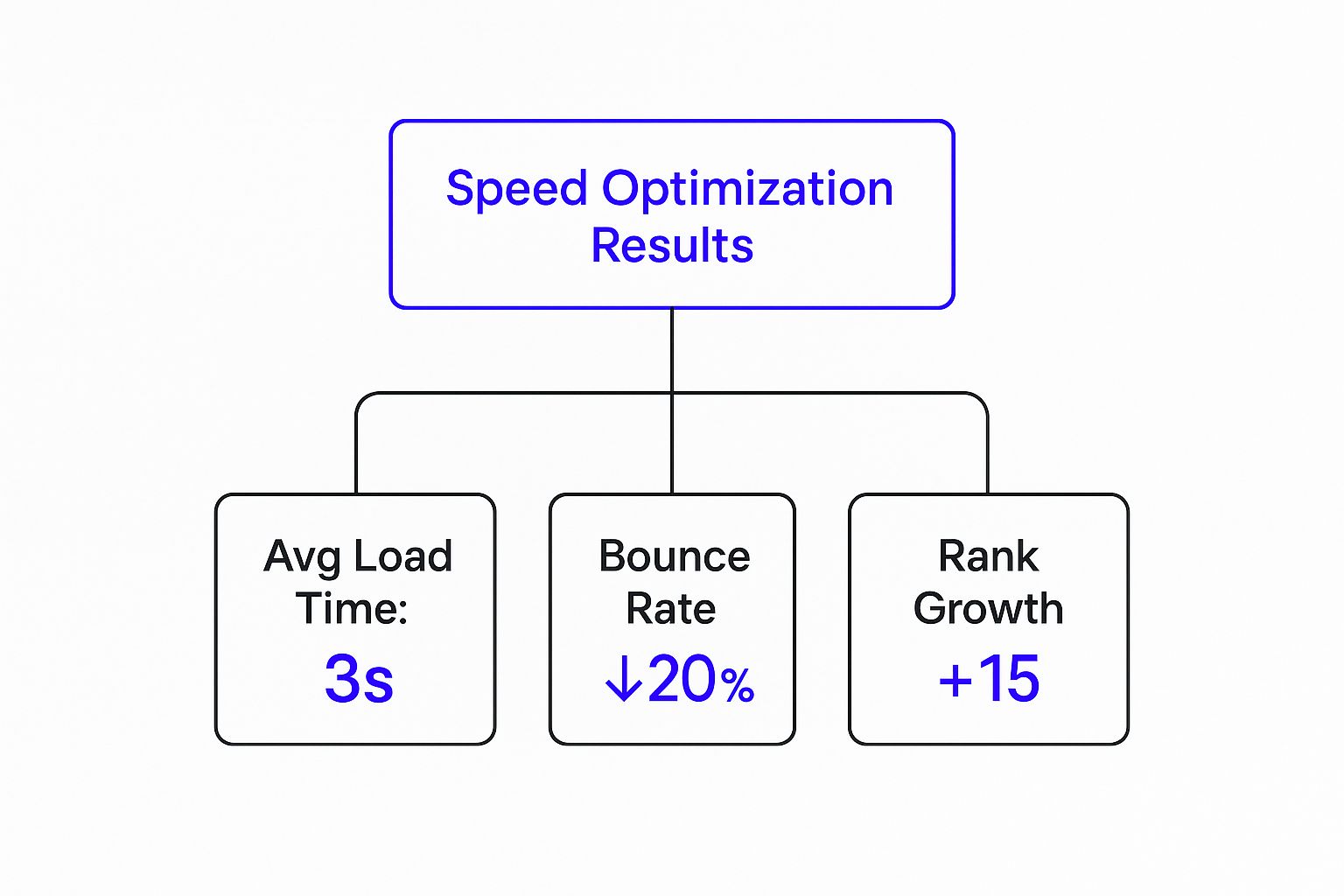
The data here is clear: even small improvements in loading time can slash bounce rates and give your search rankings a serious boost.
To give you a clearer picture, here’s a table of common issues we frequently uncover and why they're so damaging.
Common Technical SEO Issues and Their Impact
These problems are often invisible to the naked eye but can quietly sabotage all your other marketing efforts.
Does It Work on a Phone? (Mobile-Friendliness & Usability)
With well over half of all web traffic now coming from smartphones, your site has to be flawless on a small screen. This is about more than just making a smaller version of your desktop site. It means text is easy to read, buttons are big enough to tap, and navigating your site feels natural on a phone.
An audit will test your site on various screen sizes to find those frustrating little usability problems that cause mobile visitors to leave.
Is Your Site Secure and Trustworthy? (Security & Trust Signals)
Search engines want to send their users to safe, reliable websites. It’s that simple. An audit checks for the fundamental security signals that build trust with both people and search engine algorithms.
- HTTPS: Your site absolutely must use HTTPS encryption. That little "S" means all data passed between your site and a visitor is secure. It's non-negotiable today.
- No Malware: The audit includes a scan for any hidden malicious software or security holes that could harm your visitors and get your site blacklisted by Google.
Ultimately, an SEO technical audit service is about methodically clearing out all these technical roadblocks. It ensures your website is built on a strong, reliable foundation so that your amazing content and marketing efforts can finally pay off.
Decoding Your Technical Audit Report
https://www.youtube.com/embed/_yK38VG0KsY
So, the deep-dive analysis is done. Now what? Your chosen SEO technical audit service is about to hand over the results, and it's crucial to know what a genuinely useful report looks like. Spoiler alert: it’s not a giant spreadsheet full of cryptic error codes. A great audit delivers a strategic roadmap, not a data dump.
Think of it like getting the results from a full medical check-up. A bad report would be a confusing jumble of lab numbers with zero explanation. A good one, however, tells you what those numbers actually mean, highlights what’s most urgent, and gives you a clear, step-by-step treatment plan to get healthy.
The goal here is to empower you and your team, not overwhelm you. The report should turn complex technical jargon into a straightforward plan that connects every fix to your actual business goals.
The Anatomy of an Actionable Audit Report
A professional audit report is skillfully crafted for different people in your company. Your CEO or marketing director doesn't need a list of every single broken redirect, but they absolutely need to grasp the big-picture issues and opportunities. Your developer, on the other hand, needs the exact, granular details to implement fixes.
That's why a solid report is usually built around three core components:
- Executive Summary: This is the high-level overview for stakeholders. It sums up the most critical findings, describes the site's overall health, and points out the biggest opportunities for growth—all in plain English.
- Detailed Findings: Here’s the heart of the audit. This section documents each issue with specific examples, URLs, and screenshots. Crucially, it explains why something is a problem and how it's impacting your SEO and user experience.
- Prioritized Action Plan: This is arguably the most valuable part of the entire service. It’s where all that data gets turned into a clear set of instructions.
This structure ensures that everyone, from the C-suite to the dev team, gets exactly the information they need to move forward without confusion.
Your Strategic Fix-It List
That prioritized action plan is what separates a truly valuable SEO technical audit service from a simple data-dump. A random list of 200 "errors" is paralyzing and useless. A prioritized list that tells you exactly where to start? That's a game-changer.
An audit report shouldn't just tell you what's broken; it should tell you what to fix first to get the fastest and most significant results. It guides your resources toward tasks that will actually move the needle on traffic and sales.
This prioritization is typically based on two factors: how severe the problem is and how much effort it will take to fix. This helps your team focus its energy where it matters most, making sure you get the best possible return on your development time.
How Issues Are Categorized
To make the action plan even easier to digest, findings are typically sorted into clear categories. This lets your team tackle problems logically, putting out the biggest fires before moving on to the minor tune-ups.
Here’s a common way you’ll see issues organized:
By categorizing tasks this way, the report transforms from a daunting list into a manageable project plan. It gives your team the clarity to methodically improve your site's technical health, ensuring every action contributes directly to a stronger, more visible online presence. This is the real value a professional audit delivers.
How to Choose the Right Audit Partner

Picking a partner for your technical SEO audit is a huge decision, and honestly, it can make or break the whole effort. Not every SEO technical audit service is created equal. Some will give you a genuinely deep, strategic analysis, while others might just run an automated tool and hand you a generic report.
What you're really looking for is a true partner—someone who takes the time to understand your business, not just a vendor who can check a box. The right firm will act as your guide through the technical maze, translating complex issues into a clear, prioritized action plan your team can actually execute. They turn a scary list of errors into a roadmap for real growth.
Evaluating Their Experience and Process
Before you sign on the dotted line, you need to look past the slick sales pitch and see what they've actually done. The proof is in their past work and how transparent they are about their process.
Start by digging into their track record. Ask for case studies and testimonials, but get specific—look for clients in your industry or of a similar size. A 21% increase in clicks for a Fortune 500 company is great, but seeing how they helped a business like yours is what really matters. Real-world results are your best crystal ball.
Next, get them to walk you through their entire audit process. A trustworthy provider won't hesitate to pull back the curtain on their methodology.
Here are a few key things to ask about:
- Audit Tools: What software do they use? While tools like Screaming Frog or Ahrefs are essential, you should be wary of any service that relies on them exclusively. The magic is in the human analysis on top.
- Manual Review: How much of the audit is done by a real person? A seasoned expert can spot contextual issues and subtle problems that automated crawlers will always miss. This is non-negotiable.
- Communication: How do they plan to share their findings with you? You need a partner who can explain complicated problems in plain English, not someone who just drops a 100-page, jargon-filled PDF in your inbox.
Asking the Right Questions
The best way to gauge a potential partner’s skill is to ask smart questions that go beyond the basics. Their answers will tell you everything you need to know about their strategic thinking and whether they're truly invested in your success. Think of it as an interview to find the perfect "doctor" for your website's health.
A great audit partner isn’t just looking to find what’s broken. They're focused on understanding your business goals so they can align every recommendation with what truly matters to your bottom line.
Come to the conversation prepared with a list of questions that dig into their approach.
- "How do you prioritize your recommendations?" Their answer should be about a blend of impact, effort, and business goals—not just a generic "high, medium, low" scale.
- "What kind of support do you offer during the implementation phase?" Fixing technical SEO issues often requires developer time. A fantastic partner will offer to consult with your dev team to make sure the fixes are rolled out correctly.
- "How do you measure the success of an audit?" The goal isn't just fixing errors; it's improving performance. They should talk about tracking KPIs like organic traffic, keyword rankings, and conversions after the work is done.
Understanding Pricing and Value
Finally, let's talk money. Pricing for an SEO technical audit service can be all over the map, but it's usually a one-time project fee. The trick is to evaluate the price against the value you're getting, not just the number on the invoice. A cheap audit that gives you a useless report is way more expensive in the long run than a thorough one that drives real growth.
For agencies or businesses that need to scale their audit capabilities, exploring options like white label SEO audit services can also be a smart, cost-effective move.
This decision is more important than ever. The global SEO services market is projected to hit nearly $147 billion by 2025, and for good reason. Businesses are realizing that a solid technical foundation is critical for capturing their share of the organic traffic that makes up around 58% of all website visits. By vetting your options carefully, you're not just buying a report—you're investing in a healthier, more profitable website.
Of course! Here is the rewritten section with a more natural, human-expert tone.
Your Technical SEO Audit Questions, Answered
Alright, so you’ve got the basics down on what a technical SEO audit is all about. But let's be honest, this part of SEO can feel a little dense, and it’s totally normal to have some questions rattling around before you pull the trigger.
Getting clear, straightforward answers is key to feeling confident about your next move. So, let’s walk through some of the most common questions we hear from business owners just like you.
How Often Should I Really Get a Technical SEO Audit?
This is easily one of the most important questions, and the answer isn't one-size-fits-all.
For most businesses, a thorough, deep-dive audit once a year is a great rule of thumb. Think of it as an annual check-up for your website. It’s the perfect time to catch any sneaky issues that have popped up and make sure your digital foundation is still solid.
But sometimes, you need to be more proactive. You should definitely consider an audit every six months if your site is going through a lot of changes. This includes situations where you are:
- Planning a major website redesign or moving to a new platform (like from WooCommerce to Shopify).
- Migrating your entire site to a new domain name.
- Battling it out in a super-competitive industry where every little edge counts.
- Constantly adding new pages, features, or significantly changing your site's structure.
The yearly audit is your big-picture health screening. The semi-annual check is for when your website's under more stress, making sure nothing critical breaks when it matters most.
Can't I Just Use an Online Tool and Do This Myself?
It’s a tempting thought, right? There are tons of powerful SEO tools out there, and many of them are fantastic. They’re great at crawling your site and spitting out a list of potential problems, like broken links or missing image alt text. They tell you what might be wrong.
The problem is, they can't give you the two things that actually matter: context and prioritization.
This is where a professional SEO technical audit service makes all the difference. An expert doesn't just hand you a list of errors; they deliver the "why" and the "how."
An automated tool gives you a pile of data. A human expert gives you a strategic roadmap. A tool might find 50 broken links, but an expert will tell you which 10 are actually leaking revenue and how to fix them without wasting your developer's time.
A seasoned pro knows the difference between a minor hiccup and a critical, traffic-killing error. They connect the dots between a technical flaw and your bottom line. For instance, a tool flags a slow page. An expert sees that it’s your highest-converting product page and immediately bumps fixing it to the top of the list. That kind of strategic insight is something software just can't replicate.
What's a Professional SEO Technical Audit Service Going to Cost Me?
The price for a professional audit can swing pretty widely, anywhere from a few hundred to several thousand dollars. That’s not a vague answer—the cost is directly tied to the amount of work and expertise required.
Here’s a breakdown of what shapes the price tag:
- Website Size and Complexity: Auditing a simple five-page business site is a whole different ballgame than tackling a massive e-commerce store with thousands of products, faceted navigation, and international versions.
- Depth of the Audit: A quick, tool-based scan will be on the lower end. A truly comprehensive audit, where senior experts manually dig into your code, log files, and analytics, will naturally cost more.
- Provider’s Experience: An agency or consultant with a proven track record and years of experience is going to command a higher rate than a freelancer who is just starting out.
- Deliverables and Support: The final package also plays a huge role. Are you getting a simple spreadsheet of errors, or a detailed report with a prioritized action plan and follow-up calls to guide your development team?
When you’re looking at proposals, try to look past the price alone. The real value is in the scope of work and the deliverables. A cheap audit that leaves you with more questions than answers isn't a bargain; it's a wasted opportunity.
So, Will a Technical Audit Guarantee I Rank Number One?
No, it won't. And if any SEO provider ever makes that promise, you should run in the other direction. A technical audit is an absolutely crucial, foundational piece of any good SEO strategy, but it isn’t a magic wand.
Let’s think about it with a different analogy. A technical audit is like clearing a cluttered, blocked path to your front door. Before, potential customers couldn't even get to you. Now, the path is clear.
But you still need two more things to get them to come inside:
- A Great Invitation: This is your content strategy. You need compelling, helpful, and high-quality content that speaks directly to your audience.
- A Strong Reputation: These are your backlinks and off-page signals. This is what tells Google that other people trust and vouch for you.
Fixing technical issues removes the roadblocks that are holding your site back. It ensures that when you do create amazing content and earn great links, search engines can actually find, understand, and reward you for it. A technical audit doesn't guarantee you'll win the race, but it puts you on the starting line with a perfectly tuned engine. It sets the stage for everything else you do to finally work.
Ready to stop guessing and start growing? Wand Websites is your e-commerce growth partner, turning technical complexities into clear, actionable strategies that boost traffic and sales. If you're ready to build a high-performing Shopify store that converts, let's talk.
