
Your Winning SEO B2B Strategy for E-Commerce in 2026

A truly effective B2B SEO strategy isn't about chasing huge traffic numbers. It's about precision—attracting the right high-value clients and building the trust needed to navigate their long, thoughtful decision-making process. Done right, your website becomes a predictable engine for generating qualified leads.
Why Your B2B SEO Strategy Needs a Different Approach
Let’s be honest: most of the SEO advice out there is geared toward businesses selling to consumers (B2C). It’s like fishing with a giant net. But as a B2B e-commerce owner, you don’t need the giant net; you need a spear. Your goal isn't to catch every fish in the sea, but to land those specific, high-value clients who are a perfect fit for what you do.
Think about an expert artisan who's just moved from an Etsy shop to their own dedicated wholesale site on Shopify. They don't need millions of casual visitors. What they really need is a steady, reliable stream of serious buyers—the kind who recognize quality, appreciate craftsmanship, and are ready to place large, recurring orders.

That's the very heart of a modern B2B SEO strategy. It’s a fundamental shift in thinking, moving away from vanity metrics and toward creating a dependable system for bringing in high-quality business leads.
The B2B Mindset Shift
Unlike an impulsive B2C buy, a B2B purchase is a complex, considered decision that often involves multiple stakeholders, budget approvals, and a much longer sales cycle. Your SEO has to mirror this reality.
This means you need to focus on:
- Building Trust: Your content is your audition. Potential clients are vetting your expertise and credibility long before they ever think about your products.
- Solving Problems: Business customers aren't just browsing; they're actively searching for solutions to specific operational headaches. Your strategy must target these problem-focused searches.
- Nurturing Relationships: SEO is where the conversation starts. Your website's job is to guide prospects through their entire research journey, from initial awareness to the final decision.
A successful B2B SEO strategy turns your website into your most valuable salesperson—one that works 24/7 to educate, build trust, and qualify leads before they ever speak to your team.
Making this strategic pivot is more critical than ever. Recent marketing data reveals that 41% of marketers are actively overhauling their SEO strategies to keep up with new search behaviors. On top of that, 46% of B2B marketers are planning to increase their content marketing budgets, showing a clear industry trend toward quality and effectiveness over sheer volume. You can dive deeper into what these numbers mean for your business in this breakdown of B2B marketing statistics.
Finding Keywords That Signal Real Buying Intent
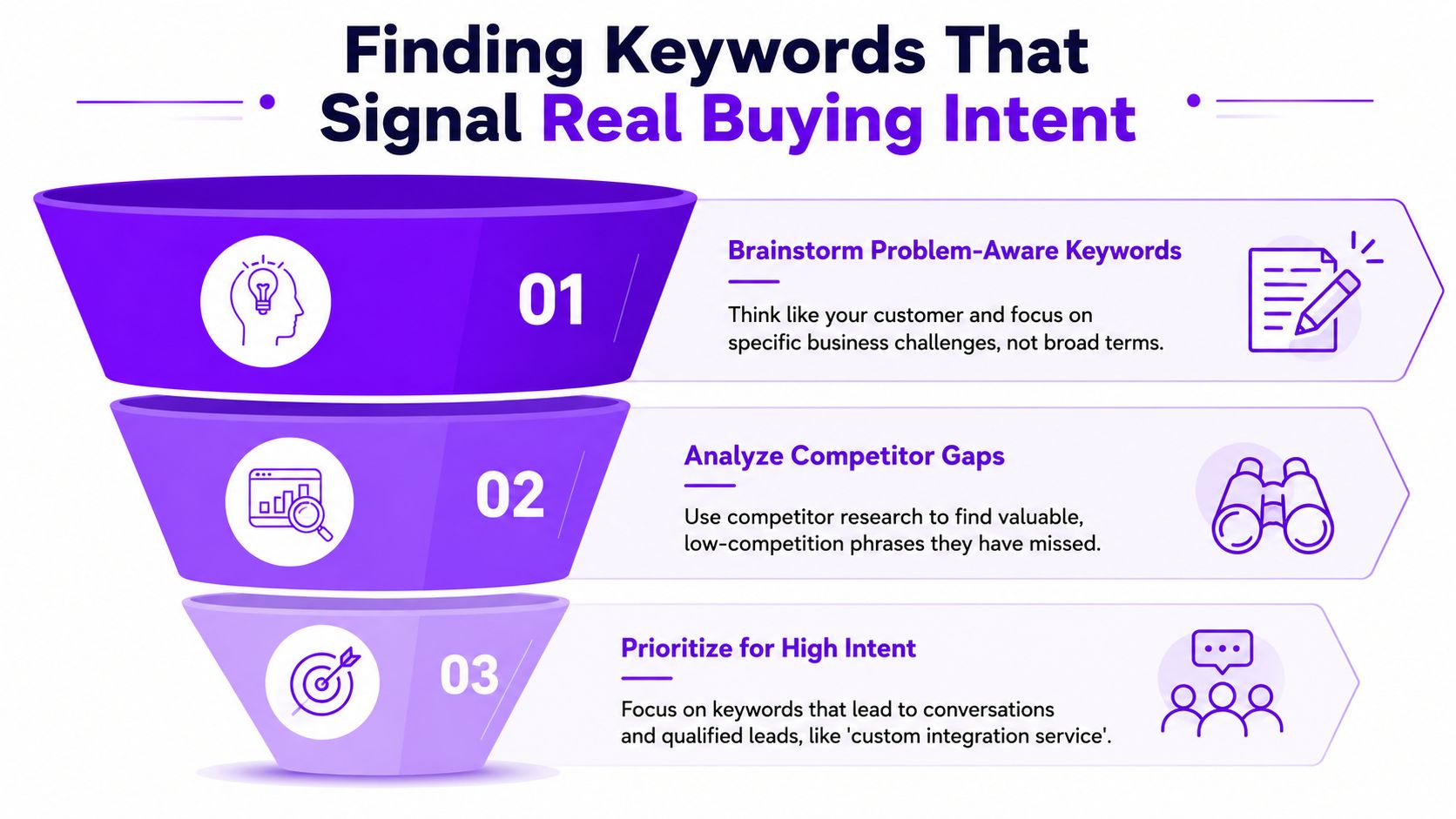
Let's get one thing straight about B2B SEO: you have to completely rethink what a "good" keyword is. We're not trying to attract everyone. Instead, our entire strategy is built around finding the exact phrases that tell us a potential client is serious about making a move. This is all about commercial intent, not just search volume.
Think about your ideal customer for a moment. They aren't idly Googling "what is e-commerce." They're a frustrated business owner whose current platform is holding them back. Their searches are sharp, specific, and laser-focused on a problem they need to solve now.
These are the kinds of keywords that practically shout, "I'm ready to hire someone!"
Focus on Problems and Solutions
The most powerful keywords in the B2B world are often longer phrases—long-tail keywords—that describe a specific business headache or a desired outcome. This means your keyword research needs to be less about spreadsheets and more about empathy.
Before you even open an SEO tool, start by brainstorming the real challenges your clients are up against. Put yourself in their shoes.
- Problem-Aware Keywords: Think about searches like "Shopify bulk pricing limitations," "how to migrate from Etsy to Shopify," or "custom e-commerce integration service."
- Solution-Seeking Keywords: These are phrases like "best Shopify agency for small business," "Wix vs Shopify for wholesale," or "e-commerce conversion rate optimization services."
Sure, these phrases have a much lower search volume than the big, broad terms. But the traffic they bring is pure gold. Every single click represents a potential client who isn't just browsing—they're actively shortlisting partners.
This is exactly why focusing on intent separates traffic that just visits from traffic that actually converts. In fact, data shows the average conversion rate for organic search is a solid 3.75%, which is more than double the 1.77% you get from display ads. To really dig into the numbers, you can see more stats on why B2B SEO is built around commercial intent and its direct impact on the bottom line.
The goal isn’t to get the most traffic; it's to get the right traffic. One qualified lead from a high-intent search for "custom Shopify Plus development" is more valuable than a thousand visitors from a search for "e-commerce tips."
The table below really highlights this distinction. Notice how the B2B keywords are tied to a specific business need or service, while the B2C-style keywords are much more general.
B2B vs. B2C Keyword Intent Examples
| Search Intent | Low-Intent Keyword (B2C/General) | High-Intent Keyword (B2B/Commercial) |
|---|---|---|
| Learning/DIY | "how to set up online store" | "Shopify Plus development agency" |
| Product Comparison | "Wix vs Shopify" | "Wix vs Shopify for wholesale business" |
| Problem Solving | "slow website speed" | "e-commerce conversion rate optimization services" |
| Finding a Tool | "bulk product editor" | "Shopify bulk pricing app limitations" |
As you can see, the high-intent keywords are used by people who understand the landscape and are looking for a professional solution, not a DIY guide.
Prioritize Keywords for Business Impact
Once you've brainstormed a solid list, it's time to prioritize. Don't just sort by search volume. Instead, ask yourself: "Which one of these phrases would be typed by a decision-maker with a budget who is ready to sign a contract?"
A search for "Shopify migration services" is infinitely more valuable than "how to start an online store."
This is how your SEO strategy becomes a direct pipeline for high-value conversations and qualified leads. Your website transforms from a digital brochure into your most effective client acquisition tool.
Alright, you've done the hard work of digging into keywords. You know what your ideal clients are searching for. Now comes the part where we turn those insights into actual leads and, eventually, new business. This is all about creating content that does the heavy lifting for you.
In the B2B world, it's a marathon, not a sprint. A single blog post isn't going to convince a company to sign a five-figure contract. Your content needs to be a patient, knowledgeable guide that walks potential clients through their entire decision-making process.
Let's put ourselves in the shoes of an e-commerce store owner. Their journey probably starts with a nagging thought, not a search for your specific service. Maybe it’s, “My current platform just can’t keep up with our orders.” This is the Awareness Stage. They’re not looking for an agency yet; they're just trying to put a name to their problem.
This is where your content strategy needs to meet them, starting broad and then getting progressively more focused on capturing high-intent prospects who are ready to talk business.
Matching Your Content to Their Buying Journey
As our store owner digs deeper, they enter the Consideration Stage. Their questions get more specific: “What are the best platforms for scaling an online business?” They're now actively comparing their options and looking for proof.
Finally, they land in the Decision Stage. The thought process shifts to, “This agency seems to really understand my challenges. Are they the right partner to get us to the next level?” This is where they’re sizing you up against your direct competitors and looking for a reason to trust you.
Your mission is to build a content library that anticipates and answers the questions at each of these stages, making it a no-brainer for them to move to the next step with you.
The B2B buying journey is long and complex because it's a team sport. It’s not about forcing one person down a funnel; it's about equipping an entire committee with the information they need to choose you with confidence.
And it really is a team sport. Research from Coalition Technologies found that B2B deals can involve an average of 62+ touchpoints and around seven different people before a decision is made. That’s why your content has to do more than just rank—it has to build unshakable trust across an entire buying committee.
A Content Blueprint for Each Stage
So, what does this look like in practice? It means mapping specific types of content to each stage of your funnel. Here’s a straightforward blueprint to get you started.
Top of Funnel (Awareness): This is all about education, not selling. Think helpful blog posts that address your audience’s earliest questions. A great example might be an article like, “5 Signs You’ve Outgrown Your Etsy Shop.” It builds awareness and positions you as a helpful expert from day one.
Middle of Funnel (Consideration): Now it's time to go deeper and prove your expertise. This is the perfect place for in-depth comparison guides, technical webinars, or detailed case studies that show exactly how you solve problems. You're giving them the proof they need to justify their decision internally.
Bottom of Funnel (Decision): At this point, they're close to reaching out. Make it easy for them. Your goal is to remove any and all friction. This means having crystal-clear service pages, transparent pricing (or a clear explanation of how it works), glowing client testimonials, and an obvious, easy way to book a call or request a demo.
Building a Trustworthy Site with Technical SEO
Let’s be honest: when you hear "technical SEO," it’s easy to tune out, thinking it’s a job for your web developer. But in reality, it’s all about the first impression you make. For a busy decision-maker vetting your company, a slow, buggy, or confusing website isn't just an annoyance—it's a deal-breaker. A bad user experience can send them clicking away to a competitor in seconds.
Think of your website as your digital storefront. Are the lights on? Is the door easy to open? Can customers find what they’re looking for without having to wander aimlessly down confusing aisles? Just as you’d want your physical shop to be welcoming and efficient, your website has to be perfectly set up for visitors.

This is exactly where technical SEO fits into your B2B strategy. It’s the behind-the-scenes work that ensures both potential clients and search engines can easily find, understand, and use your site. A technically sound website quietly communicates professionalism and reliability.
Core Technical Elements That Build Trust
The good news is you don't need to become a coding whiz to see a huge improvement. By focusing on a few high-impact areas, you can dramatically improve how potential clients see your business online. These are quick wins that directly boost user experience and, in turn, your search rankings.
Here are the big three to focus on:
- Page Speed: In the B2B world, time is quite literally money. A site that takes forever to load is frustrating and often gets abandoned before your prospect even sees what you have to offer.
- Mobile-Friendliness: Decision-makers are always on the move. Your website has to work flawlessly on a smartphone, whether they’re at their desk or checking their phone between meetings. The experience must be seamless.
- Logical Navigation: Your site’s layout should be so intuitive that it feels effortless. A prospective client needs to find your services, case studies, and contact info without having to think about it.
Your B2B website's technical health is a direct reflection of your business's attention to detail. A smooth, fast, and secure site tells a potential client that you are professional, reliable, and worthy of their investment.
Making Your Content Easy to Understand
Beyond site performance, technical SEO also helps structure your content so that people and search engines can make sense of it. This just means using some basic on-page elements correctly to add clarity and context to every page.
Simple tweaks here make a world of difference:
- Clear Page Titles: This is the first thing anyone sees in the search results. Make it compelling and ensure it accurately reflects what's on the page.
- Descriptive Meta Descriptions: Think of this as the short sales pitch under your page title in Google. Use it to explain what the user will find and give them a reason to click.
- Logical Header Tags (H1, H2, H3): Headers break up your text and create a clear outline for the page. This makes your content easy to scan and digest, which everyone appreciates.
Nailing these foundational elements ensures your digital "storefront" is polished, professional, and ready to welcome your next big client.
Earning Authority with Strategic Link Building
Think of link building as your business's digital reputation. When another respected website links to your content, it’s not just sending a few visitors your way—it’s publicly vouching for you. In Google's eyes, these links are powerful endorsements that signal your site is a trustworthy authority on a given topic.
This is a huge piece of the puzzle for any serious B2B SEO strategy. But let’s be clear: this isn’t about the old-school, spammy tactics of buying links or trading them with irrelevant websites. Modern link building is all about earning your place as a true expert by building real relationships.
Focus on Value and Relationships
The secret to earning high-quality links is to stop asking for them and start deserving them. When you consistently share valuable expertise, other sites will naturally want to reference your work. This relationship-first approach does more than just build search authority; it puts your brand directly in front of new, perfectly matched audiences.
For an e-commerce business, this might look like:
- Contributing Expert Insights: Share your unique data or perspective on supply chain trends or customer retention with e-commerce publications.
- Appearing on Podcasts: Jump on a podcast for entrepreneurs or online business owners. It's a fantastic way to share your story and expertise, and you’ll almost always get a valuable link in the show notes.
- Getting Featured in Roundups: Lend your voice to articles that gather expert opinions, like "Top E-commerce Tools for 2026" or "Expert Tips for Scaling an Online Store."
Think of each link as a bridge built on trust. You're not just trying to get a click; you're building a reputation that precedes you, demonstrating your expertise long before a potential client ever lands on your website.
Practical Link-Earning Tactics
Getting started doesn't have to be complicated. The game is all about being proactive and generous with what you know. Publishing original research is an absolute goldmine here—when you have statistics or findings no one else has, your content becomes irresistible to journalists and bloggers.
Here are a few actionable steps you can take:
- Publish Original Research: Survey your customers or analyze industry data. A blog post titled "We Analyzed 1,000 Shopify Stores and Found This Common Mistake" is practically guaranteed to attract links.
- Offer "Digital PR": Keep an eye out for journalists on social media asking for sources (look for the #journorequest hashtag) and jump in with your expert opinion.
- Collaborate with Partners: Team up with a complementary, non-competing business. You could co-host a webinar or create a shared guide that benefits both of your audiences.
By focusing on these relationship-driven tactics, you build a competitive moat of authority around your brand—one that's incredibly difficult for your competitors to copy.
Measuring What Matters for Sustainable Growth
So, how can you be sure all your hard work in B2B SEO is actually moving the needle? It’s easy to get caught up in daily traffic spikes or climbing a few spots in keyword rankings, but those are often just vanity metrics. It's time to look past them and connect your SEO efforts directly to your bottom line.
The truth is, the industry is already shifting its focus. A recent study found that 39% of B2B marketers now point to sales as their number-one measure of success, with only 30% still prioritizing raw web traffic. The message is clear: It’s all about results that impact the business.
Tracking Business-Critical KPIs
Instead of drowning in a sea of analytics, you need to zero in on the handful of Key Performance Indicators (KPIs) that tell the true story of your organic growth. For any B2B e-commerce business, knowing which numbers to watch is fundamental for long-term success. If you're on Shopify, you can learn to boost Shopify conversions with KPIs by focusing on what actually drives revenue.
To get started, I recommend tracking these core metrics above all else:
- Qualified Leads from Organic Search: How many real, potential clients are filling out your contact forms or booking a meeting after finding you through a search?
- Conversion Rate on Core Service Pages: Are your most valuable "money pages" actually persuading visitors to take the next step?
- Content-Driven Demo Requests: Which blog posts, white papers, or case studies are most effective at getting prospects to ask for a demo?
Measuring success in B2B SEO means tracking how many qualified conversations you’re starting, not just how many people visit your website. Each demo request from a high-intent search is a win.
Adopting this focused mindset helps you definitively prove the ROI of your SEO strategy and make smarter decisions about where to invest your time and budget. You’ll quickly discover which content is filling your sales pipeline and which is just attracting window shoppers. That clarity is what allows you to double down on what’s working and build a predictable engine for long-term growth.
Common Questions About B2B SEO for E-Commerce
Stepping into the world of a B2B SEO strategy always brings up a few key questions. It’s completely normal! Let’s walk through some of the most common ones I hear from e-commerce owners so you can get started with a clear head.
How Long Does B2B SEO Take to Show Results?
This is usually the first question everyone asks, and the honest answer is that it’s a marathon, not a sprint. Think of it this way: paid ads are like renting an audience, but SEO is like building your own stadium. You're creating a long-term asset that brings people to you organically.
Realistically, you’ll start to see early signs of life—like climbing up the rankings for more specific, long-tail keywords—within 3 to 6 months. But for the results that really matter, like a noticeable uptick in qualified leads and a real impact on your revenue, you should plan for a timeline closer to 6 to 12 months. The B2B buying journey is long and complex, and your SEO needs to be there to guide prospects at every single step.
Don't let the timeline discourage you. B2B SEO isn't about chasing quick, flashy wins. It's about building a reliable, predictable engine that generates high-value leads for years.
Can I Do B2B SEO Myself?
Yes, you can absolutely make a significant dent on your own! If you’re just starting out, focusing on the fundamentals is the best way to build momentum.
Here are a few high-impact areas where you can start today:
- Keyword Research: Begin by thinking like your customer. What problems are they trying to solve? Jot down the phrases and questions they might be typing into Google.
- On-Page SEO: Go through your most important product or service pages and make sure your page titles, meta descriptions, and headers are clear, descriptive, and include your target keywords.
- Content Creation: Start writing. A helpful blog post that solves a common problem or a detailed case study can go a long way in building trust and attracting the right audience.
As your business grows, though, you might find yourself short on time. That's the perfect point to consider partnering with an expert. An agency or consultant can take on the heavy lifting—like technical SEO, scaling content, and building authoritative links—so you can stay focused on what you do best: running your business.
How Much Should I Budget for B2B SEO?
The budget can really run the gamut, depending on your goals, how competitive your industry is, and whether you’re doing it yourself or hiring help. But one thing is clear: it’s a top priority for most. As of 2026, many B2B marketers are continuing to increase their SEO budgets because they know it works.
Instead of thinking of SEO as a cost, reframe it as an investment in client acquisition. Take a moment to calculate the lifetime value of a new business client. If one new client is worth tens of thousands of dollars to your business, doesn't it make sense to invest a fraction of that each month to attract them consistently? That’s the real power of SEO—building a system that pays for itself over and over again.
At Wand Websites, we don't just build websites; we build growth engines. We specialize in creating high-performance e-commerce platforms designed from day one to attract and convert valuable business clients.
If you’re ready to see how a smart B2B SEO strategy can transform your business, let’s talk. Explore our services at https://www.wandwebsites.com.
