
Boost Sales with Professional Ecommerce Website Design

Feeling a little boxed in on Etsy? It’s a fantastic platform to get your start, but if you’re serious about growth, at some point you’ll hit a ceiling. That’s when you need to stop paying someone else's fees and playing by their rules.
A professional ecommerce website design isn't just about making things look prettier. It’s the single most important step you can take to build a real, independent brand, own your customer relationships, and keep more of your hard-earned money.
Why Professional Ecommerce Design Is Your Next Growth Move
Think of your Etsy shop as a booth at a huge, crowded craft fair. You get some built-in foot traffic, which is great. But you’re also shoulder-to-shoulder with competitors, you have to follow the market's rules, and you’re handing over a slice of every single sale for the spot.
Graduating to your own professionally designed website is like leaving that booth behind to open your own beautiful flagship store right on Main Street.
Suddenly, you're the one in charge. You decide the layout, you set the mood, and you get to greet every person who walks through your digital door. This isn't just a cosmetic upgrade; it’s about building a powerful, independent sales engine that works for you.
Owning Your Brand and Your Future
Let's be honest—on a marketplace, your brand gets a bit lost in the crowd. Shoppers see themselves as "Etsy customers" first and your customer second. A professional site completely flips that around.
Build a Real Brand: Your website becomes the official home for your business. Every color, font, and photo tells your story, creating a memorable experience that builds trust and makes people want to come back.
Control the Entire Experience: You guide visitors from the second they arrive to the moment they check out. No more competitor ads or "You might also like..." suggestions luring them away. The focus is 100% on your products.
Forge Direct Customer Relationships: You can finally collect customer emails, see what they love, and reach out with special offers. This direct line of communication is pure gold, and it's something marketplaces just don't allow.
A professional website isn't an expense; it's an asset. It transforms your business from a temporary stall in someone else's market into a permanent, valuable brand that you own completely.
To truly see how this ownership impacts your wallet, you should dive into the best ecommerce website design strategies that are proven to boost sales.
The Power of Professionalism and Trust
People make judgments in a split second. A website that looks clunky, generic, or thrown together signals a hobby, not a serious business. This hesitation can be the difference between a sale and a lost customer.
A polished, professional design, on the other hand, instantly builds credibility. It tells shoppers you're the real deal. They feel more confident and secure entering their credit card details on a site that looks trustworthy, runs smoothly, and shows you’ve invested in your business.
The difference between renting space on a marketplace and owning your digital storefront is massive. This table breaks down what that really means for your business.
Etsy Marketplace Vs. Your Own Professional Website
| Feature | Etsy Marketplace | Your Professional Website |
|---|---|---|
| Brand Identity | Limited; your brand is secondary to Etsy's brand. | Total Control. Your logo, colors, and story are front and center. |
| Customer Data | Restricted; you don't own the customer list or data. | Full Ownership. You build your email list and gain valuable insights. |
| Fees | Listing fees, transaction fees, and payment processing fees. | No transaction fees. Just your platform and payment processor costs. |
| Competition | Direct competitors are displayed right next to your listings. | Zero direct competition on your site. The focus is on your products. |
| Customization | Very limited; you fit into a pre-made template. | Endless Possibilities. Design a unique experience that wows customers. |
| Rules & Policies | You must follow Etsy's ever-changing rules or risk suspension. | You make the rules. Complete freedom and security. |
As you can see, owning your site gives you the freedom to build your business on your own terms. It’s about taking back control and investing in your long-term success.
The Anatomy Of A High-Converting Ecommerce Website
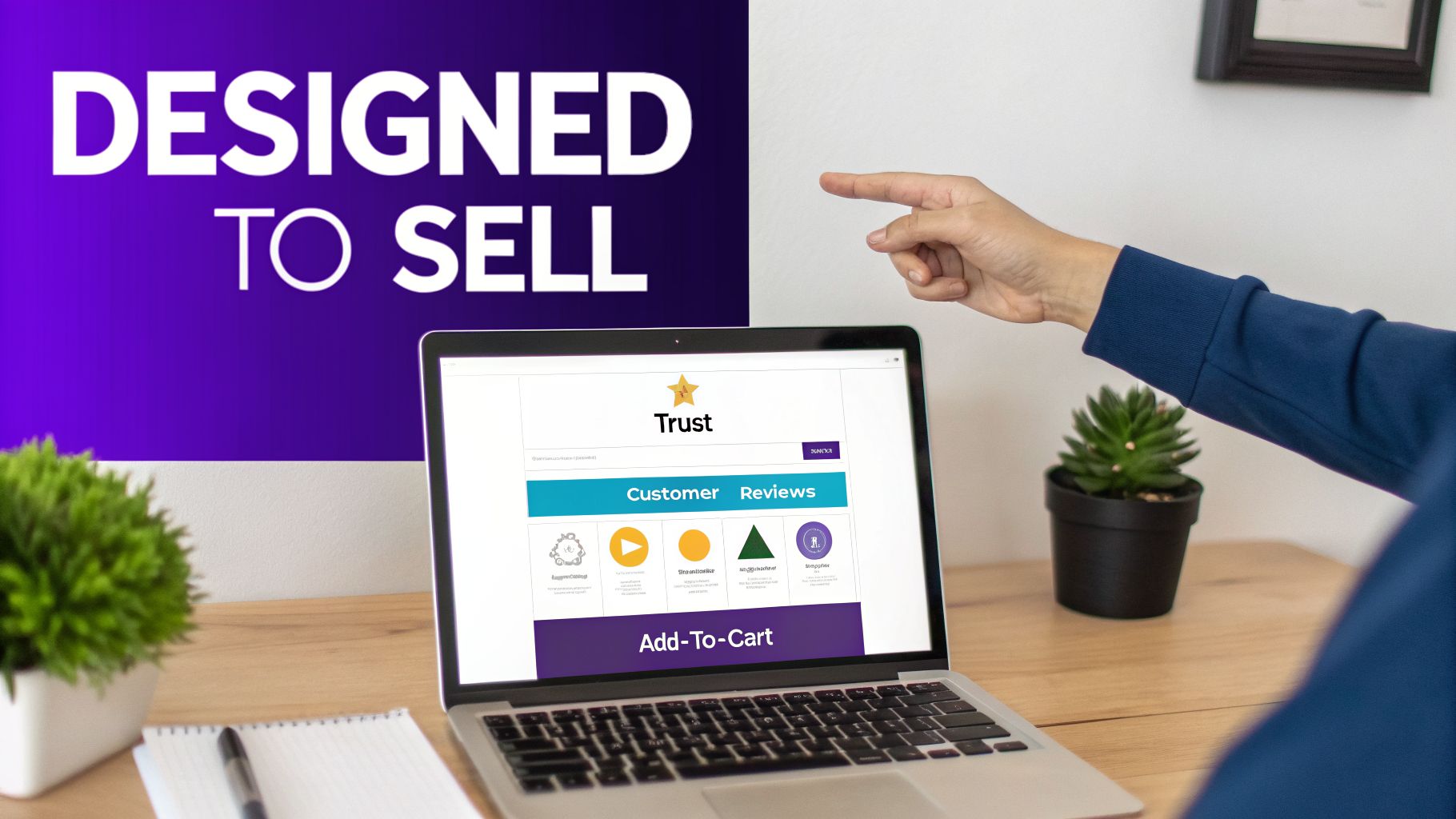
So, what’s the real difference between an online store that just sits there and one that actually turns visitors into happy, paying customers? It’s not some magic trick. It's a thoughtful mix of specific ingredients, all working together to make shopping feel easy, safe, and even a little bit fun.
This is what professional ecommerce website design is all about. It’s less about chasing flashy design trends and more about building a digital storefront where every single element has a job to do—guiding shoppers smoothly from browsing to buying.
Think of your website as your best and hardest-working salesperson. It has to be convincing, genuinely helpful, and incredibly good at its job, 24/7.
The Foundation: User Experience and Intuitive Navigation
A shopper should never have to wonder, "Where do I go now?" The second confusion or frustration creeps in, they're gone—often for good. A seamless user experience (UX) is the invisible hand that makes navigating your store feel completely natural.
This is a big one, especially if you're moving over from Etsy. Your customers are used to a specific shopping flow, so your own website needs to feel just as intuitive, if not more so. Finding a product, checking the details, and adding it to the cart should be second nature.
For example, a clear menu with categories like "Wall Art," "Handmade Mugs," and "Seasonal" works wonders compared to a vague "Shop" button. Every click needs to bring a customer closer to what they want, not send them on a wild goose chase. You want to close the gap between "Ooh, I love that!" and "It's mine!"
Building Trust with Visuals and Social Proof
You know your products are great, but a polished website proves to shoppers that your brand is great, too. This is where your branding and high-quality visuals do the heavy lifting. Professional photos and a consistent visual style aren't just nice-to-haves; they’re huge signals of trust and quality.
Investing in a great user experience isn't just fluff—it can boost conversion rates by up to 400%. When you consider that a clunky design will make 38% of visitors leave immediately, the impact is massive. In a sea of nearly 1.4 billion websites, a design built for trust and clarity is how you win. You can discover more web design insights on hostinger.com.
Beyond pretty pictures, real trust comes from being upfront and transparent. Making key information easy to find isn't optional for a site that truly converts.
- Honest Customer Reviews: Showcasing real feedback (yes, even the 4-star ones!) proves you're authentic and helps new customers buy with confidence.
- Clear Shipping & Return Policies: Don't make people dig for this. A link in your site’s footer instantly answers one of the biggest questions shoppers have.
- Secure Payment Badges: Seeing familiar logos from providers like Shopify Payments, PayPal, and major credit cards gives customers immediate peace of mind that their details are safe.
The Final Step: A Flawless Checkout
Everything you've done leads to this moment. The checkout is notoriously where sales go to die, which is why a professionally designed site is obsessed with making it as quick and painless as possible.
A checkout process that keeps customers moving forward includes:
- Fewer Form Fields: Only ask for the absolute essentials. Do you really need a phone number right now? Probably not.
- A Guest Checkout Option: Forcing someone to create an account is one of the biggest reasons for abandoned carts. Let people buy quickly as a guest.
- Multiple Ways to Pay: Give them options. Express checkouts like Shop Pay or PayPal are fantastic, but always include the standard credit card form, too.
- A Clear Progress Bar: Show shoppers exactly where they are in the process (e.g., Shipping -> Payment -> Complete). It reduces anxiety and keeps them on track.
When you break down your site and fine-tune each of these areas, you stop just having a website and start owning a true sales engine. Each piece works with the others to build confidence, remove doubt, and make it easy for a visitor to become a customer.
Winning The Mobile Shopping Game In 2026
Let's be honest, how do you shop online these days? You’re probably scrolling through your phone on the couch, waiting in line for coffee, or during your commute. It’s a quick, often distracted, moment. If your online store isn’t perfectly designed for that exact experience, you're not just losing a sale here and there—you're turning away the modern customer.
For a professional ecommerce website design, thinking "mobile-first" is no longer a cool feature; it's the only way to play the game. This isn’t about taking your big, beautiful desktop site and cramming it onto a tiny screen. It’s about starting with the phone from day one, designing a shopping journey for someone who is on the go and expects things to just work.
What Does Mobile-First Actually Mean?
Building for mobile first means you design for the smallest screen and then expand from there. This approach forces you to be ruthless with your priorities. You have to cut the fluff and focus only on what truly matters to get a customer from "ooh, I like that" to "order confirmed."
It all comes down to designing for the thumb. Can your customers easily tap the "Add to Cart" button with one hand? Is your menu so simple they don't have to pinch and zoom just to see the categories? These aren't fussy details; they're the make-or-break moments that decide whether a mobile browser becomes a buyer.
It’s not just a hunch—it's where the money is. By 2025, mobile commerce is expected to make up 59% of all online retail sales. And it's already happening: mobile devices now drive 78% of all retail website traffic, with three out of every four shoppers making purchases on their phones. An online store that isn't mobile-friendly is simply leaving money on the table.
Responsive Design And The Need For Speed
A huge piece of this puzzle is something called responsive design. This is the clever coding that lets your site automatically resize and rearrange itself to look great on any device—a small phone, a tablet, or a massive desktop screen. A professional build ensures this transition is absolutely seamless for every single visitor.
But a site that looks good is only half the battle. It also has to be lightning-fast. Mobile shoppers have zero patience. A delay of just a couple of seconds while your page loads is more than enough to send them clicking away, likely straight to a competitor.
Here’s what keeps a mobile site zippy:
- Optimized Images: Huge, high-resolution photos are the number one killer of page speed. Images need to be properly compressed for mobile screens so they load instantly without looking blurry.
- Minimalist Code: Professional developers avoid bloated code and clunky scripts that slow everything down, especially on a mobile connection.
- Fast Hosting: Your website’s server matters. Good hosting ensures your site can handle a sudden rush of visitors and deliver content quickly every time.
A Checkout Designed For People On The Move
Nowhere is the mobile-first mindset more crucial than at the checkout. If a customer has to fill out a dozen fields on a tiny screen or navigate a confusing, multi-page form, you can kiss that sale goodbye. Checkout abandonment is a real dream-killer for e-commerce brands.
Your mobile checkout process should feel almost effortless, something a customer can complete in under a minute. Think fewer form fields, big and easy-to-tap buttons, and one-click payment options like Apple Pay, Google Pay, and Shop Pay. These tools remove almost all the friction, letting shoppers buy with a fingerprint or a glance.
If you’re looking to nail down the specifics, check out these Top Tips For Effective Web Design For Ecommerce Websites to help guide your process.
Choosing Your Platform And Tech Stack
Deciding to move your business off a marketplace is a huge milestone. It’s you planting a flag and saying, "I'm ready to build this on my own terms." Before you can do that, though, you need to decide where your new online store will actually live. This choice of platform and the tools you plug into it—your "tech stack"—is the single most important decision you'll make at this stage.
Let’s be honest, the options out there can feel like a dizzying alphabet soup of tech jargon. You've got open-source systems that demand a developer on speed dial, and a dozen other all-in-one solutions. But for most creators and brands graduating from a place like Etsy, the best path forward is actually pretty clear. You just need a home base that’s powerful enough to grow with you but doesn’t get in your way.
Why Shopify Is The Go-To Choice
When it comes to building a serious brand, Shopify has become the platform of choice for a reason. It nails the perfect balance between being incredibly powerful and surprisingly easy to use. Think of your Etsy shop as a stall at a fantastic, but crowded, public market. Shopify is like getting the keys to your own beautiful, high-street boutique—you control the layout, the music, and the entire customer experience.
Everything about Shopify is designed to do one thing: help you sell. But its secret weapon is the massive app ecosystem. If you can dream up a feature—from personalized product quizzes to a customer loyalty program—there's almost certainly an app for that. This makes adding advanced capabilities to your professional ecommerce website design incredibly straightforward, no coding required.
Sure, there are other players like BigCommerce or open-source options like WooCommerce, but they often come with a much steeper learning curve or demand more technical babysitting. For sellers who want to stay focused on creating amazing products and marketing them, Shopify's all-in-one approach is the fastest and most reliable path to building a profitable business.
By the end of 2025, Shopify is projected to host over 5.5 million live websites. That’s not just a vanity metric; it’s proof that this platform scales from a one-person startup all the way to a global enterprise. You won’t outgrow it.
Strategic Power-Ups For Your New Store
Once your platform is sorted, the real fun begins. Now you get to add all the features you’ve been dreaming of—the kind of stuff that's simply impossible on a marketplace.
These aren’t just shiny objects; they are proven, strategic tools designed to get customers spending more and coming back again and again.
Product Bundling: Instead of just selling one handmade candle, why not offer a "Relaxation Kit" that bundles that candle with bath salts and a room spray at a slight discount? This is a classic move to boost your Average Order Value (AOV) by making it a no-brainer for customers to buy more at once.
Subscription Services: If you sell anything consumable—coffee, skincare, pet treats, you name it—subscriptions are a total game-changer. They create predictable, recurring revenue and turn a one-time buyer into a long-term fan, massively increasing your Customer Lifetime Value (CLV).
Affiliate and Referral Programs: It’s time to put your happiest customers to work for you. By giving your fans a unique link to share, you can reward them with a small commission or store credit for every new customer they bring in. This is word-of-mouth marketing on steroids.
These are the kinds of features that turn a simple online store into a true e-commerce engine. By building them into your new Shopify site, you’re moving beyond just selling items and starting to build a smarter, more resilient business designed for growth.
Your Stress-Free Store Migration Checklist
Let’s be honest: the thought of moving your entire shop from a familiar place like Etsy to your own website can feel like a massive undertaking. It’s a lot like packing up your home; you know the new place will be amazing, but the process itself looks exhausting. The good news? With a clear, step-by-step plan, this transition can be a smooth and genuinely exciting new chapter for your brand.
This checklist breaks the whole migration process down into simple, manageable phases. We'll show you exactly what you can get ready on your own and where an expert partner steps in to handle the heavy lifting, making sure nothing gets lost in the move.
Phase 1: Pre-Launch Groundwork
This first phase is all about gathering your essentials. Think of it as carefully packing all the boxes from your old shop so they’re ready to be unpacked in your new, custom-built space. Getting this right from the start is the key to a smooth build and a fantastic launch day.
What you can prepare:
- Export All Product Data: This is your entire inventory. You'll want to pull all your product titles, descriptions, prices, high-resolution photos, and any variations (like size or color options) into a simple spreadsheet.
- Download Your Customer List: This is your most valuable asset, hands down. Export the names and email addresses of every person who has ever bought from you on Etsy. This list is absolute gold for your launch announcement.
- Collect Your Brand Assets: Round up your logo files, specific brand color codes (hex codes are great!), fonts, and any lifestyle photos you've used. Having these all in one folder will make the design process so much faster.
Where a professional partner helps:
A design partner will take all this raw data and start structuring it for your new platform, making sure it all imports cleanly. They’ll also use your brand assets as the building blocks for a unique store design that truly captures the heart of your business.
Phase 2: Design and Development
With all your assets packed and ready, the actual build begins. This is where your vision for a professional ecommerce website design finally starts to take shape. While your partner handles the technical wizardry, your feedback and vision are what guide the entire process.
This is the point where you’ll make some key decisions about your platform and the features that will power your store's future.
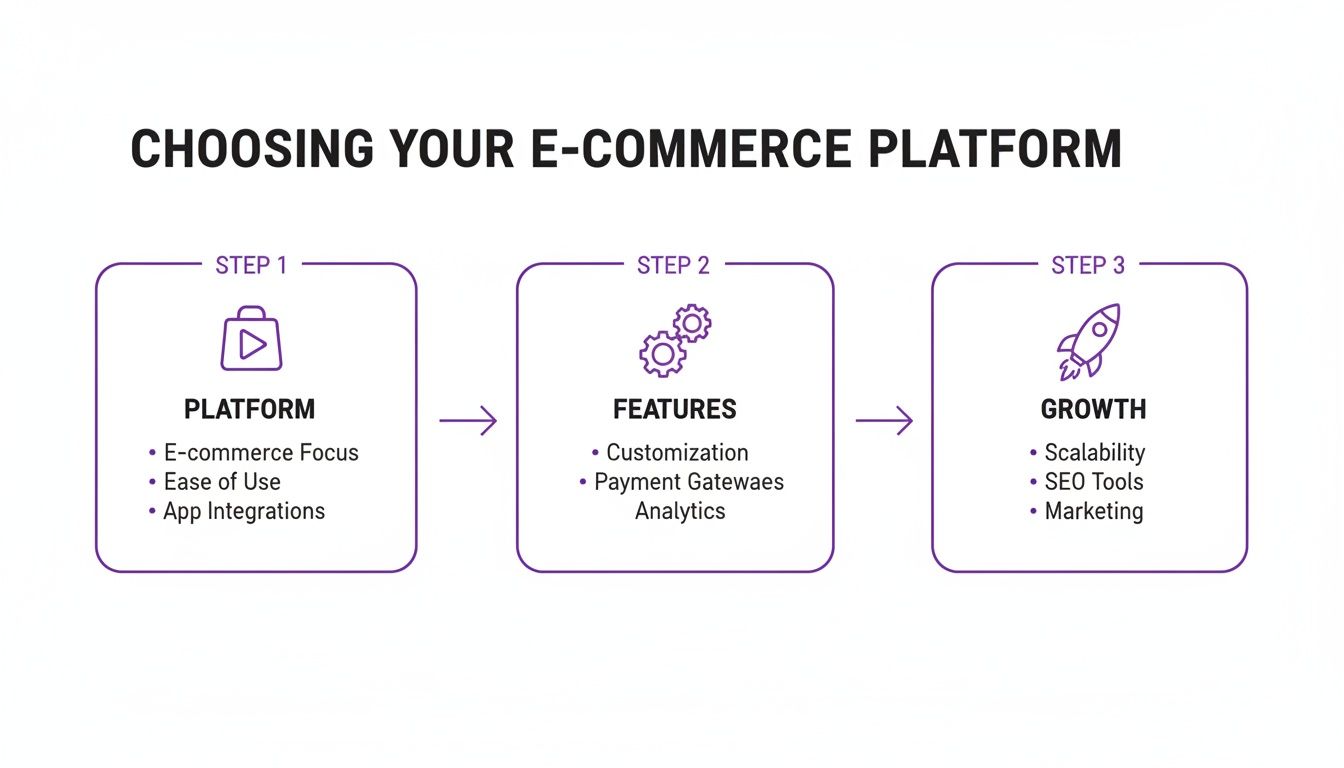
The flow here is simple: a solid platform choice, combined with the right features, is what ultimately fuels long-term growth.
What you'll collaborate on:
- Homepage and Page Layouts: You’ll review the site's blueprints (wireframes) and visual designs (mockups) to approve the overall look, feel, and how customers will navigate your store.
- Content and Copy Review: This is your story to tell. You'll provide or approve the text for your "About Us" page, fine-tune product descriptions, and shape the voice of your brand.
- Testing and Feedback: Before the big reveal, you get to be the first customer. You'll click through the entire site, test the checkout from start to finish, and flag any final tweaks needed.
Phase 3: Post-Launch Success Plan
Flipping the switch and going "live" is just the beginning. This final phase is all about making sure your customers and search engines find your new home, setting you up for incredible momentum right out of the gate.
Migrating isn’t just about moving products; it's about redirecting your audience and relaunching your brand with intention. Forgetting these post-launch steps is like moving into a beautiful new house but forgetting to tell anyone your new address.
Key post-launch steps managed by your partner:
- Setting Up 301 Redirects: If you happen to be moving from an old website, this is non-negotiable. Redirects tell Google that your pages have permanently moved, protecting all the hard-earned SEO authority you've built.
- Connecting Analytics: Tools like Google Analytics will be installed from day one. This allows you to see who is visiting your site, how they found you, and what they’re doing, giving you the data to make smart decisions.
- Announcing Your New Home: Your partner will help you put together an exciting email campaign to that customer list you exported. Announcing your new store with an exclusive launch discount is the best way to drive immediate traffic and sales, making your launch a huge success from the very first day.
Alright, let's talk about one of the most important decisions you'll make for your business: choosing the right partner to build your new online store.
How To Find The Right Ecommerce Design Partner
This isn’t just about hiring a web designer. It's about finding a team that’s as invested in your growth as you are. The right partner can be the difference between a site that’s just a pretty brochure and one that’s a powerful sales engine for your brand.
Making the jump from a marketplace like Etsy to your own platform feels like a huge leap of faith. You need a guide who has walked this path with other brands and knows where the pitfalls are. This is where you learn the difference between a simple "designer" and a true "growth partner." It all comes down to asking questions that cut through the fluff and get to what really drives sales.
Moving Beyond A Pretty Design
Let's be honest: almost anyone can build a good-looking website these days. A true growth partner, on the other hand, is obsessed with what happens after the site launches. They don’t just hand over the keys and wish you luck; they build a foundation for sales and give you a roadmap for how to keep growing.
This is a huge mental shift. You're not commissioning a piece of art; you’re investing in a machine designed to make you money. A real partner gets that. They speak your language—the language of conversion rates, average order value, and customer lifetime value.
When you're interviewing potential partners, your real goal is to figure out if they see themselves as a simple service provider or as a genuine stakeholder in your success. A designer builds what you ask for; a partner tells you what you need to grow.
To find someone with that partner mindset, you need to ask a few tough questions. Their answers will tell you whether their focus is on making things look nice or on fattening your bottom line.
Key Questions To Ask A Potential Partner
When you’re vetting an agency or freelancer for your professional ecommerce website design, how they answer these questions will reveal their entire philosophy.
How do you measure success for a project like mine? A designer will probably say something like, "If you're happy with how it looks." A growth partner’s answer will sound more like this: "Success is a measurable lift in your conversion rate, a higher average order value, and more repeat customers coming back."
What's your process for conversion rate optimization (CRO)? This question is a great filter. Amateurs might stumble, but a pro will immediately start talking about analyzing data, A/B testing different elements, and constantly refining the user journey—from the homepage all the way through checkout.
Can you show me a case study where you achieved specific business results? You're looking for proof, not just pretty portfolio pictures. Ask for hard numbers. A partner who can confidently say, "We helped a brand in your niche double their revenue in six months by redesigning their site and adding a subscription model," is talking about real growth.
Choosing the right partner completely changes the game. It turns a scary, technical project into an exciting collaboration. When you have an expert focused on tangible results, you can finally make the leap, knowing your new store is being built not just to launch, but to thrive.
Common Questions About Professional Ecommerce Design
Making the jump to your own professional ecommerce website design is a huge step. It’s completely natural to have a few questions (or a lot!) swirling around. You're not just building a website; you're building a permanent home for your brand.
Let's walk through some of the biggest questions I hear from successful sellers who are ready to graduate from marketplaces and take full control.
How Much Does A Professional Ecommerce Website Cost?
This is almost always the first question, and for good reason. But instead of focusing on the initial price tag, it's far more helpful to think about the Return on Investment (ROI). A professional website isn't an expense—it’s a sales machine you own, designed to make you money.
Think about it this way: a site built for conversions can have a massive impact. If your shop is already pulling in $20,000 a month, even a small 1% bump in your conversion rate adds up to thousands of dollars in new revenue over the year. Suddenly, that initial investment is covered by the profit it’s generating on its own.
Plus, you can finally add features like product bundles or subscriptions that just aren't possible on Etsy. These tools directly increase your average order value and build incredible customer loyalty. The better question isn't "What's the price?" but "How much new profit will this generate for my business?"
How Long Does The Build Take?
Nobody wants a website project that drags on forever. The good news is, it doesn't have to. With a clear, organized process, we can get a high-performing Shopify store designed, built, and launched in a matter of weeks, not months.
A great partner will lay out a predictable schedule right from the get-go. It usually looks something like this:
- Discovery & Strategy: The first week is all about diving deep into your brand, your goals, and who your customers really are.
- Design & Feedback: Next, we create the visual direction and mockups for you to review and approve.
- Development & Content: Once you love the design, we get to building and loading in all your products and content.
- Testing & Launch: Finally, we rigorously test everything from top to bottom before flipping the switch and going live.
This step-by-step approach means no surprises and minimal downtime, so you can launch with confidence and start seeing results immediately.
Will I Lose My Customers And SEO?
This is a big one. You've worked so hard to build a following and get seen. The thought of starting over is scary, but a professional migration is specifically designed to bring your audience with you and set you up for even better long-term growth.
This is a common fear, but a professional migration handles it strategically. Your Etsy customer list can be leveraged for an email marketing campaign to announce your new site, often with a special launch offer. You gain far more control over your long-term search visibility than you ever had on Etsy.
For your customers, we can export your buyer list from Etsy and create a "grand opening" email campaign to announce your beautiful new site. A special launch discount is a fantastic way to drive a flood of traffic and sales right out of the gate.
And when it comes to SEO, you're actually gaining a huge advantage. An expert will build your new site on a solid foundation of SEO best practices—from site structure and page speed to content optimization—to get you ranking on Google for the long haul.
Ready to move past the questions and start building your brand's future? At Wand Websites, we specialize in helping amazing Etsy sellers like you make a seamless and profitable move to your own professional Shopify store. Let's build a website that works as hard as you do.
