
10 Winning PPC Ad Examples for 2026

You hit a point where marketplace growth stops feeling like growth. Sales are coming in, your reviews are solid, and the product has already proven itself. Then the limits get expensive. Fees keep cutting margin, policy shifts can change visibility overnight, and every customer you win still belongs more to the platform than to your brand.
That is usually when sellers decide to move to Shopify. The main challenge starts after the build.
A new storefront does not create demand on its own. It gives you a place to send demand you control. PPC is often the fastest way to do that, especially for Etsy sellers with validated products who need predictable traffic, cleaner attribution, and a path to repeat purchases outside the marketplace.
Paid search now takes a large share of digital acquisition spend, and sponsored listings capture a meaningful portion of high-intent clicks. For sellers leaving Etsy, that creates a practical opportunity. You are not trying to manufacture interest from scratch. You are showing up in front of buyers who are already searching with intent to compare, buy, or switch.
The catch is that marketplace-style ads usually fail on D2C traffic. A plain headline, a product name, and a price might work inside Etsy search because the platform does part of the persuasion for you. On Google or paid social, the ad has to do more work. It needs to match the buyer's awareness level, surface the right tension, and give a reason to click now instead of later.
That is the point of this guide.
These PPC ad examples are built for marketplace sellers transitioning to their own store, not for generic SaaS brands or enterprise advertisers. Each one maps to a specific buying psychology you will run into during the move from Etsy dependency to direct customer acquisition. If you still sell on Amazon too, this in-depth Amazon PPC guide for entrepreneurs is worth reading alongside this one.
1. The Problem-Agitate-Solve Shopify Migration Ad
This is one of the most reliable PPC ad examples for sellers who know they've outgrown Etsy but haven't acted yet. You start with the friction they already feel, make the cost of staying put harder to ignore, then offer a clean next step.
For Etsy sellers, the pain usually isn't abstract. It's fees, weak brand control, limited design freedom, and the fact that every hard-won customer still feels rented. A PAS ad works when it sounds like the buyer's internal monologue, not a marketing team trying too hard.
Copy pattern that works
Use a short three-step rhythm:
- Problem: “Still growing, but Etsy keeps taking the margin?”
- Agitate: “You're paying to build traffic you don't own, under rules you can't control.”
- Solve: “Launch a Shopify store built to convert and keep the customer relationship.”
A practical version for Wand Websites could read like this:
Etsy fees cutting into every sale?
You've built demand, but you still don't control the checkout, customer data, or brand experience.
Wand Websites builds Shopify stores for established sellers who are ready to grow off-platform.
Why it converts
PAS works best when the buyer already agrees with the problem. That's why this format is strong for warm search traffic and retargeting. You're not persuading someone that Etsy has limits. You're naming the limit they already hit last month.
Keep the agitation tight. Two short lines are enough. If you overdo it, the ad starts sounding dramatic and weak.
Copy-paste template
Headline ideas
- Outgrowing Etsy?
- Ready to Own Your Store?
- Stop Renting Your Customer Base
Description template
- Built traction on Etsy? Move to Shopify with a store designed for growth, retention, and better control.
- Keep your brand, your audience, and your margins. We handle the migration and conversion-focused build.
Practical rule: PAS fails when the “problem” is generic. Name one sharp pain, not five soft ones.
2. The Social Proof and Numbers Ad
This format is simple. If buyers think, “Can these people do this for a business like mine?” you answer with proof. Not hype. Proof.
That's especially important when you're selling a service like migration, redesign, or conversion work. Sellers leaving marketplaces have heard promises before. They've seen agencies talk about “scaling brands” without showing anything real.

Use proof buyers can understand fast
The strongest proof points are the ones that shorten the trust gap in one glance. Revenue outcomes, ROAS, and visible business scale do that well when they're real and tied to a clear context.
One benchmark worth noting comes from a paid search case study where an online furniture store achieved 5x ROAS and nearly $800K in revenue. That kind of outcome matters because it shows both efficiency and volume. For a growing e-commerce brand, those are not the same thing.
What to say instead of puffed-up nonsense
Good trust-builder ad copy sounds like this:
- “See how paid search can support profitable growth at real scale.”
- “Built for established sellers who need more than a pretty storefront.”
- “Migration and store design focused on conversion, not just aesthetics.”
You can also use softer social proof if you don't have case study numbers cleared for public use:
- Trusted by established product brands
- Built for high-volume Etsy sellers moving to Shopify
- Designed for growth beyond the marketplace
Copy-paste template
Headline
- Proven Shopify Builds for Growing Sellers
- Trusted by Established E-commerce Brands
- Built for Sellers Ready to Scale Off Etsy
Description
- Your store should do more than look good. We build D2C sites that support paid traffic, repeat purchases, and stronger margins.
The trade-off is obvious. Social proof ads can raise click quality, but they can lower click volume if the proof feels too specific or too advanced for smaller sellers. That's usually a good trade.
3. The Direct Response Headline With Urgency Ad
This is the opposite of a brand-awareness ad. It asks for action now. It works best when your buyer already knows the problem and just needs a nudge to stop delaying.
Search ads are where this format shines. Someone types “Shopify migration agency” or “Etsy to Shopify help,” and they don't need a poetic manifesto. They need a strong benefit, a reason to click now, and a landing page that matches.
Urgency only works when it's believable
False urgency damages trust fast. If you say “limited spots,” your sales process needs to support that. If you say “free audit this week,” there should be a reason that offer is time-bound.
Good direct-response urgency sounds like this:
- Book Your Shopify Growth Audit
- Migration Support for Established Etsy Sellers
- Apply for a Custom Build This Month
Strong example structure
A clean version might look like:
Headline: Move Beyond Etsy
Headline: Book Your Shopify Audit
Description: Get a conversion-focused plan for your store migration, paid traffic setup, and growth priorities.
Or:
Headline: Ready to Leave Etsy?
Headline: Custom Shopify Build
Description: Fixed-scope migration support for established sellers who want more control and stronger D2C growth.
Urgency should come from a real constraint, not a dramatic adjective.
Where people get this wrong
They write urgency before clarity. “Exclusive,” “proven,” and “limited” don't matter if the buyer still can't tell what you do.
They also send the click to a vague homepage. If the ad promises an audit, the page should offer an audit. If the ad promises migration support, the page should show that process plainly.
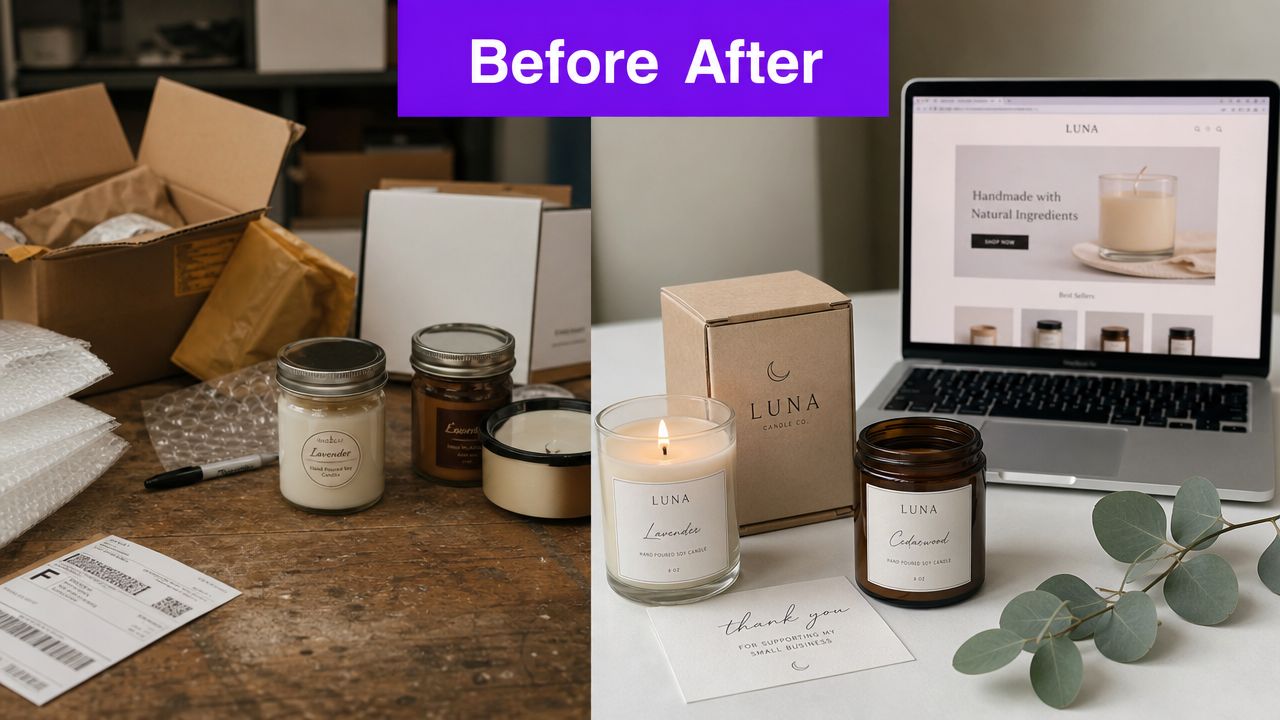
4. The Customer Before and After Transformation Ad
Transformation ads work because they show identity change, not just feature change. Marketplace sellers aren't only buying a website. They're trying to become a brand with direct customer relationships, better retention, and more control over growth.
That's why before-and-after PPC ad examples can outperform plain service ads on social and display placements. The buyer sees themselves in the “before” state.
A visual helps this format land.
Focus on the shift in control
The strongest “before” isn't always low revenue. Often it's chaos, dependence, and lack of ownership.
Examples:
- Before: strong Etsy sales, weak brand recall
- After: direct store experience with email capture and repeat purchase paths
- Before: product demand trapped inside one channel
- After: a store built to support ads, bundles, and retention
Write the contrast in plain language:
Before: “Getting orders, but building someone else's platform.”
After: “Owning the store, customer journey, and growth strategy.”
What the ad should make the buyer feel
Relief first. Ambition second.
If you jump straight to “build your empire,” some buyers tune out. If you first show them a believable operational upgrade, they're more open to the bigger transformation story.
Here's a useful supporting asset if you're running this angle with video creative:
Copy-paste template
Headline
- From Marketplace Seller to Real Brand
- Built Demand on Etsy? Own the Next Stage
- Before Etsy Dependence. After D2C Control.
Description
- Move from rented traffic to owned growth with a Shopify store built for paid acquisition and retention.
This format needs honesty. If the transformation sounds too dramatic, it feels fake. Show a believable business upgrade, not a fantasy.
5. The Simplified Value Proposition Ad
A lot of marketplace sellers click with a simpler message once they already understand the problem. They are no longer asking, "Why leave Etsy or Amazon?" They are asking, "Why this option, and why now?"
That is the job of the simplified value proposition ad. It reduces your offer to the few points that matter in a fast comparison. No brand manifesto. No long transformation story. Just a clean reason to click.
Strip the offer to the decision points
For a seller moving from marketplace dependence to a D2C store, the strongest value points are usually practical:
- Migration handled: the move gets done without turning into a side project you have to manage yourself.
- Conversion-focused build: the store is designed to turn paid traffic into revenue, not just look polished.
- Retention-ready setup: bundles, email capture, and repeat purchase paths are built in from the start.
- Clear delivery: fixed scope, defined timeline, fewer surprises.
This ad type works because it matches buyer psychology at a specific stage. They already believe change is needed. Now they want to reduce risk, compare options, and see whether your offer fits the way they buy.
Why this format converts qualified clicks
Simple ads often underperform on curiosity and outperform on intent. That trade-off is usually worth it in branded search, retargeting, and comparison campaigns, where the goal is not cheap traffic. The goal is relevant traffic from sellers who are actively weighing a move off marketplaces.
Clarity also protects spend. As noted earlier, paid clicks are expensive enough that vague copy burns budget fast. A tighter value stack filters out bad-fit clicks and sets up the landing page to continue the same argument.
Copy-paste template
Headline
- Shopify Build for Established Sellers
- Migration Done Right
- Conversion-Focused D2C Store
Description
- Done-for-you migration, conversion-focused design, and retention-ready setup for sellers ready to move beyond marketplaces.
This format rarely wins on flash. It wins when the buyer wants a credible short list of reasons to choose you.
6. The Question-Based Curiosity Ad
A strong question ad opens a mental loop. The buyer wants the answer badly enough to click. A weak question ad sounds like fluff and gets ignored.
For marketplace sellers, the best questions are not broad. They point at a tension the buyer already lives with. Control versus convenience. Growth versus dependence. Short-term sales versus long-term brand equity.
Ask a question your landing page can answer
Good examples:
- Why do strong Etsy shops stall after early growth?
- What changes when your best customers buy from your store, not a marketplace?
- Why does a well-designed Shopify store still fail to convert paid traffic?
That last one is especially useful because it filters for more discerning buyers. It tells them you understand the difference between design and conversion.
Build curiosity without clickbait
The body copy should give a partial answer, not a full one:
- “Usually it's not the product. It's the gap between search intent, ad copy, and the landing page experience.”
- “Most sellers don't need more products. They need a store that can support direct-response traffic.”
The most useful thing about this format is that it creates a smoother handoff to educational landing pages, audits, and lead magnets.
One warning: if the question is too vague, you'll get curiosity clicks from people who were never a fit.
Copy-paste template
Headline
- Why Do Etsy Sellers Hit a Ceiling?
- What Makes D2C Traffic Convert?
- Is Your Store Ready for Paid Ads?
Description
- If your site can't convert intent, more traffic won't fix it. See what needs to change before you scale spend.
7. The Guarantee and Risk Reversal Ad
High-ticket services create friction. That's normal. A guarantee ad exists to reduce that friction, especially when the buyer has already been burned by freelancers, generalist agencies, or DIY projects that dragged on.
For this format to work, the guarantee has to be specific, understandable, and operationally supportable. “Guaranteed growth” is too vague. “Satisfaction guarantee,” “fixed scope,” or “clear revision process” is easier to believe.
The psychology behind risk reversal
Buyers don't just ask, “Will this work?” They ask, “What happens if this goes sideways?”
A good guarantee ad answers that fear before the sales call.
Examples of believable guarantee angles:
- Fixed project scope and defined deliverables
- Clear handoff and migration support
- Satisfaction-based revision structure
- Transparent process and timeline commitments
Where this format gets stronger
This ad type is especially useful when paired with stronger evaluation language on the page. Signalytics makes the point well that the most useful PPC case studies report CTR, conversion rate, CPA, and ROAS, because those show the full path from click to profitability. That matters here because a guarantee should connect to real business outcomes, not just “we finished the website.”
Copy-paste template
Headline
- Lower-Risk Shopify Migration
- Fixed Scope. Clear Process.
- Build With More Confidence
Description
- Get a defined migration and store build process designed for established sellers who need clarity before they commit.
Guarantee ads usually don't carry the whole campaign. They work best as trust reinforcement for buyers already considering you.
8. The Comparison and Alternative Ad
This is one of the most effective PPC ad examples for sellers in active decision mode. They're already comparing options in their head. You just say the comparison out loud.
The key is choosing the right opponent. For Wand Websites, that's usually not another specific agency. It's staying on Etsy, doing Shopify yourself, or hiring a generalist who doesn't understand e-commerce conversion.
Use contrast that matters
Strong comparison angles:
- Etsy gives reach. Your own store gives ownership.
- DIY saves cash upfront. It usually costs time and missed momentum.
- Generalist design can look nice. Conversion-focused e-commerce design supports paid traffic better.
You don't need to insult the alternative. You need to expose the trade-off.
Better than feature wars
Most comparison ads fail because they turn into laundry lists. Better comparison ads simplify the decision:
- Stay on Etsy: easier distribution, limited control
- DIY Shopify: more ownership, more operational drag
- Specialized build partner: faster transition, cleaner execution, stronger D2C setup
This is also where current PPC strategy has changed. Recent guidance on ad strategy emphasizes that winning creative increasingly comes from multiple angles tied to customer problems, first-party data, search intent, and retail media realities, not isolated copy tricks. That shift is covered in this piece on human-centered ad strategies and ad types that work.
Copy-paste template
Headline
- Etsy or Shopify?
- DIY or Done Right?
- Marketplace Growth or Brand Ownership?
Description
- If you're ready for more control over customer experience, retention, and paid traffic, a real D2C storefront changes the game.
Comparison ads can be aggressive, but they don't need to be. Calm clarity often beats chest-thumping.
9. The ROI-Focused Cost Justification Ad
A seller leaves Etsy, launches a Shopify store, starts buying traffic, and then gets stuck on the build cost. That hesitation usually comes from framing the decision wrong.
This ad works on buyers who already respect margin, CAC, and conversion rate. They are not asking, “Is this expensive?” They are asking, “Will this pay back?”
That is the right question.
Tie the investment to return
As noted earlier, click costs vary by channel, audience, and intent. The part sellers control is what happens after the click. If the storefront is weak, paid traffic gets taxed by poor conversion. If the storefront is built to sell, the same traffic can produce more revenue, more email capture, and better repeat purchase potential.
For marketplace sellers moving to D2C, that is the key pitch. You are not selling pages. You are selling a better return on traffic they already plan to buy.
That framing matters because these buyers have lived inside marketplace economics. They know fees. They know ad costs. They know one bad conversion path can wipe out the margin on a campaign.
How to frame the ad
Good ROI-focused copy connects store quality to media efficiency:
- “Your ad costs are fixed. Your store conversion rate is not.”
- “Every paid click gets judged twice. Once by the ad platform, once by your storefront.”
- “The build cost is one line item. Lost conversion from a weak store keeps showing up every month.”
If you want a planning tool for acquisition math, this calculate ad spend for short-form video tool is useful for pressure-testing budget scenarios before you scale.
Copy-paste template
Headline
- Make Every Click Work Harder
- Stop Paying for Traffic to a Weak Store
- Better Conversion Changes the Math
Description
- If you plan to run paid traffic, store quality affects return. Judge the investment by the revenue lift, not the design line item alone.
This angle usually performs best with established sellers who have already felt the pain of paying for traffic that does not convert.
10. The Lifestyle and Vision Ad
Not every click comes from pain. Some come from identity and ambition. This ad type sells the future state the buyer wants to step into.
That future is simple for marketplace sellers. They want control. They want a branded customer journey. They want a business that doesn't feel one policy update away from chaos.

Aspiration works when it stays grounded
This format fails when it gets too dreamy. “Freedom” is overused. “Legacy” often feels inflated. What works is specific ambition:
- owning the customer journey
- building a recognizable brand
- creating repeat purchase systems
- running promotions without platform restrictions
A sharp version sounds like this:
Build a store that feels like your brand, not a borrowed shelf on someone else's marketplace.
Why this matters more now
A lot of PPC ad examples still focus on format and copy tricks. The bigger gap is angle development. Brax makes that point well in its discussion of advertising angles built from buyer psychology, objections, desires, pain points, and mirrored customer stories in this piece on using advertising angles to capture customers. That's exactly why aspiration ads can work. They tap into what the seller wants to become, not just what they want to buy.
Copy-paste template
Headline
- Own the Brand You Built
- Stop Selling Inside Someone Else's Rules
- Build a D2C Store Worth Scaling
Description
- You already proved demand. Now build the storefront, customer experience, and growth engine your brand deserves.
10-Point PPC Ad Examples Comparison
| Ad Type | Implementation Complexity 🔄 | Resource Requirements ⚡ | Expected Outcomes 📊 | Ideal Use Cases 💡 | Key Advantages ⭐ |
|---|---|---|---|---|---|
| The Problem-Agitate-Solve (PAS) Shopify Migration Ad | Medium, narrative copy and sequencing | Moderate, skilled copywriter, credible numbers | High engagement with leaky-platform sellers; good conversion | Established Etsy sellers ready to leave marketplace | Emotional motivation; clear problem→solution path |
| The Social Proof & Numbers Ad (Trust Builder) | Medium–High, needs verified metrics & case studies | High, validated data, testimonials, design for stats | Strong credibility and higher close rates for big deals | Higher-revenue merchants evaluating proven vendors | Builds authority quickly with quantifiable proof |
| The Direct Response Headline with Urgency Ad | Low, concise headline + offer | Low, simple copy, clear time-limited offer | Fast clicks and immediate response; boosts CTR | Search ads, limited-time promos, appointment drives | Drives FOMO; maximizes short-term conversions |
| The Customer Before/After Transformation Ad | Medium, case development and visual production | High, client consent, imagery/video, measurement | High social sharing and emotional conversions | Social/display/video where visual storytelling works | Demonstrates tangible results; relatable storytelling |
| The Simplified Value Proposition Ad (Feature/Benefit Stack) | Low, concise benefit ordering | Low, short copy, simple visuals/icons | Good scan-to-conversion rates; broad applicability | Decision-makers and retargeting where clarity matters | Easy to understand quickly; reduces cognitive load |
| The Question-Based Curiosity Ad | Low–Medium, crafting compelling question + follow-up | Low, creative copy, testing for angles | Improved CTR and awareness; attracts curious traffic | Cold traffic, awareness-stage campaigns | Triggers curiosity and higher initial engagement |
| The Guarantee/Risk Reversal Ad | Medium, legal clarity + fulfilment plans | Moderate, legal review, proof points, policies | Significantly reduces hesitation; boosts conversions | High-ticket services and risk-averse prospects | Removes perceived risk; builds trust rapidly |
| The Comparison/Alternative Ad (Vs. Etsy/DIY) | Medium, accurate side-by-side claims | Moderate, data, competitor analysis, clear visuals | Converts evaluators; reduces competitor consideration | Prospects actively comparing platforms/providers | Clarifies relative value; highlights differentiators |
| The ROI-Focused Cost Justification Ad | Medium–High, credible ROI modeling | High, financial data, calculators, conservative assumptions | Lowers sticker shock; justifies higher prices | Financially-minded entrepreneurs and consults | Quantifies payback and business impact clearly |
| The Lifestyle/Vision Ad (Aspiration-Based) | Medium, strong creative concept and production | High, premium visuals and authentic storytelling | Builds long-term brand affinity; less immediate conversion | Brand campaigns, social display to inspire owners | Emotional connection; positions brand as vision-driven |
Your Next Step From Ad Copy to Action
These PPC ad examples work best when you stop treating them like writing exercises and start treating them like offers matched to buyer psychology. That's the key distinction. A good ad doesn't just sound polished. It meets the prospect at the right stage of awareness, names the right friction, and sends them to the right page.
If you're moving from Etsy to Shopify, your ad strategy should reflect that transition. You're not a brand-new store trying to discover product-market fit. You already have proof of demand. Your problem is different. You need to turn rented marketplace success into owned customer acquisition. That changes the kinds of ads you should run.
Start with one or two formats, not all ten. If your audience already feels the pain of marketplace limits, begin with PAS or comparison ads. If trust is the bigger obstacle, run social proof or risk-reversal creative. If your prospects are analytical, use ROI framing and a simplified value stack. If they're emotionally ready for the leap but still hesitating, use the before-and-after or lifestyle angle.
Then measure like an operator, not a hopeful creative. Watch click quality, not just click volume. Look at what happens after the click. An ad that gets curiosity clicks but weak conversions isn't helping. An ad that attracts fewer clicks but stronger purchase intent is often the better asset. This is why CTR alone never tells the full story, and why your landing page has to carry the same promise as the ad.
It's also worth remembering that ad formats are changing. Automation, retail media, and first-party data are reshaping campaign execution. But the underlying principle hasn't changed. Buyers still click when the message feels relevant, credible, and timely. That's why angle beats cleverness. Strong positioning lasts longer than trendy copy.
If you need to sharpen performance after launch, this guide on how to optimize your online store's CTR is a solid next step.
The practical move now is simple. Pick one audience slice. Pick one pain point. Match it to one of the frameworks above. Write three ad variants, launch them with a landing page that matches the promise, and let the data tell you which angle deserves more budget.
That's how marketplace sellers become real D2C operators. Not by guessing. By building a store worth sending paid traffic to, then using PPC with the kind of message discipline most competitors never develop.
If you're ready to move beyond Etsy and build a Shopify store that's designed for conversion, retention, and long-term brand control, Wand Websites is built for that exact transition. Wand handles the migration, the storefront strategy, and the growth-focused setup so you can stop relying on marketplace rules and start building a business you own.
