
The Ultimate Guide to Pay Per Click Management Service for E-Commerce


So, what exactly is a pay per click management service? In short, it’s when you hire a dedicated expert or an entire agency to run your digital ad campaigns. They take your ad budget and use it to bring a flood of ready-to-buy shoppers directly to your online store, making sure every dollar works hard to land you new customers and sales.
What Is a Pay Per Click Management Service

Think of a PPC management service as hiring a pro navigator for your e-commerce journey. Instead of trying to chart the tricky waters of digital advertising all by yourself, you’re handing the wheel to someone who knows all the shortcuts and can steer you straight to profitable destinations. This is so much more than just “boosting a post”—it's a sophisticated system for getting in front of people who are actively looking for the very products you sell.
For any e-commerce brand that's serious about growth, PPC is your ticket to immediate, high-quality traffic. While things like SEO are great for building a brand over the long haul, PPC gets you results now. It puts your products right under the noses of shoppers at the very moment they’re ready to pull out their wallets.
The Strategic Value Beyond Clicks
A top-notch pay per click management service does way more than just place a few ads. Think of them as your growth partners, managing the entire lifecycle of your campaigns. Their work is a constant cycle of planning, launching, and fine-tuning to squeeze the most value out of your ad spend.
Here’s a glimpse of what that actually looks like:
- Deep Keyword Research: Digging in to find the exact search terms your best customers are typing into Google.
- Strategic Campaign Setup: Architecting smart campaigns across key platforms like Google, Microsoft, and Meta.
- Compelling Ad Creation: Crafting ad copy that grabs attention and designing visuals that stop the scroll.
- Intelligent Bid Management: Making sure you’re paying just the right amount for each click to stay profitable.
- Constant Monitoring & Reporting: Keeping a close eye on performance and using real data to make your campaigns better and better.
One of the biggest myths about PPC is that it's a "set it and forget it" kind of thing. The truth? Successful campaigns need daily attention and constant tweaks. A management service brings that dedicated focus, helping you compete and stopping you from burning through your budget.
Why It's a Non-Negotiable for Growth
If you're making the leap from Etsy to your own Shopify store, this service is the bridge you need to scale up. On Etsy, the marketplace brings you an audience. On your own site, you have to build that audience from scratch. A PPC service hits the accelerator on that process, helping you find your footing in the market and creating a reliable stream of new customers.
Ultimately, it transforms advertising from a line-item expense into a predictable, data-backed engine for growing your revenue. And if you're curious about different agency models, this guide on white label PPC management offers some great insight into how businesses can scale their service offerings. This isn't just an investment; it's your most direct path to acquiring customers and building a sustainable business.
The Most Profitable PPC Channels for E-Commerce
Alright, you've decided to bring in a pay per click management service. Now for the million-dollar question: where, exactly, should that ad budget go? Not every platform is a winner for e-commerce, and a great PPC team knows this. They don't just spray your money across the internet; they pick the battlegrounds where they know they can win.
Think of it like setting up a physical store. You wouldn't open a high-end sneaker shop in the middle of a business park, right? You’d go straight to the busiest shopping malls and trendiest streets where people are already looking to buy. In the digital world, those prime locations are Google, Microsoft, and Meta.
Google Ads: The King of Search Intent
When someone needs something—a new coffee maker, a specific brand of jeans, a solution to a problem—where do they go first? Nine times out of ten, it’s Google. This makes Google Ads the undisputed champ for grabbing high-intent traffic. You're getting in front of people who are literally raising their hands and telling you what they want to buy.
A good PPC service will focus your Google budget on two key areas:
Search Ads: These are the classic text ads you see at the top of the search results. They’re absolutely perfect for catching shoppers who type in specific product names, brands, or problem-solving questions like “best waterproof hiking boots for women.”
Google Shopping Ads: For any e-commerce brand, these are non-negotiable. Shopping ads are those visual product listings that show up in a carousel, complete with a picture, the price, and your store name. They are unbelievably effective because they show the product before someone even clicks.
The real magic of Google Ads is that you’re meeting customers at their exact moment of need. It’s not about interrupting their day; it's about handing them a solution on a silver platter. This is precisely why it consistently delivers the highest Return on Ad Spend (ROAS) for businesses selling physical products.
Google’s grip is especially tight on mobile. The fact is, most of your customers are shopping on their phones. PPC is a huge driver here, with 53% of all PPC clicks happening on mobile devices. And of those, a mind-boggling 95% of mobile paid search clicks come from Google. With nearly 70% of U.S. shoppers using their phones to browse and buy, your PPC team must be building mobile-first campaigns. You can see just how much mobile matters by digging into the latest PPC statistics and watching the ad spend trends.
Microsoft Advertising: The Untapped Goldmine
Here’s a pro tip: don’t sleep on Microsoft Advertising (what we used to call Bing Ads). It's the secret weapon many e-commerce brands are missing. While it’s smaller than Google, its audience is often more valuable. Microsoft’s search engine is the default on every Windows PC, and its user base tends to be a bit older, have more disposable income, and, frankly, is often more ready to buy.
A savvy PPC management service uses Microsoft Ads to get an edge. Here's how:
- Reach a New Audience: It lets you tap into a demographic of serious shoppers that your competitors are likely ignoring.
- Enjoy Lower Costs: With less competition, the Cost Per Click (CPC) is often way cheaper than on Google. More bang for your buck.
- Capture High-Quality Traffic: We often see that the people who click on Microsoft ads are more likely to complete a purchase, leading to a fantastic ROAS.
Think of Microsoft Advertising as a complementary channel. It’s a smart, efficient way to scoop up high-value customers that everyone else is flying right past.
Meta Ads: The Powerhouse of Social Discovery
While Google captures existing demand, Meta (which means Facebook and Instagram) creates it. This is the art of discovery marketing. You’re putting your amazing products in front of people who didn’t even know they wanted them… yet. The targeting tools on Meta are second to none, allowing a PPC service to build custom audiences based on interests, online behaviors, life events, and past interactions with your shop.
For an e-commerce store, Meta is crucial for two big jobs:
- Finding New Customers: Using beautiful images and engaging video ads, you can introduce your brand to huge, perfectly targeted audiences. This builds brand awareness and drives that all-important first visit.
- Mastering Retargeting: This is where Meta truly shines. It’s the best tool out there for bringing back people who visited your site, added an item to their cart, but then left. By showing them an ad for the exact product they were looking at, you can remind them why they loved it and easily recover those lost sales.
The ultimate PPC strategy uses all three of these channels in harmony. Google grabs the immediate "I need it now" sales, Microsoft finds a lucrative, overlooked audience, and Meta builds your brand fame while bringing indecisive shoppers back to complete their purchase.
What to Expect From a PPC Management Service
So, you're thinking about hiring a pay per click management service. What do they actually do? It’s easy to feel like you’re just throwing money into a black box and hoping sales pop out the other side. Let's pull back the curtain and look at the real, hands-on work that turns your ad spend into predictable revenue.
Think of it this way: a profitable PPC campaign is like a high-performance engine. It’s not just one part, but a collection of finely tuned components working in perfect harmony. A good agency is your master mechanic—they source the best parts and tune the engine for maximum power and efficiency.
When you bring on a PPC partner, they'll typically roll up their sleeves and get to work on a few core areas. These deliverables are the building blocks of any successful campaign.
A PPC management team handles a whole suite of tasks, from initial strategy to ongoing optimization. The table below breaks down the most common services you can expect and, more importantly, why each one is so crucial for growing your e-commerce store.
Typical PPC Management Service Deliverables
Each of these pieces is essential for building a campaign that doesn't just get clicks, but consistently drives sales and grows your bottom line.
Profitable PPC Channels They'll Manage
A skilled agency won't just stick to one channel. They'll build a strategy that meets customers wherever they are, from actively searching for a solution to discovering a new brand on social media.
This means creating tailored campaigns across the "big three" for e-commerce:
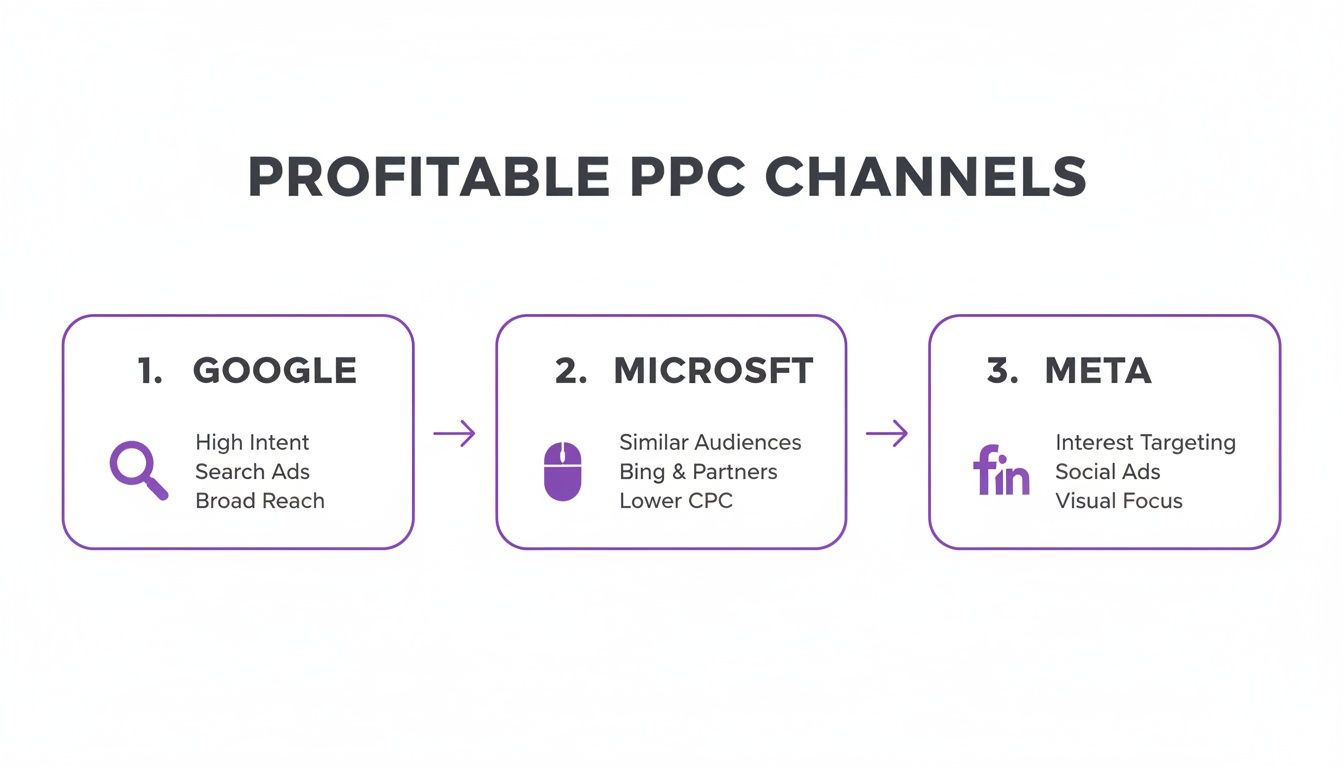
As you can see, a full-funnel approach uses Google Ads for high-intent shoppers, Microsoft Advertising to capture a valuable and often-overlooked audience, and Meta Ads for building brand awareness and bringing past visitors back to your store.
The Art and Science of Bidding
How much is a click worth? That’s the million-dollar question. This is where the "pay per click" part gets tricky, and where a pro makes all the difference. They don’t just set a bid and hope for the best; they are constantly adjusting based on real-time performance data.
It's not a simple highest-bid-wins auction. Ad platforms like Google actually reward relevance. A well-managed campaign with a high Quality Score—which is Google's rating of your ad and landing page quality—can often beat a competitor with a bigger budget by paying less per click for a better ad position.
This active, intelligent management is what ensures your money is spent on keywords and campaigns that actually drive sales, not just empty traffic.
For e-commerce brands, the results speak for themselves. A well-run PPC campaign often delivers an average of $2 in revenue for every $1 spent. That’s a 200% ROI that can truly fuel your growth.
This is especially powerful for sellers moving from Etsy to their own Shopify store. Why? Because PPC traffic is known to convert up to 50% better than organic traffic. You can check out more data on how advertising drives results by reviewing these comprehensive marketing statistics. It’s about turning ad spend directly into scalable, predictable sales—something every growing business needs.
How to Budget for PPC Management and Ad Spend
Figuring out how much to set aside for ads and for a pay per click management service is one of the biggest questions for any e-commerce brand. It feels like a catch-22, right? You have to spend money to make money. But how much is the right amount?
Let's unpack the two costs you need to plan for: the fee for expert management and the actual budget for your ads.
First up, how agencies and freelancers charge for their time and talent. You’ll generally run into three different pricing models, and each has its own vibe for a growing online store.
Common PPC Management Pricing Models
Getting a feel for these models is the first step in finding a partner who’s just as invested in your growth as you are.
Flat-Rate Monthly Retainer: This one is as simple as it sounds. You pay a set fee each month, no matter what your ad spend is. It’s perfect for predictable budgeting and for brands that want consistent, hands-on management without surprise bills.
Percentage of Ad Spend: This is probably the most common setup. The agency’s fee is a slice of your monthly ad budget, usually somewhere between 10-20%. This model gives the agency a direct incentive to scale your ad spend, since they make more as you spend more. The key is to make sure they’re focused on profitable growth, not just cranking up the dial on your budget.
Performance-Based Fees: Here, the agency gets paid based on the results they deliver—think a fee per lead or a cut of the revenue they generate from the ads. This can be fantastic because it ties their success directly to yours. Just know that these agreements can be a bit more complex to set up.
Honestly, there's no single "best" model. It all comes down to where your business is at. For a newer store, a flat rate provides stability. For a brand that's ready to hit the accelerator, a percentage-of-spend or performance model can forge a really powerful growth partnership.
Picking the right payment structure is just one side of the coin. The bigger question is deciding how much fuel you're going to put in the engine—your ad spend.
Setting a Realistic E-Commerce Ad Budget
So, what’s the magic number for your ad budget? The real answer is: it depends entirely on your goals and your current revenue. A bigger budget doesn't just mean more clicks. It means you buy data faster, which allows your PPC manager to learn, optimize, and find what works much more quickly.
Let’s walk through two common scenarios for a Shopify store.
Scenario 1: The Emerging Store ($10,000/month revenue)
A store at this stage could start with an ad budget of $1,500-$2,500 per month. This is enough to get your feet wet, test a few key channels (like Google Shopping and maybe some Instagram retargeting), and start seeing a positive Return on Ad Spend (ROAS) in the first couple of months. The name of the game here is steady, profitable growth.
Scenario 2: The Scaling Store ($50,000/month revenue)
With more established revenue, you can afford to be more aggressive. A monthly ad budget of $7,500-$10,000 opens up a world of possibilities. You can expand your reach, run much more ambitious A/B tests, and pour gas on the campaigns that are already clear winners. At this point, you’re not just finding customers; you’re starting to take real market share.
If you’re wondering if it’s worth it, just look at the global numbers. Worldwide, PPC ad spend hit a staggering $190.5 billion in 2024 alone. And it’s not slowing down—projections show that figure climbing toward $218.3 billion by 2026. You can dive deeper into these global PPC spending trends to see just how competitive the space is. Your budget is your ticket to compete in this arena.
Key Metrics to Measure Your E-Commerce PPC Success
You can't "feel" your way to success with paid ads—you have to follow the numbers. To know if your pay per click management service is actually moving the needle, you need to get comfortable with the data that tells the real story of your campaigns.
Think of these metrics as the vital signs for your e-commerce business. Each one gives you a critical piece of information. Are people seeing your ads? Are they clicking? And most importantly, are they buying? Tracking these KPIs is the only way to know if your ad spend is an investment, not just an expense.
Foundational Traffic Metrics
Before a single sale can happen, you have to get people in the door. These first few metrics are all about grabbing attention and sparking interest at the very top of your sales funnel.
Click-Through Rate (CTR): This is simply the percentage of people who see your ad and are compelled enough to click it. A high CTR tells you the ad is hitting the mark—the image is eye-catching, and the message resonates. A low CTR is a red flag that something's off.
Cost Per Click (CPC): This is what you pay every time someone clicks your ad. A good PPC manager works tirelessly to drive this number down without sacrificing the quality of the visitor. The lower your CPC, the more traffic you can buy with your budget.
These two work hand-in-hand. When your ads are engaging (high CTR), platforms like Google and Meta often reward you with a lower CPC. It's the first sign that you're on the right track.
Crucial Conversion Metrics
Getting clicks is just the first step; it doesn't put money in your bank account. The next layer of metrics is where we see if that traffic is actually turning into paying customers. This is where the real business impact is measured.
The biggest mistake I see new advertisers make is obsessing over clicks. A million clicks mean absolutely nothing if zero of them convert. The entire point of a pay per click management service is to drive profitable actions, not just eyeballs.
The most vital conversion metric for any online store is your Conversion Rate (CVR). It's the percentage of ad clicks that lead to a sale. If 100 people click your ad and 3 of them buy something, your CVR is 3%. To get a better handle on your potential performance, you can use a handy conversion rate calculator to play with the numbers.
E-Commerce PPC KPI Benchmarks
So, what do "good" numbers even look like? While every store is different, it helps to have some industry benchmarks to see where you stand. This table gives you a quick look at average performance for e-commerce stores.
Use these numbers as a starting point, not a strict rule. Your goal should always be to beat your own previous performance, but these benchmarks let you know if you're in the right ballpark.
The Ultimate E-Commerce Metric: ROAS
Now we get to the one that truly matters, the holy grail for e-commerce advertising: Return on Ad Spend (ROAS). This is the ultimate measure of profitability. It cuts through all the vanity metrics and answers one simple question: "For every dollar I put into ads, how many dollars am I getting back?"
Calculating ROAS is straightforward: (Total Revenue from Ads / Total Ad Spend).
So, if you spend $1,000 on ads and they generate $4,000 in sales, your ROAS is 4x (or 400%). This is the number that tells you if your campaigns are actually growing your business. It should be the North Star for you and your PPC management team.
How to Choose the Right PPC Management Service
Hiring someone to run your paid ads is one of the most important decisions you'll make for your store. The right pay per click management service can be the engine for incredible growth, while the wrong one can burn through your budget with nothing to show for it.
Think of it like hiring a key member of your team. You're not just buying a service; you're bringing on a partner. You need someone with the right skills, a work style that clicks with yours, and a real, genuine desire to see you win. To find that perfect fit, you have to ask the right questions and know what to look for, especially when it comes to e-commerce.
Assess Their E-Commerce Experience
PPC isn't a one-size-fits-all game. Running ads for a local dentist is a completely different world from scaling a Shopify store. You absolutely need a partner who lives and breathes e-commerce—someone who gets its unique rhythm, challenges, and opportunities.
Start by digging into their actual experience with businesses like yours. Vague claims of "e-commerce success" just won't cut it. You need proof.
- Ask for Relevant Case Studies: Don't just ask for any case study. Ask to see results from an e-commerce store they helped scale, ideally one in a similar niche or with a similar average order value to yours.
- Discuss Platform Expertise: Confirm they're wizards with Google Shopping, Meta retargeting, and other channels that are make-or-break for online stores.
- Inquire About Tooling: What’s in their toolkit? Ask if they use specialized e-commerce PPC tools for things like product feed management and deep competitor analysis.
This intense focus on e-commerce is non-negotiable. A true pro will talk your language, throwing around terms like product feed optimization, dynamic retargeting, and campaign structures built around product categories—not just generic keywords.
Understand Their Strategic Process
A great PPC agency doesn't just manage campaigns; they build and execute a clear, forward-thinking strategy. Your job during the vetting process is to get a peek inside their brain and see how they operate. You’re looking for a proactive strategist, not a reactive button-pusher.
Don't be shy about getting into the nitty-gritty. Ask them to walk you through exactly how they would approach your business. A top-tier agency will be excited to show off how they think and won't hide behind vague promises.
Drill down into their process with these essential questions:
What's your process for initial keyword research and competitor analysis? A great answer should involve more than just a keyword tool. They should talk about understanding your ideal customer avatar, digging into what your competitors are doing right (and wrong), and finding both high-intent "buy now" keywords and valuable long-tail opportunities.
How do you handle ad creation and testing? Look for a system. You want to hear about their methodology for A/B testing ad copy, trying out different images and videos, and constantly refining the message based on real performance data.
How do you track, analyze, and report on ROAS? This might be the single most important question. They need a crystal-clear method for tracking every dollar, calculating your Return on Ad Spend, and explaining the results in a way that’s easy for you to understand and act on.
Finally, ask about the simple stuff: communication. How often will you talk? Can you see a sample report? A true partner will set a regular meeting schedule and provide transparent reporting that focuses on the numbers that actually matter to your bottom line.
Frequently Asked Questions About PPC Services
Thinking about bringing in a PPC management service? It's a big move, and you've probably got a ton of questions. We get it. Here are the answers to the questions we hear most often from ambitious e-commerce owners just like you.
How Long Does It Take to See Results From PPC?
Let's be real: while you can see traffic almost instantly, true, profitable results don't happen overnight. Think of the first month as a crucial learning period. Your PPC team is basically on a fact-finding mission, figuring out which ads resonate, who your best customers are, and where the real opportunities lie.
You should start seeing consistent, positive returns around the 2-3 month mark. From there, performance just keeps getting better as your team fine-tunes everything. A little patience in the beginning pays off big time in the long run.
Can I Just Run PPC Campaigns Myself?
Honestly, yes, you absolutely can. The real question is, should you? The learning curve for PPC is incredibly steep, and managing it effectively is a full-time job that demands serious expertise in research, copywriting, bidding, and data analysis.
For a busy store owner, every hour spent wrestling with ad platforms is an hour you're not spending on product innovation, team building, or steering the ship. Bringing in a dedicated service isn't just about outsourcing a task; it's about buying back your time and leveraging specialized expertise to get better results, faster.
What Is a Good Starting Ad Budget for E-Commerce?
For a serious e-commerce store ready to grow, a great starting point for your ad spend is usually between $1,500 and $3,000 per month. This gives your PPC service enough budget to gather meaningful data quickly across different campaigns and make smart, informed decisions.
You can start with less, but it will absolutely slow down the process. A smaller budget means slower testing and learning, which delays your path to profitability. Investing a bit more upfront really just accelerates your growth.
A good agency will work with you to nail down the perfect budget based on your revenue goals and how competitive your industry is.
Is PPC Better Than SEO for My Store?
That's the million-dollar question, but it’s the wrong one to ask! They aren’t rivals; they’re the perfect partnership. Each one plays a distinct and vital role in building a powerhouse brand.
PPC (Pay-Per-Click): This is your accelerator. It delivers immediate, targeted traffic right when you need it. It's fantastic for launching products, clearing seasonal inventory, and scaling up fast. You pay for speed and predictability.
SEO (Search Engine Optimization): This is your foundation. It’s a long-term play that builds trust, authority, and a steady stream of "free" organic traffic. The results take time, but they create a sustainable asset for your business.
The most dominant e-commerce stores always use both. PPC drives sales today while your SEO strategy builds a rock-solid foundation for tomorrow. Together, they create an unstoppable marketing machine.
Ready to stop wrestling with ad platforms and start seeing real growth? At Wand Websites, we build and optimize e-commerce stores designed to turn clicks into customers. Let us handle the heavy lifting so you can get back to what you love. Learn more about our e-commerce solutions and start your growth journey today.
