
Own Website vs Etsy When to Move for Six-Figure Sellers


If you're an Etsy seller consistently pulling in $10,000 or more each month, the conversation shifts. It's no longer a question of if you should launch your own website, but when and how. Etsy was fantastic for getting you off the ground and finding your first wave of customers, but now, it might be holding you back. The platform's mounting fees, strict rules, and branding limitations can start to cap your potential.
Moving to your own website, with a platform like Shopify, is about taking back the reins. It's the key to unlocking true brand ownership, healthier profit margins, and a future with no ceiling on your growth.
Etsy vs. Your Own Website: A Showdown for Serious Sellers
For seasoned Etsy sellers, this isn't just a simple choice; it's a major strategic move. Think of it as the difference between renting a small booth in a massive, noisy market versus designing and building your very own flagship store on a prime street.
Etsy is an incredible launchpad, no doubt about it. It puts your products in front of over 80 million active buyers with a setup process that's practically foolproof. It’s the perfect low-risk environment to validate your product ideas and build an initial following.
But once your shop is a well-oiled machine churning out high-volume revenue, the shine of Etsy starts to fade. The very things that helped you grow can become roadblocks. You're at the mercy of unpredictable algorithm changes, you're surrounded by direct competitors on every single page, and the fee structure chips away at your profits with every sale you make. Your brand gets lost in the Etsy sea, and you never truly own your relationship with your customers.
The Strategic Shift to Ownership
This is the exact moment when owning your own site becomes a necessity, not just a nice-to-have. Building your business on a platform like Shopify elevates you from a simple marketplace seller to a true brand owner. You get complete control over your store's look and feel, the entire customer journey, and—most importantly—your customer data.
That data is pure gold. It’s what lets you build lasting value through powerful email marketing, laser-focused retargeting ads, and loyalty programs that keep people coming back.
When weighing your options, look for dedicated e-commerce platforms that give you the power to customize everything and maintain full control. Many successful sellers find their footing by integrating with Shopify, which provides a powerful and scalable ecosystem. This transition isn't just about changing platforms; it's a fundamental shift from chasing short-term sales to building a long-term, valuable asset.
"The creative community is divided when it comes to selling in an Etsy shop or on your own website... I like to say—why not have the best of both worlds? Etsy can be a great second revenue stream for your business while you’re building up clientele through your own website."
So, let's get into the nitty-gritty and compare the core differences that matter most to a high-volume seller.
Quick Comparison: Etsy vs. Your Own Shopify Website
Deciding between staying on a marketplace and launching your own store involves many factors. For established businesses, the differences in control, cost, and scalability are especially critical. This table gives you a quick, high-level look at how the two stack up.
As you can see, the trade-off is clear: Etsy offers a built-in audience in exchange for control, while a platform like Shopify gives you complete autonomy to build your brand and scale your business on your own terms. Now, let's dive deeper into each of these areas.
The Real Cost of Selling: A Deep Dive Into Fees and Your Profit
When you're serious about scaling an e-commerce business, your profit margin is everything. It's the fuel for your growth, funding everything from new product lines to your marketing budget. This is where the whole "my own website vs. Etsy" debate gets very real, very fast.
At first glance, Etsy's fees don't seem so bad. A small listing fee here, a transaction percentage there—it feels like a fair price for getting in front of millions of buyers. The problem is, as your sales climb past that $10,000 a month mark, those "small" fees start to compound, taking a huge bite out of your revenue.
Etsy’s costs aren't just one simple line item. They’re a stack of different charges that can quietly drain your profits. You've got listing fees, transaction fees (on the total sale price, including what the customer paid for shipping), a separate payment processing fee, and for many successful sellers, mandatory advertising fees.
Unpacking Etsy's Complex Fee Structure
On Etsy, your profitability is directly linked to a fee system that, frankly, punishes growth. The more you sell, the bigger the slice Etsy takes. This can create a frustrating financial ceiling that's tough to break through.
Let's break down the main culprits:
- Listing Fees: A flat $0.20 every time you list or renew an item.
- Transaction Fees: A 6.5% cut of the total order amount, which includes the item price, shipping, and even gift wrapping.
- Payment Processing Fees: On top of everything else, there's a percentage plus a flat fee per transaction (for example, 3% + $0.25 in the US).
- Offsite Ad Fees: This is a big one. If you make over $10,000 in a year, you're automatically enrolled and charged a 12-15% fee on any sale that comes from their offsite ads. You can't opt out.
The real issue with Etsy's fees isn't one single charge, but how they all stack up. For a successful seller, this combo can easily push your effective fee rate well over 10-15% of your total revenue. That’s a massive hurdle when you’re trying to scale.
This graphic really helps visualize the core differences in who's in control and how the fees work.
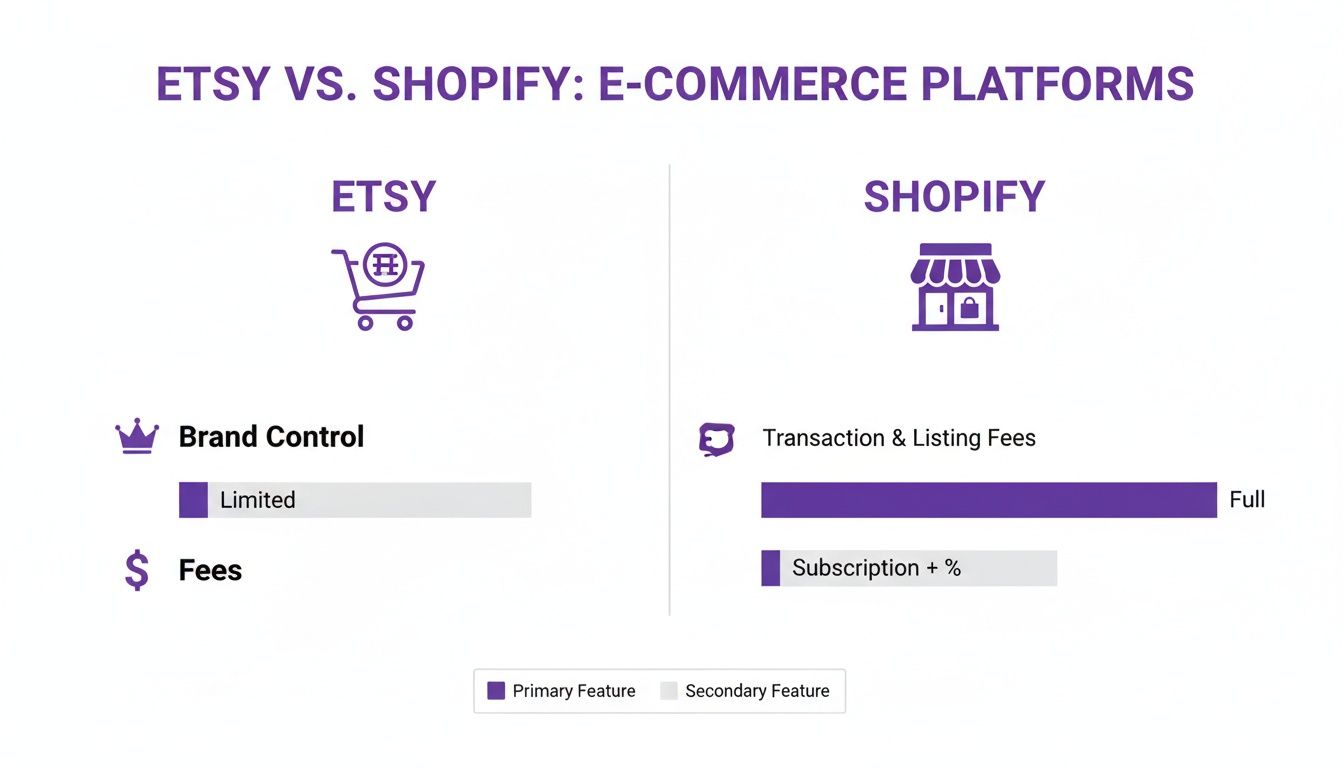
As you can see, having your own website just gives you so much more control over your brand and, crucially, a much healthier fee structure for long-term growth.
How a Shopify Store Liberates Your Profit
Switching to your own website on a platform like Shopify completely changes the financial game. Instead of a confusing stack of percentages, the cost structure is incredibly straightforward and designed to help you grow, not hold you back. You pay a flat monthly subscription and a simple, consistent payment processing fee. That's pretty much it.
Let's run a real-world scenario. Imagine you're processing 100 orders a month at $30 per item plus $5 for shipping—a totally normal situation for sellers hitting that $10k/mo milestone, like many of our clients at Wand Websites. On Etsy, those 100 orders would rack up around $378 in fees, which is an effective take-rate of 10.8%. That number includes transaction fees, payment processing, and listing renewals.
Now, let’s run the exact same numbers on your own Shopify store using their Basic plan. The total fees would drop to just $171—a take-rate of only 4.9%. This is just your payment processing fees plus that predictable monthly subscription. As your order volume grows, that gap gets wider and wider. You can even explore a detailed breakdown of these sales scenarios to see how the numbers change with volume.
That difference of over $200 a month in this example isn't just pocket change; it's capital you can pour right back into your business. Think about what you could do with that extra cash:
- Fund a real marketing budget to drive your own traffic.
- Improve your product quality or source better materials.
- Invest in custom packaging to build a memorable brand experience.
- Simply increase your take-home pay and reward yourself for all the hard work.
For any seller processing over 45 orders a month, the math becomes undeniable. Owning your e-commerce site dramatically cuts your operational costs and puts you back in control of your financial destiny, paving the way for real, scalable growth.
Marketing and Traffic: Who Really Owns Your Audience?
The classic own website vs. Etsy debate often comes down to one critical question: who’s responsible for finding your customers?
Etsy’s biggest draw is its massive, built-in audience. We're talking over 80 million active buyers actively looking for something to purchase. For anyone just starting out, this ready-made traffic feels like a godsend. It's a bustling marketplace where your products are instantly visible to shoppers.
But once your business starts hitting that six-figure mark, what once looked like a strength starts to feel like a serious weakness. The truth is, you don't own that audience. You're just renting it. Getting seen on Etsy is a constant fight for attention in a closed-off world, all dictated by a search algorithm you have zero control over. You’re literally placed right next to your biggest competitors, which often pushes you into a race-to-the-bottom on price just to get noticed.

The Limits of Rented Traffic
Relying only on Etsy for your traffic is like building a beautiful house on rented land. Sure, you can make it look amazing, but you can never truly call it yours, and the landlord can change the rules on a whim. Your marketing options are incredibly limited.
- Algorithm Dependency: A single algorithm update you never see coming can completely tank your sales overnight, with no explanation and no one to call for help.
- Minimal Customer Connection: Etsy’s rules are set up to keep all communication on their platform. This makes building a direct email list—your most valuable marketing asset—nearly impossible.
- Mandatory Ad Spend: Once you're making over $10,000 a year, Etsy’s Offsite Ads program becomes mandatory. They'll take a 12-15% cut of sales from ads you didn't even choose to run.
This system traps successful sellers in a hamster wheel. You're constantly paying for access to customers who never really become yours. You make a sale, but you don't build a long-term asset for your business.
On Etsy, you are constantly competing for the platform’s attention. On your own website, you are competing for your customer’s loyalty. The first is a short-term game of visibility; the second is a long-term strategy for building a valuable brand.
Owning Your Traffic and Your Future
Moving over to your own Shopify store puts you back in the driver's seat. The initial hurdle is obvious: you have to bring in your own traffic from scratch. But this is also where your biggest opportunity lies. Instead of renting an audience, you start building one.
With your own site, you get a whole new marketing toolkit to attract customers who are genuinely looking for what you offer.
- Search Engine Optimization (SEO): You can finally optimize your site to rank on Google for the exact keywords your ideal customers are searching for. This builds a sustainable, long-term flow of free, organic traffic that grows over time.
- Content Marketing: You can start a blog, publish how-to guides, or create videos that solve your customers' problems. This positions you as an expert and builds trust, attracting buyers who value your brand before they even see a product.
- Email and SMS Marketing: This is where you truly start to own your audience. You can collect emails and phone numbers, allowing you to speak directly to your customers. Announce new products, run exclusive sales, and turn one-time buyers into loyal fans who come back again and again.
This direct relationship is the key to creating predictable, scalable revenue. It shifts your business from being a passive shop on a huge marketplace to an active, independent brand that controls its own destiny. When it comes to the "own website vs Etsy" marketing debate, the choice is between short-term convenience and long-term sovereignty.
Building a Brand and Owning Your Customer Data
When people weigh selling on their own website versus Etsy, they usually get stuck on fees and traffic. But honestly, your most valuable long-term asset isn't just your profit margin—it's your brand and the direct line you have to your customers.
On Etsy, your brand always plays second fiddle to Etsy's. Every shop is squeezed into the same rigid layout, with barely any room to customize your storefront. This setup forces your unique brand identity—your colors, your fonts, your story—into a generic, cookie-cutter template that looks just like everyone else's.
The Constraint of Rented Brand Space
Etsy’s rules go way beyond just your shop's appearance. They dictate the entire customer journey, from the checkout process right down to the confirmation emails your buyers get. They even restrict you from including branded materials, like a simple thank you card with a discount code for your own website, because their policies are designed to keep every single transaction within their ecosystem.
"Your brand can get 'lost' on Etsy." I hear this all the time from successful sellers. They feel like their unique identity just gets watered down in the marketplace format. In reality, you're building Etsy's brand just as much as you're building your own.
In stark contrast, your own website built on a platform like Shopify is a completely blank canvas. It’s your digital flagship store where you control every single pixel.
- Custom Design: You get to create a unique, memorable shopping experience that truly reflects your brand's personality and values.
- Domain Ownership: You can build real brand equity with a professional domain (
yourbrand.com) instead of being stuck withetsy.com/shop/yourbrand. - Unforgettable Unboxing: You have total freedom to include any packaging inserts you dream up, like discount codes for future purchases that drive direct traffic and create loyal, repeat customers.
This level of control is what turns your business from a simple shop into a legitimate brand, building a much deeper connection with customers that goes way beyond a one-off sale.
Owning the Goldmine: Your Customer Data
Now for the real game-changer in the own website vs. Etsy debate: data ownership. On Etsy, you get a tiny peek at your customer information. You can't easily build an email list, track detailed customer behavior on your shop, or run any kind of sophisticated marketing campaigns. Etsy owns that customer relationship, and you’re essentially just a supplier.
When you own your Shopify website, you own 100% of your customer data. This is the key that unlocks scalable, profitable growth, especially for businesses looking to hit those $20k-$60k+ months. This data lets you:
- Build Your Email List: Directly collect customer emails and build your single most valuable marketing asset.
- Launch Retargeting Campaigns: Use pixel data to show targeted ads on Facebook and Google, bringing back visitors who browsed but didn't buy.
- Understand Customer Behavior: See exactly how shoppers interact with your site, so you can tweak things and boost your conversion rates.
- Increase Customer Lifetime Value (CLV): Set up automated email flows that nurture relationships, encourage repeat purchases, and dramatically increase the long-term worth of every customer.
Etsy might have been a great place to meet your first customers, but its limitations quickly become a bottleneck for serious growth. For example, in Q1 2025, Etsy’s mobile app drove 44.5% of its GMS using advanced AI personalization—but as a seller, you're completely locked out from powerful integrations with platforms like Facebook or Amazon. On the flip side, Shopify’s Merchant Solutions revenue hit $1.74 billion in that same quarter, largely driven by tools like Shop Pay, which processed a staggering $22 billion in GMV. This is an ecosystem with thousands of integrations for SEO, subscriptions, and multi-channel selling that are absolutely critical for scaling.
It's also essential for serious sellers to start understanding the shift to first-party data as third-party cookies fade away. Owning your site allows you to own your audience and run far more effective marketing. This isn't just about better branding; it’s a strategic move to build a resilient, future-proof e-commerce business. With your own site, you're not just making sales—you're building a sustainable asset.
Scalability and Unlocking Future Growth Potential
Hitting $10,000 a month on Etsy is a huge milestone. Seriously, take a moment to celebrate that. But if you’re like most ambitious brand owners, you're already thinking, "What's next?" This is where the own website vs Etsy debate gets really interesting—it stops being about today's costs and starts being about your brand's future.
Etsy is an amazing place to start, but it's fundamentally a marketplace with a ceiling. As your business grows, you’ll start to feel the platform’s limitations. These aren't just small annoyances; they're structural barriers that can keep a six-figure shop from ever becoming a seven-figure brand.
The Growth Ceiling on Etsy
The very simplicity that makes Etsy great for beginners becomes its biggest weakness when you're ready to scale. The platform just doesn't have the built-in tools for sophisticated growth strategies, which means you're shut out from revenue streams that are standard practice for independent stores.
You’ll start bumping into these walls:
- Inventory Management: Once your product line grows, Etsy's basic inventory system becomes a real headache. Managing hundreds of SKUs, complex variations, and product bundles turns into a manual, time-sucking chore.
- International Sales: While Etsy lets you sell globally, you have very little control over international pricing, shipping rules, and duties. This makes it tough to create a tailored, professional experience for customers in different countries.
- Wholesale (B2B): There’s simply no built-in way to handle wholesale orders. This slams the door on a massive potential revenue stream for brands that are ready to sell in bulk to other businesses.
- Advanced Features: Want to offer product subscriptions? Create custom bundles? Launch a loyalty program? On Etsy, these are either impossible or require clunky, unofficial workarounds that can feel unprofessional.
Etsy is designed to help you make your next sale. An owned website is designed to help you build your next business. This fundamental difference in purpose dictates each platform’s capacity for your long-term growth.
Engineering Your Brand for Unlimited Growth
This is where having your own site, especially on a platform like Shopify, completely changes the game. It’s an ecosystem built from the ground up with one goal in mind: helping your business grow without limits. It's the path to building a multi-million dollar brand—a journey Etsy simply isn't equipped for.
The profit margins alone tell a compelling story. Let's say a print-on-demand shop does $10,000 in revenue on Etsy by selling 334 shirts. After all the layered fees, you might only walk away with $936 in profit. By moving to Shopify, you can price your products more strategically and slash those marketplace fees. The same 334 orders could generate a much healthier profit because you’re no longer giving Etsy a cut of every single sale. You can see a full breakdown of how these financial models shift with scale in this detailed video analysis.
Powering Up Your Growth with Shopify
On your own site, you’re the one in charge. You're no longer playing by a marketplace's rules. Thanks to a massive app ecosystem, you have the freedom to implement just about any strategy you can dream up.
Here’s how a platform like Shopify gets you ready for what's next:
- Endless Customization: The Shopify App Store is your playground, with thousands of tools at your fingertips. You can easily add advanced features like affiliate programs, loyalty rewards, customer reviews, and personalized product recommendations.
- Robust Infrastructure: Your own site is built to handle huge sales volumes without a hiccup. Whether you get a sudden rush of traffic from a viral TikTok or you're running a massive Black Friday sale, your store will stay fast and stable.
- New Revenue Streams: You can unlock powerful growth levers that are off-limits on Etsy. For instance, Home & Living sellers can introduce subscriptions for recurring revenue or create product bundles to dramatically increase their average order value (AOV).
- B2B and Wholesale: Shopify has dedicated tools for managing B2B channels. This allows you to run your retail and wholesale operations from a single dashboard, opening up entirely new markets and scaling opportunities.
Ultimately, choosing between your own website and Etsy for scalability boils down to your ambition. If your goal is to grow a significant, independent brand that can stand on its own two feet, then owning your digital home isn't just an option—it's a necessity.
Your Migration Plan: From Etsy Seller to Brand Owner
So, you're ready to make the leap. Moving your thriving Etsy shop over to your own Shopify store is a huge, game-changing moment. This isn't about starting from scratch; it's about taking the success you've already built and giving it a permanent home where you call all the shots.
The whole process can feel a bit intimidating, but I promise it's manageable when you break it down. Let's walk through a clear checklist to make this move as smooth as possible. Think of this as your strategic plan to go from marketplace seller to a true brand owner.
The Migration Checklist
The secret to a stress-free move is all in the prep work. Before you even think about flipping the "live" switch on your new site, you need to lay a solid foundation. This is how you set the stage for a grand opening that actually feels grand.
Here’s a step-by-step guide to get you rolling:
Secure Your Domain Name: This is your brand's forever home on the web (think
yourbrand.com). You want something professional, easy to remember, and even easier to spell. It’s the very first step in carving out an identity that’s truly your own, far away from the Etsy marketplace.Choose the Right Shopify Plan: Don't go overboard right away. A plan like Shopify Basic is often perfect to start. You can always scale up as you grow. The goal here is to get your store up and running without locking yourself into high overhead from day one.
Migrate Your Products and Reviews: Please, don't manually re-create everything. There are fantastic Shopify apps designed specifically to pull your Etsy listings—photos, descriptions, titles, and most importantly, those hard-earned reviews—right into your new store. That social proof is pure gold for building trust.
Set Up Payments and Shipping: Get your payment gateway configured so you can accept credit cards and other popular payment methods. Then, set up your shipping zones and rates. Your goal is to make checking out feel just as easy and secure as it did on Etsy.
A smooth transition is all about communication. Your loyal Etsy customers are your first and best audience for your new website. Don't leave them behind—bring them with you on the journey.
Your Launch and Announcement Strategy
Once the backend is all set up, it’s time to plan the big reveal. This is where you tap into the loyal customer base you’ve worked so hard to build and get your new store buzzing from the very first day.
Start by dropping hints on your Etsy shop announcements and social media. Build a little anticipation around the launch of your new, independent brand home.
- Create an Incentive: Kick things off with a "Grand Opening" on your new site. An exclusive discount code for your Etsy followers is a powerful way to encourage that first direct purchase. A simple 15% off coupon can work wonders.
- Update Your Etsy Shop: As soon as your site is live, swap out your Etsy banner and update your shop announcement to point everyone to your new domain. You can also slip a branded postcard promoting your new website into your remaining Etsy orders.
- Run a Launch Campaign: Now that you own your customer data, put it to work! Run targeted email and social media campaigns announcing your new store. Frame it around the benefits for them—maybe you’ll be offering new products, a loyalty program, or even better customer service.
Making the final call in the own website vs Etsy debate is a defining moment. By following this plan, you turn what could be a stressful technical chore into a smart, strategic launch. You're not just moving; you're solidifying your brand and paving the way for real, sustainable growth.
Frequently Asked Questions
Taking the next step in your business always brings up a lot of questions. Let's tackle some of the most common ones we hear from sellers weighing the move from Etsy to their own website.
Should I Close My Etsy Shop After Launching My Website?
Definitely not, at least not right away. The smartest move is to think of this as a "both/and" strategy, not an "either/or" decision. Your Etsy shop is a fantastic tool for finding new customers, so keep it running to tap into that built-in traffic.
Then, you can get clever. Use your packaging inserts, a small thank you card, or subtle branding to gently point those new buyers toward your own website for their next purchase. On your site, you can wow them with a loyalty program, exclusive items, and a full brand experience that Etsy just can't offer. This hybrid approach lets you have the best of both worlds while you grow your own site's momentum.
How Much Traffic Do I Need Before Leaving Etsy?
There’s no magic number here. The real answer comes down to profitability and whether you feel confident in your own marketing. A good milestone to aim for is when your website’s profit can comfortably cover its own running costs plus what you're spending on marketing. Instead of fixating on a specific traffic number, focus on building marketing channels you control—like your email list, SEO, or social media following.
Once you can bring in new customers predictably without relying on the Etsy marketplace, you're in a great position to make your own site the star of the show. For most sellers already hitting $10k+/month, the money you save on Etsy fees alone is often enough to kickstart a serious marketing budget from day one.
Is It Hard to Move Products and Reviews to Shopify?
Doing it all by hand would be a massive headache, but thankfully, there are tools that make it incredibly straightforward. The Shopify App Store has several migration apps built specifically to pull your Etsy listings—we’re talking titles, descriptions, photos, and even your hard-earned reviews—over to your new store in just a few clicks.
If you want to make sure everything is transferred perfectly and set up for top-notch SEO and a great customer experience, working with a migration service is the way to go. It turns a potentially overwhelming task into a smooth, managed process. Getting the right support makes this pivotal step in the own website vs Etsy journey much, much easier.
Ready to stop renting space and start building your own brand? At Wand Websites, we make the transition from Etsy to a professional Shopify store feel simple and profitable. Let us handle the technical stuff so you can get back to what you do best: creating. Explore our website solutions today!
