
Demystifying Online Advertising Costs for Ecommerce Brands

Trying to pin down a single number for online advertising costs is like asking, "How much does a car cost?" The answer can be anything from a few hundred bucks to a few million. In the ad world, you might pay anywhere from $0.10 to over $50 for a single click, depending on who you're trying to reach, where you're advertising, and how many other people want that same person's attention.
For a small business just getting its feet wet, a monthly budget between $500 and $2,000 is a pretty common starting point. But honestly, that number can swing wildly based on your ambitions and how crowded your market is.
So, How Do Online Ad Costs Really Work?
Ever feel like digital ad costs are a complete black box? You're not alone. It can feel needlessly complicated, but it all boils down to one simple concept: a massive, real-time auction for people's eyeballs.
Imagine you're trying to buy tickets for the hottest concert of the year. The best seats—your perfect customers—are the ones everyone wants. You and a bunch of other fans (your competitors) are all bidding for those same front-row spots. The platform doesn't just give the seat to the highest bidder, though. It goes to the bidder who also has the best "vibe" (a high-quality, relevant ad). This constant bidding war is why online advertising costs are always in flux.
The Three "Currencies" of Ad Pricing
To make any sense of this auction, you need to speak the language. There are three main "currencies" or models that platforms use to charge you. Each one tells you something different about how your campaigns are performing.
- CPC (Cost Per Click): This is the simplest one. You only pay when someone actually clicks on your ad. It's the go-to model when your main goal is to get people to your website or a landing page.
- CPM (Cost Per Mille): "Mille" is just a fancy Latin word for a thousand. With CPM, you pay a flat rate for every 1,000 times your ad is shown on a screen (an "impression"). Clicks don't matter here; it's all about getting your brand seen, making it perfect for building awareness.
- CPA (Cost Per Acquisition): This is where things get really interesting for e-commerce. You only pay when someone takes a specific, valuable action—like actually buying your product or signing up for your email list. It's the ultimate performance model because it directly connects your ad spend to real-world results.
Think of these metrics as your campaign's dashboard. For most online stores, CPA is the North Star because it tells you exactly how much you're paying to make a sale.
This whole system is a huge deal. Globally, marketers are on track to spend a staggering US$790–$800 billion on digital ads between 2024 and 2025. That accounts for about 72–75% of all advertising money spent worldwide. Getting a handle on these cost structures isn't just a good idea anymore; it's essential for any brand that wants to grow. If you're curious, you can dive deeper into these advertising statistics and market trends.
A Realistic Look at Ad Costs on Major Platforms
Jumping into paid advertising can feel like walking into a massive, bustling marketplace. Every stall—or platform—has its own currency, its own crowd, and its own price tags.
What you'll pay to get a customer's attention on Google is almost never the same as what you'll pay on TikTok. Understanding these differences is the first step to spending your budget wisely, not just quickly.
Google Ads Cost Benchmarks
Google is where people go when they know what they want. They're actively searching for a solution, which makes them high-intent customers. But that kind of intent comes at a premium.
- Google Search: Clicks here can be all over the map, from $1.00 to over $50.00. Super competitive industries like law and finance are on the high end. For most e-commerce stores, you're looking at a more manageable $1.00 to $2.00 per click.
- Google Shopping: These visual ads are an e-commerce must-have and are usually more budget-friendly. The average CPC is often around $0.66 because the images do a lot of the work, pre-qualifying clicks from people who are serious about buying.
The high cost on Google Search is all about competition. You're bidding against everyone else for keywords that scream "I'm ready to buy," and that prime digital real estate costs money.
Meta Ads (Facebook and Instagram) Costs
If Google is for finding, Meta is for discovering. Its power lies in its incredible audience data, letting you get your products in front of people based on their lifestyles and interests. It's a discovery engine.
On average, you can expect a CPC of around $0.97 on Facebook. For a closer look at the numbers, this guide to Facebook advertising costs is a great resource.
Instagram, being so visual and engaging, typically sees a CPC between $0.20 and $2.00. When looking at CPMs (the cost per 1,000 views), Facebook averages about $14.40, while Instagram is often a bit lower.
TikTok and Amazon Advertising Costs
TikTok has a massive, highly engaged audience, especially if you're targeting younger demographics. The costs are still relatively low as the ad platform continues to grow, with an average CPM hovering around $10.00. But heads up—that number is climbing as more brands jump in.
Amazon Advertising is a completely different beast. It's a non-negotiable if you sell on the platform. You're reaching shoppers with their wallets out, right at the point of purchase. The average CPC is about $0.77, but the competition can be absolutely brutal, especially for popular products.
This chart gives you a quick visual on how these different pricing models stack up.
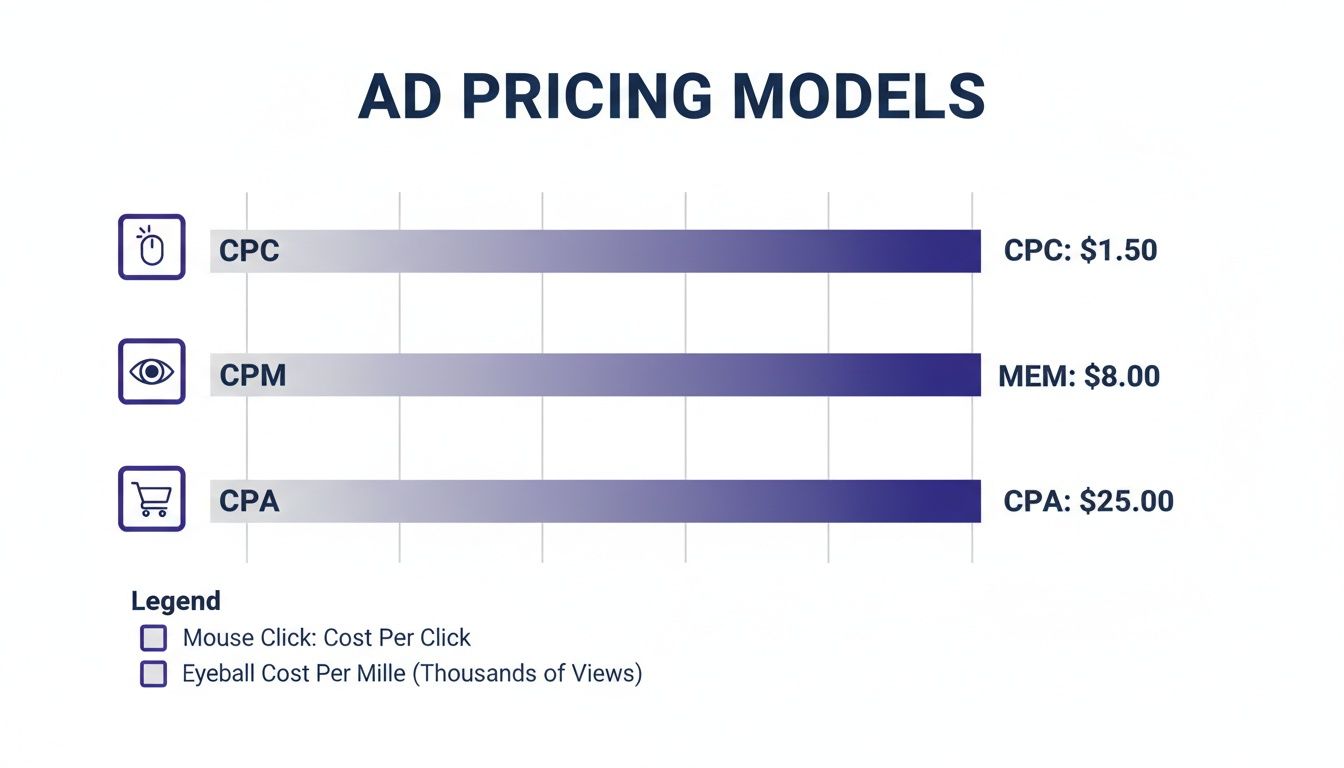
It’s pretty clear: getting clicks (CPC) or views (CPM) is one thing, but actually acquiring a paying customer (CPA) is where the real investment happens.
To give you a side-by-side comparison, here’s a quick breakdown of what you can generally expect across these major channels.
Average Online Advertising Costs By Platform
Keep in mind, these are just benchmarks. Your actual costs will swing based on your industry, audience targeting, ad quality, and a dozen other factors. Think of these numbers as a starting point, not a guarantee.
The Hidden Factors Driving Your Ad Spend
Ever feel like you’re doing everything right, but your ad costs suddenly shoot through the roof? It’s a classic, and frustrating, part of the game. While those channel benchmarks give you a decent starting point, they don't tell the whole story. Several powerful, often invisible forces are always at work, pushing your ad spend up or down.
Think of it like gas prices. The car you drive (your ad platform) is part of the equation, sure. But the real price you pay at the pump is dictated by things like global supply (your competition), the time of year (seasonality), and even the specific gas station you pull into (geography). Getting a handle on these underlying factors is how you move from just spending money to strategically investing it.
Competition and Industry Niche
The single biggest lever on your costs? Competition. Plain and simple. You're in a constant bidding war for eyeballs, and if your niche is packed with other advertisers, you're going to pay a premium.
Someone selling a $2,000 financial planning service can obviously afford to bid way more for a single click than an e-commerce store selling $25 t-shirts. This is exactly why you see insane CPCs in finance, real estate, and legal services—sometimes topping $50 a click. Your costs are directly tied to what a customer is worth in your specific corner of the market.
Seasonality and Timing
Your ad costs don't exist in a bubble; they ebb and flow with the calendar. The most obvious example is Q4, especially the mad dash from Black Friday through Christmas.
During this peak shopping frenzy, competition goes into overdrive as every brand fights for a slice of the holiday pie. It’s totally normal to see your ad costs double or even triple. On the flip side, you might find costs dip in a post-holiday slump like January, creating a golden opportunity to scoop up customers for less.
Ad Quality and Relevance
Here’s a secret not everyone gets: the platforms want you to create good ads. They actually reward you for it. By serving up relevant, high-quality experiences, you get a leg up with lower costs and better placements. This is the whole point behind metrics like "Quality Score" on Google or "Ad Relevance Diagnostics" on Meta.
A high Quality Score is like getting a discount on your ad spend. It tells the platform that your ad and landing page are a great match for what the user is looking for, so you're charged less for each click.
One of the most critical, yet often overlooked, elements dictating your costs is the Google Ads Quality Score. A higher score directly leads to a lower CPC, which can be a massive competitive advantage.
Audience Targeting and Geography
Finally, who you're trying to reach and where they live has a massive impact on your budget.
- Targeting Precision: Going broad is almost always cheaper. An audience of "fitness enthusiasts" will cost less to reach than an audience of "female yoga practitioners, aged 25-34, who have purchased from Lululemon in the last 30 days." But that super-specific audience is way more likely to convert, often making the higher price worth it.
- Geographic Location: It costs a lot more to advertise to someone in the United States or Australia than it does in a country with lower average incomes. The competition is just fiercer in those high-value markets because the potential payoff is that much bigger.
How to Calculate a Profitable Advertising Budget
Alright, let's get down to brass tacks. Understanding all the different online advertising costs is great, but the real magic happens when you know exactly how much to spend to actually grow your store. This isn't about pulling a number out of thin air; it’s about having a solid framework to build a budget that works for you.
The secret is to stop guessing and start calculating. A smart ad budget is built backward from your goals, using just three numbers you already have on hand: your product’s selling price, your cost to make or buy it, and the profit you want to pocket.
From there, we can figure out the absolute most you can spend to land one customer and still make money. This magic number is your break-even Cost Per Acquisition (CPA), and it's the guardrail that keeps your ad spend from going off a cliff.
Finding Your Break-Even Point
Let's walk through this with an example. Imagine you sell premium coffee beans online. Your most popular bag sells for $50, and after all is said and done—the beans, the bag, the shipping—your Cost of Goods Sold (COGS) is $20.
That leaves you with a gross profit of $30 per sale. Simple, right? Well, that $30 is your break-even CPA. If you spend exactly $30 on ads to get a single sale, you’ve washed your hands of the transaction—no profit, no loss. Spend less, and you're in the green. Spend more, and you’re paying people to take your coffee.
Your Break-Even CPA is your safety net. It's the maximum you can pay to acquire a customer without losing money on the initial sale. Knowing this number gives you complete control over your campaign profitability.
Once you know your break-even point, you can set a realistic target that actually puts money in your pocket.
Setting Your Target CPA and ROAS
Breaking even is fine, but we're here to grow a business. A good rule of thumb is to set a Target CPA that's around 50% of your gross profit. This gives you a healthy profit margin while still letting you be competitive enough to scale up your campaigns.
Let's go back to our coffee bean store:
- Gross Profit: $30
- Target CPA: $30 x 50% = $15
This means your goal is to spend no more than $15 to sell one bag of coffee. That leaves a cool $15 in net profit from that sale after your ad costs are paid.
Now, let's connect this to another metric you’ll hear all the time: Return on Ad Spend (ROAS). ROAS is just a simple way to measure how much money you get back for every dollar you put into ads. To find your target ROAS, just divide your product's price by your Target CPA.
- Product Price: $50
- Target CPA: $15
- Target ROAS: $50 / $15 = 3.33x
Boom. Now you have a crystal-clear goal: for every $1.00 you spend on ads, you need to generate $3.33 in revenue. This is a real, data-driven target you can actually manage your campaigns against.
Calculating Your Monthly Ad Budget
The final piece of the puzzle is turning these per-sale numbers into a monthly budget. And this part is all about your ambition. How many new customers do you want to bring in each month?
Let's say you're aiming for 100 new customers next month.
The math is beautifully simple:
- Target CPA: $15
- New Customers Goal: 100
- Monthly Ad Budget: $15 x 100 = $1,500
And there you have it—a smart, profitable, and totally scalable advertising budget. That $1,500 isn't a random guess; it's a number tied directly to your product's real-world profitability and your specific growth goals. If you want to be more aggressive, you can aim for 200 customers and double the budget. If you want to be more conservative, aim for 50. You’re in complete control.
Sample Budgets for a $10k/Month Store
To see how this plays out in the real world, let's look at a store already doing $10,000 a month in revenue. They want to invest a portion of their profits back into growth. Here’s one way they could spread their ad budget across a few key channels, each with a different but realistic ROAS target.
Sample Ad Budgets for a $10k/Month Ecommerce Store
In this scenario, a total ad spend of $2,500 (or 25% of monthly revenue) is projected to generate an additional $9,250 in sales, nearly doubling the store's monthly revenue. This is a common approach for a growth-focused brand, reinvesting a significant chunk of revenue to fuel further expansion. Your own mix and budget will depend on where your customers hang out and which channels perform best for you.
Actionable Strategies to Reduce Your Ad Costs
Alright, you've got a smart, data-driven budget. Now comes the fun part: making every single dollar stretch as far as it can. Reducing your online advertising costs isn’t about pulling the plug on your spending; it's about ruthlessly cutting out the waste and maximizing efficiency. This is exactly how profitable brands pull away from the ones just burning cash.
Think of it like tuning a high-performance engine. A few small, smart tweaks can unlock a huge boost in power and fuel efficiency. Your ad campaigns work the same way. Let's dig into the proven tactics you can put to work today to get more bang for your buck.
Sharpen Your Audience Targeting
The single fastest way to burn through your ad budget is to show your ads to the wrong people. Every click from someone who has zero interest in buying is money down the drain. The fix? Get surgical with who you're trying to reach.
Don't settle for a broad audience like "people interested in fitness." That’s way too vague. Instead, build specific audience segments based on demographics, online behaviors, and even past purchase history. You could, for instance, target "women aged 25-40 who have purchased athletic wear online in the last 90 days."
Getting this precise means your ads are only hitting the eyeballs of highly relevant potential customers. This focus naturally improves your conversion rates and drives down your cost per acquisition.
A well-targeted ad speaks directly to a specific person's needs. A broad ad speaks to everyone and resonates with no one, forcing you to pay for irrelevant attention.
Elevate Your Ad Creative and Copy
Your ad creative is your storefront window on the internet. If it’s bland or confusing, people will just scroll right on by. Ad platforms actually reward engaging ads with higher relevance scores, which directly leads to lower advertising costs for you.
To get that engagement up and your costs down, you need to test, test, and test again. Here’s what to focus on:
- A/B Test Headlines: Pit different hooks against each other. Does a benefit-driven headline ("Get a Better Night's Sleep") work better than one that hits a pain point ("Tired of Tossing and Turning?")?
- Vary Your Visuals: Don't get stuck using the same static product shots. Try running user-generated content, quick video clips, or lifestyle images to see what really grabs your audience. Even a 23% lift in engagement on Instagram can make a huge difference in your costs.
- Refine Your Call to Action (CTA): Experiment with your CTAs. "Shop Now" might sound standard, but what if "Learn More" actually performs better for your product? Tiny tweaks in wording can have a surprisingly big impact on your click-through rates.
Optimize Your Landing Page Experience
Your ad is only half the battle. You could create the most compelling ad in the world, but if it sends people to a slow, confusing, or untrustworthy landing page, you’re just lighting money on fire. The journey from that first click to the final purchase has to feel effortless.
Make sure your landing page delivers on the promise made in your ad. If your ad highlights a specific red dress, the click should take them directly to the product page for that red dress—not your generic homepage.
Concentrate on boosting your page load speed, making sure everything looks great on mobile, and simplifying the checkout process as much as humanly possible. A smooth, frictionless landing page is what turns that expensive click into a profitable sale, making every ad dollar count.
Your Simple Ecommerce Advertising Roadmap
Alright, we’ve covered a lot of ground. You now have the essential building blocks for a smart, profitable advertising strategy. We’ve pulled back the curtain on the whole world of online advertising costs, moving past the guesswork and into making real, data-driven decisions.
From understanding the nuts and bolts of metrics like CPC and CPM to actually calculating a budget based on your real profit margins, you're set up for success.
Just remember, this isn't a "set it and forget it" kind of thing. Managing your ad spend is a living, breathing process. It's a constant cycle of launching, measuring what happens, and tweaking your approach. What kills it today might need a little adjustment tomorrow as customer behavior shifts or platform costs creep up.
True success in advertising comes from staying curious. Treat every campaign as a learning opportunity to discover what truly motivates your customers and drives your growth.
Whether you're about to dive in with your very first campaign or you're trying to get more from what you're already running, you now have the knowledge to move forward with confidence.
Your Final Checklist for Success
To keep you on the right path, here’s a simple action plan to follow:
- Calculate Your Numbers: Before you even think about spending a dime, figure out your break-even CPA and set a Target ROAS that actually makes you money.
- Choose Your Battlefield: Don't try to be everywhere at once. Start with one or two platforms where you know your ideal customers are hanging out.
- Test and Learn: Always set aside a small piece of your budget to experiment with new ad creative, different headlines, and fresh audiences. This is where you'll find your next big win.
- Review and Optimize: Put a recurring reminder in your calendar—maybe every Friday—to check your campaign performance and make adjustments based on what the data is telling you.
Following this roadmap is how you turn your ad spend from a confusing expense into a predictable engine for growing your business.
Frequently Asked Questions
Diving into the world of online ads can feel like you're learning a new language, especially when it comes to the costs. Let's clear up some of the most common questions that pop up.
How Much Should a Small Business Actually Spend on Ads?
This is the million-dollar question, isn't it? While there’s no one-size-fits-all answer, a solid starting point for a small business is somewhere between $500 and $2,000 a month.
Think of this initial budget as your "learning fund." It's enough to get your ads in front of a meaningful number of people, run a few different tests, and start gathering real-world data on what resonates with your audience. You’re not just paying for clicks; you’re paying for priceless insights that will guide your strategy moving forward.
The best budget isn't a static number—it’s a dynamic investment that should grow with your business. Prove the model works on a small scale, then reinvest your returns to fuel bigger campaigns.
Why Are My Ad Costs All Over the Place?
If you've noticed your ad costs seem to have a mind of their own, you're not imagining things. It all comes down to the classic principle of supply and demand. You’re essentially in a live auction, bidding against countless other businesses for a finite amount of screen space.
Several things can make these costs swing wildly:
- Seasonality: Costs naturally climb during big shopping holidays like Black Friday or Valentine's Day when everyone is trying to get in front of buyers.
- Competition: A new, well-funded competitor jumping into your market can drive up auction prices for everyone overnight.
- Audience Targeting: Trying to reach a very specific, high-value group of people (like new homeowners with high incomes) will always be more expensive than a broader audience.
What's the Best Ad Platform if I'm Just Starting Out?
For most e-commerce brands dipping their toes into paid ads for the first time, Meta (Facebook and Instagram) is tough to beat. It strikes a great balance between being user-friendly and incredibly powerful.
Meta's strength lies in its ability to help you find your ideal customer based on their interests, online behaviors, and demographics—even if they’ve never heard of you before. While Google Ads is fantastic for capturing people actively searching for your product, it can be a bit pricier and more competitive. Meta lets you build awareness and drive sales with visually compelling ads that are perfect for sparking that "I need that!" moment of discovery.
Ready to turn your ad traffic into profit with a website that’s built to convert? Wand Websites specializes in high-performing Shopify stores that make scaling your business feel effortless. Let's build your growth engine together.
