
Local SEO Solutions: A Guide for E-commerce Brands

You've already done the hard part. Your Etsy shop works. Orders come in, reviews stack up, and people clearly want what you make.
But once a shop gets traction, Etsy starts to feel smaller. You can't fully control the customer journey. You don't own the platform. Fees eat into margin. And when someone remembers your brand name and types it into Google, Etsy often gets more of the benefit than you do.
That's where local SEO becomes useful in a way most marketplace sellers miss. It's not just for restaurants, salons, or contractors. If you make products from a home studio, run a workshop, do local pickups, attend markets, offer custom work, or want people in key cities to find your brand directly, local search can help you move from “popular Etsy shop” to “real independent brand.”
From Etsy Star to Local Legend
A familiar story goes like this. A seller starts on Etsy with one strong product line. Maybe it's handmade candles, custom wall art, wedding signage, ceramic mugs, or personalized housewarming gifts. They figure out photography, tighten listings, collect reviews, and finally cross into serious monthly revenue.
Then growth gets awkward.
When Etsy stops feeling like enough
The next level usually doesn't come from tweaking tags for the hundredth time. It comes from building demand outside the marketplace. You want customers to search for your brand, land on your site, and buy from you directly. You want repeat buyers on your email list, not borrowed attention inside a crowded search page.
That's exactly why local search matters. Search behavior is heavily location-driven. One widely cited benchmark says 46% of all Google searches have local intent, 80% of consumers use search engines when looking for local information, and 28% of local searches result in a purchase within 24 hours according to these local SEO benchmarks.
For an e-commerce brand, that matters more than is generally acknowledged.
If someone searches “custom wedding welcome sign Austin,” “handmade candles near Portland,” or “personalized baby gift Chicago,” they're often much closer to buying than someone casually browsing Etsy category pages. They may want faster fulfillment, local relevance, easier trust signals, or a seller who feels real and nearby.
Practical rule: If your product has any geographic angle at all, production location, event market, regional style, local pickup, showroom, studio, or custom service area, local SEO deserves a spot in your growth plan.
The shift from listing optimization to brand ownership
Etsy teaches you how to win inside Etsy. Local SEO helps you win as a business.
That's the big shift. You stop thinking only about listings and start thinking about search visibility attached to your own name, your own website, and your own operating footprint. A home studio can become a local signal. A workshop can become a search asset. A city-specific collection page can become a revenue page.
Here's the opinionated version. If you're already successful on Etsy and you're still ignoring local search, you're leaving high-intent demand on the table. Not all of it. But enough to matter.
And unlike marketplace traffic, local visibility can strengthen your brand instead of someone else's platform.
What Are Local SEO Solutions Anyway
Local SEO solutions are the systems you put in place so nearby or region-specific buyers can find your brand when they search on Google.
It's like opening a digital stall at every local market you want to sell in. Not manually. Not one weekend at a time. Continuously.
It's not just for storefronts
Most advice on local SEO assumes you run a bakery, plumbing company, or retail shop. That's too narrow.
If you're an Etsy seller moving into Shopify, local SEO solutions can still apply when you:
- Make products from a studio or workshop and want local credibility
- Offer pickup, appointments, or custom consultations in your region
- Sell products tied to life events like weddings, baby showers, housewarmings, and corporate gifting
- Attend markets or pop-ups and want people to discover you before and after the event
- Want to rank in specific cities where demand is strongest
A lot of the practical playbook overlaps with what service businesses use. If you want a plain-English example from another industry, these local SEO tips for contractors are worth scanning because they show the core mechanics clearly: local relevance, trust signals, and visibility where buyers are already searching.
What local SEO solutions actually include
For e-commerce brands, local SEO solutions usually involve a mix of:
- Google Business Profile setup or optimization so your brand can appear in Maps and local results
- Location-focused pages for important cities or service areas
- Consistent business information across your site and major platforms
- Locally relevant content that makes your brand feel tied to a place, not floating in the internet void
- Reviews and reputation signals that support trust
- Structured data that helps Google understand who you are and where you operate
Local SEO is a way to connect online buying behavior with geographic intent. That's useful even when the transaction happens on your site, not at a cash register.
The smartest way to think about it is this. Local SEO solutions are not a side tactic. They're a bridge. They connect your product brand to nearby buyers who are already searching with urgency.
And that's why this matters for Etsy sellers. You don't need a storefront to deserve local visibility. You need a real business with a geographic anchor and a reason someone in a place would choose you.
The 7 Core Components of Local SEO
Local SEO gets easier once you stop treating it like one big mystery. It's really a stack of parts that support each other.
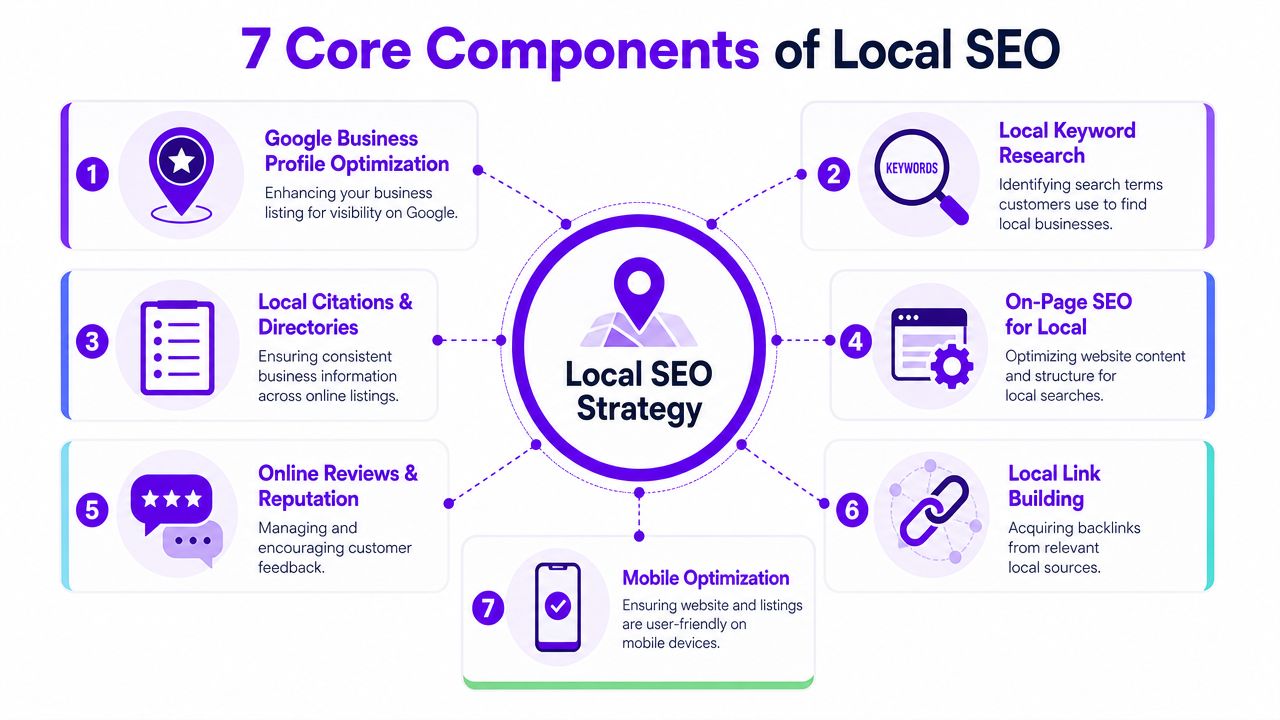
The seven pillars that actually matter
Google Business Profile
This is your public business identity on Google. Even for an e-commerce brand, it can support branded searches, map visibility, credibility, and review collection. If you need a tactical walkthrough, this 2026 Google Business Profile playbook is a useful reference.Local keyword strategy
You need to know how buyers search. Not just “soy candle,” but “soy candle gift Boston” or “custom wedding favors Nashville.” Local intent often appears in city, neighborhood, or “near me” style searches.Citations and NAP consistency
Your business name, address, and phone need to match across your website, profiles, and directory listings. Ahrefs highlights this as a trust foundation in its guide to local SEO. When details conflict, search engines can struggle to reconcile your business entity.Customer reviews
Reviews are trust in public. They influence whether someone clicks, calls, or buys. For product brands, they also help turn “I found this shop” into “this looks legitimate.”
Before going further, watch this if you want a quick overview of how the ecosystem fits together:
The website layer most sellers neglect
Local on-page SEO
Your site starts doing real work here. Title tags, headings, body copy, internal links, image alt text, and location references all help Google understand where you're relevant.Local link building
Local mentions from event pages, chambers, blogs, neighborhood publications, makers' directories, and community partners can strengthen your location signals. For Etsy sellers, this often comes from pop-up listings, gift guides, sponsorships, and collaborations.Schema markup
Schema is structured data. It helps search engines interpret your business details more clearly. You're not writing for humans here. You're making your data easier for Google to process.- Claim and manage profiles yourself rather than letting them sit half-finished
- Write unique city or service-area pages instead of cloning templates
- Check listings and business details manually across the web
- Learn enough technical SEO to avoid damaging your site structure
- A clear architecture plan for location pages and internal linking
- Technical implementation without risking site issues
- Process across listings, reviews, content, and schema
- Ongoing execution while you stay focused on products, fulfillment, and creative work
- Parent page for your broader area or regional service
- Child pages for each city you care about
- Unique copy on every page, tied to that place
- Internal links connecting products, city pages, and relevant blog content
/texas/custom-housewarming-gifts/dallas/custom-housewarming-gifts/austin/custom-housewarming-gifts- A clear title tag with the city and product or service angle
- An H1 that matches local search intent
- Original body copy written for that place
- Relevant internal links to collections, product pages, FAQs, and contact
- Map or location context when appropriate
- Images with descriptive alt text that reinforce geography
- Schema markup to help search engines understand the page
Set up Google Business Profile as a service area business if needed
If you work from home and don't want your address public, use the appropriate setup for a service area business. That lets you participate in local search without turning your house into a storefront listing.Create city pages around real demand
Don't build fifty pages. Start with the handful of places where you already get traction, attend markets, or see strong order volume. Keep them specific.Target local-intent product searches
Product keywords with city modifiers can work especially well for custom, gift, event, and seasonal categories. “Custom housewarming gift Dallas” is more useful than chasing broad vanity traffic.Publish local relevance content
Write about local markets, event prep, gift trends in your area, neighborhood guides, or seasonal buying moments tied to actual places you serve.Collect reviews that mention context
Encourage happy buyers to mention the city, event type, or local experience in a natural way. Don't script weird wording. Just ask for specifics.Build links through community participation
Sponsor a school fundraiser, partner with a local florist, join a maker market, donate to an auction, or collaborate with a venue. Local SEO gets stronger when your business appears in real local ecosystems.Keep conversion paths clean
Don't let local pages become dead ends. Every city page should drive visitors toward products, inquiries, bookings, or checkout.- Don't create duplicate city pages with near-identical text
- Don't force local intent onto every product if it isn't relevant
- Don't over-prioritize Maps visibility if your main revenue path is still online checkout
- Don't ignore site conversion while chasing rankings
- Claim or create your Google Business Profile if you haven't done it yet.
- Decide your local footprint by naming the top cities, regions, or service areas that matter to your business.
- Check your NAP details across your website, social profiles, and key business listings so the information matches exactly.
- Add location context to your site footer and contact page where appropriate and accurate.
- Choose one primary local keyword theme tied to your strongest product line.
- Create your first location page for the market with the clearest demand.
- Write original copy that speaks to buyers in that city instead of cloning a template.
- Link that page to relevant collections and products so it can support revenue, not just rankings.
- Add basic LocalBusiness schema with accurate business details and service areas.
- Request reviews from recent happy customers and ask for honest, specific feedback.
- Focus on a few markets first instead of trying to rank everywhere.
- Review pages manually before publishing so they read like useful landing pages, not SEO filler.
- Track business outcomes such as inquiries, branded search lift, product page visits from local pages, and completed orders.
- Revisit weak pages and improve them instead of pumping out more thin ones.
Worth remembering: local SEO doesn't work well when one pillar is polished and the rest are sloppy. A strong profile with a weak site won't carry you. Neither will a good site with messy business data.
How these pieces work together for e-commerce
An Etsy seller moving to Shopify usually focuses on product pages first. That's fine, but local SEO requires a broader view.
Here's a simple mental model:
| Component | What it does for your brand |
|---|---|
| Google Business Profile | Makes you discoverable in local search surfaces |
| Keywords | Matches your pages to buyer language |
| Citations and NAP | Confirms your business identity |
| Reviews | Builds click-level trust |
| On-page SEO | Gives search engines location context |
| Local links | Adds authority and relevance |
| Schema | Clarifies your data for search engines |
If one piece is missing, the system gets weaker. If several are missing, you'll struggle to show up where it counts.
Choosing Your Path DIY or Agency
At some point, every growing brand has to decide whether to handle local SEO in-house or hand it to a specialist.
There isn't a universally correct answer. There is a correct answer for your current stage.
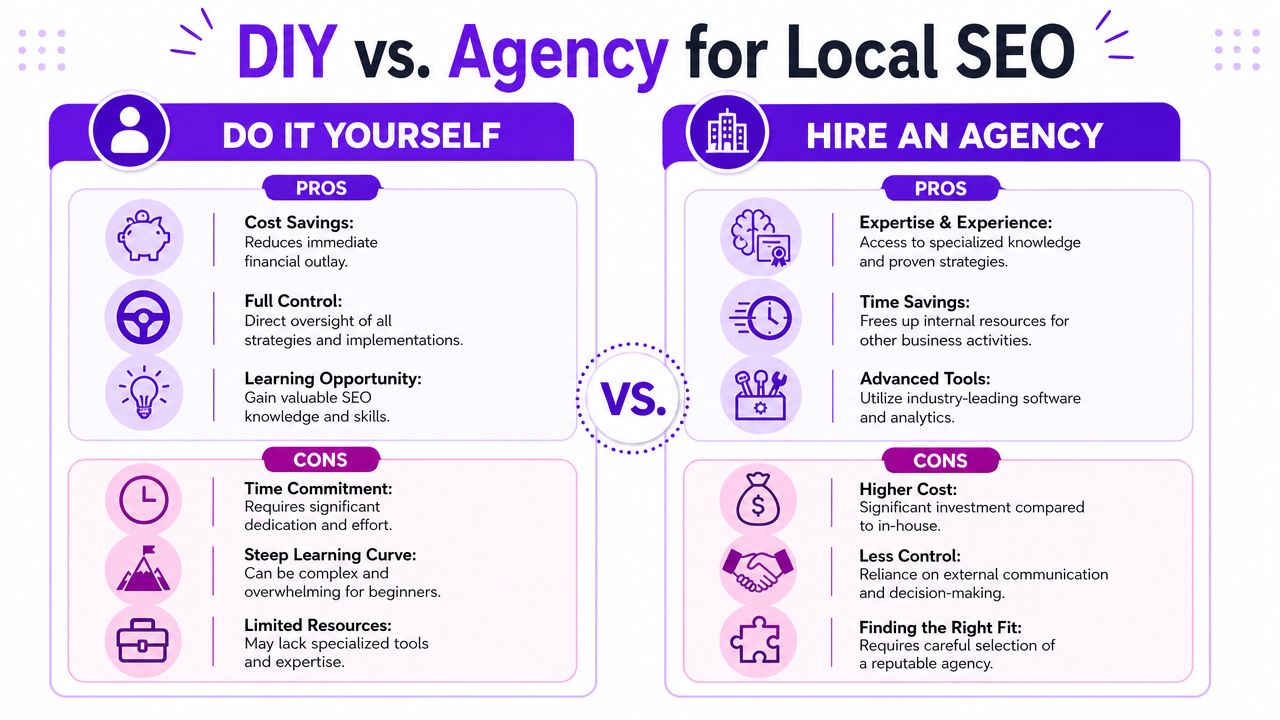
DIY makes sense when focus is still tight
DIY is the right move if you have a narrow footprint, a small number of target locations, and the discipline to implement properly.
That usually means you're willing to:
DIY is slower, but it gives you control. If you're detail-oriented and your operation is still compact, that trade-off can work.
Agency makes sense when complexity starts compounding
Once you're juggling multiple target cities, a growing Shopify catalog, event-based marketing, and a brand migration away from Etsy, local SEO gets messy fast.
An agency is useful when you need:
One option in that mix is Wand Websites, which works with e-commerce brands on Shopify builds, optimization, and growth support. For sellers leaving Etsy, that kind of support can matter because local SEO works best when the website, conversion path, and brand structure are built together.
A practical comparison
| Factor | DIY Approach | Agency Approach |
|---|---|---|
| Cost | Lower cash outlay, higher time cost | Higher cash outlay, lower founder time |
| Speed | Slower while you learn and test | Faster if the team already has process |
| Control | Full direct control | Shared control and approval flow |
| Expertise | Limited by your current skill set | Access to specialists and established workflows |
| Scalability | Fine for a few locations | Better for multi-location or multi-market growth |
| Risk | Easy to miss technical details | Easier to avoid common implementation mistakes |
Don't outsource confusion. If you hire an agency, know what you want fixed, what markets you care about, and what business outcome you expect.
My opinion is simple. If local SEO is a side experiment, do it yourself. If it's part of your next growth phase, get help before you build the wrong structure and have to redo it later.
Mastering On-Page and Technical Signals
If you only fix one technical area, fix your location-page architecture.
That's the lever most e-commerce brands miss, and it's one of the clearest local SEO opportunities available. Sitebulb notes in its guide to technical local SEO architecture that strong location pages should be distinct, indexable hubs with unique copy, location-specific URLs, and LocalBusiness schema. Thin duplicates can hold rankings back because they don't show real local intent.
Build pages for places, not just products
A generic contact page won't do the job if you want visibility in multiple cities.
A better structure looks like this:
For example, instead of one page that vaguely says you ship nationwide, build pages such as:
Each page should include location-specific context. That can be event types, customer use cases, shipping or pickup notes, testimonials from that area, or local references tied to the product category.
A city page is not a page where you swap one city name for another. It needs its own reason to exist.
What to put on a strong location page
Use this checklist:
If your store runs on Shopify, technical cleanup often overlaps with broader site issues like crawl paths, duplicate templates, and thin page structures. This guide on fixing Shopify SEO issues is useful if you need a stronger handle on the platform-specific side.
A simple schema starting point
You don't need a giant implementation to begin. A basic JSON-LD block can already help clarify who you are.
{
"@context": "https://schema.org",
"@type": "LocalBusiness",
"name": "Your Brand Name",
"url": "https://www.yourdomain.com",
"telephone": "Your Phone Number",
"address": {
"@type": "PostalAddress",
"addressLocality": "Your City",
"addressRegion": "Your State"
},
"areaServed": ["City One", "City Two", "City Three"]
}
Keep it accurate. Structured data is not a place to stuff keywords. It's a place to make your business information explicit.
A Local SEO Plan for E-commerce Brands
The biggest mistake in local SEO is assuming it only works for walk-in businesses.
That's outdated. A lot of guidance still focuses on storefronts, and there's a real gap around how local SEO fits businesses that sell online, by phone, or across regions. Arc4 points this out in its discussion of local SEO strategy for non-storefront businesses. That gap matters if you're building an e-commerce brand with local roots but broader reach.
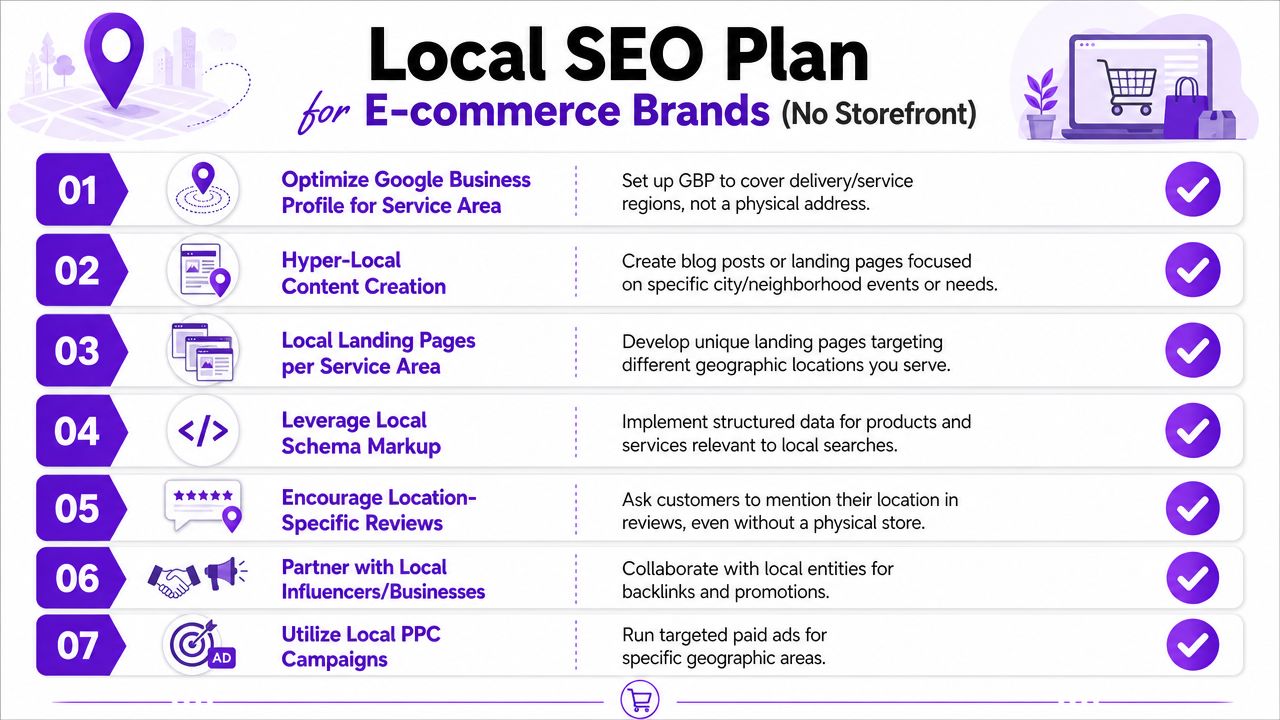
The right way to think about local when you sell online
If you ship nationally, local SEO still works. You just need to use it strategically.
Your goal isn't to pretend you're a corner shop. Your goal is to create strong local relevance in places where buyers are likely to choose you. That could be where you make the product, where you frequently serve customers, where your style fits the market, or where your event-driven demand is concentrated.
Here's the playbook I'd use.
Seven moves that fit e-commerce brands
Local SEO for e-commerce only fails when brands treat “local” and “online” as separate worlds. Buyers don't. They search locally and buy however is easiest.
What not to do
A short warning list matters here.
That last one matters most. A local page that ranks but doesn't help someone trust you, browse products, or buy is just a vanity asset.
The brands that win treat local SEO as support for brand expansion, not a replacement for e-commerce fundamentals.
Your Implementation Checklist
You don't need to do everything this week. You do need to stop leaving this as a vague future project.
Start with the highest-leverage fixes
Then build search assets you actually own
Keep the plan realistic
Start with one location, one product angle, and one clean page. That's enough to prove whether local SEO solutions can support your next stage of growth.
If you've built a strong Etsy shop, you already know how to create demand. Local SEO is about capturing a different slice of it. The slice where buyers search with place in mind, want someone credible, and are ready to act.
If you're ready to move beyond Etsy and want a site that supports both direct sales and smarter local visibility, Wand Websites can help you build a Shopify store that gives you more control over branding, conversion, and growth. It's a practical next step if your current website isn't set up to turn search traffic into owned customers.
