
Unlocking Growth with Lead Generation Campaigns

Feeling stuck selling on a marketplace like Etsy? This guide is for you. If you're an ambitious e-commerce owner ready to build a business that's truly scalable and predictable, you're in the right place. We're going to break down lead generation campaigns—not as some complex marketing chore, but as the engine for sustainable growth.
Think of it this way: you're moving from a small stall in a crowded, noisy market to building your very own flagship store. A store where you call the shots and control the entire customer experience from start to finish.
Your Blueprint for Sustainable E-commerce Growth
In this guide, we'll walk you through everything, from the basic "what is a campaign?" to picking the right channels, building a repeatable system, and fine-tuning it all for maximum success. My promise to you is clear, actionable advice that helps you smash through those revenue plateaus and build an independent brand that you truly own.

From Marketplace Seller to Brand Builder
For years, platforms like Etsy have been a fantastic launchpad. They give creators and makers a direct line to a massive, ready-made audience. But that convenience comes with a catch: you're essentially building your business on rented land.
You don't own the customer relationships, you're at the mercy of sudden algorithm changes, and those ever-increasing fees can seriously eat into your profits. Real, long-term growth means taking back control.
This is where lead generation campaigns become your most powerful tool. It's simply the process of attracting people who might be interested in your products, capturing their contact info (like an email address), and nurturing that interest until they become happy, paying customers. It’s the difference between waiting for sales to happen and actively creating them.
Why Lead Generation Is Non-Negotiable
For any independent e-commerce store, a solid lead generation strategy is the lifeblood. It's the direct answer to the single biggest challenge that former marketplace sellers face: "How do I get my own traffic and sales without a built-in audience?"
It’s all about building a direct line of communication with people who've already raised their hand and said, "Hey, I like what you're doing."
Here’s why this is so critical for your brand's future:
- You Own Your Audience: An email list is a business asset you control, period. Unlike your social media followers or marketplace customers, no algorithm update or policy change can ever take it away from you.
- It Creates Predictable Revenue: Stop crossing your fingers for good sales months. With a system in place, you can build campaigns that consistently bring in new potential buyers, leading to much more stable and predictable cash flow.
- It Lowers Customer Acquisition Costs: It’s so much cheaper to nurture a "warm" lead who already knows and likes your brand than it is to constantly pay for ads to attract brand-new, "cold" traffic.
The real goal of a lead generation campaign is to shift your mindset from being a passive seller to an active business owner. You stop renting your customers from a marketplace and start building a genuine community around your brand.
This guide is your blueprint. We'll show you exactly how to build your first campaign, measure what’s working, and turn this strategy into a repeatable engine that fuels your brand's growth for years to come.
Alright, let's break down what we really mean when we talk about a "lead generation campaign" for an e-commerce brand.
Forget the jargon for a second. The best way to think about it is as a system—a well-oiled machine you build—to turn casual browsers into interested prospects you can actually talk to.
Imagine you’re running a booth at a weekend market. Someone stops to look at your products. Instead of just standing there hoping they buy something, you offer them a free sample of your most popular item. In return, you just ask for their email to keep them in the loop on new arrivals.
That simple, friendly exchange? That’s the core of a lead generation campaign. It’s not about being pushy or aggressive. It’s about starting a relationship by offering something valuable right from the get-go.
The Three Core Components
No matter how fancy they get, every single successful lead gen campaign boils down to three key parts. Once you get how these work together, you've got the recipe for bringing in a steady stream of new customers.
Here's what they are:
- The Offer: This is your "free sample." It has to be valuable enough that your ideal customer feels like they're getting a great deal by trading their contact info for it.
- The Funnel: This is the path you create for them. It might start with an ad or a social post, which takes them to a special page where they can grab your offer.
- The Follow-up: This is where the magic really happens. It’s what you do after they sign up—the emails you send to build trust, show them you understand their needs, and gently guide them toward making their first purchase.
A lead generation campaign transforms marketing from a guessing game into a predictable process. You're not just waiting for customers to find you; you're actively building a path for them to discover, trust, and ultimately buy from your brand.
Why This Matters More Than Marketplace Sales
When you sell on a platform like Etsy, you're basically renting an audience. You don't own the relationship. You can't just email all the people who have bought from you or favorited your items. But when you build your own list through lead generation, you create an asset that is priceless.
This asset—your email list—is something you completely control. No algorithm change can suddenly hide you from your fans. No marketplace can decide to shut down your access. For a deeper dive, it's worth checking out some practical guides on crafting lead gen ads that actually convert.
Building this list is easily the most powerful thing you can do to break free from relying on other platforms. It gives your business a solid, stable foundation that isn’t at the mercy of outside forces. It's how you go from just having a shop to building a real, lasting brand.
2. Choosing Your Channels for Maximum Impact
Alright, you've got the what and why of a campaign down. Now for the million-dollar question: where do you actually find these people?
Spreading yourself thin across every social media platform and ad network is a surefire way to burn through your budget with little to show for it. The real secret is to be strategic. You need to show up where your ideal customers are already hanging out.
Think of it like fishing. You wouldn't just cast a line into a random pond and hope for the best, right? Of course not. You'd go to the specific lake known for the exact type of fish you want to catch. Your lead generation channels are those lakes, and your campaign is the perfect lure.
Let's break down the most effective channels for e-commerce brands so you can pick the right ones for your business.
Paid Ads: The Fast Track to Visibility
Paid advertising, especially on platforms like Meta (Facebook and Instagram) and Google, is the most direct way to get your products in front of a dialed-in audience. It’s like putting up a massive, flashing billboard on the busiest digital highway in the world.
- Meta Ads (Facebook & Instagram): For e-commerce, these platforms are visual goldmines. People share everything about their lives and interests, which lets you target with incredible precision—from folks who love a certain home decor style to those who follow your direct competitors. It’s perfect for sparking impulse buys and helping shoppers discover their new favorite brand.
- Google Ads: This channel is all about intent. When someone types "handmade ceramic mugs" into Google, they aren't just browsing; they are actively looking to buy. Google Ads puts your product right at the top of their search results, at the exact moment they’re ready to pull out their wallet.
The biggest win with paid ads is speed. You can launch a campaign today and see leads roll in by tomorrow. The flip side? The cost can add up quickly, and the traffic disappears the second you stop paying.
Content Marketing: The Long-Term Growth Engine
If paid ads are a sprint, content marketing is a marathon. It's not about instant gratification; it's about patiently building a valuable asset that pays dividends for years to come. Think of it as planting an orchard instead of just buying fruit from the store.
By creating genuinely helpful blog posts—like "How to Style a Bookshelf" or "The Best Non-Toxic Candles for Your Home"—you attract people who are a perfect fit for your products, and you do it for free. Each article you publish becomes a tiny salesperson, working 24/7 to bring potential customers to your website.
A great content strategy does more than just sell; it builds trust and authority. You stop being just another store and become the go-to resource in your niche. When people trust you, they are far more likely to buy from you.
Social Media Marketing: Building a Community
Beyond just running ads, using social media organically is all about building a community and telling your brand’s story. This isn’t a place for a hard sell; it's where you create a genuine connection.
- Pinterest: This platform is basically a visual search engine for inspiration. Users are actively looking for new ideas, making it a dream channel for products in home decor, fashion, crafts, and food. A single well-crafted pin can continue driving traffic for months, or even years.
- Instagram: This is where you let your brand's personality shine. Use Reels, Stories, and beautiful photos to give people a look behind the curtain. It’s less about "buy now" and more about building a loyal following of people who love what you stand for.
Organic social media takes consistency, but it allows you to forge a direct relationship with your audience at a very low cost.
Email Marketing: Your Most Valuable Asset
While many think of email for nurturing existing leads, it's also a powerhouse for generating new ones from your website traffic. Simple tools like pop-ups or embedded sign-up forms can turn casual visitors into dedicated subscribers.
Once you have someone's email address, that connection is yours. You aren't at the mercy of an algorithm. You can nurture these leads with exclusive content, special offers, and behind-the-scenes stories, turning them into loyal, repeat customers. To give your list a boost, you can even work with lead generation affiliates who specialize in driving new subscribers.
Owning your audience is crucial for long-term, sustainable growth. In fact, 53% of marketers pour over half their budget into lead generation. For Wand Websites clients building their own independent stores, we've seen SEO become a total game-changer, slashing the cost per lead by 60%. Meanwhile, smart referral strategies can be up to 80% cheaper than cold paid ads. You can dig into more stats on how different channels impact costs to see the bigger picture.
E-commerce Lead Generation Channel Comparison
Choosing where to start can feel overwhelming, so I've put together a simple table to help you compare the top channels at a glance. Think about your budget, timeline, and what you're selling to find the best fit.
No single channel is the "best"—the magic happens when you find the right mix for your brand. Start with one or two that align with your strengths, master them, and then expand from there.
Building Your Repeatable Lead Generation Funnel
Great lead generation campaigns aren’t a matter of luck; they’re built on a repeatable system. Think of it like a fantastic recipe. Once you nail the ingredients and the steps, you can whip up the same delicious result time and time again. This section is your recipe for a powerful, automated funnel that keeps a steady stream of new customers coming your way.
This is where the rubber meets the road. We're going to walk through the five essential parts of a lead generation machine you can set and forget—and then scale. Mastering this framework is how you stop chasing one-off promotions and start building a predictable engine for growth.
This flow chart gives you a bird's-eye view of how different channels—like paid ads, content, and social media—all work together to pull potential customers into your orbit.
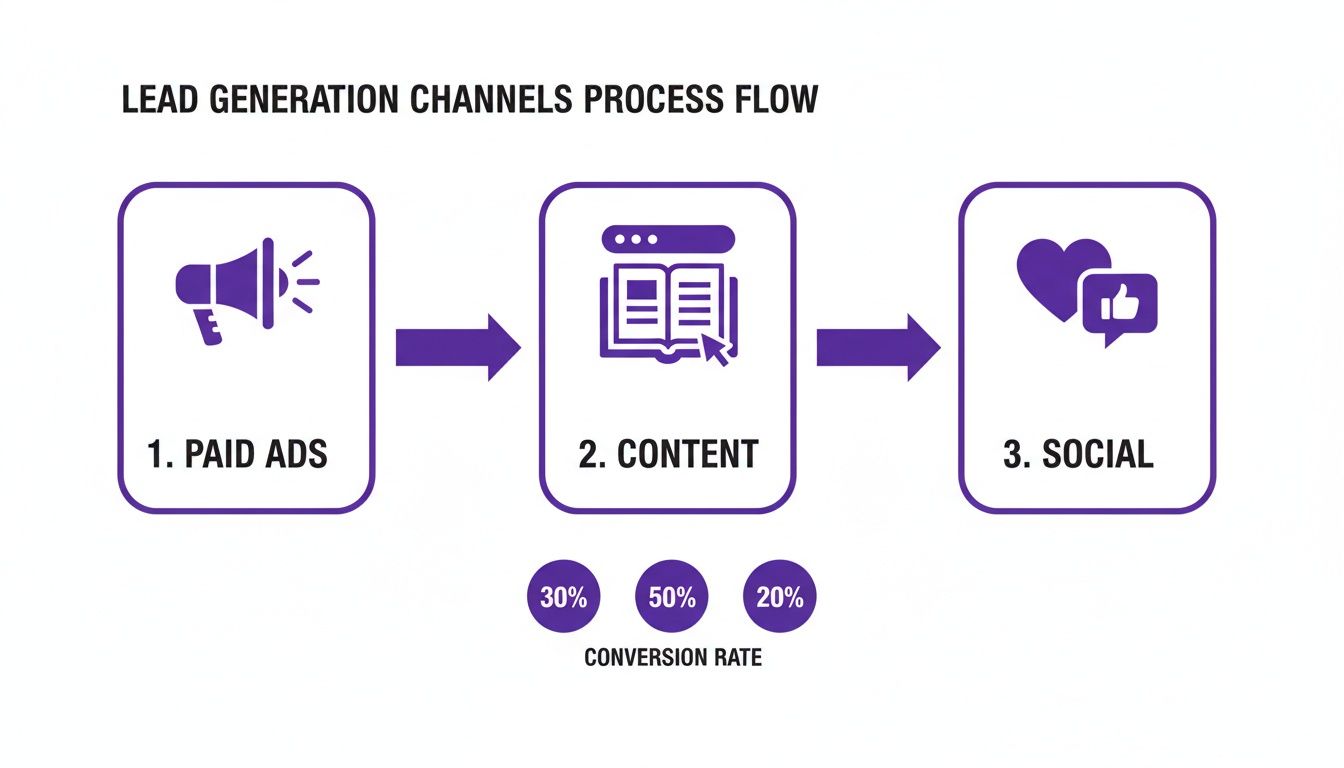
Each channel acts as a different doorway, guiding interested folks toward your offer and right into your sales funnel.
Step 1: Craft an Irresistible Offer
Everything—and I mean everything—hinges on your offer. This is often called a lead magnet, and it’s not a sales pitch. It’s a genuinely valuable piece of content or a special deal you give away in exchange for an email address. The trick is to make it so good that your ideal customer feels like they’re getting an absolute steal.
Your offer has to solve a real problem or satisfy a specific desire for your target audience. A generic "sign up for our newsletter" just doesn't cut it anymore. It’s weak. A specific, high-value offer, on the other hand, is magnetic.
For a home decor brand, some killer offers could be:
- A "Shop the Look" Style Guide: A beautifully designed PDF showing customers exactly how to recreate a popular decor style using your products.
- An Exclusive Discount: A 15% off coupon for their first order is a classic for a reason—it works.
- Early Access to New Collections: This creates a feeling of exclusivity and makes your biggest fans feel like VIPs.
Your offer is the handshake that starts the relationship. If it's weak or irrelevant, the conversation ends before it even begins. Make it valuable, specific, and directly related to what you sell.
Step 2: Design a High-Converting Landing Page
So, someone clicked your ad. Now what? They need a place to "land." This is your landing page—a simple, focused webpage with one single purpose: to get that visitor to take you up on your offer. It needs to be clean, clear, and totally free of distractions.
Unlike your main website, which is probably bustling with links and products, a landing page strips all that away. You want the visitor to do one thing and one thing only.
A great landing page always includes:
- A Compelling Headline: State the benefit of the offer loud and clear. Something like, "Get Your Free Guide to Creating a Cozy Living Room."
- Benefit-Oriented Bullets: Quickly list what they'll get or learn.
- A Simple Form: Only ask for what you absolutely need. Usually, that's just a name and an email. Every extra field you add will hurt your conversion rate.
- A Strong Call-to-Action (CTA): The button should pop. Use action-oriented text like "Download My Guide Now" or "Unlock My Discount."
Step 3: Create Scroll-Stopping Creative
Now you need to actually get people to your landing page. This is where your creative—your ads, images, and videos—comes into play. In a crowded social media feed, you have less than a second to grab someone's attention. Make it count.
For e-commerce, visuals are king. Your ad creative should connect instantly with your target audience's aspirations. Don't just show your product; show the lifestyle it enables.
Let's take a handmade goods business, for example:
- Bad Creative: A sterile photo of the product on a stark white background.
- Good Creative: A short, captivating video showing the artisan carefully crafting the product, followed by a shot of it being used and enjoyed in a beautiful, cozy home.
This kind of storytelling forges an emotional connection. It makes people curious, and that curiosity drives them to click through to your landing page.
Step 4: Define Your Ideal Target Audience
Running ads without sharp targeting is like throwing money into the wind and hoping for the best. You have to tell platforms like Meta exactly who you want to see your ads. Go beyond basic demographics like age and gender and dig into psychographics—their interests, behaviors, and values.
For that home decor brand, your targeting could include:
- Interests: People interested in "Interior Design," "HGTV," or competitors like West Elm and Crate & Barrel.
- Behaviors: Users who have recently engaged with home decor content or are frequent online shoppers.
- Custom Audiences: Upload your existing customer list to find "lookalike" audiences who share similar traits with your best buyers.
Precise targeting makes your ad spend incredibly efficient because you’re only reaching the people most likely to become customers. While many B2C brands find their home on Meta, it's worth noting that for B2B, LinkedIn is the undisputed champion. A staggering 89% of B2B marketers rely on it, partly because LinkedIn Lead Gen Forms can achieve conversion rates over five times higher than typical landing pages. You can dive deeper into the stats on LinkedIn's lead generation dominance and how it stacks up against other platforms.
Step 5: Set Up Essential Tracking
Last but certainly not least, you can't improve what you don't measure. Setting up tracking is non-negotiable. Think of it as the dashboard for your lead generation machine, showing you exactly what’s working and what’s falling flat.
The most critical tool here is the Meta Pixel (for Facebook and Instagram ads) or the Google Ads tag. These are tiny snippets of code you add to your website.
They let you track the actions that matter most:
- Page Views: Who visited your landing page.
- Leads: Who successfully filled out your form.
- Purchases: Which of those leads went on to become paying customers.
This data is pure gold. It tells you your Cost Per Lead (CPL) and which ad creative is driving results, allowing you to cut what's not working and double down on your winners. This five-step framework is your blueprint for building powerful, repeatable lead generation campaigns that fuel real growth.
Measuring Success and Optimizing Your Campaigns
Getting a lead generation campaign off the ground is one thing, but the real magic happens when you start listening to what the data is telling you. Think of your data not as a final grade on your performance, but as a treasure map showing you exactly where to dig next. By keeping an eye on a few key numbers, you can turn a flood of information into a clear, actionable plan for growth.
It's a bit like tuning a guitar. You don't just strum and hope for the best. You listen closely for the notes that are just a little bit off and make tiny adjustments until the whole thing sounds right. Your campaign data gives you that same kind of feedback, pointing out what needs a small tweak to create marketing harmony.
Key Metrics That Actually Matter
Forget about drowning in spreadsheets. For an e-commerce brand, you can get a complete picture of your campaign's health by focusing on a handful of core metrics that tell the story from the first click to the final sale.
These are the numbers you'll want to watch:
- Cost Per Lead (CPL): This is your efficiency score. It tells you exactly how much you're spending to get one new person on your email list. A nice, low CPL means your ads and your offer are hitting the mark.
- Landing Page Conversion Rate: This shows what percentage of people who clicked your ad actually followed through and signed up. If this number is high—20% or more is a great benchmark—it's a sign your landing page is clear, compelling, and user-friendly.
- Lead-to-Customer Rate: Here’s the bottom line. This metric tells you what percentage of your new email subscribers eventually become paying customers. This number is the ultimate test of lead quality.
A Practical Troubleshooting Guide
Numbers on a screen are useless unless you know what to do with them. Instead of just staring at the stats, use them to play detective and diagnose what’s happening inside your funnel. This lets you make small, smart changes that add up to big results over time.
It’s really just a simple game of "if this, then that."
Your campaign data isn't there to make you feel good or bad. Its sole purpose is to give you clues. Your job is to follow those clues to find opportunities for improvement, making your next campaign even better than the last.
Use this simple troubleshooting framework to guide your next steps:
If your Cost Per Lead (CPL) is high…
- Check your ad creative: Is it actually stopping the scroll? Does the copy connect with a real problem or desire your audience has? Try testing completely different images, videos, or headlines.
- Review your audience targeting: Are you sure you’re talking to the right people? Maybe your audience is too broad. Try narrowing it down or creating a lookalike audience from your list of best customers.
If your landing page conversion rate is low…
- Test your headline: Does it instantly communicate the value of your offer? Crucially, it needs to match the promise made in the ad they just clicked.
- Simplify your form: Are you asking for their life story? Every extra field you ask for is a reason for someone to give up. Try cutting it down to just the email address.
- Strengthen your Call-to-Action (CTA): Is the button obvious? Use exciting, action-focused words like "Get My 15% Off Code Now."
If your lead-to-customer rate is low…
- Analyze your email follow-up sequence: Are you just blasting them with sales pitches? Your first few emails should be about building trust and offering value before you ask them to buy.
- Re-evaluate your initial offer: Is your freebie attracting bargain hunters instead of genuine fans? An offer that’s more closely related to your core products might bring in leads who are more likely to buy down the road.
Your E-commerce Lead Generation Questions, Answered
Alright, let's get into the nitty-gritty. You’ve got the big picture, you know the lingo, but what does running one of these lead generation campaigns actually feel like day-to-day? It's easy to get stuck on the practical questions, so let's tackle the ones I hear most often from e-commerce owners just starting out.
Think of this as our quick chat before you flip the "open" sign. The goal is to clear up any of those last-minute hesitations so you can move forward with confidence.
How Much Should I Actually Spend on My First Campaign?
There’s no magic number here, but a good rule of thumb is to spend just enough to get useful data. For most folks starting on a platform like Meta, a budget of $10-$20 per day is the sweet spot. It's enough to see what's resonating without having to bet the farm.
The real focus shouldn't be the total spend, but your Cost Per Lead (CPL). For example, if you spend $100 and get 20 new email subscribers, your CPL is $5. Now you have a concrete number. You can look at that and ask, "Is acquiring a potential customer for $5 sustainable for my business?"
Your first campaign budget isn't about turning a profit. It's about buying data. You're making a small investment to learn exactly who your customer is and what they want, which is priceless information for scaling up later.
Seriously, How Long Until I See Sales from These New Leads?
Patience is a virtue, especially here. It’s tempting to expect a flood of sales the moment new subscribers roll in, but that’s rarely how it works. You’re building a relationship, and that takes a little time.
Some people will buy right away, but they're the exception, not the rule. Most will follow a path that looks something like this:
- The Impulse Buyers (1-3 Days): These are your low-hanging fruit. They were probably already thinking about buying, and your irresistible offer was just the little push they needed.
- The Warm-Ups (1-4 Weeks): This is where the bulk of your first-time buyers will come from. They'll open your welcome emails, get a feel for your brand, and make a purchase once they feel that connection.
- The Long-Game Nurturers (1+ Month): Don't forget about these folks! Some subscribers will happily hang out on your list for months, waiting for the right product or a seasonal sale to finally make their move.
This is exactly why having a solid, consistent email strategy is a non-negotiable. It keeps you on their radar, so when they are ready to buy, your store is the first place they go.
Ready to stop renting your customers and start building a brand you truly own? The expert team at Wand Websites specializes in crafting high-performing Shopify stores that turn your traffic into loyal customers. Let us build the engine for your growth. Learn more about our e-commerce solutions at Wand Websites.
