
How To Upsell On Shopify: Real Strategies That Boost Revenue


Why Smart Merchants Swear By Upselling

You’ve probably heard how pricey it is to acquire new customers. But here’s the thing: your existing customers are a hidden treasure trove. I’ve chatted with tons of Shopify store owners raking in six and seven figures, and they all sing the same tune: upselling on Shopify simply works.
Why? Because it fits so seamlessly into the platform.
One reason is the psychology. Customers actually appreciate relevant offers. It’s about solving their problems – even ones they don’t know they have yet. Imagine someone buying a camera. They probably need a memory card, right? Or maybe a lens cleaning kit? A well-placed upsell isn’t being pushy; it's being helpful.
The best Shopify merchants get this. They see it as customer service, not some sleazy sales tactic. They’re focused on adding value and improving the overall shopping experience.
Another factor? The sheer size of Shopify. As of 2024, there are about 4.82 million active Shopify websites globally. That’s a massive pool of potential customers just waiting to be upsold. This isn’t about squeezing a few extra bucks out of each sale; it’s about building long-term relationships and increasing customer lifetime value. Want to learn more about the scale of Shopify? Check out these Shopify statistics.
Finally, successful stores understand that upselling is about more than just a bigger average order value. It's a chance to introduce customers to products they might absolutely love, but wouldn't have found otherwise. By suggesting related items, you’re not just boosting sales; you’re building loyalty and personalizing the shopping journey.
This leads to happy customers who keep coming back for more, creating sustainable growth for your business.
Setting Your Store Up For Upselling Gold
Before you even think about installing fancy upselling apps like Rebuy or Zipify OCU or crafting clever offers, you need a rock-solid foundation. I've seen so many merchants jump into the tech without thinking about their product catalog. They just throw upsells at random and then wonder why their conversion rates are in the basement. Don't be that merchant.
Think of your product catalog like a carefully curated museum exhibit. Each item should have a logical place, and there should be clear pathways guiding visitors to discover more. This is how you create natural upgrade paths. For example, if someone's looking at a basic coffee maker, maybe they'd be interested in a premium model with a built-in grinder? Or how about a set of artisanal coffee beans to round out the experience?
Auditing Your Inventory For Hidden Gems
Take a long, hard look at your current product lineup. Are there any hidden upselling opportunities staring you in the face? Could you bundle products strategically? Could you create collections that practically sell themselves? The answer is almost always yes. I once helped a client selling handmade jewelry realize that their individual pendant listings weren’t doing much. By creating curated necklace sets (pendant + chain + earrings), they saw a 30% increase in their average order value. It was a small change with big results.
Navigation That Guides (Not Confuses)
Your site navigation is key for how to upsell on Shopify. It's the map that leads customers to higher-value purchases. A cluttered, confusing navigation structure is like a museum with no signs – your visitors will wander around lost and probably leave empty-handed. Think about how your product categories and collections can guide customers toward those premium options.
The global ecommerce market, which includes platforms like Shopify, is expected to hit $4.8 trillion by 2025. This huge growth shows just how much potential there is for ecommerce businesses to boost revenue with smart strategies like upselling. You can find some more info on these global ecommerce statistics.
Avoiding Common Pitfalls
So many merchants ruin their upselling efforts before customers even see an offer. One major mistake is bad product photography. If your product images are blurry or unprofessional, customers aren’t going to be tempted to upgrade, no matter how sweet the deal. Another killer is a complicated checkout process. If it's a pain for customers to add more items to their cart, you're just leaving money on the table. Make sure your store is optimized for a smooth, seamless shopping experience. By laying this groundwork, you're setting yourself up for upselling success.
Finding Upselling Apps That Actually Deliver
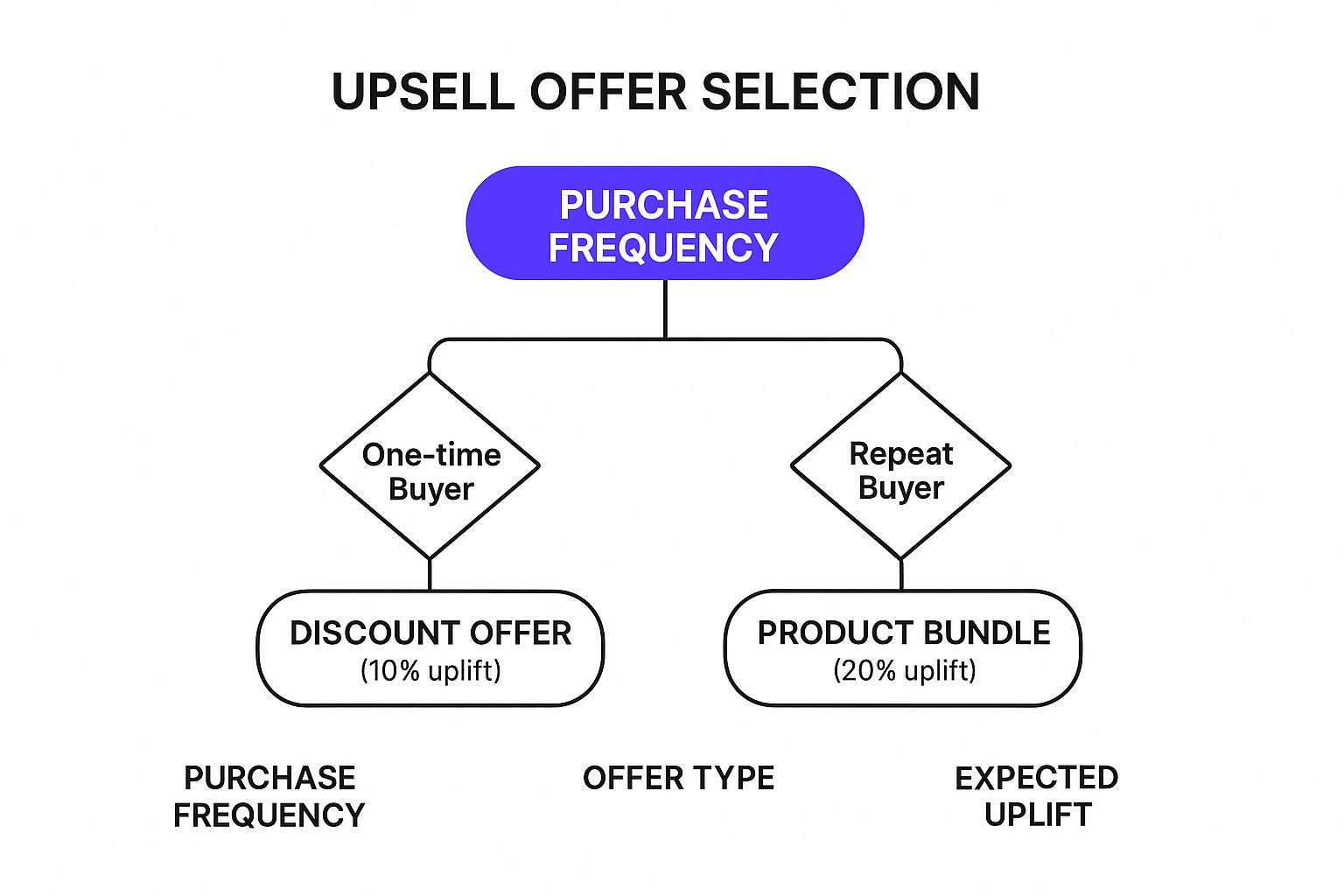
This infographic shows how to pick the right upsell offer based on how often a customer buys from you. It highlights the offer type and the expected increase in sales. Notice how bundled offers for returning customers can bring a much bigger boost (20%) compared to discounts for first-time buyers (10%). But both are important for maximizing your revenue.
Let's talk apps. The Shopify App Store is packed with hundreds of upselling apps. Finding the right one can feel overwhelming. I've seen so many merchants waste time and money on apps that don't live up to the hype. So, let's ditch the marketing jargon and get down to what really works, based on my experience with successful Shopify stores.
Comparing the Heavy Hitters
Forget boring feature lists. I want to share what each app actually does well in the real world. For example, Bold Upsell is known for its powerful customization. It's a good fit for larger stores with huge product catalogs. But, that complexity can also make it tough for smaller stores or those without much technical know-how. Plus, the price can be a bit much for beginners.
ReConvert is great for post-purchase upselling. It lets you tweak your thank you page and offer targeted deals after a customer has already bought something. This is a fantastic way to boost average order value without messing with the initial checkout process.
Then there's Frequently Bought Together. This app uses the power of product recommendations. It's super easy to set up and incredibly effective at suggesting related items and increasing sales.
To help you visualize the differences, I've put together this comparison table:
Top Shopify Upselling Apps Comparison: A side-by-side comparison of the most popular upselling apps including pricing, key features, and best use cases.
As you can see, each app has its strengths. Bold offers the most customization, ReConvert focuses on post-purchase, and Frequently Bought Together keeps things simple with product recommendations.
Hidden Costs and Integration Headaches
Be aware of hidden costs. Some apps charge transaction fees or have usage limits that get pricey as your store grows. Integration can also be a pain. Some apps don't work well with certain themes or checkout flows, which can cause technical issues.
A Practical Decision Framework
The best app for you depends on your store's size, budget, and technical skills. If you're a small store on a budget, Frequently Bought Together might be a good starting point. A larger store with more complex needs might benefit from Bold Upsell. If you're focused on post-purchase upselling, go with ReConvert. Finding the right tools for your goals and resources is key to upselling success on Shopify.
Creating Upsell Offers Customers Actually Want
I've seen so many merchants get tripped up on upselling. They focus on the mechanics – the apps, the tech – and completely forget the psychology. They forget about tapping into that moment where the customer thinks, "You know what? I actually do need that!" The secret sauce isn't the app; it's crafting offers that truly add value.
Understanding the Psychology of "Yes"
Effective upselling isn't about being a pushy salesperson; it's about being helpful. Imagine someone's buying a new phone. Offering a screen protector is a natural upsell. They might not have thought of it themselves, but it solves a real problem – a scratched screen. Timing is everything here. Offering that screen protector during checkout feels like helpful advice. A week later? It just feels like another sales pitch.
Savvy merchants also understand which products naturally go together. They're not just throwing random items at the wall; they're thinking about the customer's needs. This is where product bundling shines. A discounted bundle of related products often feels like a great deal, encouraging bigger purchases.
Creating Genuine Urgency (Without Manipulation)
Urgency can be a powerful tool, but it's got to be real. "Only 3 left in stock!" works wonders...if it's actually true. Fake scarcity just annoys people. Instead of manufactured urgency, focus on the value the upsell provides. Highlight the benefits, not just the limited availability.
Another secret weapon? Social proof. Showing how many other customers have purchased the upsell, or featuring positive reviews, can be incredibly persuasive. Something like "90% of customers add this to their order" can make a huge difference.
Shopify itself offers a ton of tools to simplify upselling. Businesses using unified commerce platforms like Shopify POS often see a 22% better total cost of ownership and 20% faster implementation times. Check out Shopify’s retail solutions for more on this.
Crafting Compelling Copy
Finally, your wording matters. Ditch the generic "Upgrade now!" Instead, focus on specific benefits. "Protect your new phone from scratches with our premium screen protector" is way more compelling. Master these principles, and you can turn casual browsers into happy customers, boosting your average order value without being annoying.
Mastering Post-Purchase Upselling Magic
Alright, so someone just hit that "buy now" button on your Shopify store – awesome! But here’s the thing: that's not where the story ends. It's actually where the real opportunity begins. Post-purchase upselling is where the magic happens. Think of it this way: the customer has their wallet out, they’re clearly digging your products, and they trust you enough to make a purchase. This is prime time to offer them something extra.
Seriously, I've seen post-purchase upselling work wonders for conversion rates. It's because the buying momentum is already there. But the key is to do it right, without making it feel pushy or ruining the good vibes. So, how do you walk that tightrope on Shopify?
Thank You Page Optimization: A Golden Opportunity
Let’s talk about your thank you page. Most stores treat it like an afterthought, just a generic "Thanks for your order!" But trust me, this page is a goldmine. Instead of a boring thank you, turn it into an opportunity to offer relevant upsells.
For example, let's say someone just bought a new camera from your store. On the thank you page, why not suggest a lens cleaning kit or a stylish camera bag? See how that works? It's not a hard sell; it's a helpful suggestion that complements their initial purchase. It's about enhancing their experience, not just adding to your bottom line.
Leveraging Shopify's Email Notifications
Another powerful tool you already have at your fingertips? Shopify's built-in customer notifications. Here's a visual: Take a look at those "Order Confirmation" and "Shipping Confirmation" emails. Those are perfect spots to subtly weave in some post-purchase offers.
These emails are expected updates, so incorporating upsells feels natural and less intrusive. It's all about timing and context. Keep the customer engaged and informed, and you’ll maximize your chances of boosting sales.
The Power of Email Sequences
Email sequences are another game-changer. After the initial purchase, a series of automated emails can nurture the customer relationship and introduce relevant upsells over time. Let's go back to that camera example. A week later, you could send an email with tips on how to get the most out of their new camera, along with a discounted offer for a tripod. See? Value and a well-timed upsell. This approach builds loyalty and turns one-time buyers into repeat customers.
Tailoring Your Follow-Up Offers
Don't just stick to product recommendations. Get creative with your follow-up offers. Think about what makes sense for different product categories and price points. Someone just splurged on a high-end drone? Offer them a premium support package or an online course on drone photography. For lower-priced items, a small discount on their next purchase can be a strong incentive.
The secret to successful upselling on Shopify is all about providing value and making the entire customer experience even better. Learn from other successful merchants, experiment with different messaging and timing, and find what works best for your audience. You'll be surprised at the impact it can have on your bottom line.
Advanced Tactics That Separate Pros From Amateurs

Want to seriously boost your Shopify upselling game? Let's explore the strategies that really make a difference. These are the tactics I've personally seen drive incredible results for top-performing stores.
Dynamic Pricing: Not One-Size-Fits-All
Consider dynamic pricing. Instead of a static price, adjust it based on individual customer behavior. For example, a frequent high-spender might see slightly different prices than a first-time browser. This lets you maximize value from loyal customers while staying competitive for newcomers.
Seasonal Upselling: Right Place, Right Time
Seasonal upselling is another game-changer. Leverage buying trends by offering relevant upsells during specific times of the year. Think of a swimwear shop. Summertime? Upsell beach towels, sunscreen, and sunglasses. Off-season? Discounted swimwear or cover-ups. Keep your upsells fresh and relevant to boost those conversions.
Predictive Upselling: Anticipating Needs
Now things get exciting: predictive upselling. Use customer data to predict the perfect upsell moment. Imagine a customer consistently buys art supplies monthly. Just before their usual purchase, offer a new brush set or premium canvas. This feels like personalized service, not a pushy sales pitch.
Customer Segmentation: Tailored Offers
The best merchants understand customer segmentation. They group customers by shared traits like purchase history, demographics, or browsing behavior. This lets you create highly targeted upsells that truly resonate. For example, organic product buyers might be receptive to other eco-friendly upsells.
Scarcity Marketing: The Urgency Factor
Scarcity is a powerful motivator, but it must be genuine. Don't fake it. Use it strategically for special promotions or limited-edition items. Highlighting exclusivity creates urgency and drives conversions.
Abandoned Cart Recovery: A Second Chance
Everyone focuses on recovering abandoned carts, but a huge opportunity often gets missed: upselling. A abandoned cart is a chance to offer a small discount or free gift to incentivize the purchase. Suggest related items they might have overlooked, turning a potential loss into an upsell win.
Beyond the Basics: Hidden Gems
Let's look at some less conventional, but highly effective strategies. Cross-selling through customer service is a great example. When a customer reaches out, your support team can subtly suggest related products or services. Turning product returns into upgrade opportunities is another smart move. Offer a premium version as a replacement. Finally, leveraging customer reviews can reveal unexpected upsell combinations. Look for patterns in customer comments—they might highlight perfect upselling pairings. These advanced tactics can significantly impact your bottom line.
Tracking your performance is key to optimizing your upselling strategies. Here's a table of essential metrics to keep an eye on:
Upselling Performance Metrics to TrackEssential KPIs for measuring upselling success with benchmarks and optimization tips
By monitoring these metrics, you can pinpoint what's working, what's not, and refine your approach for maximum impact. These advanced tactics, combined with careful performance tracking, will take your Shopify upselling to a whole new level.
Tracking Success And Avoiding Costly Mistakes
Let's get real about what drives profitable upselling on your Shopify store. Forget the vanity metrics; we're talking about the numbers that actually impact your bottom line. I've seen too many merchants chase likes and shares while completely ignoring the data that really matters.
Key Metrics That Matter
Focus on the money. Average Order Value (AOV) is king. A solid upselling strategy should give this number a visible boost. Shoot for at least a 10% lift, but 20% or more is a sign you're really hitting the sweet spot.
Then there's your Upsell Conversion Rate. This tells you how many customers are saying "yes" to your offers. A decent benchmark is 5-10%, but with smartly designed upsells, I’ve seen stores hit 15% or higher.
Finally, keep an eye on your Upsell Revenue. This is the money generated specifically from your upsells. This should ideally be at least 5% of your total revenue, with 10% or more being a fantastic goal.
Setting Up Tracking in Google Analytics
Google Analytics is essential here. Set up correctly, it can track your entire upselling funnel. Use UTM parameters to identify the source of your upsells (e.g., post-purchase page, product page). This helps pinpoint your most effective upselling strategies. Tons of helpful guides online show you how to do this.
Learning From Real Merchant Experiences
I once worked with a Shopify store offering a "premium" product upsell that just wasn't converting. Their analytics revealed the issue: the premium version’s value wasn't clear. Simply rewriting the product description to highlight the benefits boosted their upsell conversion rate from a dismal 2% to a solid 12%.
A/B Testing: Your Secret Weapon
A/B testing is your best friend. Experiment with different offers (bundles, discounts, free gifts), price points, and messaging. Even small tweaks can have a big impact. A/B testing allows you to constantly refine your offers and figure out what your customers actually want.
Knowing When to Pivot (Or Quit)
Not every upsell attempt will be a winner. If you've been diligently A/B testing and still aren't seeing results, don't be afraid to change direction or even drop the strategy entirely. Sometimes, a product just isn't suited for upselling. Knowing when to cut your losses is just as important as knowing how to upsell in the first place.
Ready to move beyond Etsy and build a Shopify store designed for real growth? Wand Websites can help. We specialize in creating high-converting Shopify stores for successful Etsy sellers, helping you scale your business. Let us handle the technical side so you can focus on what you do best – creating amazing products.
