
How to Track SEO Rankings for Your E-Commerce Store

So, what does it actually mean to "track your SEO rankings"? In a nutshell, it's about using tools like Google Search Console and specialized rank tracking software to keep a close eye on where your most important keywords show up in search results. The whole process boils down to picking the keywords that actually make you money, plugging them into your monitoring tools, and then digging into the data to see what’s working and what isn't. This is how you turn SEO from a guessing game into a measurable growth strategy.
Why SEO Rank Tracking Is Your E-Commerce Growth Engine
If you’re running an online store, you know that traffic is everything. But how do you really know if all the time and money you're pouring into SEO is paying off? That's where rank tracking steps in.
Think of it as your store's live performance report on Google. It’s the only reliable way to connect the dots between optimizing a product description and seeing a bump in your sales figures. Without it, you're just flying blind, hoping for the best.
From Data Points to Dollars
Knowing how to track your SEO rankings is what turns confusing metrics into a clear roadmap for more revenue. When you watch a high-value keyword for one of your top-selling products jump from page two to a top-three spot, you can draw a straight line from that movement to more traffic and, more importantly, more sales. This isn't about bragging rights; it's about making smarter business decisions.
A solid tracking system lets you:
- See what's working. You can finally prove which optimizations are actually moving the needle.
- Find weak spots. Easily spot underperforming product pages or categories that need a little love.
- Keep an eye on the competition. Get ahead of their moves before they start chipping away at your market share.
- Uncover hidden gems. Discover new keyword opportunities that are already sending you surprise traffic.
The impact of moving up in search results is massive. Jumping up just one position on Google can boost your click-through rate by an average of 32.3%. Even better, climbing from position 2 to the top spot can generate an incredible 74.5% more clicks.
This simple workflow shows how it all comes together—from picking the right keywords to turning the data into real action.
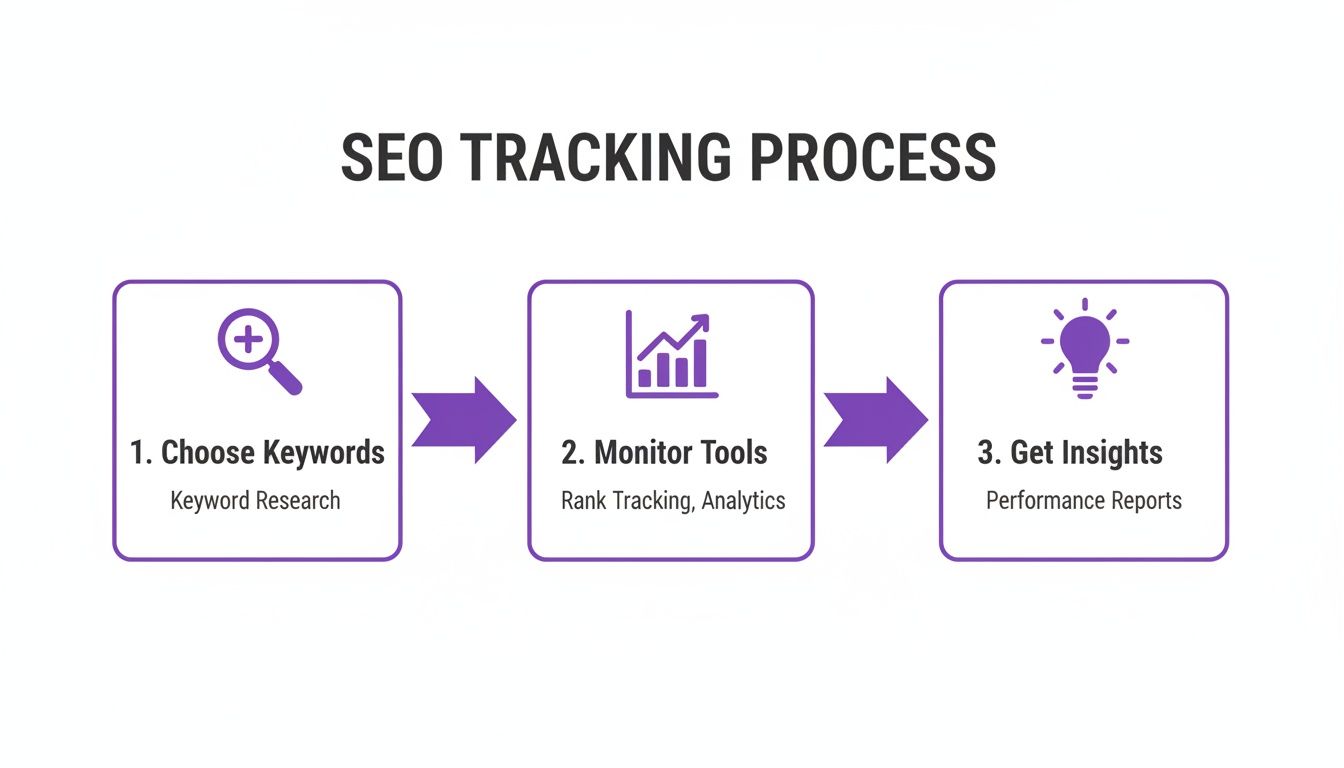
As you can see, this isn't a "set it and forget it" task. It's a constant cycle of monitoring, learning, and refining that keeps your store growing month after month.
To get the full picture, let's break down the essential components of a solid e-commerce SEO tracking strategy.
Core Pillars of E-Commerce SEO Tracking
These pillars work together to give you a complete view of your organic search performance, moving you beyond just knowing your ranks to understanding their real-world impact.
Building a Foundation for Success
For any serious e-commerce business, getting a handle on rank tracking is fundamental. It's what allows you to prioritize your work, spend your budget wisely, and build a predictable engine for organic growth. For a deep dive into the whole process, this practical guide for actionable insights on SEO rankings is an invaluable resource.
Consider this your playbook for finally taking control of your SEO and turning it into a strategic driver for your store's success.
Finding the Keywords That Actually Drive Sales

Before you can track a single ranking, you need to know which keywords are actually worth your time. It’s a classic mistake: chasing broad, high-volume terms that pull in a ton of casual browsers but very few actual buyers. Your goal isn't just traffic; it’s revenue.
This is all about building a focused "keyword hit list." We're talking about the exact phrases customers type into Google when they're ready to buy. Getting this right is the bedrock of any tracking strategy that leads to sales, not just vanity metrics.
Getting Inside Your Customer's Head
The secret is to get a handle on search intent—the real "why" behind someone's search query. Every search falls into a few categories, and for an e-commerce business, knowing the difference is everything.
Let's say you run an online store selling high-end kitchenware. A typical customer's journey might look like this:
"I need information" phase: They start by Googling "how to clean a cast iron skillet." They're just learning right now, not shopping. Great for a blog post, but not a keyword you should obsess over for a product page.
"I'm looking for a specific brand" phase: A little later, they might search "Lodge cast iron skillet." They know the brand, but they're still poking around. It shows they're getting warmer, but they haven't committed yet.
"I'm ready to buy" phase: Finally, they search for something like "buy 12 inch cast iron skillet" or "best price on pre-seasoned skillet." These are pure gold. The language is specific, action-oriented, and screams that they are ready to make a purchase now.
Key Takeaway: Your main focus for rank tracking should be on these transactional and high-intent commercial keywords. They're the ones that have a direct line to your sales numbers and show the true financial impact of your SEO efforts.
How to Build Your High-Intent Keyword List
Forget about drowning yourself in a massive spreadsheet with thousands of keywords. Your goal here is quality over quantity. Aim for a tight, targeted list of 50-100 core terms that perfectly match your products and attract customers with their wallets out.
The best way to start is to think like your customer. What problems are they trying to solve?
If we stick with our kitchenware store example, we'd go way beyond just "cast iron skillet" and start digging for gems like these:
Long-Tail Keywords: These are longer, more specific phrases. They have less search volume, but the conversion rates are so much higher. Think "non-toxic ceramic frying pan for induction cooktops" instead of just "frying pan."
Problem/Solution Keywords: What's keeping your customers up at night? "Best skillet for searing steak" or "lightweight cast iron pan for camping" are perfect examples of searches that your product can be the answer to.
Comparison Keywords: Shoppers love to weigh their options. Targeting terms like "Staub vs Le Creuset dutch oven" or "cast iron vs carbon steel pan" puts you right in front of customers at that crucial final decision-making stage.
Refining Your List with Real Data
Once you’ve brainstormed a solid list, it's time to see if the data backs it up. Pop your ideas into a keyword research tool to check search volumes and difficulty scores.
You’re looking for that sweet spot: keywords with enough search volume to matter but not so much competition that you'll never have a shot at ranking.
Finally, map each keyword on your shortlist to a specific product or category page on your website. This simple step ensures every term you track has a clear purpose and a direct path to a sale. This curated list is now the backbone of your entire SEO tracking effort, making sure you’re always focused on what truly moves the needle.
Setting Up Your Rank Tracking Toolkit
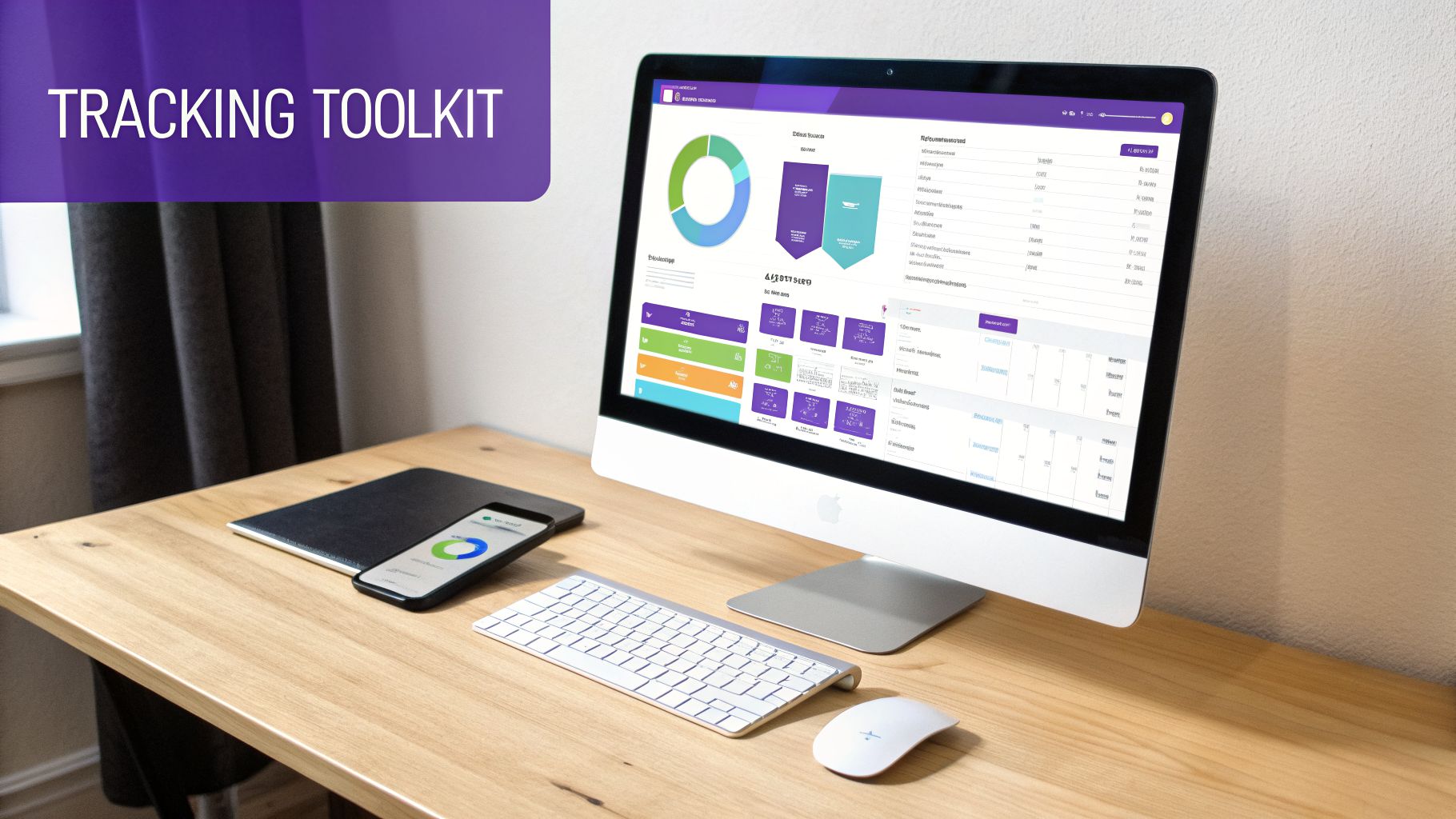
Alright, you've got your killer keyword list. Now it's time to build the dashboard that will turn all that data into something you can actually use. The idea isn't to get lost in a sea of complicated software, but to create a clean, simple system that gives you real insights without the technical headaches.
To get started, you don’t need a massive budget. In fact, there are plenty of best free SEO tools that can get you most of the way there.
We'll start with the free, foundational tools every site owner should have, then add a specialized rank tracker on top to get the full, detailed picture. This combo will become your go-to source for everything related to your SEO performance.
Start with the Essentials: Google Search Console and Analytics
Before you even think about paying for a tool, you need to get comfortable with the powerhouses Google gives you for free. Google Search Console (GSC) and Google Analytics are absolutely non-negotiable. They are the ground truth, straight from the source.
Think of GSC as your direct line to Google. It shows you exactly how the search engine sees your site and, crucially, which keywords are already sending you impressions and clicks.
Analytics picks up where GSC leaves off, telling you what people do after they click through to your store. It tracks how they browse, which pages they visit, and—most importantly for e-commerce—how much they buy. Connecting these two is how you’ll draw a straight line from a #1 ranking to your bottom line.
Pro Tip: Dive into the 'Performance' report in Google Search Console. It's a goldmine. You'll often find queries people are using to find you that you aren't even tracking yet.
This report is where I always find "striking distance" keywords—terms where you're ranking on page two or three. These are your lowest-hanging fruit for some quick and satisfying SEO wins.
Choosing a Dedicated Rank Tracking Tool
While GSC gives you a fantastic overview, it reports on average positions, which can be a bit vague. For precise, day-to-day monitoring, you’ll want a dedicated tool like Semrush, Ahrefs, or SE Ranking.
These platforms are worth their weight in gold because they offer a few key things GSC can't:
- Daily Updates: See your exact ranking for target keywords every single day, not just a smoothed-out average.
- Competitor Tracking: Keep a close eye on what your rivals are doing for the same keywords you’re fighting for.
- SERP Feature Monitoring: See if you’re showing up in crucial e-commerce spots like image packs, shopping results, or featured snippets.
- Localized Tracking: Pinpoint your rankings in specific countries, states, or even cities—a must-have for stores with a local customer base.
When you first fire up one of these tools, you'll import that high-intent keyword list you worked so hard on. This is where that initial effort pays off, making sure you’re only tracking the search terms that actually move the needle.
Configuring Your Tracking for Maximum Insight
Setting up your rank tracker correctly from day one is absolutely critical. Don't just dump your keywords in and hit "go." You have to tweak the settings to reflect how your customers actually search.
First up, nail down the tracking location. If you sell primarily to customers in the United States, you must set your tracking to google.com (United States). A top ranking in the UK means nothing if you don't ship there.
Next, and just as important, is device type. Did you know that rankings can be wildly different on desktop versus mobile? With over 60% of searches now happening on mobile, tracking both is essential. You could be dominating on desktop but totally invisible on the phones where most of your customers are actually shopping.
Once configured, a good dashboard gives you that at-a-glance health check of your SEO efforts. It's all about making complex data easy to understand.
This kind of view shows you vital metrics like visibility, average position, and how many of your keywords are hitting the top spots. The best part? You can set up scheduled reports to land in your inbox every week. This creates a consistent rhythm for monitoring your progress and turns raw data into a reliable, hands-off system.
Making Sense of Your Data and Finding the Gold

Okay, your tracking tools are set up and humming along. Now for the fun part: learning to read the story your rankings are telling you. This is where we move beyond just glancing at a number on a dashboard and start spotting the patterns that will guide your next big move.
The raw numbers from your rank tracker are just chapter one. The real magic happens when you connect those positions to what's actually happening on your website. Is a jump in rankings bringing more people to your product pages? Answering that question is how you turn data into dollars.
Hunt Down Your "Striking Distance" Keywords
One of the most valuable things you can do is go on the hunt for "striking distance" keywords. These are the terms you're already ranking for, but they're just out of sight on page two—typically hanging out in positions 11 through 20. This is your lowest-hanging fruit, by far.
Think about it: Google already sees your page as relevant and worthy of being near the top. It just needs a little nudge to get over the finish line. Often, a small content update, adding a few new internal links to the page, or even just refreshing product images can be enough to bump it onto page one where all the action is.
For an e-commerce store, a great example would be a term like "handmade leather messenger bag for men" where you're currently sitting at position 14. A quick refresh of that category page could be a massive, quick win.
Spot Red Flags and Sudden Ranking Drops
Your rank tracker is also your early-warning system. A sudden, sharp drop for a high-value keyword or an entire product category is a huge red flag that you need to investigate immediately. Don't panic, but don't ignore it, either.
These drops can happen for all sorts of reasons:
- A Google Algorithm Update: Google is always tweaking things. Sometimes a major update can shake up the rankings, and your site might get caught in the crossfire.
- Technical SEO Glitches: Did a recent site change accidentally block Google from crawling a key page? It happens more often than you'd think.
- A Competitor Made a Big Move: Maybe a rival just launched a massive content piece or a link-building campaign that pushed you down.
By catching these drops the moment they happen, you can diagnose the problem and start working on a fix before it seriously impacts your sales. Consistent check-ins are your best defense.
Look Beyond the Standard Blue Links
In today's search results, the classic list of ten blue links is only part of the story. The Search Engine Results Pages (SERPs) are now jam-packed with visual elements called SERP features. For anyone in e-commerce, these are absolute goldmines.
Your rank tracking tool should be able to show you if you own any of these valuable spots:
- Featured Snippets: The "answer boxes" right at the top. Owning one of these for a "how-to" or informational query can position you as an expert.
- Image Packs: That horizontal carousel of images is absolutely critical for visual products like clothing, furniture, or home decor.
- "People Also Ask" Boxes: Getting your content to answer these related questions can capture a whole new stream of traffic.
- Shopping Results: The product listings that appear for commercial searches, linking directly to your product pages.
If you aren't tracking these, you're missing a massive piece of the visibility puzzle. Winning a SERP feature can often drive more clicks than the #1 organic result.
By looking beyond standard rankings, you uncover a more complete picture of your visibility. Winning a featured snippet for "how to choose a coffee grinder" can drive more qualified traffic to your store than ranking #3 for a broader term.
Connect Your Rankings to Real-World Traffic
The ultimate goal here is to see how your ranking improvements translate into actual website traffic and, eventually, sales. This is where you need to connect the dots between your rank tracker and Google Analytics. Hop into your organic traffic report and filter by landing page.
Let's say your rank tracker shows your "organic cotton bed sheets" category page jumped from position 8 to position 3. You should see a corresponding increase in organic clicks to that specific page in Analytics. If you don't, it could be a sign that your page title or meta description isn't compelling enough to earn the click, even with a higher ranking.
Making this connection is vital. For e-commerce sites, a healthy benchmark to shoot for is year-over-year organic traffic growth of around 47%. This shows your SEO program is working, especially when you consider that the top three organic results get nearly 70% of all clicks, while page two gets almost none. If you want to dive deeper, check out these insightful SEO statistics from seranking.com. By turning your ranking data into a clear action plan, you're setting your business up for real, sustainable growth.
Turning Ranking Insights Into More Revenue
Okay, the data is flowing, your dashboard is live, and you're starting to get a feel for the natural ebb and flow of your rankings. This is where the real fun—and the real work—begins. Anyone can collect data; the magic happens when you turn those numbers into actions that actually grow your revenue.
An SEO report filled with green arrows feels great, but it’s just a vanity metric if those rankings aren't translating into real sales. This final step is all about building a simple, repeatable process for converting your hard-won ranking data into tangible improvements for your store.
From Ranking Data to E-Commerce Action Plan
The goal here is to create a clear "if this, then that" playbook for your store. When you see a specific change in your rank tracker, you should know exactly what to do next. This removes the guesswork and ensures you're always making forward progress, not just staring at charts.
Here’s a practical framework I use to translate common ranking signals into revenue-focused tasks.
From Ranking Data to E-Commerce Action Plan
A practical framework for translating SEO ranking changes into specific, revenue-focused tasks for your online store.
Following a structured approach like this transforms you from a passive data-watcher into an active strategist. You're directly connecting your knowledge of how to track seo rankings with bottom-line results.
Prioritizing Your SEO Tasks for Maximum Impact
You'll quickly find you have a never-ending to-do list of potential optimizations. The secret to actually getting things done is ruthless prioritization. You have to focus your limited time and energy on the actions that will move the needle financially.
Before starting any task, ask yourself one simple question: "Will this likely lead to more sales?" A #1 ranking for a keyword that never converts is just noise. Your goal is to tie every single SEO effort back to revenue.
Ranking data tells you where to look, but sales data tells you what to do. If a keyword is driving significant sales, any drop in its ranking becomes a top-priority, all-hands-on-deck emergency.
Let's say you sell custom pet portraits. You might notice the keyword "unique gift for dog lovers" has climbed to position #5. That's great! But at the same time, your main money-maker, "custom watercolor pet portrait," has slipped from #2 to #4. While the new ranking is exciting, protecting the revenue from your proven keyword is, without a doubt, the more important job.
Connecting Rankings to Your Bottom Line
Ultimately, the true measure of success is drawing a straight line from a specific keyword ranking to a sales figure. This is where you bring it all together—your rank tracker, Google Search Console, and your e-commerce platform's analytics.
You're hunting for the keywords that don't just bring traffic, but bring traffic that buys. Industry benchmarks might show a visitor-to-lead conversion rate of around 2.4%, but some of your keywords will blow that away. It's not uncommon to find a weirdly specific, long-tail keyword with low search volume that converts at 10% or higher. Those are pure gold.
Don't forget about SERP features, either—they can be a huge lever for conversions. Winning a featured snippet, for example, can command a massive 42.9% clickthrough rate compared to standard blue links, and those visitors often land on your site ready to buy. Earning those spots for your commercial keywords can directly pump up your revenue. If you want to dive deeper, you can explore more insights about tracking essential SEO metrics.
By relentlessly focusing on the keywords that are actually driving purchases, you can invest your time and budget with confidence. This is how you turn rank tracking from a simple monitoring task into one of the most powerful revenue-generating activities in your entire business.
Your Burning Rank Tracking Questions, Answered
Once you get into the rhythm of tracking your SEO performance, you'll inevitably run into a few head-scratchers. It happens to everyone. Think of this as your go-to FAQ for the real-world situations that pop up when you're in the trenches, trying to grow your store's visibility.
Let’s tackle some of the most common questions that e-commerce owners ask.
How Often Should I Actually Check My Rankings?
I get it—the urge to refresh your rank tracking tool every five minutes is strong, especially when you've just launched a new product. But honestly, it's more distracting than helpful. For most online stores, checking in once a week is the sweet spot.
Why? Because rankings can be jumpy day-to-day. Minor algorithm tweaks and competitors’ small moves can cause fluctuations that don’t actually mean anything. A weekly review smooths out that noise, letting you see the real trends and preventing you from making knee-jerk decisions based on a random Tuesday dip.
My advice: Pick a specific time each week—say, first thing Monday morning—to sit down and review your keyword performance. This turns it into a productive habit, not an anxious obsession.
This kind of discipline helps you focus on what truly matters: the long-term health of your SEO, not the tiny, insignificant blips on the radar.
Help! My Rankings Just Tanked. What Do I Do?
First thing's first: breathe. A sudden drop for a money-making keyword feels like a punch to the gut, but it’s a signal to investigate, not to hit the panic button and tear your site apart. Before you change a single thing, you need to play detective.
Start by looking into the usual suspects:
- A Technical Snafu: Pop the page's URL into Google Search Console’s URL Inspection tool. It's the fastest way to see if you’ve accidentally blocked Google or if there are other crawling errors holding you back.
- A Big Google Update: Check SEO news sites or even Twitter. If the whole community is buzzing about a major algorithm update, your drop might be part of a much bigger shift.
- A Competitor's Big Move: Take a peek at your rank tracking dashboard. Did your drop happen at the exact same time a competitor shot up to the top? They might have just launched a killer piece of content or scored a game-changing backlink.
Once you know the why, you can figure out the what. A technical problem needs a technical fix. A competitor getting smarter means it’s time to analyze their page and figure out how to make yours ten times better.
Should I Bother Tracking My Competitors' Keywords?
Yes. A thousand times, yes. This isn't about sneakily copying what they do; it's about smart market research. Knowing which keywords your top rivals are winning for is like getting a roadmap to what's already working in your niche.
When you track competitors in your tool, you start seeing things you might have missed. For instance, you might find they’re ranking for a high-value, long-tail keyword you never even thought of. Boom—that’s a new opportunity handed to you on a silver platter.
It’s also your early-warning system. If you see a competitor creeping up the rankings for one of your core product terms, it’s a heads-up that you need to strengthen your own page before they knock you off your spot. Staying on top of the search results is all about being proactive.
Ultimately, keeping an eye on the competition helps you make better, more informed decisions. You can learn from what they do right, take advantage of where they're weak, and stay a step ahead.
Ready to stop wrestling with Etsy's limitations and build an e-commerce brand that's truly your own? At Wand Websites, we create high-performing Shopify stores designed to turn your traffic into sales and your passion into profit. Let's build something bigger, together. Discover how we can grow your business at wandwebsites.com.
