
how to set up ecommerce business: 5 steps to launch fast


Alright, let's get into the heart of things. Before you ever dream of a fancy logo or a slick website, there are two questions you absolutely have to nail down: What are you going to sell, and who are you going to sell it to?
Get this right, and everything else—your branding, your marketing, your entire store—falls into place. Think of it as pouring the concrete foundation before you start framing the house. It’s that important.
Finding Your Niche and Getting to Know Your Customer
The ecommerce world is noisy and crowded. The trick isn't to shout louder than everyone else; it's to find a quiet corner where you can have a meaningful conversation with a specific group of people. The most successful brands I've seen didn't try to appeal to everyone. They found a passionate audience with a problem that wasn't being solved well and dedicated themselves to serving that group.
This isn't about jumping on the latest trend. It’s about building something that can last.
The numbers are staggering, no doubt. We're looking at a global market projected to hit $6.8 trillion, with nearly 2.77 billion people shopping online. Right now, 21% of all retail purchases are made on the web. That’s a huge pie, but it also means a ton of competition. A sharp focus is your best weapon. If you're curious, you can dig into more ecommerce platform statistics and trends to really grasp the field you’re playing on.
Brainstorming Niche Ideas That Actually Work
So, where do you find this magic idea? It's usually hiding where your passions, your skills, and what people actually want all overlap. Don't just ask, "What's popular?" Start with what you genuinely care about.
Here are a few places to start digging:
- Your Hobbies and Interests: Are you obsessed with pour-over coffee, a master at woodworking, or the go-to person for eco-friendly pet supplies? When your business is your hobby, you have an incredible advantage—you are the customer. You already get it.
- Your Professional Life: Maybe you spent years as a personal trainer, a graphic designer, or a mechanic. That expertise is gold. You can create products that solve the exact problems you used to deal with every single day.
- Problems You've Personally Faced: Think about something that's annoyed you. Ever struggled to find stylish, tough-as-nails gear for your big dog? Or spent ages looking for high-quality, vegan baking supplies? Your frustration could be your next big idea.
A niche is more than just a product; it’s about a specific person. "Handmade leather wallets" is a product. But "minimalist, RFID-blocking wallets for the modern tech professional who values security and style"? Now that's a niche. See the difference? It paints a picture.
Pinpointing Your Ideal Customer
Once you've got a niche in mind, it's time to figure out exactly who you're selling to. And I mean exactly. We need to go way beyond "women, aged 25-40." You need to create a customer avatar so detailed it feels like you're describing a real friend. Give them a name, a job, a backstory.
Get into their head by asking the right questions:
- What are their biggest daily headaches or frustrations?
- What really drives them to buy something? Is it the best price, top-notch quality, a brand's ethics, or just pure convenience?
- Where are they hanging out online? Are they scrolling Instagram, pinning on Pinterest, or deep in a niche forum somewhere?
- What kind of language do they use? Are they formal and professional, or casual and full of slang?
Knowing this stuff inside and out is your secret weapon. It will shape every piece of copy you write, every ad you run, and every product you develop, making sure you're always talking directly to the people who are most likely to become your biggest fans.
Choosing Your Tech Stack and Business Structure
https://www.youtube.com/embed/YQQD0ElE78Y
Alright, you've nailed down your niche and have a clear picture of your ideal customer. Now it’s time to build the actual store. This is where we get into two foundational decisions that will shape your entire operation: picking an ecommerce platform and setting up a legal business structure.
These might sound intimidating and technical, but they’re really just about choosing the right tools for your vision and protecting yourself for the long haul.
Selecting the Right Ecommerce Platform
Think of your ecommerce platform as the engine of your online store. It’s the software that handles everything—from displaying your products and managing inventory to processing payments at checkout. Getting this right from the start will save you a world of hurt later. Trust me, migrating an entire store to a new platform is a massive undertaking you want to avoid.
There's no single "best" platform. The only thing that matters is finding the best one for you, based on your budget, technical skills, and where you see your business going.

This shot of the Shopify homepage really shows their focus on making ecommerce accessible. The clean layout and straightforward message are all about empowering anyone to get started.
Let's break down the heavy hitters:
- Shopify: This is the go-to for a reason. It's an all-in-one solution that's incredibly easy to use, secure, and packed with beautiful, mobile-friendly themes. If you're an artist who just wants to sell prints or a boutique owner who'd rather focus on marketing than server maintenance, Shopify is a fantastic choice.
- BigCommerce: This is a powerhouse, especially for stores with huge or complex catalogs. Imagine selling car parts with thousands of individual SKUs, each needing specific fitment data. BigCommerce has robust, built-in features for advanced product filtering and management that give it a serious edge for these kinds of businesses.
- WooCommerce: This one's a different animal entirely. WooCommerce is a free plugin that turns a WordPress website into a full-fledged ecommerce store. This gives you ultimate control and flexibility, which is perfect for a content-driven brand—say, a food blogger who wants to sell a line of custom spices. The trade-off is that you're responsible for everything: hosting, security, and all the updates.
Don't get bogged down in a feature-by-feature comparison. The most critical factor is how quickly you can get your store live and how easy it is for you to manage day-to-day. A simple, functioning store that's actually making sales is infinitely better than a "perfect" one that's been stuck in development for six months.
To help you decide, here's a quick look at how these platforms stack up.
Ecommerce Platform At-a-Glance Comparison
Choosing a platform can feel overwhelming, so I've put together this simple table to compare the top options. Use it to quickly see which one aligns best with your business needs, budget, and how comfortable you are with the tech side of things.
Ultimately, the best platform is the one that lets you focus on growing your business instead of fighting with technology. Any of these can be a great foundation.
Choosing Your Business Structure
Now for the less exciting—but absolutely critical—part: your legal structure. This decision has a huge impact on your taxes, your personal liability, and your ability to get funding down the road.
While you should always chat with a legal professional or an accountant for personalized advice, it's essential to understand the basics. For most people starting out, the choice comes down to two main paths.
Sole Proprietorship: This is the default setting. If you start selling things online without formally registering a business, you're automatically a sole proprietor. It's simple and requires zero paperwork. The huge catch? There is absolutely no legal separation between you and the business. If your business gets into legal trouble, your personal assets—your car, your house—could be on the line.
Limited Liability Company (LLC): This is exactly what it sounds like. An LLC creates a separate legal entity for your business, shielding your personal assets from any business debts or lawsuits. It takes a bit more paperwork and a registration fee to set up, but the peace of mind it provides is worth its weight in gold, especially as you start to grow.
For anyone serious about building a real, lasting brand, forming an LLC is almost always the smartest move. It provides that crucial layer of protection and adds a level of professionalism that customers, banks, and partners will notice. Get this sorted out early, and you can focus on what really matters: growing your store.
Designing a Store That Actually Sells
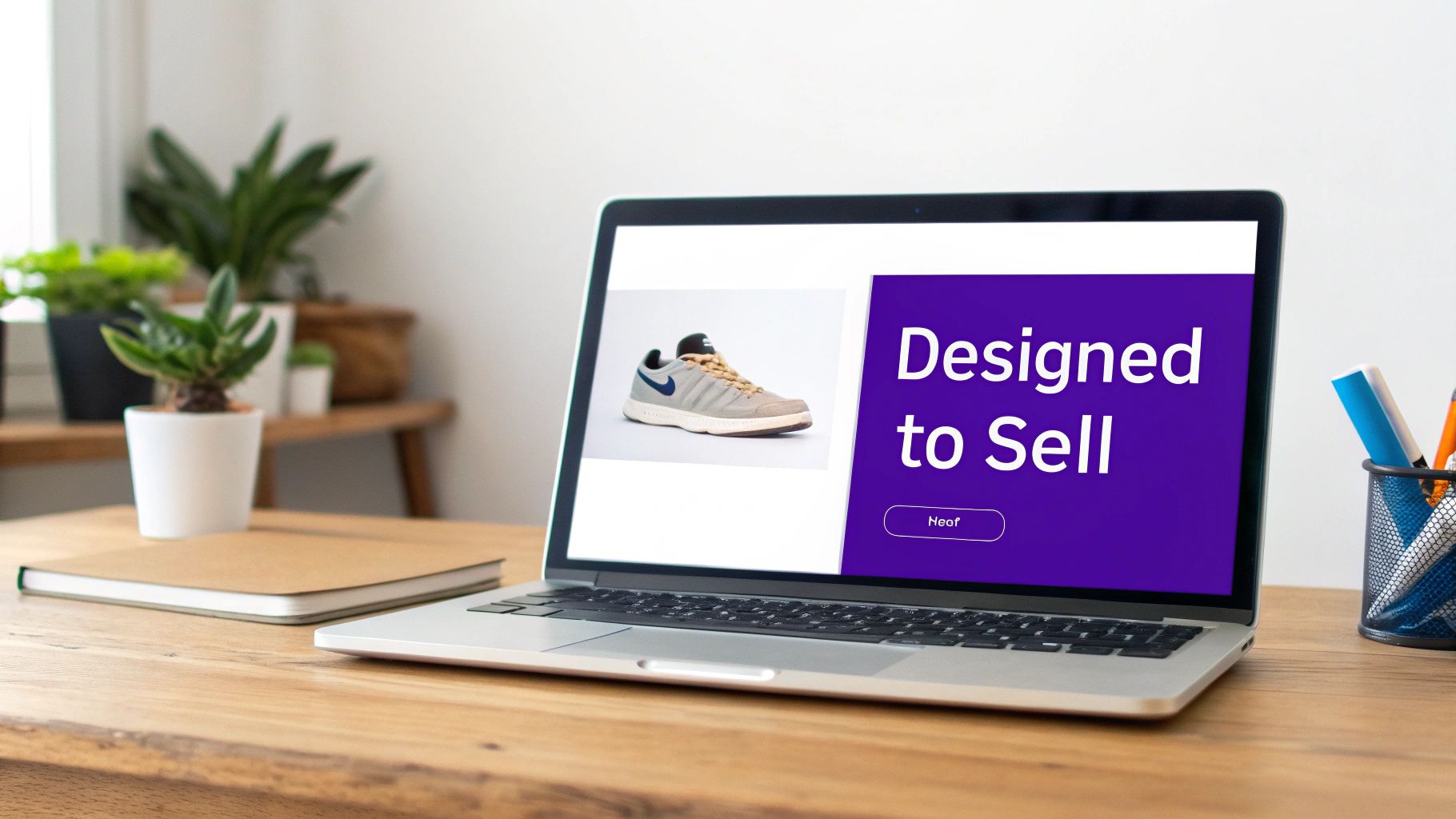
Think of your online store as more than just a digital catalog. It's your top salesperson, brand ambassador, and customer service hub, all rolled into one and working 24/7. A pretty design is nice, but what you really need is a design that smoothly guides visitors from "just browsing" to "just bought."
It's a lot like designing a physical retail space—you wouldn't hide the registers in the back or create a confusing maze of aisles. The same logic holds true online. If you're serious about building an e-commerce business that lasts, creating a seamless user experience isn't just a goal; it's a necessity.
Building a Foundation With Your Theme and Branding
Your first big design decision is picking a theme. This isn't just a coat of paint; it's the entire structural backbone of your store. It’s tempting to grab the one with all the flashiest features, but your real focus should be on clarity and speed. A slow, complicated theme will send customers clicking the 'back' button before they even see what you're selling.
When you're sifting through themes, keep these priorities top of mind:
- Mobile Responsiveness: Is it built for phones first? This is no longer a "nice-to-have" feature. It's a must.
- Clean Navigation: Can a first-time visitor instantly figure out where to find your products, your story, and how to get in touch?
- High-Quality Product Photography Support: Does the theme make your product images look sharp, compelling, and professional?
Speaking of mobile, the numbers don't lie. Launching a store in 2025 means you're operating in a world where mobile commerce drives 44.2% of all online sales. And with a staggering 99% of shoppers checking reviews before they buy, your design has to make that info easy to find on any screen size.
Crafting High-Converting Product Pages
This is where the magic happens—where a casual browser becomes a paying customer. Your product page has one job: give a shopper every piece of information and all the confidence they need to hit "Add to Cart."
Start with your photos. One static shot just won't cut it anymore. Show your product from multiple angles, show it being used, and maybe place it next to a common object to give a sense of scale. Selling clothes? Show them on different body types. Selling home decor? Show it in a real living room. These images build trust and help customers imagine the product in their own lives.
Next up, the description. Let's move beyond a dry list of specs and tell a story.
- Who is this for? (e.g., "The perfect weekend tote for busy moms on the go.")
- What problem does it solve? (e.g., "Finally, a bag with enough pockets to keep you organized.")
- How will it make them feel? (e.g., "Feel confident and put-together, even on the most chaotic days.")
Your goal isn’t just to describe the product; it’s to sell the outcome. Connect the features (what it is) to the benefits (what it does for them). A feature is a leather strap; a benefit is the durability and classic style that will last for years.
Streamlining Navigation and Checkout
Imagine walking into a store with confusing signs and a checkout line that snakes around the block. You’d leave, right? The same is true online. A great rule of thumb is the "three-click rule"—a customer should be able to find any product within three clicks of landing on your homepage.
Here’s how you can simplify that journey:
- Logical Menu Structure: Group your products into clear, intuitive categories. Use common terms people actually search for, not clever names that no one will understand.
- Visible Search Bar: If you have a decent-sized catalog, make your search bar big and obvious. Don't make people hunt for it.
- Frictionless Checkout: Cut out every unnecessary step. Offer a guest checkout option, use address autofill, and be upfront about shipping costs and taxes to avoid sticker shock at the last second.
Also, to make sure your store is on solid legal ground and accessible to everyone from day one, it's smart to get familiar with the ADA and WCAG compliance requirements for your online store. This isn't just about avoiding lawsuits; it makes your site usable for people with disabilities and is just plain good business.
Mastering Payments, Shipping, and Logistics
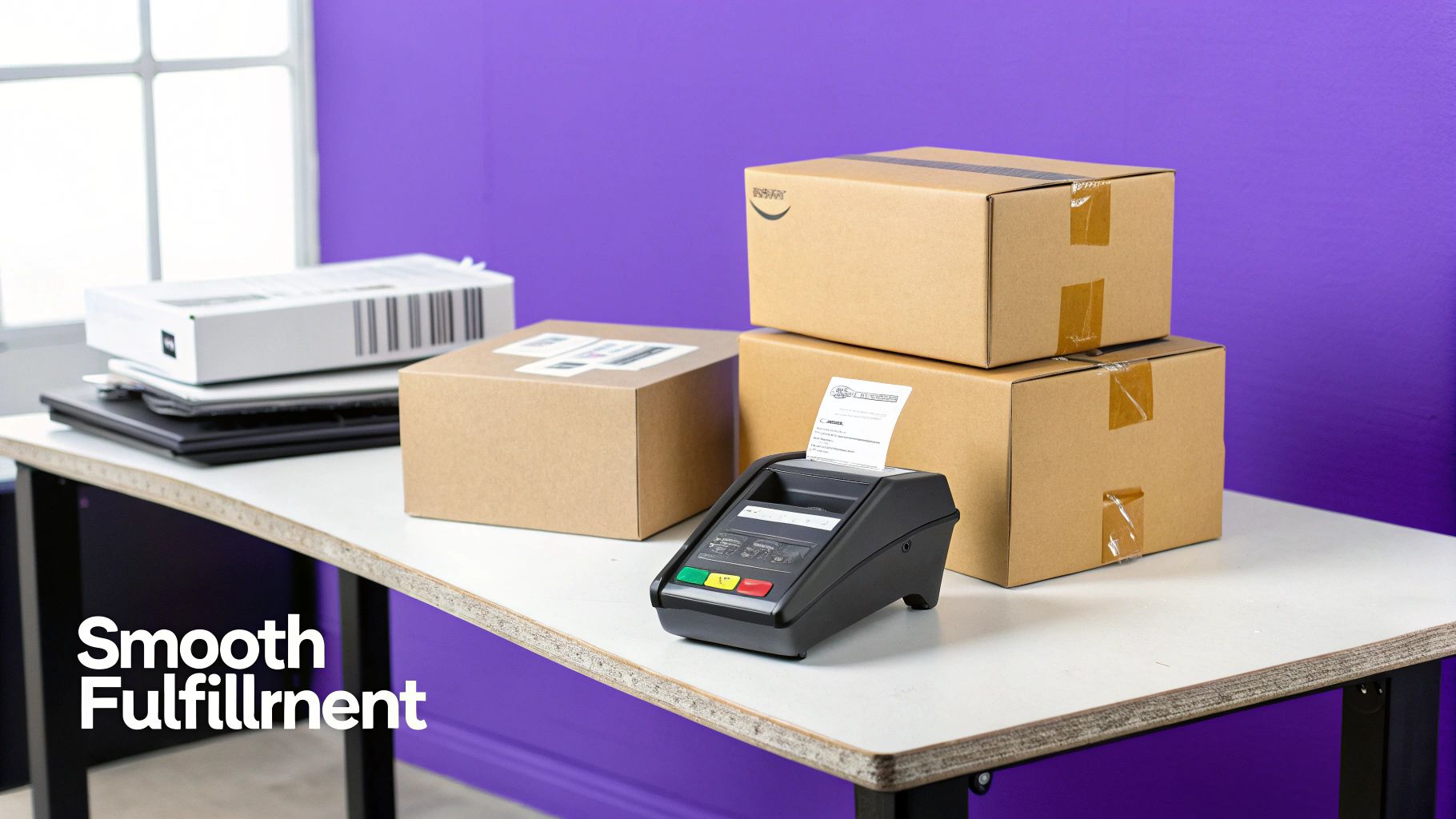
This is where your digital storefront gets real. A customer clicks 'buy,' and suddenly a whole series of physical events has to happen—money needs to change hands, a box needs to be packed, and a product has to start its journey. Getting these backend operations right is what turns a fun side project into a legitimate, scalable business.
Let's break down how you get paid and how you get products to your customers. These aren't just boring technical steps; they are make-or-break moments in the customer experience that define your brand's reputation.
Setting Up Secure and Seamless Payments
Your checkout process should be so smooth, so trustworthy, that your customer barely even thinks about it. That's the goal. The engine behind this experience is your payment gateway, the service that securely handles credit card and other digital payments.
Fortunately, most modern e-commerce platforms like Shopify have their own built-in payment solutions (e.g., Shopify Payments) that are incredibly simple to activate. They’re designed to accept major credit cards, Apple Pay, and Google Pay right out of the box, which is a huge time-saver.
Once you have a handle on the payment methods you want to offer, it's worth understanding the bigger picture. This guide on choosing the best payment gateway for your ecommerce store offers a fantastic breakdown of all the options out there.
A few key things to keep in mind:
- Transaction Fees: Every processor will take a small cut from each sale, typically a percentage plus a fixed fee (a common rate is 2.9% + 30¢). You absolutely have to account for this in your pricing strategy.
- Customer Trust: Seeing familiar logos like Visa, PayPal, or Apple Pay is an instant confidence booster for shoppers. It tells them your store is legitimate and can dramatically reduce cart abandonment.
- Simplicity: The fewer fields a customer has to fill out, the higher your conversion rate will be. Integrated options that can remember a customer's details for next time are pure gold.
Mapping Out Your Fulfillment Strategy
Okay, so you can accept money. Now, how are you actually going to get your products to your customers? This is fulfillment, and it’s a much bigger decision than just buying some boxes and bubble wrap. Your approach will directly impact your daily workload, your profit margins, and your customers' happiness.
There are really three main paths you can take, especially when you're just starting out.
The Three Main Fulfillment Models
Picking the right model is a strategic choice. If you sell handcrafted jewelry, the personal touch of your own packaging (in-house) is a core part of your brand. But if you’re selling dozens of different phone cases, a dropshipping model lets you offer a huge variety without taking on any inventory risk.
Don't overcomplicate this at the start. Many successful businesses begin by fulfilling orders from their living room. You can always switch to a 3PL partner later when your order volume makes it a smart financial move. The key is to have a plan for growth.
Calculating Shipping Rates That Work
Last but not least, you need to figure out what to charge for shipping. This is trickier than it sounds. You have to cover your costs without scaring away customers with sticker shock at checkout. In fact, unexpected shipping costs are the #1 reason people abandon their shopping carts.
Here are the most common strategies you can use:
- Offer Free Shipping: This is a killer marketing tool. You can either absorb the cost (if your margins allow) or, more practically, build the average shipping cost into your product prices.
- Charge Flat-Rate Shipping: This keeps things simple for everyone. You charge one flat fee for all orders, or maybe tiered rates based on the order value (e.g., $5 shipping for orders under $50).
- Use Real-Time Carrier Rates: Your e-commerce platform can connect to carriers like USPS or UPS and pull the exact shipping cost based on package weight and the customer's location. It’s the most accurate method, but can sometimes result in awkward-looking shipping charges (like $8.67).
For most new stores, a hybrid approach often works best: offer free shipping over a certain amount (like $75) to encourage bigger carts, and use a reasonable flat rate for all orders below that threshold. It’s predictable for your customer and easy for you to manage.
Time to Launch and Market Your Store

You've done the heavy lifting—you’ve built a great-looking store, your products are ready, and the backend is running smoothly. But here's the hard truth: none of that matters if no one knows you're open for business. A great launch isn't about just flipping the "on" switch; it's a planned event designed to build buzz and get your first real customers through the door.
Think of it like a grand opening for a physical shop. You wouldn't just unlock the doors and hope people wander in. You'd send out invites, create some hype, and make sure people are excited to show up. The goal here isn't just a few day-one sales, but to build momentum that you can ride for weeks and months to come.
Build Buzz Before You Even Open
Your marketing efforts should kick off weeks before your store goes live. This pre-launch phase is all about warming up your audience and, most importantly, building an email list of people who are genuinely excited to buy from you the second you open.
The simplest, most effective way to do this is with a "coming soon" page. This isn't just a placeholder; it's your very first marketing tool. Make sure it includes:
- A Killer Headline: Be crystal clear about what you're selling and who it's for.
- An Email Signup: This is non-negotiable. Offer an exclusive launch-day discount or a freebie to give people a real reason to sign up.
- A Sneak Peek: Build some desire by showing off a few high-quality photos of your products.
- Social Media Links: Give people a way to follow your journey and get more updates.
At the same time, start teasing your launch on social media. Post behind-the-scenes shots, tell your brand's story, and run a countdown. This makes potential customers feel like they're part of your brand's origin story.
Your Launch Day Game Plan
When the big day arrives, it’s time to make some noise. The goal is to funnel as much targeted traffic as you can to your new website. Don't spread yourself thin trying to be everywhere—pick two or three channels and hit them hard.
Here’s a simple checklist for launch day:
- Blast Your Email List: Send a launch announcement to all those eager subscribers. Craft an exciting subject line like, "We're LIVE! Your Exclusive Discount is Inside" and use a big, clear button that links straight to your store.
- Go All-In on Social: Announce the launch across your chosen social channels. Use eye-catching photos or a short video and link directly to your best products. You might even consider running a small, targeted ad campaign to reach people who fit your customer profile but don't follow you yet.
- Tap Your Personal Network: Never underestimate the power of friends and family. Let them know your store is live and ask them to share the news. Their support can make a huge difference.
Your launch isn't the finish line—it's the starting pistol. The energy you bring on day one sets the tone for everything that follows. Celebrate every single sale and use that momentum to power your next move.
Marketing Foundations for Long-Term Growth
Once the confetti settles from the launch, your focus needs to shift to building repeatable systems that bring in customers consistently. This is where you lay the groundwork for steady, predictable growth.
Get the SEO Basics Right
Search Engine Optimization (SEO) is how you get your store to show up in Google when people are searching for what you sell. It’s a marathon, not a sprint, but it's absolutely crucial. Start by making sure your product pages have descriptive titles and meta descriptions that include words your customers would actually use. For example, instead of just "Blue Mug," go with "Handmade 12oz Ceramic Coffee Mug with Deep Blue Glaze."
Kick-Off Your Email Marketing
Your email list is pure gold because you own it—no algorithm can take it away. Go beyond the launch announcement and set up a simple welcome email series for new subscribers. Use it to introduce your brand, show off your best-sellers, and maybe offer a small discount to encourage that first purchase.
Be Smart About Social Media
Pick one or two social platforms where your ideal customers actually hang out and commit to being there. You don't need to go viral. Just focus on posting great product photos, sharing customer stories, and actually talking to your followers. The goal is to build a community, not just a broadcast channel.
Got Questions About Launching Your Store? Let's Get Them Answered.
Even with the best-laid plans, a few questions are bound to pop up when you're getting your ecommerce business off the ground. That’s totally normal. Moving from a great idea to a real, functioning store always comes with a few "how do I...?" moments.
So, let's talk through some of the most common stumbling blocks I see new store owners run into. Think of this as the FAQ you didn't know you needed, covering everything from the headache of sales tax to the classic "how much stuff should I buy?" dilemma.
How on Earth Do I Handle Sales Tax?
Sales tax. Just the phrase can make a new entrepreneur's head spin, but it's simpler than you think at the start. The rules boil down to something called "nexus," which is just a fancy term for having a significant business presence in a state. For most people just starting out, this means you only have to worry about collecting sales tax from customers in your home state—the one where you're physically based.
As your business grows, that can change. Hitting certain sales figures or a specific number of transactions in other states can create nexus there, but don't sweat that on day one.
- Keep it simple: At launch, just focus on your home state.
- Let your platform do the heavy lifting: Modern ecommerce platforms like Shopify have built-in tax tools that are absolute lifesavers. They automatically figure out the correct rates at checkout based on the customer's address. Use them.
- Call a pro later: Once you're making consistent sales and expanding your reach, it's a great idea to have a quick chat with an accountant. They'll make sure you're staying on the right side of the law as you grow.
The key is not to let tax anxiety stop you before you even start. Use the tools available and tackle the bigger picture once you have sales data to work with.
How Much Inventory Should I Actually Start With?
This is the age-old ecommerce balancing act. If you order too little, you could sell out in a flash and leave potential customers disappointed. But if you order too much, you’ll have a mountain of cash tied up in boxes just sitting there. While there’s no magic number, the best strategy is always to start lean.
Honestly, for a brand-new product, it's way better to sell out than to be stuck with unsold inventory. Selling out creates a sense of urgency and proves people actually want what you're selling. Dead stock just drains your bank account.
Your first inventory order isn't really about maximizing profit. It's a paid experiment. You're buying data. That first batch will tell you what people are excited about and what they ignore, guiding you to make much smarter (and bigger) orders down the line.
Here are a few practical starting points:
- For unique or handmade items: Start with a small, manageable batch. Think 10-25 units for each variation (like a specific size or color). This keeps your financial risk super low while you test the waters.
- For products from a supplier: You'll often be limited by a minimum order quantity (MOQ). If your manufacturer's MOQ feels way too high, don't be afraid to ask if they'd be willing to do a smaller test run. The worst they can say is no.
Your goal here is to protect your capital until you know for sure what your customers want to buy.
Is It Too Soon to Form an LLC?
You can technically start selling online as a sole proprietor without any formal business structure. But if you're serious about this, forming a Limited Liability Company (LLC) is one of the smartest moves you can make, and you should do it early. The biggest reason comes down to two words: personal asset protection.
Setting up an LLC creates a legal firewall between your business and your personal life. If your business ever gets into hot water with debts or a lawsuit, your personal assets—your house, your car, your savings—are protected. It's an indispensable safety net.
So, what's the right time? Ideally, before you make your very first sale. Getting your LLC in place from the get-go protects you from day one. It also signals to customers, banks, and partners that you're a legitimate, serious business, which goes a long way in building trust.
Ready to stop wondering and start building? At Wand Websites, we take the guesswork out of launching a professional, high-converting Shopify store. Let us handle the technical details so you can focus on your products and customers. Check out our services and see how we can help you grow.
