
How to Create a Referral Program: how to create referral program that works

So, you're thinking about creating a referral program? Smart move. It’s all about turning your happy customers into your best marketers by giving them a little something—like a discount or some store credit—for sending new business your way.
The whole process is actually pretty straightforward. You'll figure out a compelling reward, pick a Shopify app to run the show, and then get the word out to your existing customers. It’s a fantastic way to capitalize on the trust you've already worked so hard to build.
Why a Referral Program Is Your Next Smart Move
Before we get into the nuts and bolts of setting it up, let's talk about why this is such a powerful strategy, especially for a growing store like yours. If you're making sales consistently, you've already got the most important piece of the puzzle: happy customers.
A referral program isn't just another box to check on your marketing to-do list. It's about creating a system that takes all that customer love and channels it into a reliable stream of new sales. Think of it less as marketing and more as community-building. Your biggest fans are probably already telling their friends about you; a formal program just gives them a little nudge and a thank-you for doing it.
It All Comes Down to Trust
Word-of-mouth has been around forever for a reason—it works. When a friend recommends a product, it instantly cuts through all the noise of sponsored posts and flashy ads. That recommendation comes with a built-in layer of trust you just can't buy. It feels like a genuine tip, not a sales pitch.
This is especially true if you've recently moved from a marketplace like Etsy to your own Shopify store. You built your initial following on unique products and personal connections. A referral program lets you scale that authentic connection, essentially empowering your loyal customers to become your volunteer marketing team.
A Smarter Way to Find New Customers
Let's be real: finding new customers can get expensive. The cost of running ads on Meta and Google is always climbing, and the results can feel like a rollercoaster. A referral program offers a much more stable and cost-effective path forward.
The real beauty of a referral program is that you only pay for results. You aren't just spending money hoping someone clicks an ad; you're rewarding a customer for bringing you an actual sale. This is a game-changer for your customer acquisition cost (CAC).
Just think about the ripple effects:
- Sky-High Conversion Rates: People who are referred by a friend are way more likely to buy. They show up already convinced your brand is worth checking out.
- Better, More Loyal Customers: Studies have shown time and again that referred customers stick around longer and spend more. Their lifetime value (LTV) is often significantly higher than customers you find through ads.
- A Growth Engine That Runs Itself: Once your program is up and running, it creates a powerful feedback loop. You get new customers, you make them happy, and they go on to refer their friends. It's a cycle of growth that can start to feel almost automatic.
Building the Foundation of Your Referral Strategy
A great referral program is built on a smart plan, not just a cool app. Before you ever touch a piece of software, we need to get the strategy right. This is where we nail down exactly what you want this program to do for your business.
What's your biggest priority right now? Are you focused on driving more traffic, converting more first-time visitors, or building a die-hard community of repeat buyers? Your answer here will shape every single decision we make down the line.
Nailing down the fundamentals is non-negotiable. For a deeper dive into planning, check out this excellent guide on how to create a referral program that works.
What’s the Goal Here, Really?
Without a clear, measurable goal, you’re just flying blind. You need a North Star to know if your efforts are actually making a difference. This shouldn’t be a vague wish; it needs to be a specific outcome you can track.
Here are a few common goals I see with e-commerce stores:
- Bring in new customers: The most straightforward goal, focused purely on first-time sales.
- Lower your Customer Acquisition Cost (CAC): Get new customers for less money than you're spending on ads.
- Boost customer lifetime value (LTV): Attract higher-quality customers who stick around and buy again.
- Drive repeat purchases: Use rewards like store credit to give existing customers a reason to come back.
My advice? Pick one primary goal to start. You can always add more later, but focus is your friend in the beginning. For many store owners coming over from Etsy, a fantastic starting point is lowering your CAC and reducing that dependency on paid ads.
Finding Your True Fans
Okay, you have a goal. Now, who are you going to ask to spread the word? The secret is to focus on the people who already love what you do—your champions.
Your most likely advocates are your repeat buyers. These folks have voted with their wallets, sometimes multiple times. They already trust your brand and are your most valuable asset. Other great candidates are customers who've left you glowing reviews or rave about you on social media.
This simple decision tree is a great gut-check to see if you're even ready for a referral program.
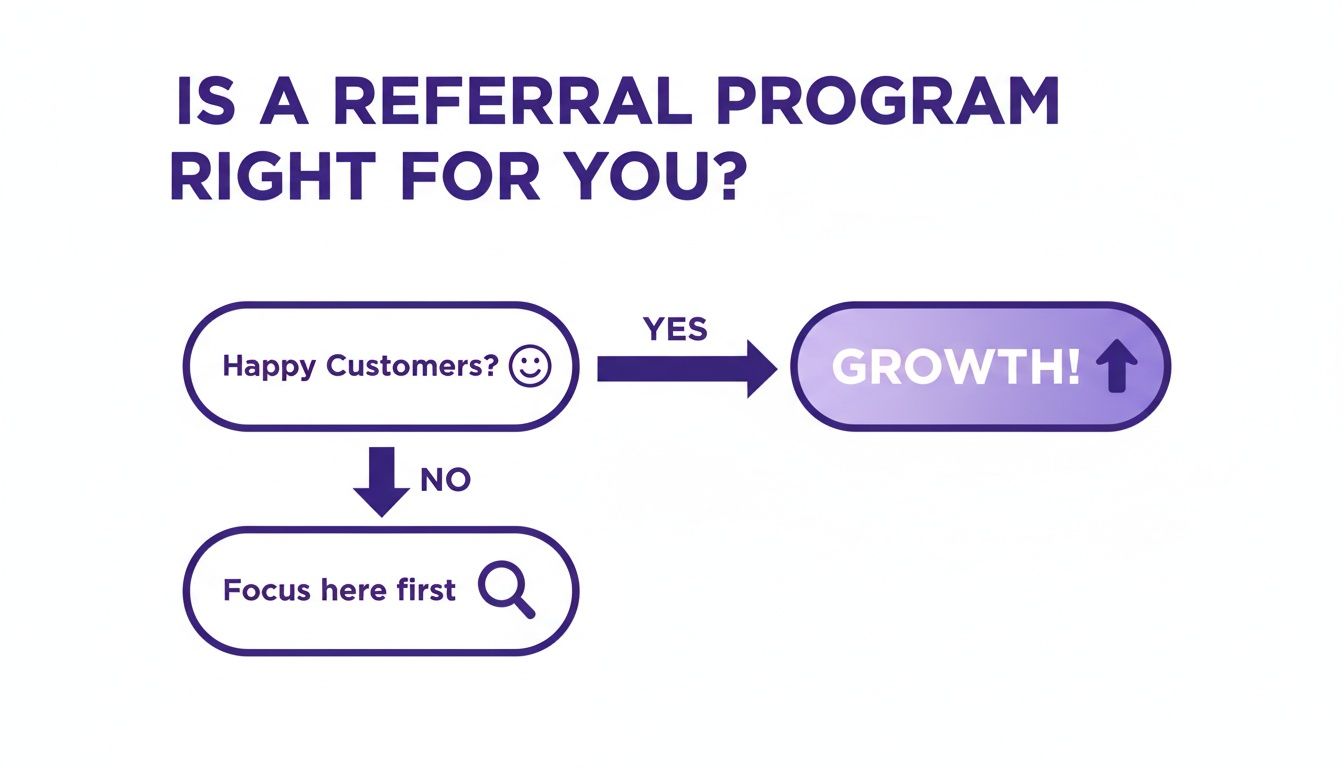
As you can see, it all comes back to happy customers. Without them, you're just spinning your wheels.
This is why referral marketing crushes traditional advertising. An incredible 92% of consumers trust recommendations from people they know over any other form of marketing. That personal trust is pure gold.
Choosing Your Referral Incentive Structure
Now for the fun part: the rewards! The right incentive is the fuel that makes your referral engine run. It has to be juicy enough to get your advocates sharing and compelling enough for their friends to actually make a purchase.
From my experience, the most effective structure for e-commerce is almost always a double-sided reward. This means both the person sharing (your advocate) and their friend (the new customer) get something. It completely changes the dynamic from a sales pitch to a friendly tip.
Why Double-Sided Works: Your advocate isn't just asking their friend to buy something; they're giving them a gift (like a discount). This simple psychological shift makes people way more comfortable and eager to share.
To help you decide what kind of reward makes the most sense for your store, here's a breakdown of the most common options.
Choosing Your Referral Incentive Structure
Ultimately, the best choice depends on your products, margins, and goals. A good rule of thumb is to offer a reward that costs you less than your current Customer Acquisition Cost (CAC) but still feels generous to your customers.
Picking the Right Shopify Referral App for Your Store
You've got your strategy and rewards mapped out—now for the fun part. It's time to bring your referral program to life, and thankfully, you don't need to be a developer to do it. The Shopify App Store is packed with fantastic tools that make this whole process a walk in the park.
Think of this as choosing a partner for your business. You want an app that feels like a natural extension of your brand, not some clunky, confusing add-on. We'll look at this from the perspective of a busy store owner, focusing on what really matters: features that actually help, pricing that won’t break the bank, and an interface that you can figure out without a 100-page manual.
Just a quick search for "referral" on the app store shows you just how many options you have.
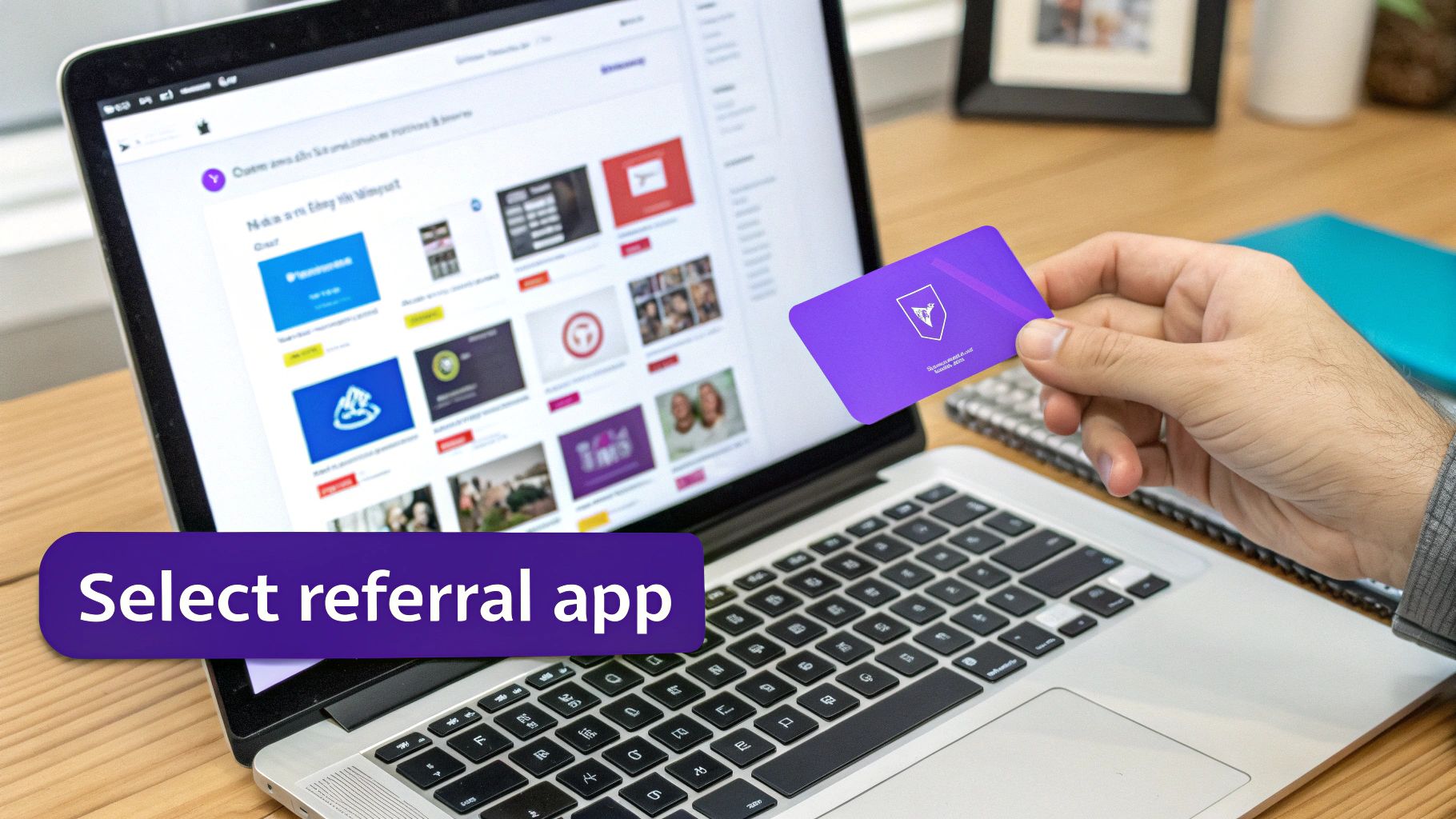
It can feel a little overwhelming, but all this choice is a good thing! It means there’s a perfect fit out there for your specific budget and needs.
What Features Actually Matter?
Let's cut through the noise. Not all referral apps are built the same. Some are bare-bones simple, while others are loaded with more bells and whistles than you'll ever use. For a growing shop, you want to hit that sweet spot right in the middle.
Here are the non-negotiables I always tell people to look for:
- Painless Setup & Customization: You should be able to get your program up and running in under an hour, seriously. Look for a clean dashboard and simple options to tweak colors, fonts, and text. It has to match your brand.
- Flexible Reward Options: The app absolutely must support the reward structure you already planned. Whether you’re giving a percentage off, a flat $10 discount, or store credit, the app needs to handle it smoothly without any weird workarounds.
- Automatic Reward Payouts: This is a big one. The app must automatically create and send coupon codes or apply store credit when a referral is successful. Doing this by hand is a recipe for mistakes and wasted time.
- Easy-to-Read Analytics: You have to know if it's working! A good app will have a simple dashboard showing you the important stuff: how many people are sharing, how many sales you're getting, and who your top advocates are.
A Quick Rundown of Your Options
While there are dozens of great apps, they generally fall into three camps. Understanding the difference will help you zero in on the right one for you.
Honestly, for most sellers making the jump from Etsy to Shopify, a dedicated referral app is the way to go. It gives you the best mix of power, simplicity, and value, letting you nail this one marketing channel before adding more complexity.
What the Setup Actually Looks Like
Let's pull back the curtain on the "techy" side of things, which I promise isn't that techy at all. Once you pick an app and click "install," the process is mostly just filling in a few boxes and making a few choices.
First, you'll set up your rewards. This is where you plug in the numbers you decided on earlier. For example, you’ll tell the app to give the advocate (the sharer) $20 in store credit and their friend 15% off their first order.
Next up is customizing the look and feel. You’ll upload your logo, pick colors for the pop-ups and sharing widgets that match your brand, and edit the default text. The goal is to make it feel like it’s truly a part of your store, not some third-party tool.
Then, you’ll tweak the automated emails. The app will come with pre-written emails for things like inviting a customer to join or congratulating someone on a successful referral. Take five minutes to read through them and adjust the language to match your brand's voice.
Finally, you’ll activate your referral page. The app automatically creates a landing page where customers can find their unique sharing link. All you have to do is add a link to this page in your store's main menu or footer so people can find it.
My Pro Tip: Spend a little extra time on the "default share message." This is the text that pops up when someone shares their link on Facebook or Twitter. A short, punchy message that clearly explains the deal ("Get $15 off your first order with my link!") works wonders.
The right app handles all the heavy lifting—the link tracking, the code generation, the reward delivery—so you can launch with confidence and focus on spreading the word.
Crafting Your Message and Onboarding Advocates
Alright, your referral program is technically set up. But even the best app in the world is useless if no one knows about it. Now we shift from the technical bits to the human side of things: communication. How you talk about your program is just as critical as the rewards you offer.
The goal here is to make sharing feel like an exciting and obvious next step for your happiest customers. This isn't about begging for sales. It's about inviting your biggest fans into an exclusive club where they get rewarded for something they probably already do.
Writing Copy That Actually Converts
Your referral messaging has to be dead simple and instantly answer every customer's favorite question: "What's in it for me?"
Ditch the corporate jargon. Use a friendly, straightforward tone that sounds like you.
I've always found that a simple, repeatable formula works best for all your referral copy: Hook, Benefit, Action.
- Hook: Snag their attention with a punchy headline. Think "Share the love," "Give $15, Get $15," or "Your friends will thank you."
- Benefit: Spell out exactly what they get and what their friend gets. Don't be vague! "You'll get a $15 credit for every friend who buys, and they'll get 15% off their first order."
- Action: Tell them exactly what to do next. "Grab your unique link now!" or "Start sharing to earn."
This isn't just theory. The legendary Dropbox referral program, launched back in 2008, used this exact kind of clear, benefit-focused messaging to explode from 100,000 to 4 million users in just 15 months. Their simple, two-sided offer of free storage resulted in a mind-blowing 4% referral conversion rate—a number that's still a benchmark today. If you want to dive deeper, you can discover more insights about referral program metrics and see just how powerful this approach is.
Creating a Simple Onboarding Flow
"Onboarding" sounds like a big, scary corporate word, but it's not. It’s just making sure your customers know the program exists and how to use it. The best part? You can automate the whole process so every new customer gets a friendly nudge to join the fun.
The absolute best time to ask for a referral is right when a customer’s excitement is at its peak. This is your golden opportunity to turn a happy buyer into an enthusiastic advocate.
Your goal isn't just to tell customers about the program. It's to make them feel like valued insiders. The invitation should feel like a special perk, not just another marketing email.
A great onboarding experience doesn't have to be complicated. It can be as simple as an automated email sequence that kicks in after someone makes a purchase.
Key Touchpoints for Welcoming New Advocates
Here are the most effective places to introduce your referral program and get people on board. Your referral app should be able to automate most, if not all, of this for you.
The Post-Purchase Thank You Page: Right after they click "complete order," they're feeling great about their purchase. A simple pop-up or banner on your thank you page saying, "Love your order? Share it with a friend and you both get rewarded!" works wonders.
The Order Confirmation Email: This email has one of the highest open rates of any you'll ever send. Don't let that valuable real estate go to waste! Add a small, attractive banner at the bottom with a clear call-to-action to join your program.
A Dedicated "Welcome to the Program" Email: Once someone signs up, don't just leave them hanging. Fire off an automated email that thanks them for joining, reminds them of the rewards, and puts their unique sharing link front and center.
By putting these simple touchpoints in place, you’re building a system that consistently turns your best customers into advocates—all without you lifting a finger. You're not just hoping they find it; you're actively guiding them toward becoming a powerful growth engine for your brand.
It’s Time to Launch and Promote Your Program
You’ve built the engine; now it’s time to fill the tank. Hitting ‘publish’ on your referral program is a great feeling, but a quiet launch won't get you very far. The real momentum comes from a focused promotional push right out of the gate. This is what separates a program that fizzles out from one that becomes a core part of your growth.
Think of your launch like a mini-campaign. Your goal is to get your program in front of your best, most loyal customers as quickly as possible. When they start sharing, the flywheel starts turning.
Your Practical Launch Checklist
A big launch doesn't require a massive budget. All it takes is a bit of coordinated effort across the channels you already own. Here’s a simple, actionable checklist to make sure your program gets the attention it deserves from day one.
Send a Dedicated Announcement Email: Don't just bury this news in your weekly newsletter. Craft an email entirely focused on the new program. Go for a clear, benefit-driven subject line like, "Give $15, Get $15! Our New Referral Program is Here."
Add a Site-Wide Banner or Pop-Up: For the first week or so, make your program impossible to miss. Use a promotional banner at the top of your site or a subtle pop-up to announce the launch. Make sure it links right to your referral page.
Pin It on Social: Whip up a few eye-catching graphics that explain how the program works. Pin them to the top of your Facebook, Instagram, and Pinterest profiles so they’re the first thing visitors see.
Update Your Email Signatures: This is a small tip with a big impact. Add a simple line to your customer service email signatures, like, "P.S. Love our products? Get rewarded for sharing!" and include the link.
To really get the most out of this, you need to see your referral program as part of your larger digital marketing for ecommerce growth strategy. It shouldn't live on an island; it should be woven into how you talk to your customers everywhere.
Tracking the Numbers That Actually Matter
Getting the word out is only half the battle. Once the invites are sent and the shares start happening, you need to know what’s actually working. Diving into your referral app's analytics can feel overwhelming at first, but you really only need to watch a few key metrics to get a clear picture.
These numbers tell the real story of how well your program is performing. Don't just glance at them—use them to make smart decisions.
The most common mistake I see is focusing only on the final number of sales. That's a lagging indicator. The real magic happens when you understand the user behavior that leads to those sales.
Here are the three core metrics to live by:
Participation Rate: This is simply the percentage of your customers who have signed up to be an advocate. If it’s low (under 5%), you probably need to promote the program more heavily, or maybe the offer isn't quite juicy enough.
Share Rate: Of the people who joined, what percentage are actually sharing their links? If this number is low, the reward might be fine, but the sharing process itself could be clunky or confusing. It’s a great signal to re-evaluate the user experience.
Referral Conversion Rate: This is the big one. Of all the people who click a referral link, how many make a purchase? Industry benchmarks hover around 3-5%, but top-tier programs can see this number jump to an incredible 10-30% of their total revenue. The data is clear: programs that reward both the advocate and the friend see much higher engagement.
Keep Optimizing Over Time
Your launch is just the beginning. The most successful referral programs are the ones that evolve. Use the data you’re tracking to ask smart questions and run small experiments.
Is your share rate a bit weak? Try A/B testing the default social sharing message. Are conversions lagging? Maybe the discount you’re offering the new customer needs to be a little sweeter. Sometimes, a small tweak—like changing a 10% off offer to a flat $15 off—can have a massive impact.
Treat your referral program as a living, breathing part of your business. Listen to the data, make small adjustments, and watch as you turn your happy customers into your most powerful and cost-effective marketing channel.
Got Questions About Your Referral Program? We've Got Answers.
Alright, you've got the big pieces in place—the strategy, the tech, the launch plan. But if you're like most store owners I've worked with, a few last-minute questions are probably rattling around in your head. That's totally normal.
Let's tackle some of the most common ones right now so you can move forward with confidence.
How Much Should I Actually Give as a Reward?
This is the big one, right? There's no single magic number, but a great starting point is to offer something that feels genuinely valuable without tanking your margins. A solid rule of thumb is to aim for a reward worth 10-20% of your average order value (AOV).
So, if your typical order is about $100, offering a $15 store credit to the person sharing and 15% off for their friend is a pretty sweet deal. It feels generous to both sides. The key is making sure your cost to get that new customer is lower than what you'd pay for them through paid ads.
Whatever you choose, always go for a "double-sided" incentive where both the referrer and their friend get something. It’s a proven way to get more people to actually share.
The goal isn't just to give away a discount. It's to create a win-win-win. The person sharing feels like a hero, the new customer gets an awesome deal, and you get a new fan.
That simple mindset is what separates a program that fizzles out from one that really scales.
When's the Best Time to Ask for a Referral?
Timing is everything. You want to pop the question when a customer is at their absolute happiest with you and your products. When you catch them in that "I love this brand!" moment, sharing feels like a natural next step, not a chore.
The golden moments are:
- Right after they buy. I'm talking on the thank-you page or in the order confirmation email. Their excitement is fresh, making it the perfect time to plant the seed.
- A few days after the package lands. Once they've unboxed their goodies and are really enjoying them, a quick, friendly email can work wonders. This is when they feel the value.
- The second they leave a glowing review. If someone just gave you 5 stars, they've literally raised their hand and said, "I'm a fan!" This is the lowest-hanging fruit you'll ever find.
Set up automations for these touchpoints using your referral app or email platform. That way, you're consistently asking at the perfect time without lifting a finger.
How Do I Stop People From Gaming the System?
Referral fraud—like someone referring themselves with a different email—is a real thing, but it’s completely manageable with the right setup. Most of the good Shopify referral apps have built-in fraud protection.
These tools can automatically flag sketchy behavior, like multiple referrals coming from the same IP address. You can also lay down some clear ground rules, like specifying that rewards only apply to a friend's first purchase.
Another pro tip: add a short delay before paying out rewards, say 14 or 30 days. This "pending period" gives you a buffer to make sure the new customer doesn't just buy and immediately return the item. It’s a simple way to protect yourself from paying commissions on refunded sales.
Do Referral Programs Even Work for High-End Products?
They absolutely do. In fact, they can be even more effective for luxury or high-ticket brands. Why? Because expensive purchases are all about trust. A personal recommendation from a friend slices through the skepticism in a way no fancy ad ever could.
For premium products, though, a simple percentage discount can feel a little cheap and might even devalue the brand. You need to think bigger.
Consider rewards that feel more exclusive:
- A significant, fixed-amount store credit ($100 off feels a lot more premium than 10% off).
- An exclusive, high-value free gift with their next order.
- Early access to a new collection or a limited-edition drop.
The idea is to make the reward feel just as special as the products you sell. This turns your best customers into your most passionate advocates.
Ready to stop relying on Etsy's unpredictable algorithm and build a brand that's truly your own? At Wand Websites, we specialize in creating high-performing Shopify stores that turn your hard work into more traffic, bigger orders, and loyal customers. Let’s build your growth engine together. Find out more about how we can help.
