
How to Create Email Marketing Campaigns That Actually Convert

Before we dive into the fun stuff like crafting clever subject lines and beautiful designs, we need to get the groundwork right. Every single successful email campaign I've ever seen—whether for a product launch, an automated welcome series, or a cart recovery push—starts with these three things: a clear goal, the right tools, and a great list of subscribers.
Get these fundamentals locked in, and everything else falls into place.
Building Your Foundation for Profitable Emails
It's tempting to jump straight into writing emails, but a profitable email strategy isn't built on guesswork. It’s built on purpose. Without a solid foundation, even the most creative campaign will miss the mark.
Think of it like building a house. You wouldn't start picking out throw pillows before you've poured the concrete. The same idea applies here. Your foundation is your why, your how, and your who.
Define Your Campaign Goal
First things first: what are you actually trying to achieve? Every email campaign needs a single, specific objective. Without one, your message will be scattered and confusing.
Are you trying to drive sales for a new collection? Win back customers who haven't shopped in a while? Or maybe you just want to get more eyes on your latest blog post. Nailing down your goal makes every other decision—from the audience you target to the call-to-action you write—so much easier.
For example, a campaign to clear out old inventory is a completely different beast than one meant to welcome new subscribers.
- Inventory Clearance Goal: This is all about urgency and big discounts. You'll likely email your entire list, and your main success metric is immediate sales revenue.
- Welcome Series Goal: Here, the focus is on storytelling and building trust. You're only targeting brand-new subscribers, and you're measuring success with open rates, click-throughs, and long-term engagement.
A clear goal is your compass. Don't send a single email without one.
Choose Your Email Service Provider
Your Email Service Provider (ESP) is your command center. For any e-commerce store, especially those running on Shopify or with Wand Websites, choosing a platform that integrates seamlessly is a must. There's a reason tools like Klaviyo and Mailchimp are so popular—they are built from the ground up for e-commerce.
A great ESP does so much more than just send emails. It's your partner in growth, helping you understand customer behavior, automate complex workflows like abandoned cart reminders, and deliver the data you need to make smarter marketing decisions.
When you're picking an ESP, look closely at its segmentation, automation, and reporting features. These are the engines that power personalized, high-converting campaigns.
Build a High-Quality Email List
Let’s be clear: your email list is your single most valuable marketing asset. It's a direct line to your customers, and you own it completely. But here's the secret—quality beats quantity every single time. A list of 1,000 engaged subscribers who actually want to hear from you is a goldmine compared to a list of 10,000 people who don't care.
Whatever you do, never, ever buy an email list. It’s a shortcut to the spam folder and a one-way ticket to a damaged sender reputation. The only sustainable path is to build an email list that actually grows your business organically.
Here are a few proven ways to do just that:
- Embedded Sign-up Forms: Add simple, clean forms to your website's footer or blog sidebar. Make it easy for people to say yes.
- Pop-up Offers: Use a timed or exit-intent pop-up with a compelling offer. A quick "10% off your first order" in exchange for an email address works wonders.
- Checkout Opt-in: Add a simple, unchecked box during checkout that invites customers to join your list for future deals and updates.
These methods attract people who are genuinely interested in what you have to offer, setting you up for real, long-term success.
Use Smart Segmentation to Get to Know Your Audience
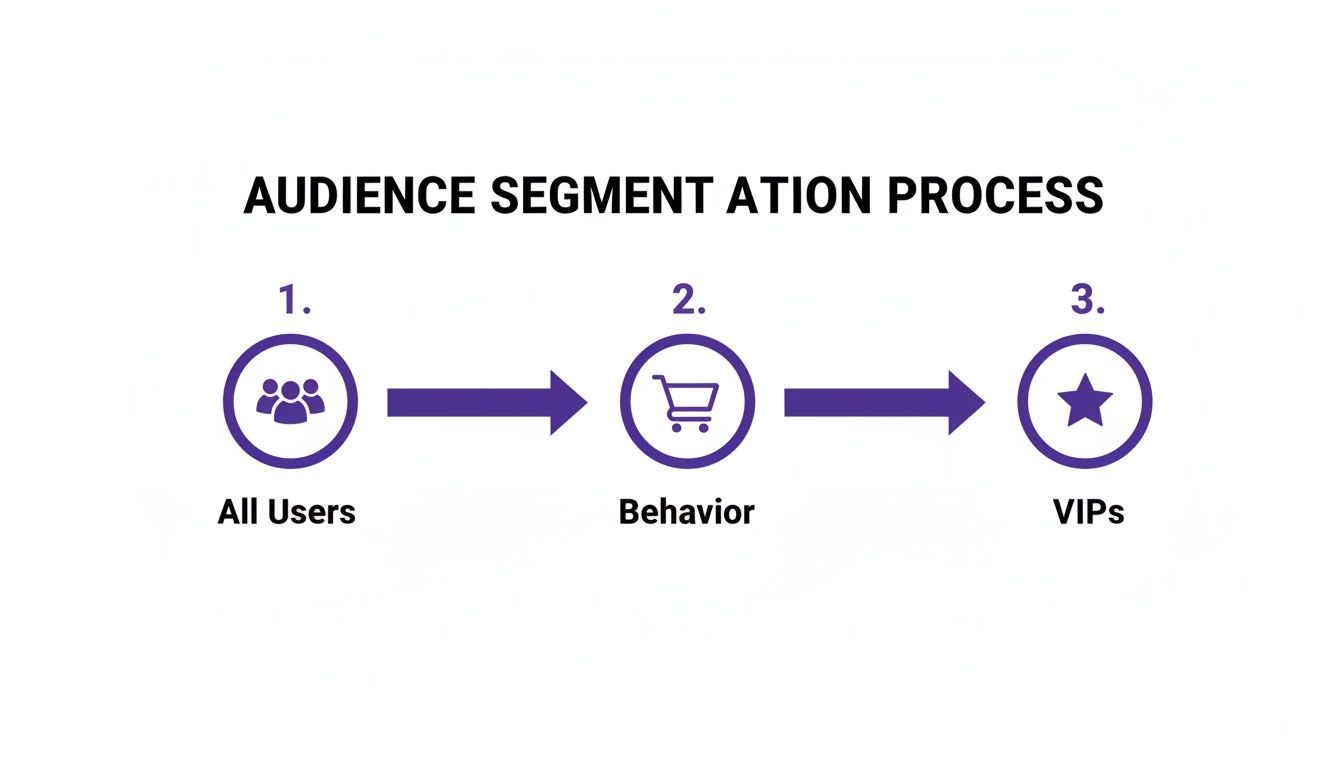
Blasting a generic email to your entire list is a surefire way to land in the spam folder. If you want your email marketing to actually work, the secret lies in segmentation—the art of slicing your audience into smaller, more relevant groups. This is how you stop shouting at everyone and start having real conversations with your customers.
When you group subscribers based on things they have in common, you can craft a message that's incredibly specific and valuable to them. That simple act of being relevant is what turns a casual browser into a loyal fan.
Go Deeper Than Basic Demographics
Sure, segmenting by location or gender can be useful, but for e-commerce, the real gold is in purchase behavior. This data tells you exactly what your customers are into and where they are in their relationship with your brand. Of course, before you can slice and dice your list, it's a good idea to know how to identify a target audience in the first place. Getting that foundation right makes everything else so much easier.
I always recommend starting with segments that can directly boost your revenue. Here are a few high-impact groups to build right away:
- First-Time Buyers: These folks just took a chance on you and are perfectly primed to become repeat customers. A targeted welcome email thanking them and sharing a bit about your brand story can make a huge difference.
- Loyal VIPs: This is your inner circle—the people who buy from you often or spend the most. Treat them like gold. Give them exclusive access, early-bird deals, and special discounts to show them you appreciate their business.
- At-Risk Customers: These are subscribers who haven't bought or opened an email in a while, maybe 90-120 days. A gentle "we miss you" campaign with a compelling offer can be just the nudge they need to come back.
- Category Shoppers: Group customers based on the product categories they’ve bought from. If someone bought hiking boots from you, they’re the perfect person to email when your new waterproof jackets drop.
Personalization in Action
Segmentation is what makes real personalization possible. When you know who you're talking to, you can write messages that feel like they were created just for them.
Let's say an Etsy seller just moved her home decor shop over to Shopify using Wand Websites. Instead of a generic "New Arrivals!" email, she could send a message that says, "Sarah, check out these cozy throws that would look perfect with the cushions you bought last month."
This level of detail isn't just a nice little touch; it's a revenue driver. When you create email marketing campaigns with personalized elements, you’re not just selling a product—you're showing the customer you get them.
This targeted approach has a massive payoff. In fact, one analysis of over 100 billion emails found that personalized subject lines are 26% more likely to be opened, and tailored calls-to-action convert a staggering 202% better than generic ones. This stuff really works and can be the key to hitting your monthly sales goals.
How to Put Behavioral Segments to Work
Getting started with this is easier than you think, especially with modern email platforms that plug right into your store. Here’s a simple, practical example you can steal today:
- Build a 'Summer Collection' Segment: First, pull a list of every customer who bought something from your "Summer Collection" last year.
- Craft an Exclusive Offer: Write an email just for them, offering an exclusive "early bird" discount on this year's new summer line before anyone else sees it.
- Make Them Feel Special: Use a subject line that screams exclusivity, like "Just For You: First Look at Our New Summer Styles!"
A simple campaign like this does more than just drive sales. It acknowledges their past loyalty, makes them feel like insiders, and builds a much stronger connection to your brand. That's how you turn one-time buyers into customers for life.
Putting Your Core E-Commerce Email Campaigns to Work
Alright, you've sliced and diced your audience into smart segments. Now for the fun part: building the email campaigns that will actually make you money, even while you sleep.
We’re not just talking about one-off email blasts here. We’re talking about creating strategic sequences—often called "flows" or "automations"—that trigger automatically based on what a customer does (or doesn't do). Think of them as your 24/7 sales team, always ready to welcome new subscribers, recover lost sales, and keep customers coming back.
Let's dive into the essential campaigns every e-commerce store needs to have in its corner.
Promotional Campaigns: Your Go-To for Sales and Launches
These are your classic, time-sensitive emails. You'll use them to shout about a flash sale, a new product drop, or a big holiday promotion. The key here is focus. Each email should have one clear goal and a strong call to action to create a sense of urgency.
For something like a Black Friday sale, you don't just send one email and hope for the best. A much better approach is a mini-series:
- The Teaser: A few days before, send a quick email to build some buzz. Hint at the amazing deals coming their way.
- The Launch: The moment the sale goes live, hit send. Make the subject line impossible to ignore, like "It's Go Time! Our Black Friday Sale is LIVE."
- The Last Chance: A few hours before it's all over, create some real FOMO (fear of missing out). Something like "Going, Going... Ends Tonight! Don't Miss 40% Off."
This multi-email rhythm keeps your offer top-of-mind without feeling spammy.
Automated Flows That Run on Autopilot
This is where the real magic happens. Setting up automated flows is how you turn a one-time effort into a steady, passive income stream. The numbers don't lie: automated emails see an average open rate of 42.1% and a click rate of 5.4%—blowing standard newsletters out of the water.
This is especially true if you're a busy entrepreneur moving your shop from a place like Etsy to your own dedicated Shopify store with partners like Wand Websites.
Industry data consistently shows that automated flows can deliver 4x better conversions than your manual campaigns. Imagine setting up post-purchase upsells, birthday discounts, or win-back sequences that just work. With 88% of people checking their email every single day, your customers are right there, waiting for these timely messages. For e-commerce stores, a solid automation strategy can pull in a staggering 45:1 return on investment. You can see more on this in these in-depth email marketing statistics.
Here's a quick look at the core automations you should absolutely have running for your store.
Essential E-Commerce Email Automation Flows
Setting up even just the first two or three of these automations can have a massive impact on your bottom line, often right away.
The Essential Welcome Series
If you only set up one automation, make it this one. Your welcome series is your first real conversation with a new subscriber, and these emails get an insane average open rate of over 80%. This is your golden opportunity to roll out the red carpet and make an amazing first impression.
A simple but powerful three-part welcome series might look like this:
- Email 1 (Sent Immediately): Deliver the goods! If you promised a discount code or a free guide for signing up, give it to them right away. Keep this email short, sweet, and focused on that promise.
- Email 2 (Sent 1 Day Later): Tell your story. Who are you? What’s your mission? This is where you connect with them on a human level and show them the face behind the brand.
- Email 3 (Sent 3 Days Later): Show off a little. Highlight your best-selling products and sprinkle in some social proof like customer reviews or user-generated photos to build trust.
The Abandoned Cart Recovery Sequence
Without a doubt, this is the single most profitable automation you can build. People abandon carts for a million reasons—the dog started barking, they got sticker shock from shipping costs, or they just got distracted. A timely, helpful reminder is often all it takes to get them back to your site to finish checking out.
Here’s a simple three-email playbook that works wonders:
- Email 1 (1-4 hours after abandonment): Send a gentle nudge. A simple "Did you forget something?" or "Your cart is waiting for you" works perfectly. No pressure, just a friendly reminder.
- Email 2 (24 hours after abandonment): Time to address their hesitation. Use this email to showcase your easy return policy, share glowing reviews for the specific items in their cart, or answer frequently asked questions.
- Email 3 (48-72 hours after abandonment): Create some urgency with a little incentive. A small discount, like "Here's 10% off to complete your order," can be the final push they need to click "buy now."
This sequence is designed to systematically bring back sales you would have otherwise lost forever. It's like finding money in the couch cushions, but way more effective.
Designing Emails That Demand a Click
Getting the right email to the right person at the right time is a huge win. But all that hard work setting up segments and automations goes right out the window if the email itself falls flat.
The design and copy are what turn a subscriber's curiosity into a sale. It’s the bridge between their inbox and your checkout page. This is where you get to blend a little bit of art with a whole lot of strategy to create something that not only looks great but actually converts.
Let's dig into how you can design emails that stop the scroll, tell a compelling story, and guide your reader straight to that "buy now" button.
Nailing the First Impression with Subject Lines
Before anyone even sees your beautiful hero image or tempting offer, they see one thing: the subject line. This tiny piece of text has a single, high-stakes job—earn the open. No pressure, right?
A great subject line piques curiosity, creates a sense of urgency, or makes a crystal-clear promise of what's inside. Think of it as the headline for your entire email. You've got maybe two seconds to convince someone your message is more interesting than the 50 others in their inbox.
Here are a few formulas I've seen work time and time again:
- Urgency + Benefit: "Last Chance! 20% Off Your Favorite Candles Ends Tonight"
- Curiosity + Exclusivity: "A Special Something Just For Our VIPs..."
- Direct Value: "Your Guide to Perfect Summer Skincare is Here"
And don't sleep on the preview text! That’s the little snippet that shows up right after the subject line. Use it to add context or another hook. Seeing "View this email in your browser" is a huge missed opportunity to give them another reason to click.
Creating a Clear Visual Path
Once someone opens your email, their eyes need to know where to go. That's where visual hierarchy comes in. It's simply the art of arranging everything so your reader is naturally guided from the most important piece of info down to the call to action.
Without it, your email is just a jumble of images and text that’s confusing to read and even harder to act on. For an e-commerce store, a solid, proven structure usually follows this path:
- A Killer Hero Image: The first thing people see should be a gorgeous, high-quality image that immediately sets the scene. Promoting a new dress? Show a lifestyle shot of someone looking incredible in it.
- A Punchy Headline: Right below the image, a bold, simple headline should state the email's main point.
- Scannable Body Copy: Keep paragraphs short. I mean it—two or three sentences, max. Use bullet points and bold text to break up the copy so people can skim and still get the gist.
- An Unmissable Call-to-Action (CTA): The final piece is a bright, obvious button that tells the reader exactly what to do next.
A well-designed email isn't just about looking pretty. It's about reducing friction and making it as easy as possible for your customer to say "yes." Every single element should serve that one goal.
Mobile-First Isn't a Suggestion—It's a Rule
Well over 50% of all emails are now opened on a mobile device. Let that sink in. If your email looks broken or clunky on a phone, you're shutting the door on more than half your audience.
When you create email marketing campaigns, designing for mobile first is non-negotiable.
This means sticking to a single-column layout that’s easy to scroll with one thumb. Your text needs to be large enough to read without pinching and zooming, and your CTA button has to be big enough for a finger to tap easily. Before you ever hit send, always, always send a test to your own phone to see how it looks and feels.
Keep Your Branding on Point
Your emails are a direct reflection of your brand. Every single one should feel like it came from your store, not some generic template. That means consistently using your brand's specific fonts, colors, and logo.
When a customer opens your email, it should be instantly recognizable. This kind of consistency builds trust and reinforces your brand identity, making your messages feel less like an ad and more like a friendly note from a company they know and like.
Finally, let's talk about that call-to-action button. This should be the visual finish line of your email. Use a color that contrasts with the background to make it pop, and write copy that creates excitement. Instead of a boring "Click Here," try something more specific and compelling like "Shop the New Collection" or "Claim My 20% Off." This is your final shot—make it count.
Measuring Success and Optimizing for Growth
So you’ve built a beautiful campaign and hit "send." Job done, right? Not even close.
That moment is actually the beginning of the most important part: the feedback loop. This is where you stop guessing and start knowing what actually works. True growth in email marketing comes from digging into your performance data and using those insights to make your next campaign even better.
This is how you turn email from a hopeful shot in the dark into a predictable, revenue-driving machine. It’s all about listening to what your subscribers are telling you with their clicks and actions.
Focus on the E-Commerce Metrics That Matter
Your email service provider, whether it's Klaviyo or Mailchimp, will throw a mountain of data at you. It can be overwhelming, but for an e-commerce store, a few key metrics tell most of the story.
Understanding what they mean is the first step toward improving them.
Open Rate: This is the percentage of people who actually opened your email. It's a direct reflection of how good your subject line and preview text are. A low open rate means your first impression isn't landing.
Click-Through Rate (CTR): Of those who opened the email, what percentage clicked a link? This tells you if your offer, images, and copy were engaging enough to make someone take the next step.
Conversion Rate: Here's the big one. This tracks how many people who clicked through actually went on to make a purchase. This is the ultimate test of your email's effectiveness from start to finish.
The real magic happens when you look at these metrics together. A high open rate but a low CTR suggests a great subject line but a weak message inside. A high CTR but a low conversion rate might mean your email was compelling, but something on your product page is killing the sale.
From Data to Decisions
Once you get a feel for the numbers, you can start making smarter choices. This data isn't just for a report you glance at once a month; it’s a roadmap telling you exactly what to fix.
Here’s a quick guide to turning your data into action:
If Open Rates Are Low: Your subject line is almost certainly the problem. Start testing different angles. Try adding the customer's first name, asking a question, or creating a little urgency.
If CTR Is Low: Your email's content and design need work. Is your offer crystal clear? Are your images compelling? Is your call-to-action button obvious and easy to find?
If Conversions Are Low: The issue might be on your website, not in the email. Check your landing page for clarity, make sure your checkout process is dead simple, and look for any surprise shipping costs that might be scaring people away at the last second.
To help you get a handle on this, here's a quick reference table for the most common metrics you'll be looking at.
Key Email Marketing Metrics and What They Mean
Keeping an eye on these numbers will tell you the story of your campaign's performance and point you directly to where you can make the biggest improvements.
Unlock Growth with A/B Testing
So, how do you know if a new subject line or a different button color will actually work better? You test it.
A/B testing, also called split testing, is your secret weapon for continuous improvement. The idea is simple: you create two versions of an email (Version A and Version B) but change only one thing, like the subject line. You send each version to a small, random slice of your audience, see which one performs better, and then send the winner to everyone else.
It's a disciplined way to let your audience vote with their clicks. When you create email marketing campaigns, this process takes the guesswork out of the equation and replaces it with cold, hard data.
What Should You Be Testing?
You can test just about anything, but you'll get the best results by starting with the elements that have the biggest impact.
Subject Lines: This is the easiest place to start and often yields the biggest wins. Test a direct, benefit-driven subject line ("Save 25% on All Jackets") against one that sparks curiosity ("The Coat We Can't Keep in Stock").
Call-to-Action (CTA): Experiment with the text on your button ("Shop Now" vs. "Claim My Discount"), the color of the button itself, and even where you place it in the email.
Images and Visuals: Try a lifestyle photo of your product being used against a clean, studio shot on a white background. See which one resonates more with your audience.
The Offer Itself: Does a 20% off discount perform better than a Free Shipping offer? The only way to know for your specific audience is to test it.
By consistently measuring your results and methodically testing new ideas, you create a powerful cycle of optimization. This is what ensures your email marketing becomes more effective and more profitable with every single send.
Let's Talk About Those Lingering Email Questions
Once you’ve got your automations humming along and a few promotional campaigns under your belt, the real questions start to pop up. You start thinking about the nitty-gritty details—the stuff that separates a good email strategy from a great one.
Getting the timing, frequency, and list management right can feel like walking a tightrope. One misstep and you're just inbox noise. Let's dig into some of the most common questions I hear from e-commerce owners just like you.
"How Often Should I Actually Be Emailing People?"
This is the big one, isn't it? And if I'm being completely honest, there's no single magic number. The right frequency is all about finding that sweet spot between staying on your customers' minds and totally overwhelming them.
For most online stores, a great place to start is sending one to two promotional emails per week. This is in addition to your automated flows, of course, like cart reminders and welcome emails. That kind of rhythm tends to keep people engaged without sending them running for the unsubscribe button.
But here’s the real secret: your data holds the true answer. Pay close attention to your unsubscribe rates. If you decide to send more emails and suddenly see a spike in people leaving, that’s your audience telling you to ease off. On the flip side, if engagement is high and unsubscribes are low, you might just have the green light to experiment with sending a little more often.
"When Is the Absolute Best Day and Time to Send an Email?"
You've probably seen those studies claiming Tuesday at 10 AM is the golden hour. The truth is, that's old news. With so many people working from home or on flexible schedules, inbox behavior has totally changed.
Instead of chasing a universal "best time," think about your specific customer. A logical guess is way better than a generic one.
- For most B2C brands: Mid-mornings from Tuesday to Thursday (think 9 AM - 11 AM) are usually a safe bet. People have had their coffee and are settling into their workday.
- Don't forget the weekend: If you sell products for hobbies, home projects, or leisure activities, Saturday and Sunday mornings can be gold. That's when people have the free time to actually browse and dream.
Ultimately, testing is your best friend here. Send campaigns at different times and on different days, then look at the results. Who opened it fastest? Most modern email platforms, like Klaviyo or Mailchimp, even have "send time optimization" features that do the heavy lifting for you, sending the email right when each person is most likely to open it.
The goal isn’t to find one perfect time slot and stick to it forever. Your audience's habits change. What works during the holiday rush is completely different from a slow month in July. Keep listening and adapting.
"What Do I Do When Someone Unsubscribes?"
Okay, let's be real—it stings a little when someone clicks that "unsubscribe" link. But you can't take it personally. Unsubscribes are a normal, even healthy, part of growing an email list. You want a list full of people who actually look forward to hearing from you, not people who feel stuck.
Here’s how to handle it like a pro:
- Make it easy to leave. Seriously. Hiding the unsubscribe link is a surefire way to frustrate people and get your emails marked as spam. That’s a one-way ticket to damaging your sender reputation for good.
- Offer a preference center. Instead of a simple all-or-nothing unsubscribe link, give people options. Let them choose to hear from you less often (say, once a month) or only about certain product categories. You might be surprised how many people would rather scale back than leave completely.
- Clean your list. Every so often, you should be proactively removing subscribers who haven't opened or clicked an email in a long time—maybe 6-12 months. This is called list hygiene, and it’s crucial for good deliverability. It makes sure you’re only talking to people who are actually listening.
Think of unsubscribes as helpful feedback. Your list is essentially cleaning itself, leaving you with a core group of your most loyal and engaged fans.
Ready to stop relying on marketplace rules and build an e-commerce brand you truly own? At Wand Websites, we craft high-performing Shopify stores that turn your hard work into more traffic, bigger orders, and loyal customers. Let us handle the technical heavy lifting so you can focus on creating amazing products. Learn more about how we can help you grow.
