
How to Create Brand Guidelines: A Simple Guide to Consistent Branding

So, what actually goes into creating brand guidelines? At its heart, it’s about defining your brand’s personality, nailing down its visual look, and creating a consistent voice. You’ll be documenting your mission and values, setting clear rules for your logo, colors, and fonts, and pulling together real examples of how your brand should talk to people.
Why Consistent Branding Is Your E-commerce Superpower
Making the leap from a marketplace like Etsy to your own Shopify store is a huge milestone. It’s exciting! You’re no longer just a vendor in a massive digital mall; you're the master architect of your own customer experience. This freedom is amazing, but it also brings a new, crucial responsibility: earning customer trust from scratch.
This is where brand guidelines become your most valuable asset.
Think of them as the official recipe for your brand's secret sauce. They make sure every single customer interaction—from the banner on your homepage to the packing slip tucked inside their order—feels like it came from the same, intentional place.

From Marketplace Seller to Trusted Brand
Let's paint a picture. Imagine a fantastic Etsy seller who makes minimalist, eco-friendly home goods. Their Etsy shop looks cohesive and beautiful. But once they launch their own Shopify site, things start to get a little… chaotic.
Product photos from different shoots clash. The Instagram feed flip-flops between playful and formal captions. Promotional emails use fonts that are nowhere to be found on the website.
These little inconsistencies create friction. It makes the brand feel less polished and can chip away at the trust a new customer needs to feel before they hit "buy." Without a clear guide, every marketing decision is a guess, and you end up with a fractured brand identity that just confuses people.
Brand guidelines aren't just for mega-corporations with huge marketing departments. They are the practical foundation for any serious e-commerce entrepreneur who is ready to scale their business and build lasting customer loyalty.
The Real Cost of Inconsistency
This isn't just about looking good; it has a real impact on your sales. It’s a surprisingly common problem. Research shows that only 30% of businesses have brand guidelines that are well-known and consistently followed.
Even more telling, 77% of businesses admit to creating off-brand content multiple times a year. That’s a conversion killer, especially when a customer lands on a product page with mismatched colors or confusing messaging. You can dig into more of these branding statistics and their impact on businesses to see the full picture.
Having a set of brand guidelines solves this problem by creating a single source of truth. It empowers you, your team, and any freelancers you hire to represent your brand perfectly, every single time. It’s how you turn casual window shoppers into loyal customers who trust your quality and recognize your brand in a heartbeat.
Finding Your Brand's Heart and Soul
Before you even think about picking a single font or HEX code, you have to get crystal clear on what your brand actually stands for. This is the bedrock. Get this right, and every other decision—from your email signature to your unboxing experience—will feel intuitive and perfectly aligned.
Lots of people make the mistake of jumping straight into the fun visual stuff. But that's like building a house without a blueprint. It might look okay on the surface, but it's not going to last.
Think of this first phase as your brand's soul-searching workshop. We're going deeper than just a logo to figure out the real "why" behind your business. This isn't just fluffy marketing talk; it's the core strategy that gives your brand meaning and helps customers connect with you on a much deeper level.
Uncovering Your Brand's Purpose
Let's start by asking the big questions. This isn't about what you sell, but why you sell it. Grab a notebook or open a fresh document and just start writing. Don't overthink it.
Your Mission: What’s your goal right now? What problem are you solving for people? For example, if you sell handmade ceramics, your mission might be "To create beautiful, functional art that brings a sense of calm and intention to everyday moments."
Your Vision: Fast forward five years. What’s the ultimate impact you want to have? This is your big, audacious dream. For our ceramics seller, a vision could be "To become the go-to brand for minimalist, ethically-made homewares that inspire mindful living."
Your Values: What are the non-negotiable principles guiding your business? Aim for three to five core values. These could be things like "Sustainability," "Craftsmanship," "Simplicity," or "Community." These are the guardrails for everything from your sourcing to your customer service.
This exercise forces you to spell out what makes your brand more than just a store. It's the story people are actually buying into.
Defining Your Brand Personality
Okay, you know your purpose. Now, let's give your brand a personality. If your brand walked into a party, who would it be? Answering this helps you nail down your tone of voice and visual style later.
Let's say you sell vibrant, handmade jewelry. Is your brand the witty, confident best friend? Or is it more of a serene, inspiring mentor? Trying to be everything at once just makes you bland and forgettable. Instead, pick three to five core personality traits that feel true to you.
A brand selling quirky, pop-culture-inspired enamel pins might choose these traits: Playful, Witty, Nostalgic, and Bold. A simple list like this immediately becomes a guidepost. A witty Instagram caption? Perfect. A stuffy, formal product description? Not so much.
This is all about consistency. Once you know your brand's personality, you can make sure your website copy, your social media posts, and even your return policy all sound like they’re coming from the same "person."
Crafting Your Ideal Customer Persona
You can't connect with your audience if you don't know who you're talking to. Most Etsy sellers have a vague idea, like "craft lovers" or "people who like handmade things." For your own Shopify store, you've got to go deeper.
Creating a detailed customer persona takes you from a fuzzy demographic to a real, relatable person. Give them a name, an age, a job, and hobbies. What are their dreams and frustrations? What other brands do they love?
Example Customer Persona
- Name: Olivia Chen
- Age: 32
- Occupation: Graphic Designer
- Values: Appreciates sustainable products, supports small businesses, and invests in quality over quantity. She's tired of mass-produced decor.
- Pain Points: Finds it hard to discover unique home goods that reflect her minimalist aesthetic and ethical values.
- Goals: Wants to create a serene and beautiful living space that feels personal and curated.
By defining Olivia, our handmade ceramics seller now knows exactly who they’re talking to. They can write product descriptions that speak directly to her desire for quality and sustainability. They can shoot photos that reflect the minimalist, serene home she’s trying to build.
This strategic foundation is everything. It transforms your brand guidelines from a boring list of rules into a powerful tool for building a brand people truly love.
Crafting Your Unforgettable Visual Identity
This is where all that soul-searching you did about your brand's purpose and personality finally gets a face. It’s how you make your brand visible. A strong visual identity means that whether a customer sees your product on a shelf, an ad on Instagram, or your logo on a shipping box, they instantly know it’s yours. Think of it as your silent ambassador, working for you 24/7.
Here’s the thing, though. While over 85% of organizations say they have brand guidelines, a pretty shocking 30% actually enforce them properly. This gap is where things get messy and brands start to look inconsistent.
That inconsistency is a killer for e-commerce stores. When 81% of consumers say they need to trust a brand before buying from it, a haphazard visual presence directly translates into lost sales. You can dive deeper into the importance of brand consistency with these stats.
Let's nail down the core visual elements you need to define.
Mastering Your Logo Usage
Your logo is the handshake of your brand, but it needs clear rules to look its best everywhere. Just having a logo file isn't enough; you have to spell out exactly how it should—and, more importantly, should not—be used.
Here’s what your guidelines absolutely must cover:
- Clear Space: This is the logo’s personal bubble. Mandate an invisible border around it (a good rule of thumb is using the height of a key letter in your logo) to make sure it never gets crowded by other text or graphics.
- Minimum Size: How small is too small? Define the absolute minimum size for print (like a business card) and digital (like a website favicon). This stops it from turning into an unreadable smudge.
- Approved Variations: Show all the acceptable versions. You’ll need your primary full-color logo, a one-color version for dark backgrounds, and maybe an icon-only mark for social media profiles.
- Incorrect Usage: This is my favorite part. Show visual examples of what not to do. Common no-nos include stretching or squishing the logo, changing its colors, adding cheesy drop shadows, or slapping it on a busy background where it gets lost.
Defining Your Color Palette
Color hits us on an emotional level, so your brand’s palette needs to be locked in. This ensures every button, banner, and social post feels like it came from the same place. Don't just pick pretty colors; create a clear hierarchy.
A solid e-commerce color palette needs:
- Primary Colors: These are the one or two heavy lifters that define your brand. Use them for big-impact elements like your website header and main call-to-action buttons.
- Secondary Colors: These are your supporting actors. They complement the primary colors and are perfect for less critical elements like subheadings, secondary buttons, or info boxes.
- Accent Color: This is your "look at me!" color. Use this single, contrasting color sparingly to draw attention to something important, like a "Sale" tag or a limited-time offer.
For every color in your palette, you must include the exact codes. Providing the HEX code (for web), RGB (for digital screens), and CMYK (for printing) is non-negotiable. It ensures perfect color matching everywhere, from your Shopify theme to your product packaging.
To help you get started, here's a quick checklist for the visual elements we've discussed so far.
Core Visual Brand Elements Checklist
This table is your quick-reference guide to make sure you've covered the essential visual decisions for your brand.
Once you’ve filled this out for your own brand, you have a solid foundation for a consistent visual identity.
Choosing Your Brand Typography
The fonts you pick say a lot about your personality. A classic serif font might feel established and trustworthy, while a clean sans-serif font can feel modern and approachable. Your guidelines need to establish a clear typographic hierarchy so your site is easy to read.
You’ll typically need to define:
- Heading Font: A distinct, attention-grabbing font for your main headlines (H1, H2). This is where you can show off a bit of personality.
- Body Font: An easy-to-read font for paragraphs and product descriptions. Readability is king here, so pick something that works well on all screen sizes.
- Font Weights and Styles: Get specific. When should text be bold? When is italics appropriate? Defining sizes for different headings (H1, H2, H3) creates a clear visual structure that guides the customer's eye.
Setting Photography and Imagery Standards
For an e-commerce brand, your photos are your product. Inconsistent, low-quality imagery makes a store feel cheap and untrustworthy in a heartbeat. Your guidelines need to set crystal-clear standards so every photo feels like it belongs.
Get specific about rules for:
- Product Photography: Define the background (e.g., always pure white or a specific neutral gray), lighting style (soft and natural vs. bright and direct), and the exact angles you need (front, back, 45-degree, detail shot).
- Lifestyle Photography: Describe the vibe. Are your photos bright and airy or dark and moody? Do models look at the camera and smile, or are the shots more candid and anonymous?
- Editing Style: Nail down the post-production look. Specify things like color grading, saturation levels, and contrast. This ensures that photos from different shoots can sit side-by-side on your homepage and look like they came from the same world.
Finding Your Unique Brand Voice
How you talk to your customers is every bit as important as how your store looks. Your brand voice is the personality that shines through in every word you write. It’s the magic that turns a cold, forgettable transaction into a warm, memorable connection.
Think of it this way: if your visual identity is your brand’s outfit, your voice is its personality. Nailing this is non-negotiable, especially when you’re building brand guidelines from scratch. A consistent voice makes your customers feel like they're interacting with a real person, not just a faceless online shop.
Defining Your Core Voice Traits
Before you even think about writing a product description, you need to pin down your brand's personality in just a few key words. This isn't about being clever for the sake of it; it's about being intentional. Start by brainstorming adjectives that feel true to the mission and values you’ve already set.
Are you Warm, Witty, and Encouraging? Or maybe you're more Sophisticated, Direct, and Reassuring? Try to land on three or four core traits that will become your North Star for every piece of communication.
Let’s take a brand that sells quirky, handmade planters for houseplant fanatics. Their voice traits might look something like this:
- Playful: We don't take ourselves too seriously and love a good plant pun.
- Knowledgeable: We offer genuine, no-fluff advice for plant care.
- Supportive: We’re your biggest cheerleaders on your plant-parent journey.
This simple list is a powerful gut-check. Suddenly, a dry, overly technical product description just wouldn't work. A stuffy, formal email would feel completely off-brand. Every word you choose should pass through this filter.
Differentiating Voice from Tone
Okay, this is where a lot of people get tripped up. Your brand voice is your unchanging personality. Your tone, on the other hand, shifts depending on the situation.
Think about it in your own life: you have one personality (your voice), but you speak differently to your best friend than you do to your boss (your tone).
A customer checking out your new arrivals should feel a buzz of excitement, so your tone can be upbeat and energetic. But when that same customer is reading your return policy, they need clarity and reassurance. Your tone becomes more direct and helpful, but it’s still you.
Your voice is constant, but your tone has to be flexible. The real skill is sounding like the same brand whether you're celebrating a launch or handling a customer complaint with empathy.
To really get this right, it helps to dig into resources on Mastering Different Tones of Voice for Your Brand and see how you can adapt while staying true to your core personality.
Putting Your Voice into Practice with Examples
The most useful part of any brand guidelines is seeing the voice in action. This is where you bring it all to life with concrete "say this, not that" examples. Providing actual copy snippets makes it incredibly easy for anyone—from a new social media manager to a customer service rep—to nail it every time.
Here’s how you can lay this out in your guide:
Scenario: Order Confirmation Email
- Don't Say This: "Your order #12345 has been processed and will be shipped."
- Say This Instead: "Great news! Your new goodies are being prepped for their journey to you. We'll pop back in your inbox the moment they're on their way!"
Scenario: Instagram Caption for a New Product
- Don't Say This: "Shop our new ceramic mug, available now on our website."
- Say This Instead: "Your morning coffee is about to get a major upgrade. ✨ Meet the Sunrise Mug—handcrafted to make every sip feel a little more special. Tap the link in our bio to bring one home!"
Scenario: Product Description for a Candle
- Don't Say This: "This candle has notes of lavender and chamomile. Burn time is 40 hours."
- Say This Instead: "Unwind after a long day with our Dream Weaver candle. Calming notes of lavender and chamomile will fill your space, creating the perfect cozy escape. Burns for up to 40 hours of pure bliss."
When you include practical examples like these, your brand voice stops being an abstract idea and becomes a real, tangible tool that helps you build a genuine connection with every single customer.
Putting Your Brand Guidelines to Work
A gorgeous brand guide is completely useless if it just gathers dust in a forgotten folder. The last—and honestly, most critical—step is making sure your guidelines become a living, breathing resource that your team actually uses. This is where all your hard work finally pays off and creates real-world consistency.
The point isn't to create a rigid rulebook that kills all creativity. Think of it more like a helpful manual for your brand's operating system, making it incredibly easy for everyone to make the right choices.
Choosing the Right Format for Your Guide
How you package your guidelines has a huge impact on how often they get used. A clunky, hard-to-navigate document will be ignored every time. The key is picking a format that fits your team's workflow and is dead simple to share.
Here are a few practical options I've seen work well for e-commerce sellers:
- The Simple PDF: Tools like Canva make it ridiculously easy to whip up a professional-looking PDF guide, even if design isn't your strong suit. This is perfect for sending to external partners like photographers, printers, or a new virtual assistant.
- The Collaborative Google Doc: If you need a guide that's dynamic and easy to update on the fly, a Google Doc or Slide deck is fantastic. You share one link, and everyone automatically has the latest version. This is my go-to for internal teams.
- A Dedicated Website Page: As you grow, you might even create a password-protected page on your Shopify store to serve as a central brand hub. This is a great way to house not just the rules but all your downloadable assets, too.
No matter which format you land on, the number one priority is usability. If a new team member can’t find your primary HEX code in under 30 seconds, your format isn’t working.
Structuring Your Guide for Quick Access
A chaotic document is just as bad as having no document at all. You need to organize your brand guidelines with a clear, logical structure. Someone should be able to jump directly to the section they need without having to read the whole thing from start to finish.
Here’s a simple, effective structure I recommend:
- Brand Foundation: Kick things off with the "why"—your mission, vision, and core values.
- Logo Guidelines: Show all the approved logos, clear space rules, and, just as importantly, examples of what not to do.
- Color Palette: Display your primary, secondary, and accent colors with their HEX, RGB, and CMYK codes.
- Typography: Clearly define your heading and body fonts, including specific sizes and weights.
- Brand Voice & Tone: This is huge. Include your core voice traits and plenty of "say this, not that" examples.
- Imagery & Photography: Detail your standards for product shots, lifestyle photos, and social media graphics.
This diagram breaks down the process for defining your brand voice, which is often one of the trickiest but most important parts of the guide.
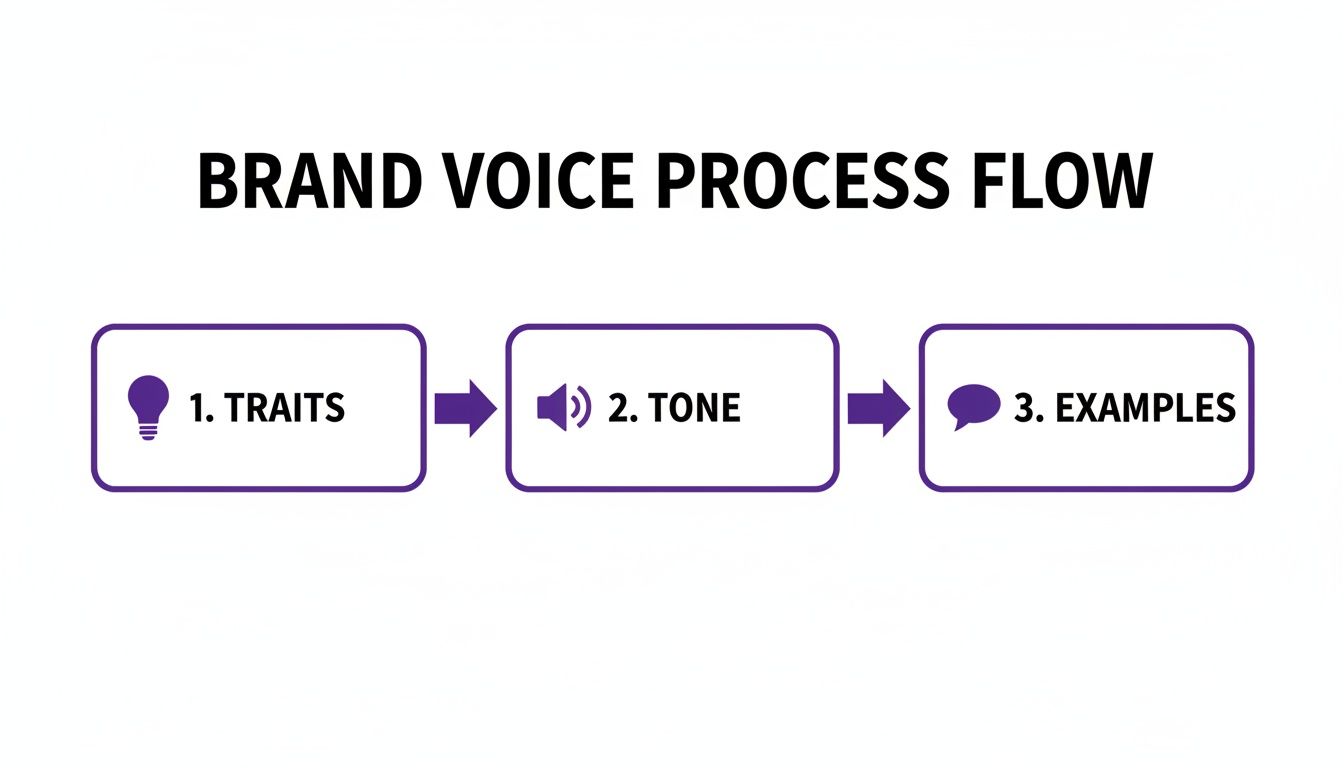
Visualizing the flow from abstract traits to concrete, real-world examples makes it so much easier for anyone to grasp your communication style and apply it consistently.
Building a Central Asset Library
This is a non-negotiable step that will save you and your team countless hours. Alongside your guidelines document, set up a central, cloud-based folder (using something like Google Drive or Dropbox) that holds every single one of your approved brand assets.
Your brand asset library is the single source of truth. It eliminates the frustrating back-and-forth of "Can you send me the latest logo?" and ensures no one ever uses an outdated file again.
Organize it with clean, obvious subfolders:
- Logos: Include .PNG, .JPG, and vector (.SVG or .AI) files for every approved logo variation.
- Fonts: Add the actual font files for anyone who needs to install them.
- Photos: Create separate folders for approved product photography and lifestyle images.
- Templates: Store any pre-made social media graphics, email banners, or other branded templates here.
Once your brand guidelines are set, they become the blueprint for everything you do externally. From social media posts to choosing effective promotional products that build brand loyalty, it all starts here. By making your guidelines and assets incredibly easy to find and use, you empower your entire team—and any future collaborators—to execute your brand vision perfectly, every single time.
Your E-commerce Branding Questions, Answered
As you start to map out your brand, a lot of questions will probably come up. That's completely normal. Moving from the wild, anything-goes world of a marketplace to building your own brand on your own turf is a huge step.
Let's walk through some of the most common questions I hear from business owners just like you. Think of this as your go-to cheat sheet for getting the details right—the kind of stuff that often trips people up but makes all the difference in the long run.
How Often Should I Update My Brand Guidelines?
Your brand guide isn't a "set it and forget it" kind of document. It's a living, breathing guide that should grow right along with your business. I usually tell clients to schedule a formal review at least once a year.
But sometimes, your business will tell you it's time for an update sooner. A few big moments should trigger an immediate review:
- You're launching a new product line. Your handmade candle shop is now selling artisanal soaps. Does your messaging still fit? Does your photography style work for both?
- You're speaking to a new audience. If you're shifting from targeting budget-conscious students to high-end corporate gift buyers, your entire brand voice and visual feel will need a major overhaul.
- Your customers are telling you something. Pay attention to your reviews and DMs. If people consistently describe your brand in a way that surprises you, it might be time to realign your guide with how your brand is actually perceived in the real world.
The goal here is consistency, not rigidity. Small, smart tweaks keep your brand feeling fresh without giving your loyal customers whiplash.
I'm a Solo Business Owner. Do I Really Need This?
Yes, you absolutely do. In fact, when you're a one-person show, brand guidelines are arguably even more important. It's a huge myth that these are just for big companies with massive teams.
For starters, the act of creating the guide forces you to get incredibly clear on your own strategy. It takes your brand identity from a fuzzy idea floating around in your head and turns it into a concrete, actionable plan. That kind of clarity is priceless when you're making a hundred little decisions every single day.
It also becomes your secret weapon for staying consistent. When you're the one designing social posts one day and writing product descriptions the next, a guide stops you from just going with whatever "feels right" at the moment. It’s your anchor.
The second you decide to hire your first freelancer—a social media manager, a copywriter, a VA—your brand guidelines become the single most valuable onboarding tool you have. Handing them a clear guide saves you hours of painful back-and-forth and ensures they nail your vibe from day one.
What's the Difference Between a Brand Guide and a Style Guide?
People throw these terms around interchangeably all the time, but for an e-commerce seller, the difference really matters.
Here’s the simplest way to think about it: a style guide tells you how to do things, while a brand guide also tells you why.
A style guide is the tactical rulebook. It's focused on the practical, visual elements:
- Logo files and spacing rules
- The exact HEX codes for your color palette
- Your typography hierarchy (which fonts, sizes, and weights to use for headlines vs. body text)
- Basic grammar preferences (e.g., do you use the Oxford comma?)
A brand guide is the whole story. It includes everything from the style guide but wraps it around the heart and soul of your business. It gets into your mission, your vision, your core values, your brand personality, and who your ideal customer really is.
For a growing shop trying to build a true community, a full brand guide is where the magic happens. It connects the "why" behind your business to the "how" of your daily work, making every choice feel more intentional and cohesive.
What Are the Best Tools for Creating a Brand Guidelines Document?
You don't need fancy, expensive software to create a guide that works. The best tool is simply the one you'll actually use—something that's easy to build, update, and share.
For most small business owners, simple and accessible is the way to go.
- Canva: This is an excellent choice. Canva has tons of free, beautiful templates designed specifically for brand guidelines. It's super intuitive and you can export a professional-looking PDF in no time.
- Google Slides/Docs: Don't underestimate the power of a well-organized Google Doc. It's collaborative, lives in the cloud, and you can share it with anyone using a simple link. A solid Google Doc is a million times better than no guide at all.
- Specialized Software: Tools like Frontify are fantastic for larger teams with complex needs, but they usually come with a monthly subscription. You can definitely hold off on something like this until your team grows.
My advice? Focus on the quality of the content inside the guide first. The format is important, but it's secondary to the clarity of your vision.
At Wand Websites, we help ambitious Etsy sellers turn their passion into a powerful, independent brand. If you’re ready to build a professional Shopify store designed for growth, we handle the heavy lifting so you can focus on what you do best. Let's build something amazing together at https://www.wandwebsites.com.
