
How to Calculate Wholesale Price for Profit

Figuring out your wholesale price boils down to one simple idea: take what it costs you to make your product and add a healthy profit margin on top. It’s about adding up every single expense—materials, labor, and overhead—and then marking it up.
A great starting point for many businesses is a 50% profit margin. This isn't just a random number; it’s a solid buffer that helps cover all your bases and ensures your business is built to last.
The Building Blocks of a Profitable Wholesale Price
Before you can even think about profit, you need to get forensic about your costs. I mean every single cost. This goes way beyond just the price of your raw materials. You have to dig into all those little hidden expenses that can quietly nibble away at your profits until there’s nothing left.
Getting your wholesale price right is the foundation of a brand that can grow. A smart price ensures every sale moves you forward, not just keeps you afloat.
What Goes Into Your Product Cost?
Your costs generally fall into two buckets: the direct expenses to physically make the item and the indirect expenses of just keeping the lights on. Both are critical for getting an accurate picture of your true costs.
I've seen so many new sellers only account for their materials. This is a huge pitfall.
Forgetting to factor in your own time and a slice of your business overhead is the fastest way I've seen brands underprice their products and actually lose money on each sale.
To get this right, you have to track every component that makes up your total product cost. Here’s a quick breakdown to help you organize your numbers.
Core Components of Your Total Product Cost
Once you have these costs tallied up, you can build a reliable pricing model.
A proven method for this is called absorption pricing. It’s a fancy term for a simple concept: you "absorb" all your costs—both COGS and overhead—into your final price before adding your profit margin.
Let's say a product costs you $30 per unit to create, all-in. If you want a 40% profit margin, you’d mark that up to a $42 wholesale price. This way, you know for a fact that every single sale is profitable.
To manage all these numbers without losing your mind, a simple spreadsheet is your best friend. If you’re not a spreadsheet wizard, brushing up on some essential Excel formulas can be a game-changer. It helps you build a pricing worksheet that's accurate, repeatable, and easy to adjust as your costs change.
Finding Your True Cost Per Unit
This is where the real work begins, and honestly, where many new sellers stumble. We're going to take that long list of expenses and boil it down to one critical number: your cost per unit. This is the total, all-in cost to create a single item, and it’s the bedrock of your entire wholesale pricing strategy.
Getting this number right means accounting for every single penny. It's so easy to miss small things, which is why a lot of business owners I know streamline expense management with receipt scanning software to make sure no cost falls through the cracks. It saves you from drowning in a sea of receipts.
Let’s walk through this with a hands-on example. Picture yourself as an artisan candle maker. Your cost isn't just the wax and the wick—it’s a tiny slice of everything that keeps the lights on.
Tallying Up Your Total Costs
First, we'll look at your Cost of Goods Sold (COGS) for each candle. These are your direct costs, the expenses that scale up or down depending on how many candles you make.
- Materials: This includes the wax, fragrance oils, wicks, and the glass jar itself.
- Direct Labor: What do you pay yourself (or an employee) per hour? Calculate the time it takes to mix, pour, and label one candle.
- Product Packaging: Think about the box, the branded label, and any crinkle paper or inserts that go into the final presentation.
Now for the part everyone forgets: overhead costs. These are the fixed expenses you pay every month, whether you sell one candle or a thousand. This bucket includes things like your studio rent, your Shopify plan, marketing software, and business insurance.
The biggest mistake new wholesalers make is ignoring overhead. If you only price based on materials and labor, you are essentially paying out-of-pocket to run your business, which is a recipe for failure.
You have to assign a small piece of your monthly overhead to every single candle you make.
For instance, if your total monthly overhead comes out to $500 and you typically produce 1,000 candles in a month, you'd add $0.50 of overhead to each candle's base cost. This one simple step is crucial for building a price that actually sustains your business.
This image breaks down how all those costs stack up.
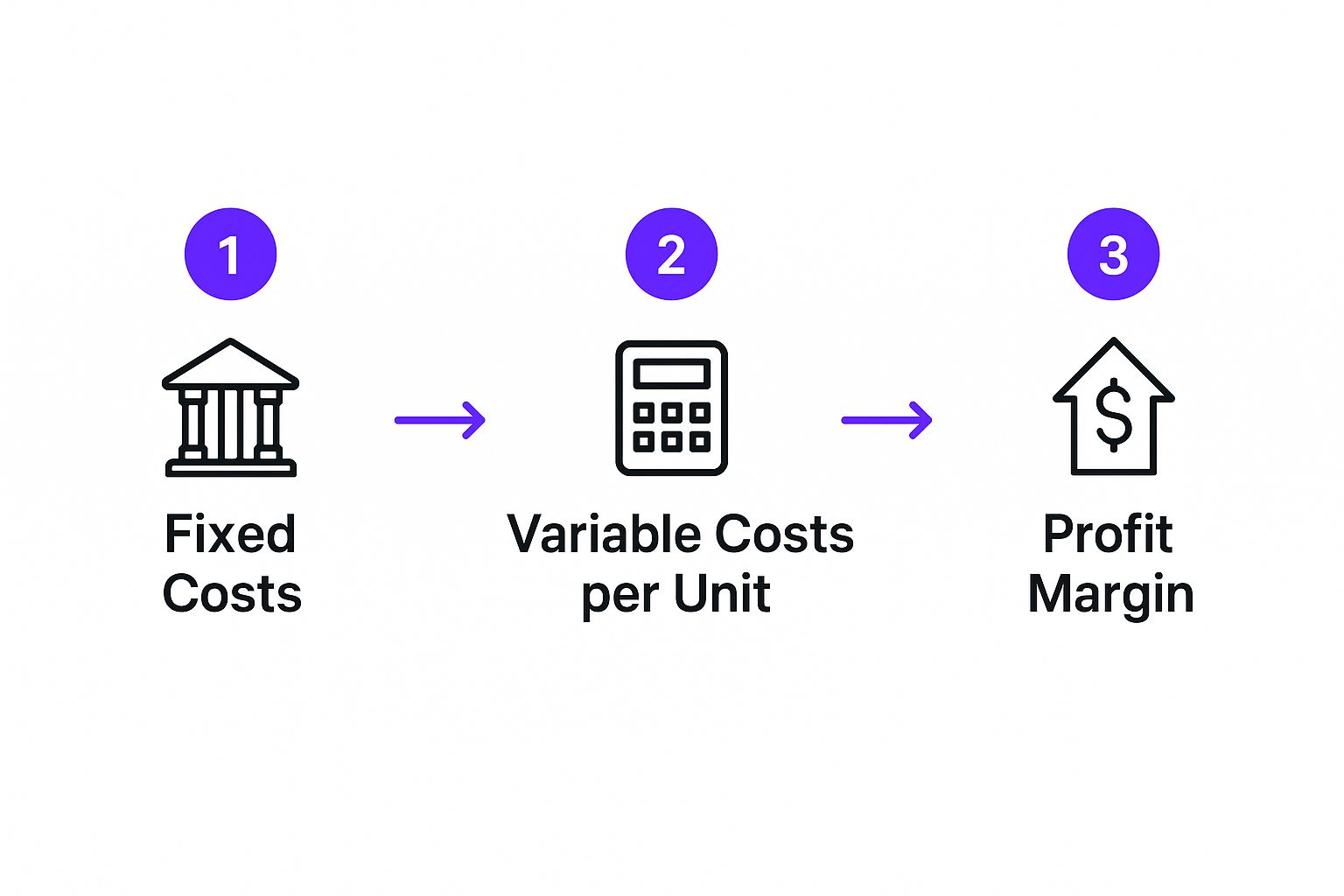
As you can see, your final price is built on a foundation of both your direct product costs and your business-wide overhead. Only after covering all of that do you start thinking about profit. This complete cost per unit is the number we'll use to set a smart, profitable wholesale price.
Choosing the Right Wholesale Markup Strategy
Alright, you've nailed down your cost per unit. Now comes the fun part—deciding how much to mark it up. This isn't just about picking a number out of thin air; your markup strategy is a huge piece of the puzzle that dictates your profit and how your brand is seen in the market.
Many makers start with a 50% wholesale profit margin, often called a "keystone" markup. It's a solid, industry-standard rule of thumb. So, if your product costs you $10 to make, you’d sell it to a retailer for $20. This gives you a decent cushion to work with. But that’s just a starting point. Let’s dig into a couple of popular methods to see what might work best for you.
Absorption Pricing: The "Cover Your Bases" Method
Absorption pricing is probably the most straightforward and dependable way to set your price. The whole idea is to make sure every single cost—from materials and labor to your rent and electricity—gets "absorbed" into the final price, along with the profit you want to make.
Wholesale Price = Cost Price + Profit Margin
The big win with this method is its safety. You know for a fact that every sale is profitable because you've accounted for all your expenses. It gives you a solid, logical floor for your pricing that protects your business.
The downside? It completely ignores what's happening in the market. You might accidentally price your product way too high for a crowded field or, just as bad, price it too low when you have something really special that people would pay more for.
Value-Based Pricing: The Customer-Centric Approach
This is where you stop looking at your spreadsheets and start looking at your customers. With value-based pricing, your price is tied directly to how valuable your customers perceive your product to be.
Think about it: If you sell handmade ceramic mugs with a unique glaze and a compelling brand story, people aren't just buying a mug. They're buying a piece of art. That perceived value means they'll happily pay more, regardless of what it cost you to make it.
So, which path should you take?
- Absorption Pricing: This is your go-to for products in a competitive space where price really matters. It's a safe bet and ensures you're always in the black.
- Value-Based Pricing: This is perfect for one-of-a-kind, premium, or artisan goods. If your brand's story and quality are your key selling points, this strategy lets you capture the higher profit you've earned.
Honestly, the best approach is often a mix of both. Use absorption pricing to figure out your absolute minimum price—your break-even point. Then, layer on value-based thinking. Research your competitors, understand what makes your product stand out, and adjust your price upward from there. This hybrid model gives you the best of both worlds: the safety of knowing your costs are covered and the opportunity to earn what you're truly worth.
Working Backwards from the Retail Price Tag
Instead of building your price from the ground up, sometimes it's much smarter to start at the finish line and work backward. This is a common industry approach where you look at the final price tag a customer will see—the Suggested Retail Price (SRP)—and use it to figure out a wholesale price that makes sense for everyone.
This method completely flips the usual script. It forces you to think about your product's place in the market right from the start. When you know what a comparable item actually sells for, you can set a wholesale price that gives your retail partners a healthy profit margin. And trust me, that makes them far more excited to carry your products.
Using the Keystone Pricing Model
A popular and straightforward strategy you'll see everywhere is the Keystone pricing model. It's a simple rule of thumb where the retail price is set at double the wholesale price. This gives the retailer a 100% markup.
The formula couldn't be easier: Wholesale Price = Retail Price / 2.
For instance, if you make a ceramic mug that similar brands sell for $80 in stores, the keystone wholesale price would be $40. This is a great starting point, and you can explore other pricing examples to get a feel for how different models work.
Does This Approach Work for You?
Working backward from the retail price is an excellent way to gut-check your numbers. If you've already figured out your cost per unit (like we talked about before), you can quickly see if the wholesale price you land on is actually profitable.
Let's walk through a quick scenario.
- Imagine your total cost to produce one unit is $25.
- Similar products are retailing for $80.
- Using the Keystone model, your wholesale price would be $40 ($80 / 2).
In this case, you’d make a $15 profit on every unit sold to a retailer, which is a very healthy 37.5% margin. That’s a strong signal that your pricing is sustainable.
But what if the market can only support a retail price of $40? Your wholesale price would have to be $20. Since your cost is $25, you'd be losing money on every single sale. This is a huge red flag that tells you something is seriously wrong with either your production costs or your product's position in the market.
This "working backward" exercise isn't just about the math; it's a crucial reality check. It helps ensure your wholesale price is not just profitable for you, but also genuinely attractive to the retailers who will ultimately become your most important partners for growth.
Putting Your Wholesale Price to the Test
So, you’ve crunched the numbers and have a price on your spreadsheet. That's a great start, but those numbers are only half the story. A calculated price doesn't mean much until it meets the real world. Now it's time to see if your pricing can hold up under pressure and actually appeal to the retailers you want to work with.
Your first move? A little candid competitor research. Go see what similar brands are charging for their wholesale products. The point isn't to copy them, but to get a feel for the neighborhood. You need to know where you fit in. Are you accidentally positioning yourself as a luxury item? Or, even worse, are you leaving money on the table by undervaluing your work?
Gauging Market Demand and Your Unique Value
Next, it’s time for an honest look in the mirror. Is there genuine demand for what you’re selling at the price you’ve set? This is also where you need to get crystal clear on what makes your product special. Your brand story, the high-quality materials you use, or a unique feature—these are the things that justify your price tag to a skeptical retailer.
A price that looks perfect on paper can absolutely fall flat if it doesn't align with what the market expects. Retailers simply won't stock a product they don't think their customers will buy, no matter how precise your cost calculations are.
This is where you shift from theory to action and start formalizing your wholesale offer.
Building Out Your Wholesale Policies
Creating a professional wholesale price list is non-negotiable. This document needs to be clean, clear, and easy for a busy shop owner to scan and understand. Think of it as more than just a list of prices; it's one of your most important sales tools.
To attract serious buyers and protect your own bottom line, you'll want to set up some clear policies. These often include:
- Minimum Order Quantities (MOQs): By setting a minimum number of units per order, you ensure that every wholesale transaction is actually worth the time and effort it takes to fulfill.
- Volume Discounts: Offering better pricing for larger orders is a classic way to incentivize retailers. It can seriously boost your cash flow and help you move more inventory at once.
Think of this entire stage as one final, crucial gut-check. It ensures your wholesale price isn't just a number, but a strategic tool for building a healthy, profitable business.
Got Questions About Wholesale Pricing? Let's Clear Things Up.
Diving into wholesale can feel like you're navigating a maze. Just when you think you've got it figured out, a new question pops up. That's completely normal. Let's tackle some of the most common hurdles sellers face when setting their wholesale prices.
Getting these right from the start will save you a world of headaches later on.
What’s a "Good" Profit Margin for Wholesale, Really?
This is the million-dollar question, isn't it? While there's no magic number, a healthy wholesale profit margin typically lands somewhere between 20% and 50%.
But here's the thing: that range is huge for a reason. If you're creating unique, handmade goods, you can and should aim for the higher end of that scale. Your craftsmanship has value. On the flip side, if you're in a high-volume market with lots of competition, a tighter margin of 20-30% might be what it takes to get your foot in the door.
The key is to find the sweet spot where you cover all your costs (and I mean all of them) and still bank a respectable profit.
Should I Really Pay Myself? (Yes, You Absolutely Should)
I can't stress this enough: Yes. A thousand times, yes. Forgetting to include your own labor costs is one of the quickest ways to run your business into the ground. Your time is valuable, and you need to pay yourself a real wage for it.
Think of it this way: if you're not paying yourself, your business isn't truly profitable. It’s a hobby being funded by your own free time.
Factoring in a fair hourly rate as part of your Cost of Goods Sold (COGS) is non-negotiable for building a real, sustainable business. It ensures your pricing is realistic and can support you now and when you're ready to hire help down the road.
How Do I Make a Wholesale Price List That Doesn't Look Amateur?
Your wholesale price list (or line sheet) is often a buyer's first real introduction to your brand. It needs to look sharp and make their job easy. A cluttered, confusing list is a red flag for a busy retailer.
Here’s a checklist to create a price list that screams "professional":
- Great Photos: Use clear, high-quality images of your products.
- The Nitty-Gritty: Include product names and SKUs (Stock Keeping Units) so ordering is foolproof.
- The Numbers: Clearly list your wholesale price and the Suggested Retail Price (SRP).
- The Rules of Engagement: Spell out your Minimum Order Quantities (MOQs), case pack requirements, payment terms, and how long it takes you to ship an order.
- How to Reach You: Make your contact information and ordering instructions impossible to miss.
A polished price list shows you're serious and organized, making retailers feel confident about doing business with you.
Ready to build an ecommerce site that turns your perfectly priced products into more sales? Wand Websites specializes in creating high-performing Shopify stores that help businesses like yours grow. Let's build your brand's future together.
