
Ecommerce Website Development Cost A Realistic Guide

So, how much does an e-commerce website actually cost? The honest answer is: it depends. You could be looking at anywhere from a couple of hundred dollars for a simple DIY store to well over $100,000 for a custom-built enterprise powerhouse. The final price tag really comes down to the complexity, features, and unique touches your business needs to thrive online.
Your Quick Guide To Ecommerce Website Costs
Think of it like building a house. You could grab a prefabricated kit—a template-based site—for a fast and budget-friendly setup. Or, you could hire an architect and a crew of custom builders to create a sprawling, feature-packed mansion—a custom-developed site. Neither option is "better"; it's all about what fits your budget, goals, and timeline.
This quick overview will help you connect your business dreams to a realistic price point. Getting a handle on these cost tiers is the first step toward making a smart investment in your digital storefront.
Setting Realistic Budget Expectations
It all starts with matching your big vision to your financial reality. A startup just getting its feet wet has entirely different needs than a global brand processing thousands of orders every day.
For Startups and Small Businesses: User-friendly platforms like Shopify, WooCommerce, or BigCommerce are a great starting point. Their monthly plans, usually ranging from $29 to $300, cover all the basics like hosting and core sales features.
For Growing Businesses: When you need a more tailored look, unique branding, and special integrations, you're typically looking at a project in the $10,000 to $50,000 range. This is where you bring in professionals to build something that truly stands out.
For Large Enterprises: If your checklist includes complex needs like ERP integration, managing multiple storefronts, or building one-of-a-kind features from scratch, the investment can easily climb to $250,000 or more. If you're curious about the details, you can discover more insights about web development costs.
The key is to see this as an investment, not just an expense. A well-built website is a 24/7 sales engine that directly drives revenue and brand growth, making it one of the most critical assets for any online business.
To give you a clearer picture, here's a quick summary of what to expect at each level.
Ecommerce Website Cost At A Glance
This table should help you quickly identify where your project might fall. The "approach" you take—from doing it yourself to hiring a large agency—is the biggest factor influencing that initial cost.
The infographic below offers another great visual breakdown of how these costs add up.
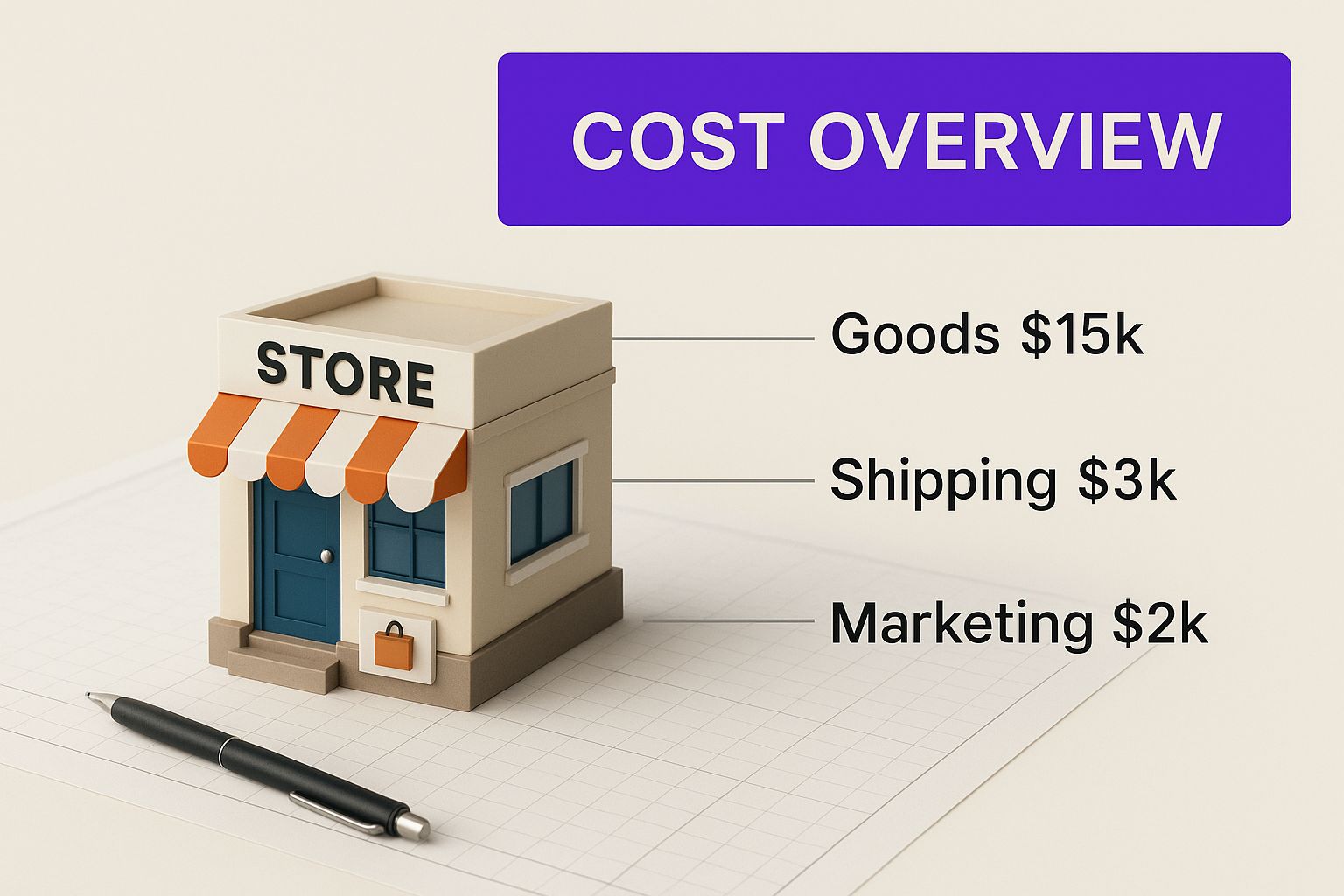
As you can see, the price escalates quickly as you move away from simple templates and toward fully custom solutions packed with advanced features.
The Three Pillars That Define Your Budget
Trying to nail down the cost of an e-commerce website isn't about finding some magic number. Your total investment really comes down to three core pillars: the platform you build on, the complexity of your design, and the features you need to run your business.
Think of it like building a physical retail store. You have to decide on the location (your platform), the architectural style and interior design (your design), and all the special fixtures like security systems and inventory trackers (your features). Each choice you make has a direct impact on the final price tag.
Your Platform: The Foundation Of Your Store
The single biggest factor that will shape your budget is your choice of e-commerce platform. This is the digital real estate your entire store is built on, and it dictates everything from monthly fees to how much you can customize down the line. Each option strikes a different balance between ease of use, raw power, and price.
Here’s a quick rundown of the big players:
- Shopify: This is the go-to for a reason. Shopify is an all-in-one solution where you pay a monthly fee that covers hosting, security, and support. It's fantastic for businesses that want to get up and running quickly without a ton of technical headaches.
- WooCommerce: If you already know and love WordPress, this is for you. WooCommerce is a powerful and flexible plugin that transforms a standard WordPress site into a full-blown online store. Since it's open-source (meaning the software itself is free), your costs come from things like web hosting and any premium add-ons you buy.
- Adobe Commerce (formerly Magento): This is the enterprise-level powerhouse. Adobe Commerce is built for huge businesses with massive product catalogs and high sales volume. It offers incredible scalability, but the development and maintenance costs are in a different league entirely.
The right platform is all about fit. It needs to match your technical skills, business size, and where you see yourself in five years. A startup can absolutely crush it on Shopify, while a global brand might need the heavy-duty architecture of Adobe Commerce.
Design Complexity: From Template To Tailor-Made
How your website looks and feels isn't just about aesthetics; it directly impacts customer trust and sales. The second major pillar affecting your budget is how custom you want your design to be. Your options span from affordable, off-the-shelf solutions to completely bespoke digital experiences.
A template-based design is the most budget-friendly path. You buy a pre-made theme for a one-time fee, usually between $50 - $200, and then customize the colors, fonts, and logos to match your brand. It’s a great starting point, but the trade-off is that your site might look a little like others using the same theme.
On the other end of the spectrum is a fully custom UI/UX design. This is where you hire designers and developers to build a unique storefront from scratch. The result is a one-of-a-kind brand experience that’s perfectly tailored to your customers, but it comes at a premium—often $5,000 to $20,000+. When you're budgeting, don't forget to factor in your overall branding costs, as a custom design is just one piece of building a memorable online identity.
Feature Integrations: The Bells And Whistles
Finally, the features and third-party tools you plug into your site will scale your costs. Every store needs the basics: a product catalog, a shopping cart, and a checkout. But as you grow, you'll need more advanced tools to operate efficiently.
Each new integration adds development time, and that means a higher cost.
Some of the most common integrations that bump up the ecommerce website development cost include:
- CRM (Customer Relationship Management) systems to track customer interactions.
- ERP (Enterprise Resource Planning) software to sync inventory and orders.
- Advanced search and filtering to help customers navigate large catalogs.
- Personalized marketing tools for targeted email and ad campaigns.
- Subscription or loyalty program features to encourage repeat business.
By thinking through these three pillars—platform, design, and features—you can start to build a realistic budget that actually aligns with your business goals and helps you avoid any nasty surprises later on.
The Nuts and Bolts: Breaking Down Your Technical Costs
Okay, let's pull back the curtain for a second. Beyond all the cool designs and flashy features, every online store needs a solid technical foundation to actually exist on the internet.
Think of it like running a physical shop. You've got recurring bills that aren't glamorous but are absolutely essential—the rent, the electricity, the security system. These are the non-negotiables that keep your doors open, and in the digital world, it's no different. Budgeting for these from the start is key to building a sustainable business.
Your Digital Address and Security Guard
First things first, you need two pieces of digital ID: a domain name and an SSL certificate.
Your domain name is simply your address online (think yourstore.com). It’s how people find you and a huge part of your brand. You don't buy it outright; you rent it annually to keep it yours.
Then there's the SSL certificate. This is your digital security guard. It encrypts the connection between a customer's browser and your site, which is what protects sensitive info like credit card numbers. See that little padlock icon in the browser bar? That's the SSL at work, and it’s a massive trust signal. Without it, most browsers will actively warn visitors away.
While these technical costs are mandatory, they're usually a small slice of your overall budget. Factoring them in from day one just means you're not forgetting the very things that establish your store's identity and security.
Getting down to numbers, a typical domain registration will run you $10–$30 a year. An SSL certificate can be free (many hosting plans include one) or cost up to $200 per year for more advanced versions. If you want to dig deeper, you can learn more about ecommerce cost factors that influence your total spend.
Picking a Place for Your Store to Live
Next up is web hosting. If your domain is the address, hosting is the actual plot of land where your website is built. It's the server space you rent to store all your files, product images, and customer data so that people can access your shop from anywhere in the world.
Your choice of hosting directly affects your site's speed, how much traffic it can handle, and its overall reliability. Let's look at the main options, kind of like choosing real estate.
Shared Hosting: This is like renting an apartment. You're sharing the building (the server) and its resources with a bunch of other websites. It's super affordable and a great starting point for brand-new stores that don't have a lot of visitors yet.
VPS (Virtual Private Server) Hosting: Think of this as a townhouse. You’re still in a shared building, but you have your own dedicated space with your own resources. It’s a solid step up, giving you much better performance and control without the cost of a private house.
Dedicated Hosting: This is the equivalent of owning a standalone house. You get an entire server all to yourself. It offers the best possible performance, security, and control, making it the go-to for big, high-traffic stores that can't afford any slowdowns.
Choosing Your Development Partner
So, who's actually going to build this thing? This decision is one of the biggest levers on your final e-commerce website development cost. It’s like deciding between hiring a skilled solo carpenter to build a custom bookshelf versus bringing in a full construction crew to build a house. Both get the job done, but the scope, cost, and process are worlds apart.
Your choice here will ripple through everything—your budget, your timeline, and the kind of support you'll get once you're live. The trick is to find the right expertise for your project's complexity and where you see your business going in the future.
Freelancers: The Cost-Effective Specialists
Hiring a freelancer is often the most wallet-friendly option, making it a go-to for startups or businesses with a very clear, limited scope. Think of a freelancer as a specialist you parachute in for a specific mission—maybe customizing a theme or getting a tricky integration to work.
They offer a ton of flexibility and can be an amazing resource. The main catch? Availability and scale. One person can only do so much. If your project suddenly gets more complex or you realize you need a designer, a back-end developer, and an SEO expert, you'll end up juggling multiple contractors. That can quickly turn into a project management nightmare.
Agencies: The All-in-One Solution
Working with a development agency is like hiring a full, pre-built team. You get designers, developers (both front-end and back-end), a project manager, and testers all working in sync. It's an integrated approach that’s perfect for complex projects needing a solid strategy from day one.
Of course, an agency comes with a higher price tag. But what you're paying for is a structured process, clear accountability, and a deep bench of skills that a single person just can't offer. They're set up to handle bigger, more ambitious projects and can provide the ongoing support and maintenance you'll need long after launch. This choice is a big deal for your schedule, as a standard e-commerce site build can take anywhere from 6–20 weeks. You can get a better sense of how development costs and timelines are connected to see how these factors influence each other.
Key Takeaway: The "right" partner depends entirely on your needs. For a simple, specific task, a freelancer is a smart, cost-effective choice. For a complex, custom-built store that needs to scale, an agency’s comprehensive expertise is a worthwhile investment.
In-House Team: The Ultimate Investment
The third path is building your own in-house team. This is the long game. You hire your own developers, designers, and project managers who live and breathe your brand every single day. They become experts in your specific business needs, which can be a massive competitive advantage.
This option offers unparalleled control and alignment with your business goals. The downside? It's by far the most expensive and time-consuming route upfront. You're not just paying for project work; you're paying salaries, benefits, and all the overhead that comes with full-time employees. It’s a serious commitment best suited for established businesses ready to invest heavily in their digital presence.
To help you visualize the trade-offs, let's break down how these three options stack up against each other.
Comparing Development Team Options
Ultimately, there's no single "best" choice—only the best choice for your business right now. A freelancer might be perfect for getting your MVP off the ground, while an agency could be the partner you need to scale to the next level. And if e-commerce is the absolute core of your business, an in-house team might be the ultimate goal.
Planning For The Hidden Costs Of Ecommerce
Getting your new website live is a huge milestone, but it’s the starting line, not the finish. So many first-time store owners focus entirely on the initial ecommerce website development cost and get completely blindsided by what comes next.
The best way to think about these ongoing expenses is like the rent and utilities for your digital storefront. They’re the predictable, recurring fees that keep the lights on. Planning for them from the get-go is the difference between building a profitable business and scrambling to cover surprise bills every month.
Uncovering Your Ongoing Operational Costs
The moment your site launches, a new set of costs kicks in. These aren't one-and-done deals; they are the monthly and annual investments that keep your store running, secure, and competitive. Ignoring them can quietly drain your profits and kill your momentum.
Here are the usual suspects you need to get into your budget right away:
Platform Subscriptions: If you’re on a platform like Shopify, your monthly plan is a fixed cost. You’re looking at anywhere from $29 to $300 a month, which covers your hosting, basic security, and all the core features.
Payment Processing Fees: Every single time a customer clicks "buy," your payment processor (think Stripe or PayPal) takes a small slice. The industry standard is around 2.9% + $0.30 per transaction. It’s just a non-negotiable cost of doing business online.
App and Plugin Costs: Want to add a cool loyalty program, fancy product reviews, or subscription boxes? You’ll probably need paid apps for that. These can be as cheap as a few bucks or run into hundreds per month for more powerful tools.
So many entrepreneurs make the mistake of underestimating how quickly small app subscriptions add up. A dozen apps at $15 a pop doesn't sound like much, but that's over $2,100 a year. You have to bake that cost into your product pricing and profit margins.
Budgeting For Growth And Maintenance
Beyond just keeping the site online, you have to invest in actually getting people to it and making sure it stays in great shape. These are your growth investments—the money you spend that directly fuels your bottom line. It's wild how often this gets left out of the initial budget.
Your growth and maintenance fund should cover:
Digital Marketing and SEO: A beautiful store is worthless if nobody can find it. You absolutely need a consistent budget for SEO, paid ads, and social media to drive traffic. This can be a huge variable, running anywhere from $500 to $10,000+ per month.
Security and Backups: While platforms handle a lot, you might want an extra layer of security monitoring or a premium backup service for peace of mind. As you grow, this becomes less of a "nice-to-have" and more of a necessity.
Technical Support and Updates: Things break. It's a fact of life. Having a small budget set aside for a developer to fix a bug, install a tricky theme update, or add a small new feature will save you a lot of headaches.
While you're zeroed in on the initial build, don't forget to earmark funds for the day-to-day operational side, like managing your ecommerce shipping expenses. By getting ahead of these recurring costs, you’re building a much stronger, more financially resilient business from the ground up.
How To Keep Your Development Budget On Track
Watching the estimated costs for your new ecommerce site start to climb can be a little nerve-wracking. But managing your budget doesn't mean you have to compromise on quality. The real secret is being smart and strategic right from the get-go, focusing your investment on what truly matters to your customers from day one.
One of the best ways to do this is by launching a Minimum Viable Product (MVP). It’s a bit like opening a new food truck. You wouldn't launch with a 50-item menu that tries to be everything to everyone. Instead, you'd start with your five absolute best, most crowd-pleasing dishes. This gets you open for business faster, lets you see what people are actually buying, and you can add new items based on real customer feedback.
Define Your Project Clearly
If there's one thing that can absolutely wreck a development budget, it's "scope creep." This is what happens when small requests and "can we just add..." ideas start piling up after the project is already underway. Each of those seemingly tiny changes adds time and, you guessed it, money to the final invoice.
The best defense against scope creep is a rock-solid, detailed project brief created before a single line of code is written.
Your brief should be crystal clear about:
- Must-Have Features: The non-negotiable functions your store needs to launch and make sales.
- Nice-to-Have Features: Great ideas and cool additions that can wait for a future update (Phase 2, 3, etc.).
- Business Goals: What you actually want this website to accomplish. For example, are you trying to increase sales by 20% or reduce checkout abandonment?
Think of this brief as the blueprint for your project. It keeps everyone on the same page and helps you avoid those surprise costs.
A pro tip: Always get quotes from a few different developers or agencies. It’s not just about finding the best price. Seeing different proposals can give you a much better feel for the market and might even introduce you to new ideas you hadn't thought of.
Prioritize Today, Plan for Tomorrow
With your quotes in hand and a list of features you want, it's time to play favorites. Not every feature is going to deliver the same bang for your buck. You have to ask yourself what will make the biggest difference to your bottom line right now. Is an advanced customer loyalty program really more important than making sure your checkout process is lightning-fast and dead simple? Probably not.
By launching with a lean, focused MVP and having a clear roadmap for what comes next, you can take control of your ecommerce website development cost. It’s a smarter way to build—get your investment working for you quickly and set yourself up for sustainable growth down the road.
Frequently Asked Questions
It's totally normal to have a ton of questions when you're trying to figure out the budget for your online store. Let's tackle some of the most common ones with quick, no-nonsense answers.
How Much Does a Simple Ecommerce Website Cost?
For a straightforward, basic online store, you’re generally looking at an initial setup cost somewhere between $500 and $5,000. This range usually gets you a site built on a platform like Shopify using a great-looking pre-designed theme.
That price typically covers getting your main product pages up, a standard shopping cart, and a payment system so you can start making sales. It's a fantastic starting point for new businesses, but don't forget to budget for those ongoing monthly costs for the platform subscription, your domain name, and hosting.
Is It Cheaper to Build My Own Ecommerce Website?
Absolutely. Going the DIY route with a website builder is almost always the cheapest option in terms of initial cash outlay. But what you save in money, you'll definitely spend in time.
You'll be the one learning the platform, designing the pages, adding products, and fixing anything that breaks. If you have a really specific vision or you need to launch yesterday, bringing in a professional can end up being the smarter, more cost-effective move when you factor in your own time and potential delays.
Building it yourself saves money, but hiring an expert saves time. The right choice really comes down to which of those two things you have more of right now.
Why Is Custom Ecommerce Development So Expensive?
Think of it like building a custom home versus buying a model home. The higher price tag for custom development comes from the sheer amount of specialized, hands-on work involved. You're paying for hundreds of hours from skilled designers, developers, and project managers.
They aren't just tweaking a template; they're building a one-of-a-kind platform from scratch that's perfectly aligned with how your business runs and what your brand stands for. That level of detailed personalization, security, and performance is something a pre-built solution just can't offer.
Ready to build a high-performing Shopify store that turns your hard work into more sales? At Wand Websites, we specialize in crafting conversion-focused websites for growing businesses. Let us handle the heavy lifting so you can focus on your products. Learn more and get started today!
