
Ecommerce Subscription Model: Your Complete Success Guide


Understanding the Ecommerce Subscription Model Revolution
Think of traditional retail as a series of one-off transactions, like constantly going on first dates. You're always trying to win over someone new. The ecommerce subscription model, on the other hand, is about building a long-term relationship. It's more than just setting up automatic payments; it’s a deep shift in how customers connect with your brand and how you create a more stable business. Instead of the endless chase for one-time buyers, this approach focuses on cultivating a community of loyal, returning subscribers.
This model is built on a simple idea: solve a recurring need or consistently deliver a delightful experience. When it works, everyone wins. Customers get convenience, value, or the excitement of discovery sent right to them. Businesses get the stability of predictable revenue. This financial consistency is a game-changer, enabling more accurate inventory management, smarter budgeting, and confident investments in future growth.
The Psychology Behind the Switch
So, why are so many consumers embracing subscriptions? The attraction taps into fundamental human desires for convenience, value, and a personalized touch. A replenishment model, like that famously used by Dollar Shave Club, removes the chore of remembering to buy essentials like razors. A curation model, such as a monthly coffee box, provides the joy of new discoveries without the risk of making a bad choice. An access model makes members feel like they are part of an exclusive club.
This chart shows how the average number of subscription services per person has climbed, demonstrating that consumers are becoming more and more comfortable with this model.
The data clearly points to a growing trend where consumers use multiple subscription services. This isn't just a niche behavior anymore; it's becoming a mainstream expectation.
More Than Just Recurring Revenue
While predictable cash flow is often the main draw, the operational benefits are just as powerful. When you know roughly how many orders you'll need to fill each month, you can fine-tune your stock levels, cut down on waste, and even negotiate better deals with your suppliers. This efficiency boost leads directly to healthier profit margins. Plus, the continuous relationship with subscribers offers a steady stream of valuable feedback, helping you improve your products and build even stronger customer loyalty.
The economic effect of this change is immense. The subscription ecommerce market is on track to become a massive industry. Projections suggest the market could grow past $450 billion globally by 2025, a huge leap from around $15 billion in 2019. You can dive deeper into these numbers by checking out the latest ecommerce trends and statistics on SellersCommerce. This rapid growth shows a lasting shift in how people shop and presents a huge opportunity for businesses ready to adapt. The ecommerce subscription model isn't a fleeting trend; it’s a strategic move toward building more durable, customer-focused, and profitable companies.
Business Benefits That Make Subscription Models Irresistible

Imagine starting each month knowing exactly how much money your business will make. That's the most celebrated benefit of the ecommerce subscription model: predictable, recurring revenue. This stability shifts your financial planning from a guessing game to a strategic exercise. Instead of starting from scratch every month, you begin with a reliable income base, which allows for confident investments in inventory, marketing, and growth.
This financial predictability is the foundation of a more resilient and sustainable operation. But the advantages don't stop there. A well-designed subscription model also improves how your business runs and helps you build stronger, more valuable relationships with your customers.
Enhanced Customer Relationships and Lifetime Value
The traditional retail model often treats a sale as a one-time transaction. In contrast, a subscription turns that single interaction into an ongoing partnership. This consistent connection gives you a direct line to your customers, allowing you to gather feedback and adjust your products based on what your most loyal supporters truly want. The result is a major boost in Customer Lifetime Value (CLV).
Because subscribers are continuously engaged, their value to your business increases over time. They are more likely to:
- Become genuine brand fans, spreading the word to friends and family.
- Offer honest, useful feedback for product development.
- Show interest in new products and exclusive deals.
Building these deep relationships means you spend less time and money constantly chasing new customers. It's estimated that acquiring a new customer can cost five times more than keeping an existing one. Subscriptions make retention a core part of your business, which can significantly lower your customer acquisition costs.
Smarter Operations and Reduced Waste
Predictable demand isn't just a financial perk; it’s an operational game-changer. When you know how many subscription orders you need to fill each month, your inventory forecasting becomes much more accurate. This leads to several operational improvements:
- Less Overstock: You avoid the risk of having too much unsold product, which frees up your capital and prevents waste.
- Stronger Supplier Negotiations: Consistent order volumes can give you more power to secure better pricing from your suppliers.
- Efficient Fulfillment: Your logistics become more predictable, making your packing and shipping workflows smoother.
To illustrate how these benefits stack up against the old way of doing things, let's compare the two models side-by-side.
Traditional vs Subscription Model Benefits ComparisonA comprehensive comparison showing the key advantages of subscription models over traditional one-time purchase approaches
This table shows that a subscription model doesn't just change how you get paid—it fundamentally improves your relationship with customers and makes your entire operation more efficient.
These benefits are driving huge growth in the market. The global subscription e-commerce market was valued at about $18.82 billion in 2024 and is projected to reach $20.58 billion in 2025. You can explore more about these market projections on Precedence Research. Adopting an ecommerce subscription model is about building a smarter, more customer-focused business from the inside out.
Choosing the Right Subscription Model for Your Business
Picking the right ecommerce subscription model is a bit like choosing the perfect tool for a job. You wouldn't use a hammer to saw a board, and trying to fit the wrong subscription model to your products can cause high cancellation rates and operational messes. The trick is to align the model with both your products and your customers' reasons for buying. Not all subscriptions are the same, and knowing the main types is the first step to building a reliable recurring revenue source.
The field is largely shaped by three main models: replenishment, curation, and access. Each one meets a different customer need and has its own set of expectations and challenges. Choosing the right one means getting to the core of "why" a customer would subscribe. Are they looking for convenience, the joy of discovery, or exclusive benefits? Your answer will point you in the right direction.
The Replenishment Model: Solving a Recurring Problem
Think of the replenishment model as the ultimate in convenience. This model is ideal for products customers use up and need to reorder on a predictable timeline. Good examples include coffee, vitamins, pet food, or shaving supplies. The main appeal isn't the product itself—which the customer already knows and trusts—but the service of never needing to remember to reorder it. You're not just selling a product; you're giving your customers back their time and mental space.
This model depends on consistency and dependability. Success comes down to a few key elements:
- Consumable Products: The item must be something that gets used up regularly.
- Predictable Cadence: Customers should have a clear idea of how often they'll need a new supply.
- Seamless Experience: The process to sign up, pause a delivery, or change an order needs to be incredibly straightforward.
While it's a great model for creating steady revenue and keeping customers long-term, its use is mostly limited to consumable goods.
The Curation Model: Delivering Delight and Discovery
On the other hand, the curation model is all about surprise and personalization. This model, made famous by subscription boxes for beauty, snacks, or clothing, sends customers a hand-selected group of items. The value is not only in the products but also in the fun of discovering something new with the help of an expert. You become a trusted guide for your customers, showing them things they'll love but might not have found otherwise.
This model is more complex to run than replenishment. It demands a solid grasp of customer tastes, strong relationships with suppliers, and a talent for creating a memorable unboxing experience. The objective is to forge an emotional bond. When a customer feels like you truly understand them, they become passionate supporters of your brand.
The Access Model: Offering Exclusivity and Perks
Lastly, the access model sells membership. Instead of a box of physical goods, subscribers pay a regular fee for special benefits. This can include members-only prices, early access to new products, exclusive content, or entry into a private community. Think of it as a VIP club for your most loyal fans. This model is excellent for building a strong community and encouraging higher overall spending, as members have a reason to shop more often to use their perks.
To help you decide which model might fit your business, the table below breaks down these core types, highlighting what they're best for and which companies are using them successfully.
This breakdown shows that simpler models like replenishment are great for essentials, while curation and access models build deeper customer relationships through discovery and community.
The infographic below compares the average monthly costs and subscription lengths for two of the most popular models for physical goods: curation and replenishment.
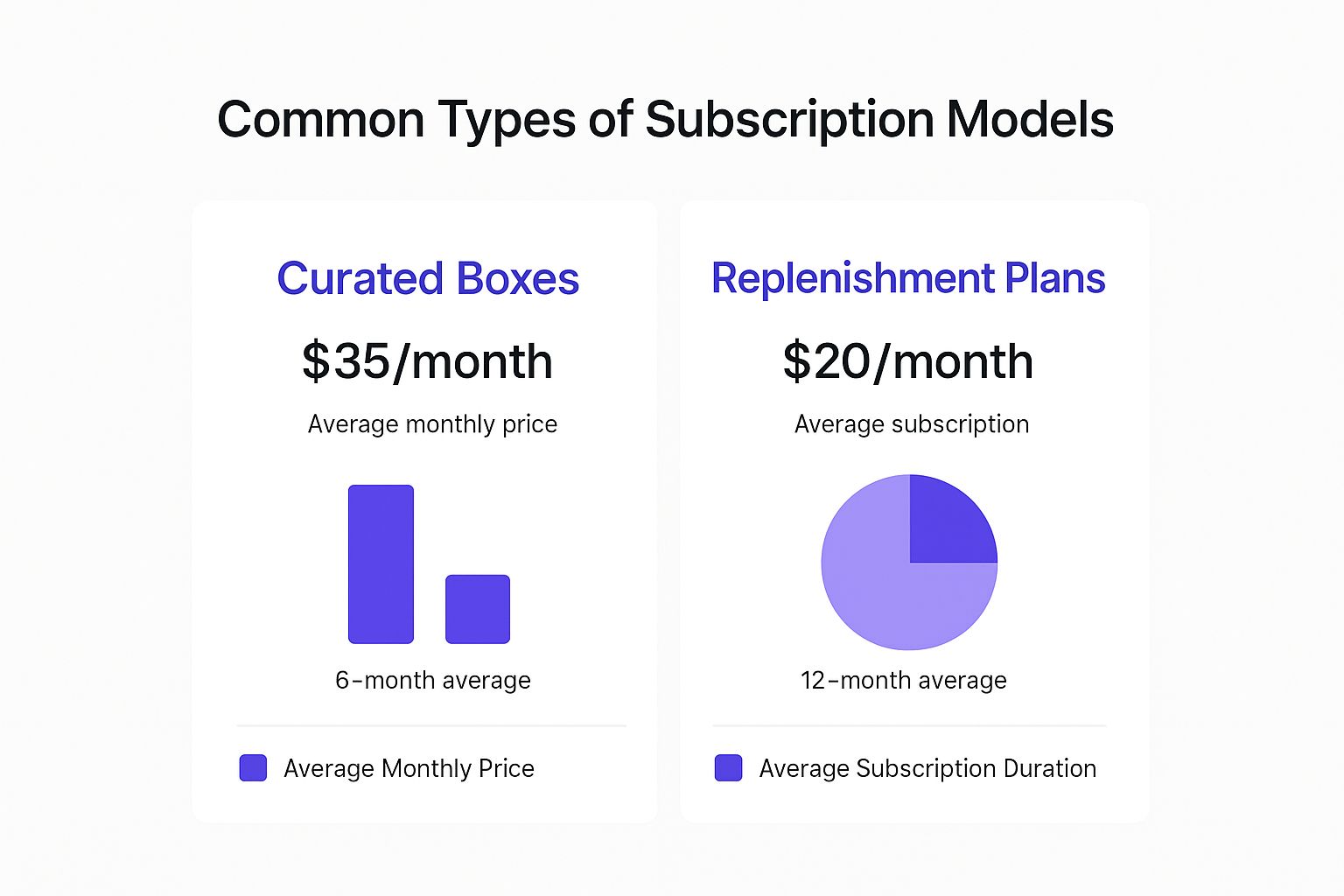
The data shows that while curated boxes often have a higher monthly price, replenishment plans tend to keep customers longer because they focus on essential, repeatable purchases. This growth is happening across all models; while the subscription industry overall sees about 10% annual growth, some specific areas have seen growth rates as high as 60% in recent years. You can learn more about these trends and what they mean for ecommerce by checking out predictions for the subscription market on sticky.io. By choosing the right ecommerce subscription model, your business can effectively ride this wave of growth.
Pricing Strategies That Convert Browsers Into Loyal Subscribers
Setting the price for your ecommerce subscription model is more of an art than a science; it's a fascinating look into customer psychology. A smart pricing strategy does more than just hit a profit target—it creates a sense of undeniable value that turns casual browsers into committed subscribers. The idea is to make your customers feel like they've made a brilliant decision, building loyalty from the moment they sign up.
A great pricing structure subtly points customers toward your preferred plan, all while making them feel completely in control of their choice. This involves carefully setting up your tiers, using psychological principles, and clearly showing the value at each level.
Structuring Your Tiers for Maximum Impact
One of the most effective pricing tactics is a tiered structure, typically offering three choices. This method works by framing the customer's perception of value. Imagine buying popcorn at the movies: the small seems too small, the large is way too much, but the medium feels just right. In pricing, this is known as the decoy effect. By adding a slightly less appealing option, you can make another one look like the clear winner.
Many businesses design their tiers to spotlight a particular plan—often the middle one—by packing it with the most popular features at a price that seems like a bargain. This guides the customer to what feels like the perfect sweet spot. Companies like Netflix are masters at presenting their plans to show the benefit of upgrading.
The screenshot below shows how Netflix lays out the benefits for each plan, making it simple for customers to compare and see the extra value they get with higher-priced tiers.
This visual design naturally draws the eye, with checkmarks and clear feature descriptions that make the "Standard" or "Premium" plans feel like a worthwhile upgrade for only a few dollars more per month.
Leveraging Freemium, Trials, and Annual Discounts
Beyond just setting up tiers, a few other powerful strategies can help you win over new subscribers. Each one tackles a different kind of customer hesitation:
- Freemium Models: This approach offers a basic, no-cost version of your service to attract a large audience. It’s a fantastic fit for software or digital content, like Spotify, because it gets users familiar with the core product. The objective isn't to profit from free users but to provide a seamless upgrade path once they recognize the value of premium features.
- Free Trials: Unlike a freemium model, a free trial grants full access to the premium experience for a set period. This is ideal for more complex products or high-value services where customers need to feel the benefits firsthand before they buy. It removes the fear of making a bad purchase, which is a major hurdle for many people.
- Annual Discounts: Offering a hefty discount for a yearly commitment is a timeless and effective tactic. It helps your business in two key ways: it gives you a significant amount of cash upfront and greatly increases customer lifetime value. When customers pay for a full year, they are much less likely to cancel. This single move can stabilize your revenue and boost retention.
Ultimately, the right pricing strategy depends on your specific products, audience, and business goals. Whether you opt for tiered pricing, a freemium model, or annual discounts, the key is to test your approach, analyze the results, and listen to what your customers are telling you. Your pricing should be a dynamic tool for growth, not something you set and forget.
Technical Foundation: Building a Subscription Business That Scales
Trying to launch an ecommerce subscription model without the right technology is like building a house on a shaky foundation. It might look good at first, but it won't be long before serious problems appear. The technology you choose isn't just a background detail; it's the engine that drives a scalable, smooth, and customer-friendly subscription business. Your platform and tools will directly affect your ability to handle growth, lower customer churn, and automate repetitive tasks.
At the heart of this foundation is your subscription management platform. This is much more than a simple payment tool. Think of it as the central nervous system for your entire subscription operation, connecting what your customer does to your billing, shipping, and support systems. When you pick a platform, you're not just buying software; you're investing in a system that needs to manage the entire subscriber journey, from an easy sign-up to handling payment issues that might come up later.
Must-Have Platform Features
When you're looking at different options, focus on the features that solve the most common subscription headaches. A solid platform should do more than just handle basic recurring payments. It needs to give you a full set of tools for managing customer relationships and automating tasks that would otherwise take up a lot of your time.
Key features to look for include:
- Automated Recurring Billing: The system must be able to process different billing schedules (like monthly, quarterly, or yearly) automatically.
- Dunning Management: This is a vital feature for automatically dealing with failed payments. The platform should retry declined charges and send customized messages asking customers to update their payment details. This single feature can drastically reduce involuntary churn.
- Customer Portal: A self-service portal is a must for cutting down on support requests. It lets customers manage their own subscriptions—pausing, skipping, canceling, or changing their details—without having to contact you.
- Flexible APIs and Integrations: Your subscription platform has to work well with your other key tools, like your ecommerce store (e.g., Shopify), email marketing software, and shipping partners.
The image below shows how a platform like Shopify can build subscription management right into the product page, making it simple and straightforward for customers to subscribe.
This kind of seamless integration is important because it makes subscribing feel like a natural part of shopping, not a complicated add-on. This alone can help you get more subscribers.
Choosing the Right Technology Partner
Picking your technology is a strategic choice that should be based on your business's current size and where you want it to go. For new businesses, an all-in-one solution like Shopify with a good subscription app can be a great starting point. These platforms manage everything from the online store to secure payments in one place. They are also designed to meet strict PCI compliance standards, which is essential for handling credit card information safely.
As your business expands, you might look at more specialized platforms like Recharge or Bold Subscriptions, which offer more in-depth customization and better analytics. Whatever you choose, the goal is always the same: build a technical setup that supports your ecommerce subscription model, not one that limits it. A scalable system gives you the freedom to focus on what really matters—your products and your customers.
Tracking Success: 6 Metrics That Actually Matter

Moving to an ecommerce subscription model means changing how you measure success. Standard retail metrics like one-time sales don't tell the whole story for a business built on recurring revenue. To know if your subscription is truly healthy, you need to track metrics that reflect customer relationships and long-term value, not just single purchases.
Think of it like being a doctor checking a patient's vital signs. Their weight might seem normal, but their blood pressure reveals much more about their long-term health. For a subscription business, metrics like Monthly Recurring Revenue (MRR) and Customer Lifetime Value (CLV) are your vitals. They show whether your business is genuinely thriving or just treading water.
The Core Vitals of a Subscription Business
A few key performance indicators (KPIs) should be front and center on your analytics dashboard. These metrics work together to give you a clear, honest picture of your financial health and customer loyalty.
- Monthly Recurring Revenue (MRR): This is the predictable income you expect to receive every month. It’s the lifeblood of your business, providing a stable baseline for budgeting and forecasting future growth.
- Customer Lifetime Value (CLV): This metric forecasts the total revenue you can expect from a single customer over their entire time with you. A high CLV is a strong sign of customer loyalty and a successful business model.
- Churn Rate: This is the percentage of subscribers who cancel their subscriptions in a given period (usually a month). It's a direct reflection of customer satisfaction. A high churn rate is a major red flag that something is wrong with your product, pricing, or overall experience.
- Customer Acquisition Cost (CAC): This is the total sales and marketing cost required to sign up one new subscriber. A healthy business ensures that its CLV is much higher than its CAC. Ideally, your CLV to CAC ratio should be at least 3:1, meaning you generate three times more value from a customer than you spent to acquire them.
Beyond the Basics: Finding Actionable Insights
Just tracking these numbers isn't enough. The real power comes from understanding what makes them go up or down. This is how you shift from simply measuring to actively managing your business’s growth. For example, cohort analysis is a great technique where you group customers by their sign-up month and track their behavior over time. This can show if a pricing change in March led to better long-term retention compared to customers who signed up in February.
To help you get started, the table below breaks down these crucial metrics, showing you how to calculate them and why they are so important for making smart business decisions.
By keeping a close eye on these metrics, you can make informed decisions that strengthen your ecommerce subscription model. Whether it's tweaking your pricing, refining your onboarding process, or investing more in customer support, these numbers will guide you toward building a business that lasts.
Learning From Subscription Success Stories and Failures
The best way to get a feel for what makes an ecommerce subscription model work is to look at real-world examples. Examining the wins and losses of other companies offers practical lessons you can apply directly to your own business. Studying both famous successes and cautionary tales gives you a clear map of what to do—and what to avoid.
The journey of any subscription business is one of constant adjustment. Success isn't usually about getting everything perfect from the start. Instead, it’s about listening to your customers, being open to change, and focusing relentlessly on delivering value.
The Success Story: Dollar Shave Club’s Masterclass in Simplicity
You can't talk about successful subscriptions without mentioning Dollar Shave Club (DSC). Their victory wasn't due to a groundbreaking new razor but to the brilliant execution of a replenishment model. They zeroed in on a common headache—overpriced razors and the hassle of buying them—and offered a simple, affordable fix.
Their launch strategy was famous, centered on a viral video that nailed their brand's witty and direct personality. However, their lasting success is built on a few core ideas:
- A Clear Value Proposition: High-quality, inexpensive razors delivered right to your door. It's simple and easy to understand.
- Minimal Friction: The sign-up process was incredibly straightforward, removing any hesitation a potential customer might have.
- Strong Brand Identity: They weren't just selling razors; they were selling a lifestyle and a sense of community.
Their current website still embodies this commitment to direct value and a strong brand voice.
The site immediately communicates convenience ("Get your favorites on repeat") and affordability, sticking to the core principles that made their ecommerce subscription model a game-changer from day one.
Cautionary Tales: When Good Ideas Go Wrong
For every Dollar Shave Club, there are many subscription businesses that didn't survive. Most failures can be traced back to a few common blunders. A classic example is the meal-kit industry, which, despite its appealing concept, often struggles with high churn rates. While the idea is fantastic, customers frequently experience "box fatigue," and the service starts to feel more like a chore than a convenience.
Another frequent pitfall is a mismatch between the subscription model and the market. Some curation boxes don't last because their product selections are too narrow to attract a wide audience or too generic to feel unique. A business can also stumble from poor unit economics, such as offering steep discounts to attract customers without a solid plan for long-term profitability. This breaks the essential 3:1 CLV to CAC ratio needed for sustainable growth.
The lesson here is crucial. A successful subscription business is more than just a great idea; it requires excellent operations, a keen understanding of customer behavior, and the financial discipline to build a lasting model.
Ready to build a subscription experience that drives growth and customer loyalty? Wand Websites specializes in creating high-performing Shopify stores with powerful features like recurring billing. Let us help you turn your great idea into a profitable reality. Discover our e-commerce solutions today.
