
10 E-Commerce Pricing Strategies to Boost Your Sales in 2025

Setting the right price for your products feels like a tightrope walk. Price too high, and you risk scaring away potential customers. Price too low, and you leave money on the table, crippling your profit margins and devaluing your brand. If you've been relying on a simple "cost-plus" model or just guessing what the market will bear, you're likely missing out on significant revenue. Your pricing isn't just a number; it's a powerful tool for positioning your brand, attracting the right customers, and driving sustainable growth.
This guide moves beyond the basics. We're diving deep into ten powerful e-commerce pricing strategies that successful brands use to maximize profitability and market share. From the real-time adjustments of Dynamic Pricing to the customer psychology behind Psychological Pricing, you’ll find actionable methods you can implement right away. Each strategy is broken down with clear benefits, real-world examples, and practical steps to help you choose and apply the perfect approach for your business. To identify the best fit for your store, you might also explore essential Shopify pricing strategies. Let's find the strategy that will stop holding your business back and start accelerating its success.
1. Dynamic Pricing
Dynamic pricing is one of the most sophisticated e-commerce pricing strategies, where product prices change in real-time based on a variety of factors. Instead of a "set it and forget it" price, this strategy uses algorithms to automatically adjust costs based on market demand, competitor pricing, inventory levels, and even customer behavior. Think of it as a smart system that constantly seeks the optimal price point to maximize revenue and conversions.
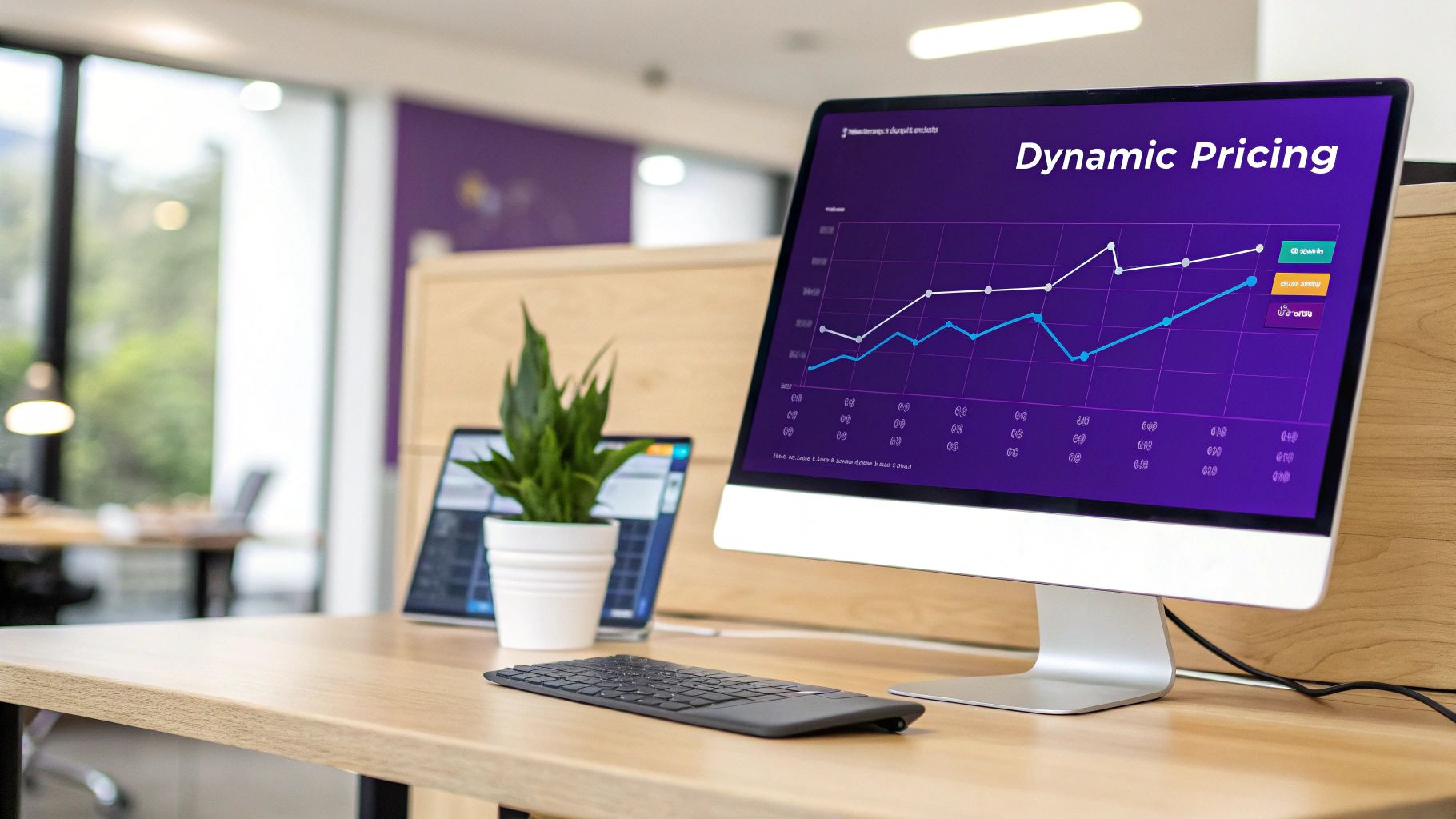
You’ve seen this in action with airlines, where ticket prices fluctuate based on booking dates and seat availability, or with Uber’s surge pricing during peak hours. E-commerce giant Amazon is a prime example, constantly tweaking prices on millions of items to stay competitive. This approach allows your business to be incredibly agile, responding instantly to market shifts.
How to Implement Dynamic Pricing
- Set Clear Boundaries: Establish firm rules for your pricing algorithm. Define a minimum price to protect your profit margins and a maximum price to avoid alienating customers.
- Start Small: Don't overhaul your entire store at once. Test dynamic pricing on a small, select group of products to analyze its impact and fine-tune your approach.
- Monitor Competitors: Keep a close eye on how your competitors react. This strategy doesn't exist in a vacuum, and their responses will influence your success.
- Communicate Value: If customers notice price changes, be prepared to justify the value. Transparency about demand or seasonality can help maintain trust. For a more advanced approach to real-time adjustments, consider Personalised Pricing, which utilizes AI to tailor offers to individual users.
2. Penetration Pricing
Penetration pricing is a powerful e-commerce pricing strategy designed to quickly capture market share. It involves launching a new product at a price significantly lower than the competition to attract a large customer base right from the start. The goal isn't immediate profit, but rather to disrupt the market, establish a strong brand presence, and build a loyal following. Once your brand is established, you can gradually raise prices.
This strategy is common in highly competitive industries. Think of how Netflix entered the streaming market with incredibly low subscription fees to pull users away from traditional cable. Similarly, Xiaomi offered feature-packed smartphones at aggressive prices to gain a foothold in new regions. The core idea is to make your offer too good to refuse, creating rapid adoption and making it harder for competitors to react.
How to Implement Penetration Pricing
- Secure Your Capital: This strategy requires you to operate on thin margins, or even at a loss, for a period. Ensure you have enough capital to sustain your business until you can increase prices.
- Plan Your Price Increase: Don’t make the initial low price permanent. Have a clear, data-driven plan for when and how you will transition to a more profitable price point without losing your new customers.
- Focus on Loyalty: Use the initial low-price period to build strong customer relationships. Offer excellent service and a fantastic product experience so customers stick around when the price goes up.
- Communicate Value: Emphasize the long-term value your product offers, not just its low cost. This helps justify future price adjustments and builds a brand image beyond being the "cheap" option. For more on creating customer lifetime value, explore retention marketing tactics.
3. Psychological Pricing
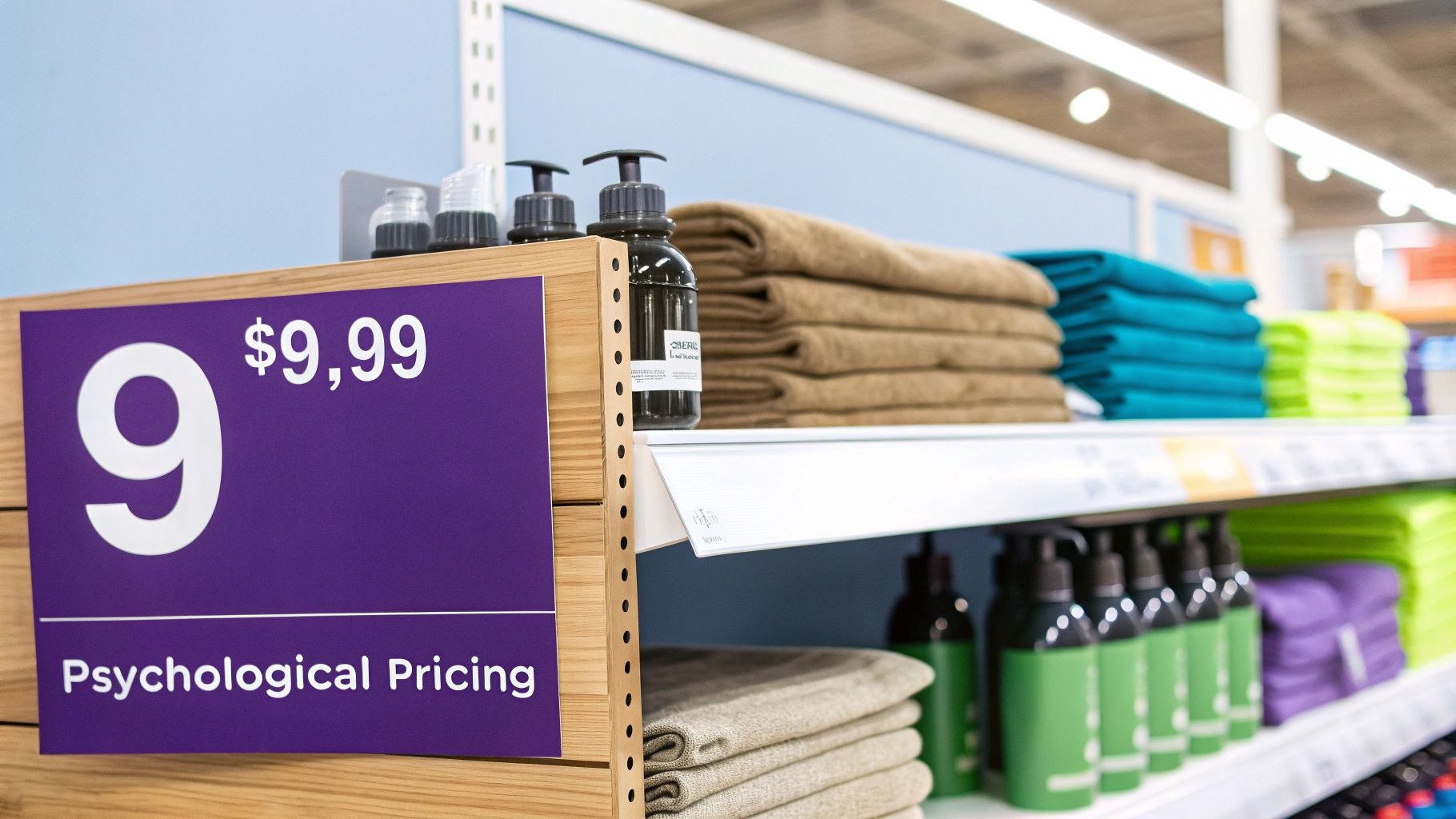
Psychological pricing is a popular e-commerce pricing strategy that taps into consumer psychology to make prices feel more attractive and encourage sales. Rather than pricing products at round numbers, this approach uses subtle tweaks that trigger an emotional, rather than purely rational, response. It’s all about perception, making a price seem lower or like a better deal than it actually is, nudging customers toward the "buy" button.

The most common example is "charm pricing," where an item is priced at $9.99 instead of $10.00. Our brains tend to anchor on the first digit, perceiving $9.99 as significantly cheaper. You see this everywhere, from Apple’s $999 iPhone to a monthly subscription offered at $19.99. Another technique is price anchoring, where a higher original price is shown next to a sale price ($100 now $75) to frame the deal as a major bargain.
How to Implement Psychological Pricing
- Test Charm Pricing: Experiment with prices ending in 9, 99, or 95. See how your audience responds to a price like $49.99 versus a flat $50. A/B testing is your best friend here.
- Use Price Anchoring: When running a sale, always display the original price crossed out next to the new, lower price. This highlights the savings and creates a sense of urgency.
- Offer Tiered Options: Present three options (e.g., Basic, Pro, Premium). Most customers will avoid the cheapest and most expensive, gravitating toward the middle "decoy" option, which you can price for maximum margin.
- Align with Your Brand: A luxury brand might use round numbers ($500) to convey premium quality, while a budget-friendly store will benefit more from charm pricing ($499.99). Ensure your pricing style matches your brand’s position.
4. Freemium Pricing
Freemium pricing is a powerful model, especially for digital products and services, where you offer a basic version of your product for free. The goal is to attract a large user base with the free offering and then convert a fraction of those users into paying customers who want access to premium features, enhanced functionality, or an ad-free experience. This strategy excels at lowering the barrier to entry, allowing potential customers to experience your product's value firsthand before committing to a purchase.
You interact with freemium models every day. Think of Spotify, which offers a free, ad-supported tier while its premium subscription unlocks ad-free listening and offline downloads. Similarly, Dropbox provides a few gigabytes of free cloud storage, encouraging users to upgrade when they need more space. This approach builds brand loyalty and creates a steady pipeline of warm leads for your paid offerings, making it a sustainable e-commerce pricing strategy for long-term growth.
How to Implement Freemium Pricing
- Balance Your Features: The free version must be valuable enough to attract and retain users, but limited enough to make the premium upgrade compelling. Don't give away too much.
- Focus on Engagement: Track how free users interact with your product. Identify which features they use most and use this data to inform your upgrade prompts and marketing messages.
- Provide Clear Value Differentiation: Clearly communicate what customers gain by upgrading. Use comparison charts or feature lists to highlight the exclusive benefits of the paid version.
- Monitor Acquisition Costs: While the product is "free" for the user, acquiring that user isn't free for you. Keep a close eye on your customer acquisition cost (CAC) to ensure the model remains profitable as you convert users. For a deeper look at scaling this model, check out how SaaS companies like Slack have perfected the freemium strategy.
5. Bundle Pricing
Bundle pricing is an effective e-commerce pricing strategy where you package several products together and sell them as a single unit, often for a lower price than if the customer bought each item individually. This approach is fantastic for increasing the average order value (AOV) while also giving customers a sense of getting a great deal. It simplifies the buying decision and can help you sell slower-moving inventory alongside popular items.
You encounter this strategy everywhere. Think of Microsoft's Office Suite, which packages Word, Excel, and PowerPoint together, or fast-food combo meals that combine a burger, fries, and a drink. In e-commerce, a skincare brand might bundle a cleanser, serum, and moisturizer into a "Complete Morning Routine" kit. This not only boosts sales but also introduces customers to more of your product line.
How to Implement Bundle Pricing
- Create Logical Pairings: Group products that complement each other. For example, a camera with a lens, memory card, and a bag. The bundle should solve a complete problem or fulfill a broader need for the customer.
- Show the Savings: Clearly display the bundled price next to the total cost of buying the items separately. Emphasizing the discount, such as "Save $20 with this kit!," makes the perceived value tangible and compelling.
- Offer Both Options: Don't force customers into a bundle. Keep products available for individual purchase. This gives shoppers autonomy and makes the bundle feel like a value-added option, not a restriction.
- Test and Analyze: Experiment with different product combinations and price points to see what resonates most with your audience. Monitor sales data to identify which bundles generate the highest AOV and profit margin. You can explore how companies like Nintendo have mastered this strategy for both hardware and software.
6. Subscription Pricing
Subscription pricing is a powerful recurring revenue model where customers pay a regular fee, often monthly or annually, for continuous access to a product or service. Instead of one-off purchases, this strategy focuses on building long-term relationships and creating a predictable, stable income stream for your e-commerce business. It shifts the focus from customer acquisition to customer retention, making loyalty paramount.
This model has been popularized by giants like Netflix for streaming, Adobe for software, and Dollar Shave Club for physical goods. It works because it offers customers convenience and consistent value while providing businesses with reliable cash flow. For e-commerce stores, this is one of the most effective pricing strategies for fostering deep customer loyalty and increasing lifetime value.
How to Implement Subscription Pricing
- Offer Multiple Tiers: Create several subscription levels with different features and price points. This allows you to cater to a wider range of customers, from casual users to power users, maximizing your potential market.
- Focus on Retention: Your work doesn't end after the first sale. Continuously add value, improve your offerings, and engage with your community to keep subscribers happy and reduce churn.
- Incentivize Annual Plans: Encourage longer commitments by offering a discount for annual subscriptions compared to monthly ones. This boosts your cash flow and locks in customers for a full year. For an in-depth look at frameworks specific to this model, refer to these Proven Subscription Pricing Strategies.
- Monitor Churn Rate: Closely track the percentage of subscribers who cancel their subscriptions. A high churn rate is a critical warning sign that you need to re-evaluate your product, pricing, or customer service.
7. Competitive Pricing
Competitive pricing is a straightforward yet powerful strategy where you set your prices primarily based on what your competitors are charging. Instead of focusing internally on your costs or perceived value, your attention shifts outward to the market landscape. This approach is all about positioning your brand relative to others, aiming to attract customers by offering comparable or better prices for similar products.
You see this strategy everywhere, from your local gas station adjusting its prices based on the station across the street to retail giants like Best Buy and Walmart. Their famous price-matching guarantees are a direct application of competitive pricing, ensuring they aren't beaten on price for key items. This is one of the most common e-commerce pricing strategies for businesses in crowded markets where price is a major deciding factor for consumers.
How to Implement Competitive Pricing
- Monitor Key Competitors: You don’t need to track everyone. Identify your top 3-5 direct competitors and use tools to regularly monitor their pricing on overlapping products. This keeps your efforts focused and manageable.
- Define Your Position: Decide if you want to price match exactly, price slightly below to gain an edge, or price slightly above to signal higher quality or better service. Your brand identity should guide this decision.
- Balance with Profitability: Never follow a competitor’s price so low that you lose money. Always know your own costs and set a hard floor for your prices to protect your profit margins.
- Highlight Total Value: If you can't compete on price alone, emphasize your unique value proposition. This could be faster shipping, a better return policy, or exceptional customer service. Make it clear to customers why they might pay a little more with you.
8. Value-Based Pricing
Value-based pricing is an e-commerce pricing strategy that flips the script on traditional models. Instead of looking inward at your costs or outward at competitors, this strategy sets prices based on the perceived value your product delivers to the customer. It’s all about what your customer believes your product is worth, focusing on the benefits, outcomes, and positive experience you provide.
Think of Apple’s premium pricing for its iPhones; customers pay for the superior design, user experience, and ecosystem, not just the hardware components. Similarly, a high-end skincare brand prices its products based on the promise of clear skin and confidence, not just the cost of the ingredients. This approach allows you to capture the true value you’ve created and anchor your brand on quality and results rather than price.
How to Implement Value-Based Pricing
- Conduct Customer Research: You can't guess what customers value; you have to ask them. Use surveys, interviews, and focus groups to understand what benefits they seek and how much they are willing to pay for them.
- Clearly Communicate Your Value: Your product descriptions, marketing copy, and branding must all shout your unique value proposition. Why is your product better? What problem does it solve that no one else can?
- Segment Your Audience: Different customers will perceive value differently. Create customer segments based on their needs and willingness to pay, allowing you to tailor offers and messaging to maximize revenue from each group.
- Use Social Proof: Reinforce your product's value with customer testimonials, case studies, and user-generated content. When potential buyers see how much others have benefited, they are more likely to accept a higher price point. If you sell specialized products, you can find more on niche marketing strategies that align well with this pricing model.
9. Loss Leader Pricing
Loss leader pricing is a bold e-commerce pricing strategy where you intentionally sell certain popular products at a loss or just above cost. The goal isn't to profit from these specific items, but to attract a flood of new customers to your store who will then purchase other, more profitable products during their visit. This tactic effectively uses a "magnet" product to boost overall traffic and increase the average order value.
This strategy is famously used by brick-and-mortar giants. Think of Costco's iconic $4.99 rotisserie chicken, which drives millions to their warehouses, or grocery stores that price milk and eggs below cost. In e-commerce, a retailer might sell a popular gaming console at a loss, knowing that customers will also buy high-margin accessories and games. It’s a calculated sacrifice on one item to win a much larger sale.
How to Implement Loss Leader Pricing
- Choose the Right Product: Select a high-demand, well-known product that customers frequently search for and recognize the value of. This makes the low price stand out.
- Prominently Display Profitable Items: Strategically place your higher-margin products near the loss leader. Use "frequently bought together" sections or bundle offers to encourage upsells and cross-sells.
- Monitor Your Margins: This strategy can be risky. Keep a close watch on the total basket value to ensure the profits from other items are covering the loss on the leader product.
- Consider Purchase Limits: To prevent competitors or bargain hunters from clearing out your stock, you might need to limit the quantity of the loss leader item per customer. This ensures the deal benefits genuine shoppers. For a deeper dive into how this impacts customer perception and long-term value, you can explore the psychological aspects of pricing.
10. Tiered Pricing
Tiered pricing is a powerful strategy that involves offering a product or service at different price points, with each tier providing a different set of features, quantities, or service levels. This "good-better-best" approach allows you to cater to a wider audience, from budget-conscious shoppers to premium customers seeking the full experience. It empowers customers to choose the option that best fits their needs and budget, maximizing your potential revenue by capturing value across different segments.
This strategy is everywhere once you start looking for it. Software companies like Asana offer Basic, Premium, and Business plans with increasing features. Streaming services like Netflix provide different tiers based on video quality and the number of simultaneous streams. This model works because it shifts the customer's question from "Should I buy this?" to "Which version should I buy?"
How to Implement Tiered Pricing
- Create Clear Value Differentiation: Each tier must offer a distinct and justifiable increase in value. Customers should easily understand why one tier costs more than another. Vague benefits will only cause confusion and lead to indecision.
- Leverage the Anchoring Effect: Design your tiers to make the middle option the most appealing. By presenting a high-end "Pro" or "Enterprise" option, the standard mid-tier plan often appears as the most reasonable and popular choice.
- Provide an Easy Upgrade Path: Make it simple for customers to move up to a higher tier as their needs grow. A seamless upgrade process can significantly increase customer lifetime value without requiring new customer acquisition.
- Communicate Benefits Clearly: Don't just list features; explain the benefits. Use a comparison table to visually lay out what each tier includes, helping customers make an informed choice. For more insight on structuring these offers, check out this guide on designing pricing pages.
E-Commerce Pricing Strategies Comparison
Choosing Your Strategy and Taking the Next Step
We’ve navigated the complex and fascinating world of e-commerce pricing strategies, from the data-driven precision of dynamic pricing to the customer-centric approach of value-based models. Each strategy, whether it's bundling products for higher perceived value or using psychological pricing to frame a deal perfectly, offers a unique lever you can pull to drive growth, increase profitability, and build a stronger brand.
The sheer number of options can feel overwhelming, but remember this: you don't have to choose just one and stick with it forever. The most successful e-commerce businesses are agile. They view pricing not as a static, "set it and forget it" task, but as an active, evolving component of their overall business strategy.
Your Action Plan for Smarter Pricing
So, what's next? It's time to move from learning to doing. The key is to start small, test rigorously, and build on what works. Here’s a simple, actionable plan to get you started:
Analyze Your Current Position: Before you can chart a new course, you need to know where you are. Review your current pricing. Is it based on cost-plus, or have you just been matching competitors? Dig into your analytics to understand your profit margins, best-selling products, and customer purchase behavior.
Select a Test Candidate: You don't need to overhaul your entire store's pricing overnight. Pick one product or a small, related category of products to be your testing ground. A product with steady traffic but a lower-than-desired conversion rate is often a great place to start.
Formulate a Hypothesis: Choose one or two strategies from this list that seem like a natural fit. For example, your hypothesis might be: "Implementing bundle pricing for our shampoo and conditioner will increase the average order value by 15%." or "Using psychological pricing ($39 instead of $40) on our best-selling t-shirt will increase its conversion rate."
Measure Everything: The only way to know if a change is working is to track the results. Before you launch your test, make sure you know your baseline metrics: conversion rate, average order value (AOV), profit margin, and units sold. Use A/B testing tools if possible to get clean, reliable data. Run your test for a specific period, like two weeks or a month, to gather enough information.
Key Takeaway: Pricing is a powerful conversation you have with your customers. It communicates your brand's value, quality, and position in the market. Mastering these e-commerce pricing strategies means you can lead that conversation with confidence and intention.
Ultimately, finding the right pricing strategy is a journey of continuous improvement. What works today might need tweaking in six months as market conditions change, new competitors emerge, and your customers' expectations evolve. By embracing a mindset of testing and optimization, you transform pricing from a source of anxiety into your most powerful tool for sustainable growth.
Ready to implement these powerful pricing strategies but feel held back by a clunky or inflexible website? A high-performing e-commerce platform is the foundation of any successful pricing test. Wand Websites builds stunning, conversion-optimized Shopify stores that give you the control and flexibility you need to easily manage products, create bundles, and run A/B tests. Visit Wand Websites to see how we can build you a site that not only looks incredible but also works as a powerful engine for your growth.
