
Your Modern E Commerce Growth Strategy

A solid e-commerce growth strategy is more than just a list of marketing tactics. It’s your roadmap for how you’ll pull in new customers, boost sales, and create a brand people genuinely love. Forget random, scattered efforts—we're talking about a focused plan that ties together everything from your marketing and operations to the customer experience itself.
The best strategies are always built on a strong foundation and guided by clear, data-driven goals.
Building Your Foundation for Scalable Growth
Before you even think about chasing the latest marketing trend or throwing a bunch of money at ads, let's talk about building a rock-solid foundation. Explosive e-commerce growth isn't about luck; it's about getting your business ready to handle that success when it comes.
Think of it like building a house. You wouldn't start putting up walls without first pouring a perfect foundation, right? This first phase is all about taking a realistic look at where you are right now, making sure every part of your business is ready to scale smoothly.
Audit Your Current State
First things first, let's look at your tech stack. Can your platform, whether it's Shopify or BigCommerce, actually handle a huge spike in traffic? Are your payment processing and inventory systems talking to each other, or are they held together with digital duct tape? As you grow, you also become a bigger target, which is why implementing effective fraud prevention for e-commerce is a non-negotiable part of a scalable foundation.
Next, walk through your entire customer journey, from the very first ad they see to the follow-up email after they buy. Where are people dropping off? Is your checkout process a nightmare on mobile? Pinpointing these friction spots is like finding gold—they’re often easy wins that can lift your conversion rate without you spending another dime on ads.
Set Goals That Actually Matter
Vague goals like "increase sales" are pretty much useless. A powerful growth strategy is built on specific, measurable objectives that tell you what’s really going on in your business.
Instead of fluff, focus on the metrics that tell a story:
- Customer Lifetime Value (CLV): This is the total profit you can expect from a single customer. A rising CLV is a sure sign you're building a loyal following.
- Customer Acquisition Cost (CAC): This is what it costs you, on average, to win a new customer. The big goal here is to keep this number way below your CLV.
- Conversion Rate: What percentage of your website visitors actually buy something? Even tiny improvements here can lead to massive gains in revenue.
- Average Order Value (AOV): How much does the typical customer spend in one go? Finding ways to bump this number up is one of the fastest paths to growth.
The global e-commerce market is absolutely booming. By 2025, online sales are expected to hit a staggering $8.3 trillion worldwide, which is a 55.3% jump from 2021. This incredible growth is being driven by digital wallets and a massive shift to mobile commerce, with over 70% of purchases projected to happen on a phone.
With numbers like these, having a solid, scalable foundation isn't just a nice-to-have anymore—it’s essential if you want to grab your slice of the pie.
Key Takeaway: Your goal isn't just growth; it's profitable growth. The ultimate sign of a healthy, sustainable business is a strong CLV-to-CAC ratio. You should be aiming for at least 3:1 (meaning a customer is worth three times what it cost you to acquire them).
By starting with this foundational audit and setting meaningful goals, you ensure that every dollar you invest and every tactic you try is built on a system designed for success from the ground up.
Key Pillars of a Modern E-Commerce Growth Strategy
Before we dive deeper into specific tactics, let's zoom out. A truly comprehensive growth plan needs to address several core areas of your business simultaneously. This table gives you a quick snapshot of the essential pillars every modern e-commerce brand should be focused on.
Think of these pillars as the legs of a table—if one is weak, the whole thing becomes unstable. A winning strategy keeps all of them strong and balanced.
Winning Customers in a Crowded Marketplace

Getting new customers through the door is the fuel for any e-commerce brand. But let's be honest, just throwing more money at ads feels like a race to the bottom. In today's jam-packed market, a smarter, more balanced plan is what separates the brands that thrive from those that just survive.
This means you have to think beyond a single channel and start building a real system—one that artfully blends paid traffic, organic reach, and powerful word-of-mouth referrals.
The truth is, you're not just up against a few local competitors anymore. To actually grab market share and connect with different types of shoppers, you need a modern multi-channel marketing strategy. It’s all about meeting people where they already are, instead of hoping they magically find you. Think of it as creating multiple pathways to your store, with each one making the others stronger.
Mastering Organic Reach with E-commerce SEO
Search Engine Optimization (SEO) is the ultimate long game. It’s not about flashy, overnight wins; it’s about building a rock-solid asset that brings in customers who are ready to buy, month after month, without you paying for every click. For any online store, this journey begins with your product pages.
Get inside your customer's head. Are they typing "handmade leather tote bag" into Google, or are they looking for a "durable work-from-home carryall"? Tools like Google Keyword Planner are great for uncovering these high-intent phrases. Once you have them, weave them naturally into your:
- Product Titles: Keep them clear, descriptive, and packed with the words people actually use.
- Product Descriptions: Don't just list features. Tell a story that uses your keywords while showing how the product solves a real problem for the shopper.
- Image Alt Text: This is a simple but powerful way to help Google "see" your product images, getting them to show up in image searches.
Beyond the products themselves, a smart content strategy can be a game-changer for attracting people who aren't quite ready to buy. A blog post on "How to Organize Your Home Office" can bring in future customers for your desk accessories long before they even think about searching for the product itself. This kind of content positions you as a helpful expert and builds trust from the get-go.
Making Paid Ads Work Smarter
Paid ads on platforms like Meta (Facebook and Instagram) and Google are often the quickest way to get in front of fresh eyes. They can also be a ridiculously fast way to burn through your budget if you're not careful. The secret to a great Return on Ad Spend (ROAS) isn't a bigger budget—it's laser-focused targeting and non-stop creative testing.
Stop targeting generic buckets like "women ages 25-45." You have to dig deeper.
- For Meta: Build Lookalike Audiences from your absolute best customers (the ones with the highest lifetime value). You're essentially telling the algorithm, "Go find me more people exactly like these!" Also, make sure you're running retargeting ads to bring back all those people who added items to their cart but got distracted.
- For Google: Zero in on "long-tail keywords" for your Search Ads, like "eco-friendly yoga mat for hot yoga." These longer phrases are less competitive and signal that someone is much closer to making a purchase. And for products, Google Shopping ads with killer images and sharp pricing are your best friend.
Pro Tip: Your ad creative is the biggest lever you can pull. Always be A/B testing your ad copy, images, and videos. I've seen a simple lifestyle shot of a product outperform a standard studio photo by 2x or more. Never assume you know what will work—let the data tell you.
Building an Army of Advocates
The most convincing marketing on the planet is a recommendation from someone you trust. That’s where affiliate and influencer programs come in, creating a powerful, performance-based channel that drives authentic sales.
- Affiliate Marketing: This is a low-risk, high-reward model. You partner with bloggers and creators in your niche, give them a unique link to share with their audience, and pay them a commission for every sale they send your way.
- Influencer Marketing: Work with influencers whose values and vibe genuinely match your brand. It’s not about chasing the biggest follower count; it’s about finding someone with a highly engaged audience that looks just like your ideal customer. A micro-influencer with 10,000 loyal fans can often drive more sales than a mega-influencer with a million passive followers.
With over 28 million online stores expected globally by 2025—and more than 2,000 new ones popping up every single day—relying on just one source of traffic is a huge gamble. By combining smart SEO, strategic paid ads, and authentic partnerships, you build a customer acquisition engine that’s not just effective, but resilient.
Designing a High-Converting Shopping Experience
Getting people to your site is one thing. But getting them to actually buy something? That’s where a truly effective e-commerce growth strategy proves its worth.
The whole game is turning those clicks into loyal, paying customers. This is what we call Conversion Rate Optimization (CRO), and it's all about making the journey from "I'm just looking" to "Take my money!" as seamless as possible.
Think of your website like a physical store. If it's messy, poorly lit, or hard to navigate, people won't stick around. Your online store is no different. Every single element needs to work together to build confidence and guide shoppers smoothly toward that final checkout button.
Speed and Simplicity: The Foundation of a Great Experience
Let's be blunt: modern shoppers have zero patience. A mere one-second delay in your site’s load time can torpedo conversions by up to 7%. Your absolute first priority has to be a lightning-fast website, especially on mobile, which is where most of your traffic probably comes from. A slow site is a conversion killer.
Navigation should be second nature. Customers shouldn't have to think about where to go next. This means crystal-clear categories, a search bar that actually helps, and a menu that just makes sense. If someone can't find what they want in a couple of clicks, they're gone—probably to a competitor's site that’s easier to use.
Building Trust with Great Visuals and Social Proof
People shop with their eyes. That makes high-quality product photography one of your most powerful sales tools. You need to show your products from every angle, in real-life contexts, and even use video to bring them to life. This is how you close the gap between seeing an item online and actually holding it.
And your product descriptions? They need to do more than just list specs. They should tell a story and sell the benefits. Write compelling copy that answers a customer's questions before they even think to ask them. Help them imagine how much better their life will be with your product in it.
Of course, nothing builds trust quite like hearing from other happy customers.
- Customer Reviews: Don't hide them! Make reviews and ratings a prominent feature on your product pages. A staggering 93% of consumers say online reviews impact their buying decisions.
- User-Generated Content (UGC): Get your customers involved. Encourage them to share photos of themselves using your products and feature that content right on your site. It’s authentic and incredibly persuasive.
- Testimonials: For bigger purchases, a detailed testimonial can be the final nudge a hesitant buyer needs to feel confident in their decision.
Smoothing Out the Path to Purchase
Optimizing for conversions isn't about throwing things at the wall and seeing what sticks; it's a science. You have to constantly test different parts of your site to learn what your audience responds to.
A great place to start is A/B testing your call-to-action (CTA) buttons. Does "Shop Now" work better than "Add to Cart"? Does a bright green button get more clicks than a subtle blue one? You’ll never know for sure until you test it.
The checkout process is often the final hurdle where so many sales are lost. Your mission here is to remove every single bit of friction.
The Baymard Institute found that the average cart abandonment rate is just under 70%. A huge chunk of that is because of long or confusing checkout processes. Things like offering a guest checkout, providing multiple payment options, and showing a clear progress bar can make a massive difference.
By methodically finding and fixing these little roadblocks, you create a shopping experience that feels easy and natural. This doesn't just boost your sales today—it builds the kind of loyalty that keeps customers coming back again and again.
Transforming Buyers into Brand Advocates

The real magic of a solid e commerce growth strategy isn't just getting that first sale. It’s what happens after the purchase that separates a flash-in-the-pan store from a brand that truly lasts.
Sustainable growth is all about retention. It’s the art of turning a one-time buyer into a loyal fan who not only comes back for more but also tells their friends about you. This isn’t just a nice-to-have; it's a financial imperative. After all, acquiring a new customer can cost five times more than keeping an existing one.
When you shift your focus from constantly chasing new leads to maximizing Customer Lifetime Value (CLV), you build a much more profitable and resilient business. Every interaction after the checkout is a golden opportunity to build trust, delight your customer, and pave the way for their next purchase.
Crafting a Memorable Post-Purchase Experience
The moment a customer clicks "buy" isn't the finish line—it's the start of a whole new race. A thoughtful post-purchase experience solidifies their decision and makes them feel genuinely good about choosing your brand.
It all starts with automated communication that feels personal, not robotic. These automated flows are your secret weapon for building loyalty at scale.
- Order Confirmation: Ditch the generic "Thanks for your order." Try including a personal note from the founder, sharing a quick tip on using their new product, or linking to a helpful blog post.
- Shipping Updates: Keep them in the loop. A simple SMS or email letting them know their order has shipped and is out for delivery builds excitement and dramatically cuts down on "Where is my order?" support tickets.
- Welcome Series: For new customers, a dedicated welcome email series is a must. Use it to introduce your brand's story, showcase other popular products, and maybe offer a small incentive for their next purchase. It makes them feel like part of the family from day one.
Key Insight: Don't sleep on win-back campaigns. A carefully timed email to a customer who hasn't purchased in a while, maybe with a friendly "We miss you!" discount, can reactivate dormant revenue and remind them why they liked you in the first place.
Building Community with a Valuable Loyalty Program
A truly great loyalty program does more than just hand out discounts; it makes your best customers feel like VIPs. The goal here is to build an ecosystem where repeat business feels less like a transaction and more like a relationship.
Instead of a generic "earn points" system, think about what your customers actually find valuable.
- Tiered Rewards: Create different levels (think Bronze, Silver, Gold) that customers can climb as they spend more. Higher tiers should unlock better perks like permanent free shipping, early access to new collections, or exclusive content.
- Experiential Perks: Offer rewards that money can't buy. This could be anything from an invitation to a virtual workshop with an expert to a one-on-one consultation or even a shout-out on your social media.
- Community Access: Consider creating a private Facebook group or Slack channel just for loyalty members. This fosters a powerful sense of belonging and gives you a direct line to your most passionate fans.
Personalization That Makes Customers Feel Seen
In a sea of generic marketing, personalization is how you stand out and connect. It’s about using the data you have to create an experience that feels like it was made just for them. This goes way beyond just using their first name in an email subject line.
Here are a couple of effective personalization tactics:
- Tailored Product Recommendations: Use a customer's browsing and purchase history to suggest other items they'll genuinely love. You can showcase these on your homepage, in email campaigns, and even on product pages to help them discover more of what you offer.
- Segmented Communication: Stop sending the same email to everyone on your list. Segment your audience based on their behavior—first-time buyers, repeat customers, high-spenders—and send them content and offers that make sense for their relationship with your brand. A first-time buyer might get a "how-to" guide, while a long-time loyalist gets a sneak peek at an upcoming launch.
This level of attention to detail makes customers feel understood. When you consistently show them you know who they are and what they like, you're not just selling a product; you're building a relationship. And in e-commerce, strong relationships are the ultimate growth engine.
Scaling Operations for the Next Level
Growth is a great problem to have, but it's still a problem. When orders start flooding in, the manual systems you cobbled together in the early days will inevitably start to crack. A real e-commerce growth strategy isn't just about flashy marketing campaigns; it’s about building a backend that can actually handle the success you’re chasing.
This is the moment you transition from a small-time operation to a serious player by automating the things that are holding you back. The goal is to get out of the weeds—away from manually updating inventory and answering the same customer service questions over and over—so you can focus on the big picture. That means investing in the right tech to make sure your operations can keep pace with your sales.
Choosing Your Expansion Path
Once your internal house is in order, you can start looking outward. Where do you grow next? Expansion isn't a "one-size-fits-all" deal. It's about making a calculated bet on where your brand can make the biggest splash and see the best return.
You've got a few solid options on the table:
- New Geographic Markets: This could be as big as launching in a new country or as focused as targeting a specific region where you're already seeing some organic interest. Just be ready to do your homework on local laws, shipping headaches, and cultural buying habits.
- Third-Party Marketplaces: Jumping onto platforms like Amazon or Walmart Marketplace gives you instant access to a huge, ready-made audience. The trade-off? You lose some brand control, face intense competition, and have to stomach commission fees that can slice into your profits.
- Wholesale or B2B Channels: Partnering up with other retailers can be a fantastic way to move serious volume and get your brand name out there without having to manage thousands of individual customer orders.
The right move really depends on your product, your customers, and how much cash you have to play with. This decision tree is a great way to visualize how different factors, like acquisition cost and audience reach, can point you in the right direction.
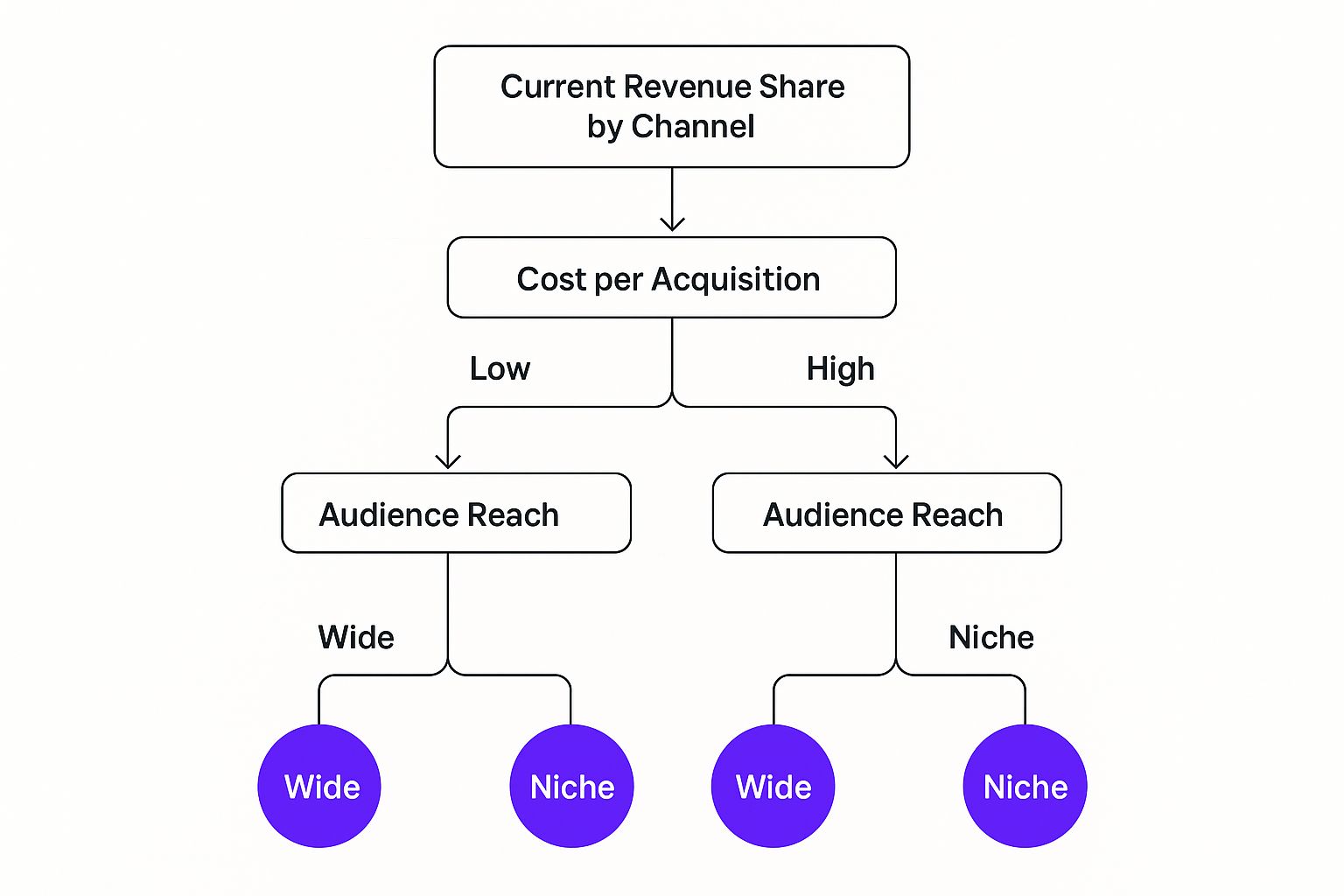
As the framework shows, channels with low acquisition costs and wide reach often offer the most bang for your buck for scalable growth. Niche channels, on the other hand, can be perfect for testing the waters with a new product.
Deciding where to expand is a critical step. Below is a quick look at the potential benefits and challenges of different expansion strategies for growing e-commerce brands.
Comparing Market Expansion Channels
Each path has its own set of pros and cons, so it's crucial to weigh them against your specific business goals and resources before diving in.
A Framework for Smart Market Research
Jumping into a new market blind is a recipe for disaster. You need a structured plan for your market research to make sure your next move is a calculated win, not just a costly gamble.
Before you commit a single dollar, start digging into the data. What’s the total addressable market size? Who are your main competitors, and what are they good (and bad) at? Use tools like Google Trends to see how much search interest there is for your product category in that region. This initial analysis will tell you if the prize is even big enough to chase.
Key Takeaway: Don't just look at the market—look at your own data. Dive into your existing customer base. Are you seeing a surprising number of orders from a specific country? That organic demand is often the clearest signal of where to expand next.
The global shift to online shopping isn't slowing down. By 2025, e-commerce is expected to account for nearly 24% of all global retail sales, with shoppers spending a staggering $7.4 trillion. This incredible growth, fueled by over 2.77 billion digital buyers, shows just how massive the opportunity is for brands prepared to scale. You can dig into more of these fascinating e-commerce trends at Exploding Topics.
With that context, scaling smartly becomes more critical than ever. By automating your operations and making data-backed decisions on where to expand, you put your brand in a prime position to grab a piece of this exploding market.
Answering Your Top E-commerce Growth Questions
https://www.youtube.com/embed/vqZ1C2elmac
Running an e-commerce business can feel like spinning plates. You're trying to keep marketing, sales, customer service, and a dozen other things going all at once. To cut through the noise, I've pulled together some of the most common questions I hear from founders trying to nail down their growth strategy. Here are some quick, no-nonsense answers to help you get unstuck and move forward.
How Do I Choose the Right Marketing Channels?
The "perfect" channel doesn't exist—but the perfect channel for your customer does. The biggest mistake you can make is spraying your budget across every platform hoping something sticks. Instead, get laser-focused on your ideal customer. Where do they actually hang out online?
If you sell visually appealing products like fashion or home decor, platforms like Instagram and Pinterest are your natural home. On the other hand, if your brand solves a very specific, searchable problem, mastering Google Search and SEO is your best bet for grabbing customers who are ready to buy right now.
My go-to advice is to take a "test and invest" approach. Carve out a small, fixed budget to experiment with two or three promising channels at the same time. Keep a close eye on your Cost Per Acquisition (CPA) and Return on Ad Spend (ROAS) for each one. Within a few weeks, the data will tell you a story. Double down on the clear winner, and use a smaller part of your budget to keep testing new ideas.
What Is the Single Most Important Metric for Growth?
While everyone loves to talk about revenue and conversion rates, I've found that the real pros obsess over Customer Lifetime Value (CLV). This is the true north star for building a sustainable, long-term business.
CLV tells you the total profit you can expect from the average customer over their entire relationship with your brand. A high CLV is a fantastic sign that your product is great and your customers are happy enough to come back again and again.
Understanding this metric is a strategic game-changer. When you know your CLV, you know exactly how much you can afford to spend to acquire a new customer (your CAC). This insight lets you confidently outbid competitors in ad auctions and scale your business aggressively—and, more importantly, profitably.
Should I Focus on Acquiring New Customers or Retaining Current Ones?
This is the classic growth dilemma, and the right answer really depends on where your business is in its journey. If you're just starting out, your main job is acquisition, period. You need to get that initial base of customers, collect crucial feedback, and prove that people actually want what you're selling.
But as your brand grows and matures, the pendulum should swing decisively toward retention. The numbers don't lie: it costs about five times more to attract a new customer than to keep an existing one. A truly smart growth strategy uses acquisition to get people in the door, then immediately shifts to wowing them with an incredible experience that keeps them coming back.
Start building these retention tactics into your business from day one:
- A killer post-purchase email series: Reassure them they made a great choice and build excitement for their order's arrival.
- A simple but valuable loyalty program: Make your best customers feel like true insiders.
- Personalized follow-ups: Show them you're paying attention to what they like.
This two-pronged approach ensures you’re squeezing every drop of value from each customer, starting with their very first purchase.
How Often Should I Adjust My E-commerce Growth Strategy?
Your growth strategy should be a living document, not a dusty binder on a shelf. The e-commerce world moves way too fast for a "set it and forget it" mindset.
I recommend scheduling a deep-dive strategy review every quarter. This is your chance to dig into your KPIs, analyze what worked (and what flopped), and see what your competitors have been up to. This is where you make your big, directional shifts for the next 90 days.
That said, you should be checking in on your core metrics weekly, if not daily. This is what allows you to be nimble. For instance, if a top-performing ad campaign suddenly starts to nosedive, you can hit the pause button immediately instead of bleeding cash for a whole quarter.
Think of it this way: your major strategic pivots happen quarterly, but small, tactical adjustments should be happening all the time, guided by real-time data.
Ready to build a professional Shopify store that’s designed for growth? At Wand Websites, we craft high-performing, conversion-focused websites that turn your hard work into more traffic, bigger orders, and loyal customers. Let’s make your next move easy and profitable. Learn more about our services.
