
10 E-Commerce Growth Strategies to Thrive in 2025


Ready to Skyrocket Your E-Commerce Sales?
Want to boost your online store's performance? You're in the right place. This listicle delivers ten proven e-commerce growth strategies to help you scale your business in 2025 and beyond. Whether you're an established Etsy seller, managing a growing e-commerce website, or already hitting significant monthly revenue, these strategies will help you reach the next level. Learn how to leverage personalization, mobile optimization, content marketing, and other powerful techniques. We'll cover everything from omnichannel retail and social commerce to subscription models and international expansion. Implementing these e-commerce growth strategies is crucial for maximizing revenue and building a thriving online presence.
1. Personalization and Customer Experience Optimization
In today's competitive e-commerce landscape, treating all customers the same is a recipe for missed opportunities. Personalization and customer experience optimization is about tailoring the online shopping journey to each individual user, making them feel seen, understood, and valued. This approach leverages data analytics and AI to create customized product recommendations, targeted content, special offers, and even personalized user interfaces that resonate with each visitor. By anticipating and catering to individual needs, you can significantly boost engagement, encourage repeat purchases, and ultimately, drive higher conversion rates. This isn't just about adding a name to an email; it's about crafting an experience that speaks directly to each customer's unique interests and preferences. For e-commerce businesses aiming for substantial growth, particularly those in the $20k-$60k per month range or Etsy shops exceeding $10k monthly, personalization is no longer a luxury, but a necessity.

Think about it: wouldn't you be more likely to buy from a store that seems to get you? This strategy uses data like browsing history, past purchases, demographics, and even stated preferences to create a more relevant and engaging shopping experience. Features like AI-driven product recommendations (think "Customers Who Bought This Also Bought"), personalized email marketing campaigns showcasing items you’ve previously browsed, and dynamic website content based on user behavior all contribute to this individualized approach. Even something as simple as customizing landing pages for different customer segments or personalizing search results can make a huge difference.
Examples of Successful Implementation:
- Amazon: Their "Recommended for You" and "Customers Who Bought This Also Bought" features are personalization powerhouses, reportedly generating 35% of their revenue.
- Netflix: Personalized content recommendations keep users engaged and coming back for more, contributing significantly to their subscriber retention rates.
- Spotify: Customized playlists based on listening habits create a hyper-personalized music experience.
- Sephora's Beauty Insider program: Combines personalized product recommendations with a loyalty program for a winning combination.
Actionable Tips for E-commerce Businesses:
- Start simple: Begin with basic customer segmentation (e.g., new vs. returning customers) before diving into advanced personalization tactics.
- A/B test everything: Measure the effectiveness of your personalization efforts through rigorous A/B testing. This allows you to fine-tune your strategies based on real data.
- Transparency is key: Be upfront about your data usage to build trust and address privacy concerns. Clearly communicate your data collection and usage policies with your customers, complying with regulations like GDPR and CCPA.
- Focus on high-impact touchpoints: Prioritize personalizing key areas like your homepage, product pages, and email marketing campaigns for maximum impact.
- Use both explicit and implicit data: Gather data directly from customers (explicit – like preferences from quizzes or surveys) and indirectly through their behavior (implicit – like browsing history) for a more complete picture.
Pros and Cons:
Pros:
- Increased Average Order Value (AOV): Typically see a 10-30% increase.
- Improved Conversion Rates: Up to 15% higher.
- Enhanced Customer Satisfaction and Loyalty: Creates a more positive and engaging experience.
- Reduced Cart Abandonment: By offering more relevant products and incentives.
- More Meaningful Customer Interactions: Builds stronger relationships with your audience.
Cons:
- Data Management: Requires robust data collection and management systems.
- Privacy Concerns: Adhering to regulations like GDPR and CCPA is essential.
- Technical Complexity: Implementing advanced personalization can be resource-intensive.
- Filter Bubbles: Over-personalization can limit customer exposure to new products.
This strategy deserves its place on the list of top e-commerce growth strategies because it directly addresses the increasing customer demand for personalized experiences. For businesses looking to scale and build a loyal customer base, embracing personalization is crucial. It’s an investment that can yield significant returns in terms of increased sales, improved customer lifetime value, and stronger brand affinity.
2. Mobile Commerce Optimization
With over 70% of e-commerce traffic originating from mobile devices, optimizing your online store for mobile is no longer a luxury—it's a necessity. Mobile commerce optimization focuses on delivering a smooth, user-friendly shopping experience tailored specifically for smartphones and tablets. This means thinking beyond just shrinking your desktop website; it requires a mobile-first approach that prioritizes speed, simplicity, and intuitive navigation. For e-commerce businesses doing $20k-$60k per month, capturing this substantial mobile audience is crucial for continued growth and staying competitive. Etsy shop owners already seeing success and those with established e-commerce stores looking to scale should pay particular attention to this strategy as it offers a significant opportunity to enhance conversion rates and improve customer satisfaction.

This strategy encompasses several key components: responsive design that adapts to various screen sizes, mobile-specific features like click-to-call buttons and store locators, lightning-fast loading times, streamlined checkout processes, and potentially, the development of a dedicated mobile app. By prioritizing the mobile experience, you cater to the on-the-go shopper and create a more convenient and enjoyable browsing and purchasing journey.
Examples of Successful Mobile Commerce Optimization:
- ASOS: Their mobile app boasts a 50% higher conversion rate compared to their mobile site, demonstrating the power of a dedicated app experience.
- Alibaba: With a mobile-first approach, Alibaba generates over 90% of its sales from mobile devices, solidifying the dominance of mobile in e-commerce.
- Starbucks: Their mobile app, integrating loyalty programs and mobile ordering, drives a significant 25% of their transactions.
- Sephora: By incorporating AR features into their mobile app, Sephora allows customers to virtually test products, enhancing engagement and driving sales.
Actionable Tips for Optimizing Your Mobile Commerce:
- Prioritize Page Speed: Aim for load times under 3 seconds. A slow-loading mobile site can lead to high bounce rates and lost sales.
- Simplify Checkout: Minimize typing and steps required to complete a purchase. Consider offering guest checkout and mobile-specific payment options like Apple Pay and Google Pay.
- Implement Mobile-Specific Features: Incorporate features like click-to-call buttons, store locators, and mobile-optimized product images to enhance the mobile shopping experience.
- Test Thoroughly: Test your mobile experience across various devices and operating systems to ensure consistent performance and usability.
- Consider a Progressive Web App (PWA): PWAs offer an app-like experience without the need for app store downloads, providing a compelling alternative to native app development.
Pros and Cons of Mobile Commerce Optimization:
Pros:
- Captures the rapidly expanding mobile shopping audience.
- Improves conversion rates on mobile devices.
- Enhances the overall customer experience.
- Opens doors for location-based marketing.
- Mobile apps can foster customer loyalty and engagement.
Cons:
- Requires continuous investment to keep pace with mobile technology advancements.
- Managing both website and app experiences adds complexity.
- Limited screen real estate presents design challenges.
- App development and maintenance can be expensive.
- User acquisition for mobile apps is becoming increasingly costly.
When and Why to Use This Approach:
If you're an Etsy shop owner doing over $10k per month or an e-commerce business generating $20k-$60k monthly, mobile optimization is essential for continued growth. It allows you to tap into the dominant mobile shopping trend, improve conversion rates, and compete effectively in the ever-evolving e-commerce landscape. This approach is particularly valuable for businesses targeting younger demographics who are heavily reliant on mobile devices.
This strategy is vital for any e-commerce business seeking to expand its reach and maximize its revenue potential in today's mobile-centric world. It's not just about keeping up; it's about getting ahead.
3. Content Marketing and SEO Strategy
Content marketing and SEO are essential e-commerce growth strategies for online businesses looking to establish a strong online presence, attract organic traffic, and build a loyal customer base. For Etsy shop owners hitting $10k/month, e-commerce store owners with some traction but needing website improvements, and businesses in the $20k-$60k/month range, this strategy offers immense potential for sustainable growth. It’s about creating valuable, relevant content that not only attracts potential customers but also ranks well in search engine results, effectively bridging the gap between what your audience is searching for and what you offer.
How it Works:
This comprehensive approach intertwines the creation of engaging content—think informative blog posts, practical buying guides, captivating videos, insightful infographics, and compelling product descriptions—with the technical aspects of SEO. By optimizing your content for search engines, you increase your visibility in organic search results, driving targeted traffic to your online store. This strategy works by attracting potential customers who are actively searching for information related to your products or niche. By providing them with valuable content that addresses their needs and answers their questions, you position yourself as a trusted resource and increase the likelihood of converting them into paying customers.
Examples of Success:
- REI: Their expert advice section, filled with in-depth outdoor gear guides, drives significant organic traffic and positions them as a go-to resource for outdoor enthusiasts.
- Glossier: This beauty brand built its empire primarily through content marketing, cultivating a dedicated community before even launching products. They understood the power of engaging their target audience with valuable content.
- Beardbrand: Educational YouTube content focused on beard care created a loyal community and established Beardbrand as a leading authority in their niche. They used content to build trust and drive sales.
- Chewy: Their comprehensive pet advice center establishes them as a trusted pet care authority beyond just an online pet store. They provide value beyond product sales.
Actionable Tips for E-commerce Businesses:
- Keyword Research is Key: Conduct thorough keyword research focusing on both commercial intent (keywords indicating a desire to purchase) and informational intent (keywords indicating a desire to learn). Tools like Ahrefs, SEMrush, and even free tools like Google Keyword Planner can be invaluable.
- Map Content to the Buyer's Journey: Create content that addresses every stage of the buyer’s journey – from awareness (blog posts, infographics) to consideration (buying guides, comparison charts) to decision (product descriptions, customer reviews).
- Optimize Product Pages: Don’t neglect your product pages! Use unique, keyword-optimized descriptions, detailed specifications, high-quality images, and rich media like videos to enhance the customer experience and improve search visibility.
- Topic Clusters: Organize your content around main themes (pillar content) with supporting articles (cluster content) to establish topical authority and improve internal linking.
- Leverage User-Generated Content (UGC): Incorporate customer questions, reviews, and testimonials into your content strategy. This builds social proof and provides valuable insights into customer needs.
- Structured Data: Implement schema markup to enhance your search results with rich snippets, increasing click-through rates from search engine results pages (SERPs).
- E-A-T: Focus on building Expertise, Authoritativeness, and Trustworthiness (E-A-T) signals. This is crucial for building credibility with both search engines and potential customers.
Why This Strategy Deserves Its Place on the List:
For e-commerce businesses aiming for sustained growth, content marketing coupled with SEO is indispensable. Unlike paid advertising, organic traffic generated through content marketing offers a lower-cost, long-term solution. It builds brand authority, fosters customer trust, and improves organic rankings, all contributing to a stronger online presence. This approach has compounding returns over time, meaning the effort you put in today continues to pay dividends in the future.
Pros and Cons:
Pros:
- Sustainable, lower-cost traffic compared to paid channels
- Builds brand authority and customer trust
- Improves organic rankings and visibility
- Supports customers throughout their buying journey
- Compounding returns over time
- Educates customers, potentially reducing returns
Cons:
- Results take time (typically 6-12 months)
- Requires consistent content creation and updates
- Needs ongoing adaptation to search algorithm changes
- Content saturation in some niches can make standing out challenging
- Requires diverse skill sets (writing, SEO, analytics)
When and Why to Use This Approach:
If you're looking for a long-term, sustainable e-commerce growth strategy that builds brand equity and establishes your business as a leader in your niche, content marketing and SEO are crucial. This approach is particularly effective for businesses that are committed to creating valuable content and are willing to invest the time and effort required to see results. While it requires patience and consistency, the long-term benefits of organic traffic, brand authority, and customer loyalty make this strategy a cornerstone of any successful e-commerce business.
4. Omnichannel Retail Integration: Bridge the Gap Between Online and Offline for Explosive Growth
Omnichannel retail integration is a powerful e-commerce growth strategy that focuses on creating a seamless and unified customer experience across all your sales channels. Think of it as tearing down the walls between your online store, physical locations (if you have them), social media platforms, and any other place your customers interact with your brand. This approach synchronizes everything – inventory, customer data, marketing, and fulfillment – so your customers enjoy a consistent brand experience no matter where they shop. For e-commerce businesses looking to level up, particularly those doing $20k-$60k per month and seeking to break through to the next tier, omnichannel strategies offer a significant opportunity to expand reach and boost customer loyalty.
How it Works:
Imagine a customer browses your Etsy shop, adds an item to their cart, but doesn't complete the purchase. Later, they see an ad for the same item on Instagram and click through to your main website. With omnichannel integration, that item is still in their cart, ready for checkout. They could even choose to buy online and pick up in-store (BOPIS) if you have a physical location. This level of interconnectedness removes friction, enhances customer satisfaction, and drives conversions.
Features that Fuel Growth:
- Unified Inventory Management: Real-time inventory updates across all channels prevent overselling and stockouts.
- BOPIS and Ship-from-Store: Offer flexible fulfillment options that cater to customer preferences and speed up delivery.
- Consistent Pricing and Promotions: Maintain brand consistency and avoid customer confusion.
- Shared Customer Data: Gain a 360-degree view of your customer to personalize marketing and enhance customer service.
- Cross-Channel Returns and Exchanges: Simplify the returns process and boost customer confidence.
Why Omnichannel Deserves a Spot in Your Growth Strategy:
For Etsy sellers hitting $10k+ monthly and e-commerce businesses in the $20k-$60k range, omnichannel isn't just a trendy buzzword; it's a crucial differentiator. It allows you to:
- Increase Customer Lifetime Value: Omnichannel customers are more engaged and loyal, spending more over time. Studies show that omnichannel customers have a 30% higher lifetime value.
- Improve Inventory Efficiency: Reduce waste and optimize stock levels by leveraging all your inventory across different channels.
- Create Multiple Touchpoints for Engagement: Reach your customers where they are and nurture relationships across various platforms.
- Gain a Competitive Advantage: Offer a superior experience that sets you apart from pure-play online retailers and other Etsy sellers.
- Enhance Data Collection: Gather valuable insights into customer behavior to refine your marketing and product offerings.
Pros and Cons:
Pros: Increased customer lifetime value, improved inventory efficiency, multiple touchpoints for engagement, competitive advantage, enhanced data collection.
Cons: Significant technology investment, complex implementation, staff training needs, increased importance of inventory accuracy, potentially higher initial operational costs.
Success Stories and Examples:
- Target: Masterfully integrates online and in-store experiences, with a significant portion of online orders fulfilled by stores.
- Sephora: The Beauty Insider program seamlessly tracks purchases and rewards across all channels.
- Best Buy: Successfully leveraged ship-from-store and BOPIS to enhance their customer offering and compete with Amazon.
Actionable Tips for Implementation:
- Start with a Unified Customer Database: This is the foundation of any successful omnichannel strategy.
- Implement Real-time Inventory Visibility: Ensure accurate stock information is available across all sales channels.
- Train Staff (if applicable): Equip your team to handle omnichannel operations effectively.
- Consistent Branding: Maintain a unified brand message and experience across all touchpoints.
- Measure Your Progress: Track key metrics to understand what's working and where you can improve.
- Consider Headless Commerce: This architecture offers flexibility and scalability for future growth.
When and Why to Use This Approach:
If you're experiencing limitations with your current e-commerce setup, hitting plateaus in growth, or noticing a disconnect between different sales channels, omnichannel is the solution. It's especially relevant for businesses ready to scale and invest in long-term growth and customer loyalty. While it requires upfront investment and planning, the potential rewards – increased customer lifetime value, improved efficiency, and a stronger brand presence – make it a powerful strategy for e-commerce success.
5. Social Commerce Integration
Social commerce integration is one of the most potent e-commerce growth strategies available today, transforming your social media presence into a dynamic sales channel. It allows you to sell directly through platforms like Instagram, Facebook, TikTok, and Pinterest, streamlining the customer journey by enabling in-app purchasing and seamless checkout experiences. Instead of simply directing traffic to your website, social commerce brings the shopping experience within the social platform itself. This strategy capitalizes on the massive user bases and high engagement levels of these platforms, combining social discovery with immediate purchase opportunities. It’s about turning social media browsers into buyers, directly at the point of inspiration.

For e-commerce businesses doing $20k-$60k per month, and especially for Etsy shop owners already achieving $10k+ monthly, social commerce integration offers a powerful way to diversify sales channels and reach new customers. Imagine your Etsy shop seamlessly integrated with Instagram Shopping, allowing your followers to buy your handcrafted goods directly through shoppable posts. Or picture your e-commerce website's products featured within engaging TikTok videos, driving instant purchases. This strategy allows you to tap into the immense power of social proof, leveraging influencer marketing, user-generated content (UGC), and reviews to build trust and drive conversions.
Features of social commerce integration include shoppable posts and product tags on Instagram and Facebook, TikTok Shop and live shopping features, Pinterest Product Pins and shopping ads, social checkout capabilities, social media storefront integration, and easy integration of user-generated content with product links and social proof like reviews and ratings.
Why This Strategy Matters:
This approach deserves a spot on any e-commerce growth strategy list because it significantly reduces the friction between product discovery and purchase. It leverages the inherent trust users place in peer recommendations and creates a more organic, discovery-based shopping experience. This is particularly effective for targeting younger demographics who are heavily engaged on these platforms. Moreover, social commerce provides valuable data insights into customer behavior and preferences, allowing for marketing optimization.
Pros:
- Reduced friction: Shortens the customer journey from discovery to purchase.
- Expanded reach: Taps into massive social media audiences.
- Social proof: Leverages users' trust in peer recommendations and UGC.
- Organic discovery: Creates more natural shopping experiences.
- Targeted demographics: Particularly effective for reaching younger audiences.
- Data-driven insights: Provides valuable social data for marketing optimization.
Cons:
- Platform dependency: Vulnerable to algorithm changes and platform policies.
- Limited control: Less control over the customer experience and data compared to your own website.
- Platform fees: Costs associated with selling on these platforms.
- Brand dilution: Potential for brand inconsistency across multiple platforms.
- Inventory synchronization: Challenges in managing inventory across various channels.
Examples of Success:
- Kylie Cosmetics built a billion-dollar brand primarily through Instagram marketing.
- Fashion Nova achieved rapid growth through Instagram influencer partnerships.
- Glossier leverages user-generated content to drive authentic social commerce.
- Allbirds utilized Pinterest shopping campaigns to increase traffic by 170%.
- Gymshark effectively uses TikTok to drive engagement and sales.
Actionable Tips for Implementation:
- Tailor your content: Create platform-specific content optimized for each social channel.
- Utilize product tags: Tag products consistently in organic content and encourage UGC with tags.
- Maintain a cohesive strategy: Implement a consistent brand experience across platforms while respecting each platform's unique attributes.
- Integrate data: Connect social commerce data with your main e-commerce analytics for a holistic view.
- Develop an influencer strategy: Partner with influencers and track ROI.
- Optimize social ads: Run targeted ads that link directly to shoppable content.
- Listen to your audience: Use social listening to identify trends and opportunities.
By thoughtfully implementing these tips and understanding the nuances of each platform, you can leverage the power of social commerce integration to significantly boost your e-commerce growth. For businesses already seeing traction, this strategy is a key to unlocking the next level of success.
6. Marketplace Expansion Strategy
For e-commerce businesses looking to level up, a marketplace expansion strategy is a powerful tool for growth. This strategy involves strategically listing your products on established third-party marketplaces like Amazon, eBay, Walmart, Etsy (if you're not already there!), and even vertical-specific platforms. The goal? Reaching significantly larger audiences, capitalizing on built-in customer trust, and ultimately creating multiple revenue streams. This approach is particularly relevant for Etsy shop owners exceeding $10k/month, e-commerce store owners with some traction but room for website improvement, and businesses generating $20k-$60k monthly – essentially, those poised for significant scaling.
How it Works: Essentially, you're leveraging the existing infrastructure and customer base of a well-established platform. Think of it as setting up shop in a bustling mall instead of solely relying on foot traffic to your standalone store. You list your products, optimize them for the specific marketplace's search algorithm, and handle (or outsource) fulfillment. The marketplace handles the traffic, payment processing, and much of the customer service infrastructure.
Why This Strategy Deserves a Spot on the List: For businesses in our target audience, marketplace expansion offers a relatively quick path to increased visibility and sales. You gain instant access to millions of potential customers who are already actively shopping on these platforms. This drastically reduces customer acquisition costs compared to driving traffic solely to your own website. It also diversifies your revenue streams, making your business less vulnerable to changes in any single sales channel.
Features of a Successful Marketplace Expansion Strategy:
- Multi-marketplace presence management: Tools and strategies to manage listings, inventory, and orders across different marketplaces.
- Optimized marketplace-specific listings: Tailoring product titles, descriptions, and keywords to each platform's search algorithm.
- Unified inventory management across platforms: Preventing overselling and stockouts by synchronizing inventory levels across all sales channels.
- Marketplace-specific pricing strategies: Balancing competitiveness with profitability, considering marketplace fees and competitor pricing.
- Fulfilled by Amazon (FBA) and similar programs: Leveraging marketplace fulfillment services for faster shipping and improved customer service.
- Cross-platform analytics and performance tracking: Monitoring key metrics like sales, conversion rates, and ROI across all marketplaces.
- Marketplace advertising campaigns: Using sponsored product listings and other advertising options to boost visibility and drive sales.
Pros:
- Instant access to massive customer bases: Reach millions of potential buyers immediately.
- Leverages established marketplace trust and traffic: Benefit from the platform's reputation and existing customer loyalty.
- Often provides logistics and fulfillment infrastructure: Simplify shipping and handling with FBA or similar programs.
- Can be scaled relatively quickly with existing products: Expand your reach without needing to develop new product lines.
- Reduces customer acquisition costs for new markets: Reach new customers more cost-effectively than traditional marketing.
- Creates diversified revenue streams beyond owned stores: Reduce reliance on a single sales channel.
Cons:
- High competition and price sensitivity: Be prepared to compete on price and offer compelling value.
- Marketplace fees and commissions (typically 8-15%): Factor these costs into your pricing strategy.
- Limited control over customer relationships: Marketplaces own the customer data and communication.
- Potential for channel conflict with direct sales: Carefully manage pricing and promotions to avoid cannibalizing your own website sales.
- Vulnerability to marketplace policy changes and account suspensions: Stay informed about marketplace rules and regulations.
- Less brand differentiation and identity: It can be challenging to stand out from the crowd on large marketplaces.
Examples of Success:
- Anker: Built a $1.5B electronics brand primarily through Amazon.
- Beardbrand: Successfully balances Amazon presence while driving traffic to their direct website.
- KitchenAid: Maintains premium brand positioning across multiple marketplaces.
- Death Wish Coffee: Scaled rapidly through Amazon while maintaining direct-to-consumer (DTC) operations.
- Instant Pot: Became a household name through marketplace dominance.
Actionable Tips for Implementation:
- Start small: Begin with your best-selling products when expanding to new marketplaces.
- Optimize: Meticulously optimize each listing for marketplace-specific search algorithms. Don’t just copy and paste from your website!
- Consider FBA: Explore fulfillment services like FBA to improve delivery speeds and customer service.
- Strategic Pricing: Develop a consistent cross-marketplace pricing strategy to prevent cannibalization of your own website sales.
- Inventory Management: Implement robust inventory management software to prevent stockouts across all channels.
- Advertising: Use marketplace advertising strategically to boost visibility for new listings and compete effectively.
- Drive Traffic Back to Your Site: Develop a plan to drive marketplace customers back to your direct channels for repeat purchases and stronger brand engagement. This could involve including inserts in packaging or running targeted ads to customers who purchased through the marketplace.
By strategically leveraging marketplace expansion, e-commerce businesses can tap into vast customer bases, accelerate growth, and build a more resilient and profitable business. This is a key e-commerce growth strategy for businesses ready to scale.
7. Subscription and Recurring Revenue Models
Want to transform unpredictable sales into a consistent, predictable income stream? Subscription and recurring revenue models are a powerful e-commerce growth strategy that can significantly boost your bottom line and foster stronger customer relationships. This approach involves offering products or services on a recurring basis, creating a reliable revenue stream and deepening customer loyalty. This can be achieved through a variety of methods, from replenishment services for consumable goods to curated subscription boxes and exclusive membership programs. This strategy focuses on transforming one-time purchases into predictable recurring revenue, enhancing customer lifetime value, and creating deeper relationships through regular engagement and personalization.
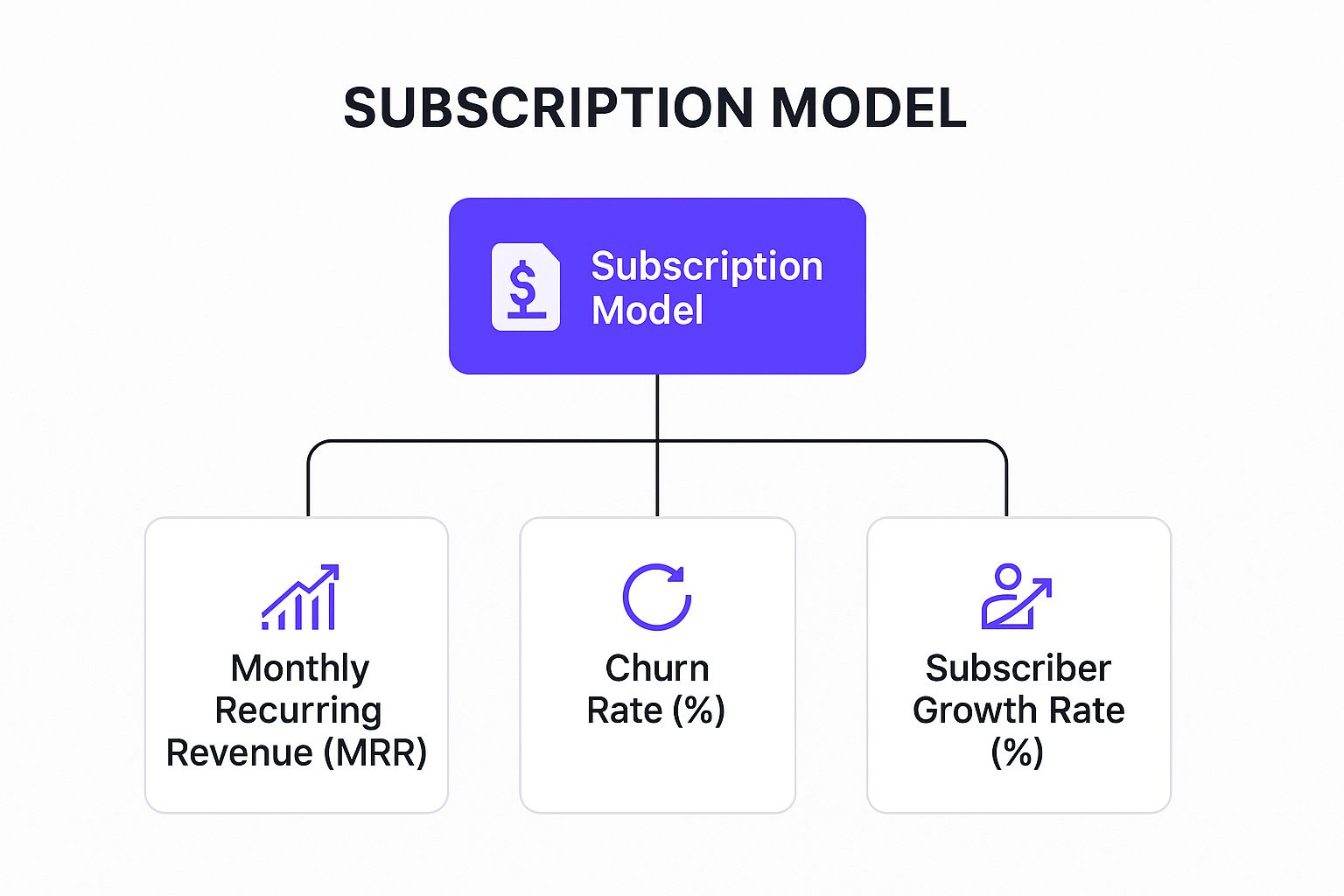
The infographic above visualizes the hierarchical relationship between the core components of a successful subscription model. At the top, we have the overarching goal: Recurring Revenue. This is supported by two key pillars: Customer Retention & Acquisition, and Value Delivery. Under Customer Retention & Acquisition, we see tactics like personalization and exclusive offers. Value Delivery is further broken down into convenient replenishment, curated experiences, and member benefits. Finally, at the base, we see the metric that ties it all together: increased Customer Lifetime Value.
As the infographic illustrates, a successful subscription model hinges on providing consistent value to the customer while simultaneously simplifying their lives. This value can come in various forms depending on your product and target audience.
For e-commerce businesses already generating substantial revenue, like those doing $20k-$60k per month, subscriptions offer a way to scale predictably. Imagine knowing roughly how much revenue you'll generate next month. This predictability allows for better inventory management, more effective marketing campaigns, and ultimately, more informed business decisions. For Etsy shop owners hitting $10k+ monthly, subscriptions can turn one-time buyers into loyal subscribers, increasing customer lifetime value and stabilizing income.
Examples of successful subscription models:
- Product Replenishment: Dollar Shave Club revolutionized the razor industry and Amazon's Subscribe & Save program provides discounts on recurring essentials. This is a great option for consumable products.
- Curated Boxes: Birchbox (beauty) and HelloFresh (meal kits) offer curated experiences, introducing customers to new products and removing the hassle of decision-making. Perfect for Etsy shops offering craft supplies, beauty products, or even specialty food items.
- Membership Programs: Thrive Market provides exclusive access to natural grocery products at discounted prices through its membership model. This fosters a sense of community and loyalty.
Features to consider implementing:
- Flexible subscription options: Offer different frequencies, quantities, and the ability to skip deliveries.
- Tiered subscriptions: Create different levels of membership with varying benefits.
- Subscriber-exclusive products or pricing: Reward subscribers with special offers.
- Customer account management portals: Empower subscribers to manage their subscriptions easily.
Pros:
- Predictable recurring revenue: Stabilizes income and improves forecasting.
- Increased customer lifetime value: Subscribers typically spend more over time.
- Enhanced customer relationships: Regular engagement fosters loyalty.
Cons:
- Higher initial acquisition costs: Attracting subscribers can be expensive.
- Churn management: Requires strategies to retain subscribers.
- Robust systems: Need reliable billing and customer management software.
Actionable Tips for Implementation:
- Offer a clear value proposition: Highlight the benefits of subscribing over one-time purchases.
- Seamless onboarding: Make the signup process easy and intuitive.
- Proactive churn prevention: Implement strategies to identify and address potential churn.
- Personalization: Use customer data to tailor the subscription experience.
When and Why to Use Subscriptions:
Subscription models are best suited for products that are consumed regularly or offer ongoing value. If you're looking to build a predictable revenue stream, increase customer lifetime value, and create a loyal customer base, then subscriptions are worth exploring. This strategy is particularly effective for e-commerce businesses that have established some traction and are looking to scale in a sustainable way. It allows you to capitalize on your existing customer base and maximize their long-term value. Remember, a successful subscription model relies on providing consistent value and a frictionless customer experience.
8. International E-commerce Expansion
Want to supercharge your e-commerce growth? Look beyond your borders! International e-commerce expansion is a powerful growth strategy that involves strategically tapping into global consumer demand by entering new geographic markets. This opens up a world of opportunities to significantly expand your total addressable market and diversify your revenue streams. It's a key component of robust e-commerce growth strategies, especially for businesses already experiencing domestic traction.
For Etsy shop owners hitting $10k/month, established e-commerce stores in the $20k-$60k/month range, or anyone with a solid product and proven market fit, international expansion can be a game-changer. While you might be comfortable with your current success, reaching international customers can unlock exponential growth and reduce your reliance on a single market.
How it Works:
International e-commerce expansion requires more than just translating your website. It involves adapting your entire business model to cater to the nuances of each target market. This includes:
- Multi-language and multi-currency store capabilities: Offering your store in the local language and currency creates a more welcoming and trustworthy experience for international customers.
- International payment gateway integration: Accepting preferred payment methods in each region (beyond just credit cards) is crucial for conversion.
- Cross-border logistics and fulfillment solutions: Efficient and cost-effective shipping is paramount. Consider localized fulfillment centers for key markets.
- Country-specific domains or storefronts: This can improve SEO and build trust.
- Localized marketing and content strategies: Adapt your messaging and imagery to resonate with local cultural contexts.
- Tax and regulatory compliance management: Navigating international tax laws and regulations is complex and requires careful planning.
- International customer support: Offering support in local languages and across time zones is essential.
Examples of Success:
- ASOS: Expanded from the UK to become a global fashion retailer serving 200+ countries.
- Gymshark: Successfully expanded from the UK to the US and beyond, becoming a global fitness brand.
- iHerb: Grew into 150+ countries by providing localized experiences.
- Allbirds: Strategically expanded into targeted international markets with great success.
- SHEIN: Achieved rapid global expansion through highly efficient cross-border operations.
Pros:
- Expands total addressable market significantly: Reach millions of new potential customers.
- Diversifies revenue across different economies: Reduces dependence on a single market.
- Can extend product lifecycles: Products nearing the end of their lifecycle in one market might thrive in another.
- Potential for higher margins in less competitive markets: Capitalize on first-mover advantage.
- Access to new customer segments and use cases: Discover new ways your product is being used and adapt your offerings accordingly.
Cons:
- Complex regulatory and tax compliance requirements: Navigating international laws can be challenging.
- Language and cultural adaptation challenges: Effective localization requires careful research and investment.
- Higher shipping costs and delivery times: Cross-border shipping can be expensive and time-consuming.
- Payment processing complexities: Integrating with multiple payment gateways and managing currency fluctuations can be complex.
- Customer service across time zones and languages: Providing effective support can be logistically challenging.
Actionable Tips:
- Research: Thoroughly research market-specific preferences and regulations before entering.
- Start Small: Begin with English-speaking or culturally similar markets for an easier initial expansion.
- Localize Fulfillment: Consider localized fulfillment centers for key markets to improve delivery times and reduce costs.
- Adapt Marketing: Tailor your marketing messaging and imagery to resonate with local cultural contexts.
- Offer Preferred Payment Methods: Don't limit yourself to credit cards. Research preferred payment options in each target market.
- Landed Pricing: Be transparent about all costs by implementing landed pricing, which shows import fees and taxes upfront.
- Partner with Experts: Consider partnering with local experts or utilizing market entry services for complex regions.
- Test the Waters: Use geotargeted campaigns to test market potential before committing to a full-scale launch.
Popularized By:
Solutions like Amazon Global, Shopify Markets, Global-e, BigCommerce, and Flow Commerce (acquired by Global-e) provide tools and resources to facilitate international e-commerce expansion.
International expansion is not a quick fix, but a strategic investment in long-term growth. By carefully planning and executing your expansion strategy, you can tap into a world of opportunity and propel your e-commerce business to new heights. This approach deserves a place in any list of e-commerce growth strategies because it offers significant potential for scaling your business and reaching new levels of success.
9. Customer Retention and Loyalty Programs
One of the most potent e-commerce growth strategies, especially for established businesses like yours doing $20k-$60k per month, is focusing on customer retention and loyalty. Why chase new customers constantly when you can cultivate a dedicated base of repeat buyers? This approach is all about maximizing the value of your existing customers – turning one-time shoppers into loyal brand advocates. And it’s a strategy that directly impacts your bottom line. Bain & Company research shows that even a small 5% increase in customer retention can boost profits by a staggering 25-95%. This makes loyalty programs a far more cost-effective e-commerce growth strategy compared to the continuous acquisition of new customers.
How it Works:
Customer retention and loyalty programs work by rewarding customers for repeat purchases and engagement with your brand. This can take many forms, from simple points systems to elaborate tiered structures with exclusive perks. The core idea is to create a sense of community and appreciation, making customers feel valued and incentivized to return.
Features to Consider:
- Points-based loyalty programs: A classic approach where customers earn points for every purchase, redeemable for discounts or rewards.
- Tiered membership structures: Offer escalating benefits as customers spend more, creating a sense of progression and exclusivity.
- Exclusive access and early product releases: Reward loyal customers with sneak peeks and first dibs on new items.
- Personalized rewards: Tailor rewards based on individual customer purchase history and preferences.
- Gamification: Introduce game-like elements like missions, challenges, and badges to increase engagement and fun.
- Referral incentives: Encourage your happy customers to spread the word by rewarding them for bringing in new business.
- Customer win-back campaigns: Re-engage lapsed customers with targeted offers and personalized messaging.
- Post-purchase engagement sequences: Nurture customer relationships after a purchase with thank you notes, product recommendations, and valuable content.
Pros:
- Increases Customer Lifetime Value (CLTV): Repeat customers typically spend 5-25x more than a one-time buyer.
- Lower Acquisition Costs: Retaining a customer is 5-25x cheaper than acquiring a new one.
- Predictable Revenue: Repeat purchases create a more stable and foreseeable revenue stream.
- Valuable Feedback: Loyal customers are more likely to provide valuable product insights and feedback.
- Brand Advocacy: Loyal customers become natural brand ambassadors, driving word-of-mouth referrals.
- Competitive Edge: Loyalty programs provide a defense against competitive offers and price wars.
Cons:
- Program Costs: Implementing and maintaining a loyalty program can involve costs related to technology, rewards, and management.
- Discount Dependency: Over-reliance on discounts can train customers to only purchase during sales.
- Differentiation Challenge: Creating a truly unique and memorable loyalty experience can be difficult.
- Program Complexity: Overly complex programs can confuse customers and hinder participation.
- Maintaining Engagement: Keeping the program fresh and engaging over the long term requires ongoing effort.
- Data Management: Collecting and managing customer data responsibly requires adherence to privacy regulations.
Examples of Successful Implementations:
- Sephora's Beauty Insider: This tiered program boasts over 25 million members and offers escalating benefits like exclusive products, birthday gifts, and personalized experiences.
- REI's Co-op Membership: A one-time fee grants lifetime benefits, including discounts, dividends, and access to special events.
- Amazon Prime: This subscription-based model bundles various perks like free shipping, streaming services, and exclusive deals, creating immense customer loyalty.
- Starbucks Rewards: This mobile-first program incorporates gamification elements, rewarding customers with stars for every purchase, redeemable for free drinks and food.
Tips for Etsy Shop Owners and E-commerce Businesses:
- Focus on High-Value Behaviors: Reward actions that contribute most to your business goals, such as repeat purchases, referrals, and reviews.
- Balance Transactional and Experiential Rewards: Offer a mix of discounts, points, and exclusive experiences to cater to different customer preferences.
- Triggered Communications: Implement automated email sequences for key moments like birthdays, anniversaries, and abandoned carts.
- Clear Progression Pathways: Make it easy for customers to understand how to earn points and advance to higher tiers.
- Personalization: Use customer data to tailor rewards and offers based on individual preferences and purchase history.
- Analyze and Optimize: Regularly track program performance and make adjustments to maximize ROI.
- Attainable Rewards: Ensure rewards are valuable but not so difficult to earn that customers lose motivation.
- Create Exclusivity: Offer member-only products or early access to new releases to make your loyal customers feel special.
Why This Deserves a Spot on the List:
For Etsy shop owners doing over $10k/month and e-commerce businesses in the $20k-$60k/month range, customer retention is crucial for sustainable growth. A well-designed loyalty program can significantly increase customer lifetime value, reduce acquisition costs, and build a strong community of brand advocates. By fostering lasting relationships with your customers, you'll create a solid foundation for long-term success in the competitive e-commerce landscape.
10. Conversion Rate Optimization (CRO)
For e-commerce businesses already seeing some traction—like Etsy shops doing $10k+/month or online stores bringing in $20k-$60k/month—Conversion Rate Optimization (CRO) is a powerful lever for growth. It's about squeezing more value from the traffic you already have, rather than constantly chasing new visitors. Think of it as fine-tuning your engine for maximum performance. Instead of pouring more fuel (traffic) into a leaky engine, you're fixing the leaks so that every drop counts.
CRO is a systematic, data-driven approach to improving your website's performance. Instead of relying on guesswork, you use data to understand visitor behavior and identify areas for improvement. The goal? To increase the percentage of visitors who complete desired actions—purchases, sign-ups, adding items to their cart, etc. This is achieved through iterative improvements, constantly testing and tweaking different elements on your site.
How CRO Works:
CRO leverages a variety of techniques, including:
- Structured A/B and Multivariate Testing: This is the cornerstone of CRO. You create different versions of a webpage (e.g., different headlines, images, button colors) and test them simultaneously to see which performs best. Multivariate testing takes this further, testing multiple variations of multiple elements at once.
- User Behavior Analysis: Tools like heatmaps and session recordings allow you to see how visitors interact with your site. Where do they click? Where do they get stuck? This insight reveals friction points in the customer journey.
- Customer Journey Mapping: Visualizing the steps a customer takes, from initial awareness to purchase, helps identify potential drop-off points and areas for optimization.
- Qualitative Research: Surveys, user interviews, and usability testing provide valuable qualitative data to understand why visitors behave the way they do.
- Abandoned Cart Recovery Optimization: Strategies to recapture lost sales by reminding customers about items left in their cart.
- Landing Page and Product Page Conversion Improvements: Optimizing these key pages for higher conversion rates. This often includes improvements to copywriting, imagery, calls to action, and overall page design.
- Checkout Flow Optimization: Streamlining the checkout process to reduce friction and encourage completion.
Examples of CRO in Action:
- Booking.com: Famous for running thousands of A/B tests simultaneously, constantly optimizing everything from button placement to wording.
- ASOS: Increased add-to-cart rates by 50% simply by changing the layout of their product pages.
- Zalando: Achieved 15% higher conversions by offering personalized size recommendations.
Why CRO Deserves Its Place in Your Growth Strategy:
For businesses at your stage, CRO is a game-changer because:
- Maximizes Existing Traffic: You're getting more out of the traffic you've already worked hard to acquire. Improvements of 50-200% in conversion rates are not uncommon.
- Compounds Over Time: As you implement successful changes, the gains accumulate, creating a snowball effect.
- Data-Driven Decisions: CRO replaces guesswork with hard data, showing you what actually works, not just what you think works.
- Improves Customer Experience: By reducing friction and making your site easier to use, you improve the customer experience while increasing conversions.
- Cost-Effective: Compared to traffic acquisition, CRO often requires a more modest investment.
Pros and Cons:
Pros: Maximizes value from existing traffic, creates compounding returns, data-driven decisions, improves customer experience, cost-effective.
Cons: Requires sufficient traffic for statistically significant results, needs skilled analysts, testing tools add costs, potential for cultural resistance to data-driven decisions.
Tips for Getting Started:
- Start Small, Focus Big: Begin with high-traffic, high-impact pages like your homepage, top product pages, and checkout flow. Focus on the biggest potential wins first (value proposition, main CTA, forms).
- Prioritize Wisely: Base your tests on potential impact, implementation effort, and confidence level.
- Use Both Quantitative and Qualitative Data: Analytics tell you what is happening, while user feedback tells you why.
- Test Meaningful Changes: Don't waste time on minor tweaks. Focus on substantial changes for larger impacts.
- Document Everything: Keep detailed records of your hypotheses, results, and learnings.
CRO is not a one-time fix, but an ongoing process of continuous improvement. By embracing a data-driven approach and consistently testing and optimizing your website, you can unlock significant growth potential without necessarily increasing your marketing spend.
E-Commerce Growth Strategies Comparison
Level Up Your E-Commerce Game
From optimizing your customer's mobile experience to expanding into new marketplaces and nurturing loyalty through recurring revenue models, the e-commerce growth strategies we've covered provide a roadmap for significant expansion. Mastering core elements like personalization, SEO, and a strong omnichannel presence can fundamentally reshape your business trajectory. Remember, conversion rate optimization (CRO) is an ongoing process of refinement, and integrating social commerce expands your reach to new customer bases. Harnessing the power of these strategies allows you to not just survive but thrive in the ever-evolving world of online retail.
To further accelerate your growth, explore these proven strategies to boost ecommerce sales and maximize your success in the competitive online marketplace. This resource from CartBoss provides additional tactics to complement the strategies outlined in this article.
Taking your e-commerce business to the next level requires a strategic approach. By focusing on these key areas, you're not simply increasing sales; you're building a sustainable and resilient brand ready to capitalize on future opportunities. Ready to take your e-commerce vision and transform it into a thriving reality? Partner with Wand Websites to implement personalized e-commerce growth strategies tailored to your specific business needs and unlock your full potential. Let us help you navigate the complexities of the digital landscape and achieve lasting success in 2025 and beyond.
