
Do Facebook Ads Work for Ecommerce in 2026

So, you’re wondering if Facebook ads actually work for e-commerce. Let’s cut right to the chase: Yes, they absolutely do. But there's a huge catch.
Facebook ads can deliver incredible results, but only when you send that traffic to a website built to convert. If you’re just pointing ads to a standard marketplace page like your Etsy shop, you’re probably just lighting your money on fire.
Why Your Website is the Real Key to Ad Success
Here's the thing most people miss: the success of your ads has less to do with the ads themselves and everything to do with where you send the people who click them.
Think of your website as a high-performance race car and your Facebook ads as the rocket fuel. You can have the best fuel on the planet, but if your car has a leaky engine and flat tires, you aren't winning any races. It’s that simple.
Getting ads up and running is the easy part. The real work—the part that actually determines your success—is creating a smooth, frictionless path from the moment someone clicks your ad to the second they hit "complete purchase."
The Problem with Running Ads to a Marketplace
For many small business owners, especially those starting out on Etsy, using a marketplace feels like the safest option. But when it comes to paid advertising, these platforms create massive roadblocks that kill your return on investment.
Sending your precious ad traffic directly to a marketplace page puts you at a huge disadvantage.
To see the difference, let's compare running ads to an Etsy shop versus your own optimized website.
Ad Performance on an Etsy Page vs an Optimized Website
This table breaks down why sending ad traffic to your own site is a game-changer.
The takeaway here is clear: marketplaces just aren't built for effective paid advertising.
The bottom line: Running ads to a marketplace page is like paying to send customers to a crowded mall where your direct competitors have set up shop right next door. It's a gamble you will almost always lose.
An optimized store built on a platform like Shopify, on the other hand, puts you in the driver's seat. You get total control over the customer's journey, letting you gather priceless data, eliminate distractions, and build an experience that turns clicks into profitable, long-term fans of your brand.
How Facebook's Algorithm Finds Your Next Customer
To really get to the bottom of whether Facebook ads actually work, you first have to peek behind the curtain at the powerful engine driving everything. The Meta ad platform isn't just a digital billboard where you throw up an ad and hope for the best. It's an incredibly sophisticated matchmaking machine, built specifically to connect your products with the people most likely to buy them.
Think of the algorithm as the world's most efficient personal shopper, but instead of working for one person, it's working for your entire potential customer base. It churns through billions of data points every second—what people "like," the pages they follow, the videos they watch, and even their shopping habits. Its only job is to take the ad you've created and put it right in front of the users it predicts will be most interested.
The All-Important Learning Phase
When you launch a new ad campaign, the algorithm kicks into what’s called the learning phase. This is hands-down one of the most critical (and most misunderstood) parts of the whole process. It’s not a bug or a flaw; it's a fundamental feature.
Picture the algorithm taking a crash course on your specific customer. During this initial period, it’s actively testing your ad on different slices of your target audience to see who bites. It’s gathering crucial data on every click, every "add to cart," and every single purchase.
With each action someone takes, the algorithm gets a little bit smarter. It starts piecing together a detailed profile of your perfect buyer, then goes out and actively looks for more people just like them. This is exactly why you have to resist the urge to tinker with your ads for the first few days—you have to give the system time to learn.
This intelligent process is precisely what makes the platform so effective. It’s not just about picking a few broad interests and calling it a day. The algorithm's knack for finding hidden patterns in user behavior often uncovers new pockets of customers you would have never thought to target on your own. It's how small shops suddenly find a much bigger audience.
How Clicks and Conversions Fuel the Machine
The algorithm's performance is directly tied to the feedback it gets. Strong signals, like a high number of clicks and, more importantly, actual sales, tell the system it’s on the right track. This is where having a great product and a compelling offer becomes non-negotiable for e-commerce stores.
For example, lead generation campaigns on Facebook in 2026 are seeing an impressive average click-through rate (CTR) of 2.53%, which blows other campaign types out of the water. That's because the user's goal is crystal clear. For an e-commerce brand, this means your ad needs to do a great job of getting people excited to buy, with top-performing brands seeing their landing page view rates hit a median of 6%. You can discover more insights on Facebook ad benchmarks and see how your numbers stack up.
This data really hammers home a key point: the better your ad connects with people, the more efficiently Facebook can go find you new customers. In fact, Meta's Q4 2025 AI upgrades have already boosted ad clicks by 3.5% by getting even better at this process. The system literally rewards ads that people want to see, which is a win for everyone—users get relevant content, and you get qualified traffic knocking on your shop's door.
The Key Metrics That Actually Tell You What's Working
Diving into your Facebook Ads Manager for the first time can feel like staring at a spaceship's control panel. All those acronyms—ROAS, CPA, CTR—are a lot to take in. But don't get intimidated. These are just numbers that tell a story about whether your ads are making you money or just costing you.
Let’s cut through the jargon. Imagine you sell handmade jewelry. You decide to spend $100 on a Facebook ad, and by the end of the week, you've made five sales, bringing in $500. You don't need a data science degree to figure out if that was a good investment. You just need to know which numbers matter.
H3: ROAS: The Only Number That Proves Profitability
If you only track one thing, make it Return On Ad Spend (ROAS). This is the holy grail for any e-commerce business because it answers the most important question of all: for every dollar I spend on ads, how many dollars am I getting back?
In our jewelry example, you spent $100 and made $500. Your ROAS is a 5x ($500 in revenue / $100 in ad spend). Simple. This one number instantly tells you if your campaign is profitable. If your ROAS is below 1x, you're losing money. A 3x ROAS is often seen as a solid baseline, but what’s “good” really depends on your profit margins.
A healthy ROAS changes the entire conversation. You stop asking, "How much are we spending?" and start asking, "How much are we earning?" It’s the ultimate proof that your ads aren't just getting attention—they're actually growing your bottom line.
This metric is especially critical if you're moving from a platform like Etsy to your own Shopify store. You need to see that direct return. And in 2026, Facebook ads are still a beast for driving sales. The median purchase conversion rate from ad clicks is 2.5%, and top performers often hit 4% or more with smart retargeting and a smooth website experience. We're even seeing new AI like Meta Lattice drive a 1% conversion lift on Instagram and a 12% boost in ad quality. The potential is definitely still there. You can see more stats on modern Facebook ad performance here.
H3: CPA: How Much Are You Paying for a Sale?
Next up is your Cost Per Purchase (CPA), sometimes called Cost Per Acquisition. This one is just as straightforward: how much ad money did it take to get one person to buy something?
If you spent $100 and got five sales, your CPA is $20 ($100 ad spend / 5 sales).
Knowing your CPA is absolutely vital. Let's say your average profit on a piece of jewelry is $40. If your CPA is $20, you're pocketing a cool $20 profit from every ad-driven sale. Fantastic! But if your CPA creeps up to $45, you’re actually losing $5 on every sale. A "good" CPA is completely unique to your business and your product's profit margin.
This image shows a real-world example of how optimizing your ads can dramatically improve your results, which in turn lowers your CPA and boosts your ROAS.
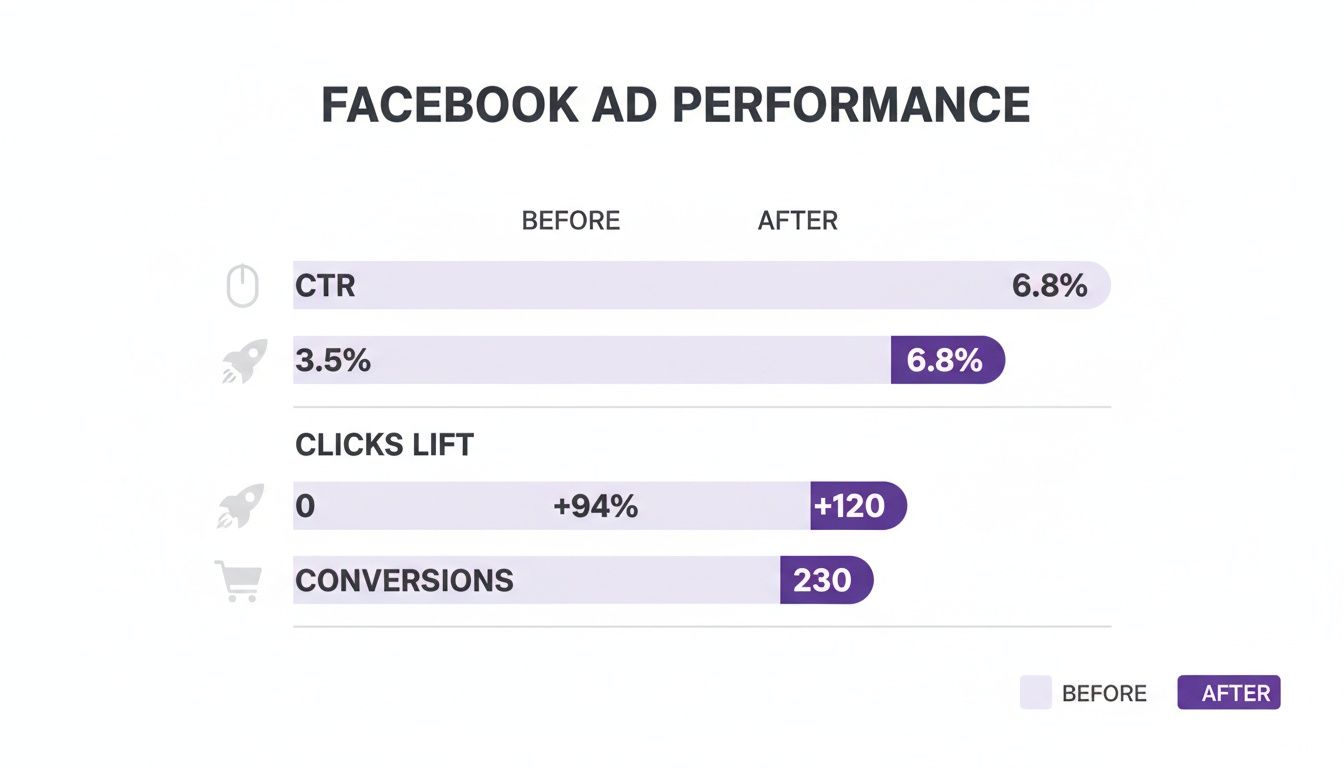
As you can see, a few smart tweaks can lead to a huge lift in what really matters: clicks and, ultimately, conversions.
H3: The Diagnostic Tools: CTR and CVR
Finally, let's talk about the two metrics that act as your diagnostic tools: Click-Through Rate (CTR) and Conversion Rate (CVR). These help you figure out why your ROAS and CPA are what they are.
Click-Through Rate (CTR): This tells you if your ad is doing its first job: stopping the scroll. It’s the percentage of people who see your ad and actually click it. For e-commerce, anything over 1.5% is a great sign that your creative and headline are resonating.
Conversion Rate (CVR): This tells you if your website is doing its job. Of all the people who clicked your ad, what percentage actually bought something? A strong CVR (aim for 2% or higher) means your landing page, product photos, and checkout process are sealing the deal.
Think of them this way: a high CTR but a low CVR usually means your ad is great, but your website has a problem. On the flip side, a low CTR points to a weak ad. By keeping an eye on both, you can stop guessing and start making targeted fixes.
Ecommerce Facebook Ad Benchmarks for 2026
To give you a clearer picture, here’s a quick rundown of what "good" looks like in the e-commerce world. These are general benchmarks, so don't panic if your numbers are a bit different—just use them as a guidepost.
Remember, these numbers are a starting point. The goal isn't just to hit a benchmark but to understand the story your own data is telling you. Once you get a feel for these key metrics, you’ll be able to confidently steer your ad campaigns toward real, measurable growth.
Your Playbook for a Winning Ad Campaign
A profitable Facebook ad campaign isn't built on luck—it's built on a solid, repeatable strategy. The real answer to "do Facebook ads work?" comes down to how well you execute a few key fundamentals. So, let's stop crossing our fingers and hoping for sales.
Instead, we're going to break down the four essential pillars that hold up every successful campaign I've ever run. Think of it like building a house: if one pillar is weak, the whole thing gets wobbly. But when all four are strong, you create a powerful, predictable engine for growth.
Pillar 1: Find the Right Audience
You could have the most gorgeous, compelling ad ever created, but if it’s shown to the wrong people, it’s going to fall flat. Every single time. Your first job is to become a master matchmaker, connecting your product with the people who need it most.
Luckily, Facebook gives us some amazing tools for this.
- Interest Targeting: This is your starting line. You can begin by targeting people based on their interests, like "handmade jewelry" or "farmhouse decor," or even fans of brands similar to yours. This helps you cast a wide but relevant net to find your first customers.
- Lookalike Audiences: Now this is where the real magic happens. You can take a list of your past customers (or even just website visitors), upload it, and ask Facebook to find millions of other users who behave and look just like them. It's easily the most powerful way to scale your ads.
The goal is to move from educated guesses (Interests) to laser-focused precision (Lookalikes). You use the first to get the data you need to build the second.
Pillar 2: Craft Scroll-Stopping Creative
Okay, you've found your people. Now you have to get them to stop their mindless scrolling and actually pay attention. Your creative—the images, videos, and words in your ad—is your one shot to grab them.
In 2026, authenticity is everything. Slick, over-produced corporate ads just get ignored. What really works is content that feels genuine and relatable.
User-Generated Content (UGC) is your absolute secret weapon. A simple iPhone video from a happy customer unboxing your product will almost always outperform a polished studio ad. Why? Because it’s real, and it builds instant trust and social proof.
Your ad copy needs to tell a story, not just list product features. Hook them with a relatable problem, show them how your product is the solution, and give them a clear, simple next step. You're not writing an ad; you're starting a conversation. If you want a leg up, seeing what’s already working for others is a huge advantage. Using the best Facebook Ads spy tools for 2026 can give you incredible insight into your competitors' winning strategies.
Pillar 3: Perfect the Customer Journey
The ad is just the beginning. What happens after someone clicks is just as crucial, if not more so. You paid for that click, so you need to make sure the experience on the other side is smooth, trustworthy, and guides them toward a purchase. We call this the sales funnel, or the customer journey.
A solid funnel usually has three main parts:
- The Ad: This gets their attention and earns the click.
- The Landing Page: Your product page needs to seal the deal. This means great photos, a clear description that solves a problem, customer reviews, and a big, obvious "Add to Cart" button.
- The Checkout: Make this part as painless as possible. Don't force people to create an account and offer multiple ways to pay. Fewer clicks mean fewer abandoned carts.
Every step is a chance to either build their confidence or create friction. Your job is to spot and remove every single roadblock between their initial curiosity and a completed order.
Pillar 4: Use a Smart Budgeting Strategy
Finally, let's talk about the money. You need a smart plan for your ad spend to get the biggest bang for your buck. Stop thinking of it as "spending" money and start seeing it as "investing" to acquire customers profitably.
A smart budget doesn't mean throwing cash at the wall. It means starting small—usually around $20-$50 per day—to test which audiences and ads are actually working.
Once you find a winning combination that brings in sales at a profitable Cost Per Purchase (CPA), you then begin to carefully increase the budget on that specific ad set. The entire game is about scaling what works and quickly turning off what doesn't, making sure every dollar you invest is pulling its weight.
From Etsy Success to Ecommerce Powerhouse
All the theory in the world doesn't mean much until you see it in action. So, let’s talk about a real brand, a story I see play out all the time. We'll call them "The Gilded Fern," an artisan home decor shop that was absolutely crushing it on Etsy. They had a devoted following and a solid income—a true marketplace success story.
But they hit a ceiling. The very platform that launched their business was now holding it back. Etsy’s fees were taking a huge slice of their revenue, they had zero control over their branding, and their own product pages were cluttered with ads for "similar items" from their competitors. To truly scale, they knew they needed to own their own space online.
Making the Leap to Shopify
They knew what they had to do: build a real brand home. The Gilded Fern partnered with a team to launch their own store on Shopify, giving them total command over the customer journey. This was more than just a pretty storefront; it was their launchpad for real growth. With the new site live, the next big question was: how do we get people to show up?
This is where Facebook ads came into play. We're not talking about just boosting a few posts here. This was a strategic, multi-layered campaign built to find brand-new customers and bring their existing fans along for the ride. The strategy itself was beautifully simple.
Top of Funnel: They ran gorgeous Carousel ads showing off their latest product line. These ads were aimed at broad "lookalike" audiences built from their Etsy customer list, letting them reach thousands of new people who were a perfect fit for their brand but had never heard of them.
Mid & Bottom of Funnel: For anyone who clicked over to the new site but left without buying, they launched retargeting campaigns. These ads were smart, featuring compelling video testimonials from happy customers and a small "first-purchase" discount to gently nudge shoppers to complete their order.
At first, the results were okay, but not earth-shattering. The initial campaigns brought in a 2x Return On Ad Spend (ROAS). For every dollar they put in, they got two dollars back. Profitable? Yes. But they knew there was more potential. The ads were doing their job, but the bridge between the ad click and the final purchase was a bit shaky.
The real breakthrough didn't come from tweaking the ads. It came from focusing on what happened after the click. They completely overhauled their product pages with better photos, richer descriptions, and customer reviews placed front and center. They made it easier for people to trust them and click "buy."
The Power of Optimization
With the optimized product pages live, the numbers started to climb dramatically. Those exact same ads that were delivering a 2x ROAS suddenly took off. Within a month, their ROAS hit a staggering 4.5x. Now, every $1 they spent on ads was bringing in $4.50 in sales.
But they didn't stop there. They got even smarter, segmenting their retargeting campaigns to show complementary products and new collections to people who had already bought from them. This one move triggered a 40% increase in their repeat purchase rate. They were no longer just chasing new customers; they were building a thriving community.
The Gilded Fern’s story is the perfect example: Facebook ads absolutely work, but they work best when you’re sending that traffic to a high-powered website that’s built to convert.
Diagnosing and Fixing Underperforming Ads
There's nothing more deflating than launching a new Facebook ad campaign, checking your stats, and seeing... nothing. It’s a moment every shop owner has, and it's easy to think your money just went down the drain. But don't throw in the towel just yet.
An underperforming ad isn't a failure—it's a data point. It’s telling you exactly what to fix. Think of it like a plumbing system: your ad budget is the water flowing in, and sales are supposed to be coming out the other end. If you're not getting sales, there's a leak somewhere. Our job is to find it.
Are You Getting Clicks But No Sales?
This is the most common scenario I see, and it’s actually good news. If people are clicking your ad (meaning you have a healthy CTR), but they aren't buying on your website (a low CVR), the ad itself isn't the problem. The leak is happening after the click.
This means you need to take a hard look at your landing page and checkout process.
- Product Page Mismatch: Does your product page deliver on the promise of your ad? The images, the description, and the price should all feel like a natural next step. Make sure you have plenty of high-quality photos and showcase customer reviews to build instant trust.
- Surprise Shipping Costs: This is the #1 killer of conversions. If a customer is hit with an unexpected shipping fee at the very end, they’ll leave. Be upfront about your shipping costs on the product page itself.
- A Frustrating Checkout: Is buying from you a pain? If you ask for too much information or force people to create an account, you'll lose them. Simplify your checkout and offer express options like Shop Pay or PayPal.
Fixing these on-site issues is often where you'll find the biggest wins. You’re not just patching a leak; you're making your entire store more profitable.
Is Your Click-Through Rate Too Low?
What if the problem is that no one is even clicking your ad in the first place? A low Click-Through Rate (CTR), especially anything under 1%, is a clear sign that your ad isn't grabbing attention in the newsfeed. The leak is the ad itself.
This usually points to one of two things: your ad creative is weak, or your audience has seen it too many times.
Ad fatigue is real. No matter how great an ad is, it will stop working eventually. Once you see your CTR start to drop while your costs climb, you know your audience is tired of seeing the same ad. It's time for a refresh.
And I don't mean just changing the button color. You need to test completely new ideas.
- Switch from a static image to a customer testimonial video.
- Write a totally new headline that focuses on a different benefit.
- Run your polished brand photos against authentic, user-generated content (UGC) and see what wins.
Troubleshooting your ads isn’t a guessing game. It's a process of elimination. Start with your key metrics—CTR and CVR—to figure out where things are going wrong. Is it the ad or the website? Once you know where the leak is, you can make a targeted fix and get your campaign back on track.
Got Questions About Facebook Ads? Let's Clear Things Up.
Even after you've mapped out a plan, it's totally normal to have some nagging questions. Let's tackle the big ones we hear all the time from shop owners who are wondering if Facebook ads can really work for them.
How Much Should I Actually Spend on Facebook Ads?
There isn't a single magic number here, but a good rule of thumb is to aim for 10-20% of your monthly revenue. But don't let that big number scare you! You absolutely don't need a massive budget to get started. Many businesses start seeing real traction with as little as $20-$50 per day.
The trick is to start small, see what sticks, and then pour your profits back into the ads that are working. Stop obsessing over the total amount you're spending and focus on your Cost Per Purchase (CPA). Think of it this way: if your product sells for $150, it costs you $50 to make, and your CPA is $30, you just pocketed a $70 profit from that single ad. Once you've got a profitable campaign, you can scale your budget with confidence.
How Long Until My Facebook Ads Start Working?
This is where patience really pays off. Every new ad campaign goes through a "learning phase" that usually lasts about 3-7 days. During this time, Meta's algorithm is busy crunching data, trying to figure out who your perfect customer is.
You might see a few sales trickle in, but your results will probably be a bit all over the place. It's so important to let a new campaign run for at least a week or two before you jump in and start changing things. One of the most common mistakes we see is people panicking and turning off their ads too soon.
You have to give the algorithm time to learn. It needs data to find your people, and if you keep making changes too early, you're just resetting the process and burning through your budget.
Do I Need Professional Photos and Videos for My Ads?
Nope, definitely not! In fact, the exact opposite is often true. Overly polished, slick creative can scream "ADVERTISEMENT!" and cause people to scroll right on by. In 2026, authenticity is everything.
Often, it's the genuine, lo-fi content that grabs attention and gets the sale. A simple video you shot on your smartphone showing off your product can work wonders. Even better? User-generated content (UGC). These are real photos and videos from your happy customers (just be sure to get their permission!). This kind of content acts as instant social proof and builds a level of trust that studio shots just can't match.
Can I Run Ads Successfully Without My Own Website?
Technically, you can run ads that point to an Etsy shop or an Amazon page, but for any serious e-commerce brand, we strongly advise against it. You're essentially setting yourself up for failure and a poor return on your money.
When you send your ad traffic to a marketplace, you lose all control.
- You can't install the Meta Pixel: Without it, you’re flying blind. You have no way to track sales accurately, let Meta optimize for conversions, or even know which ads are driving results.
- You can't retarget visitors: This is a huge loss. You miss out on showing ads to people who visited your page but didn't buy—one of the most profitable strategies out there.
- You can't control the experience: Your product is sitting right next to your competitors, and you have zero say in the branding or checkout process.
Running ads without your own website is like trying to fill a leaky bucket with water. You'll lose most of your investment before it ever has a chance to become a sale.
Ready to stop sending your hard-earned traffic to a marketplace and start building a real, profitable brand? Wand Websites specializes in creating high-performing Shopify stores designed to turn ad clicks into loyal customers. Let us handle the technical side so you can focus on growth. Get your conversion-focused website today.
