
Build a Conversion Optimized Website Moving from Etsy to Shopify

So, what exactly is a conversion-optimized website? Think of it less like a digital catalog and more like your best salesperson, working 24/7. It’s an online store where every single element—from the hero image on your homepage to the color of the "Add to Cart" button—is intentionally designed to guide a visitor toward making a purchase.
From Marketplace Hustle to Your Own Brand
Making the jump from Etsy to your own Shopify store is a huge, exciting move. You're graduating from being a renter in a bustling, crowded marketplace to owning your very own piece of digital real estate. This transition isn't just about changing platforms; it's a complete mindset shift.
On Etsy, you played by their rules and relied on their built-in traffic and rigid templates. Now, you’re in the driver's seat. You get to design the entire customer experience from the moment they land on your site to the final "thank you for your order" page.
This is where understanding conversion rate optimization (CRO) becomes absolutely essential. It's the art and science of tweaking your website to get more visitors to take that final step and buy something. It’s all about turning casual browsers into loyal customers.
Why Conversion Optimization Matters Now More Than Ever
Without a sharp focus on conversions, you're essentially flying blind. You could have the most beautiful store in the world, but if nobody buys anything, it's just an expensive hobby.
The hard truth is that the average website conversion rate across all industries hovers around a modest 2.9%. But here's the good news: top-performing e-commerce stores can hit rates over 11.45%. That massive gap shows just how much room there is to grow when you get serious about optimization.
The biggest advantage of owning your website is owning your data. Every click, every scroll, every abandoned cart tells a story. This direct feedback from your customers is your single most powerful tool for growth—a level of insight you could only dream of on Etsy.
This map helps visualize how all the pieces of a conversion-focused website fit together, connecting the customer's journey, your site's design, and ultimately, your sales.
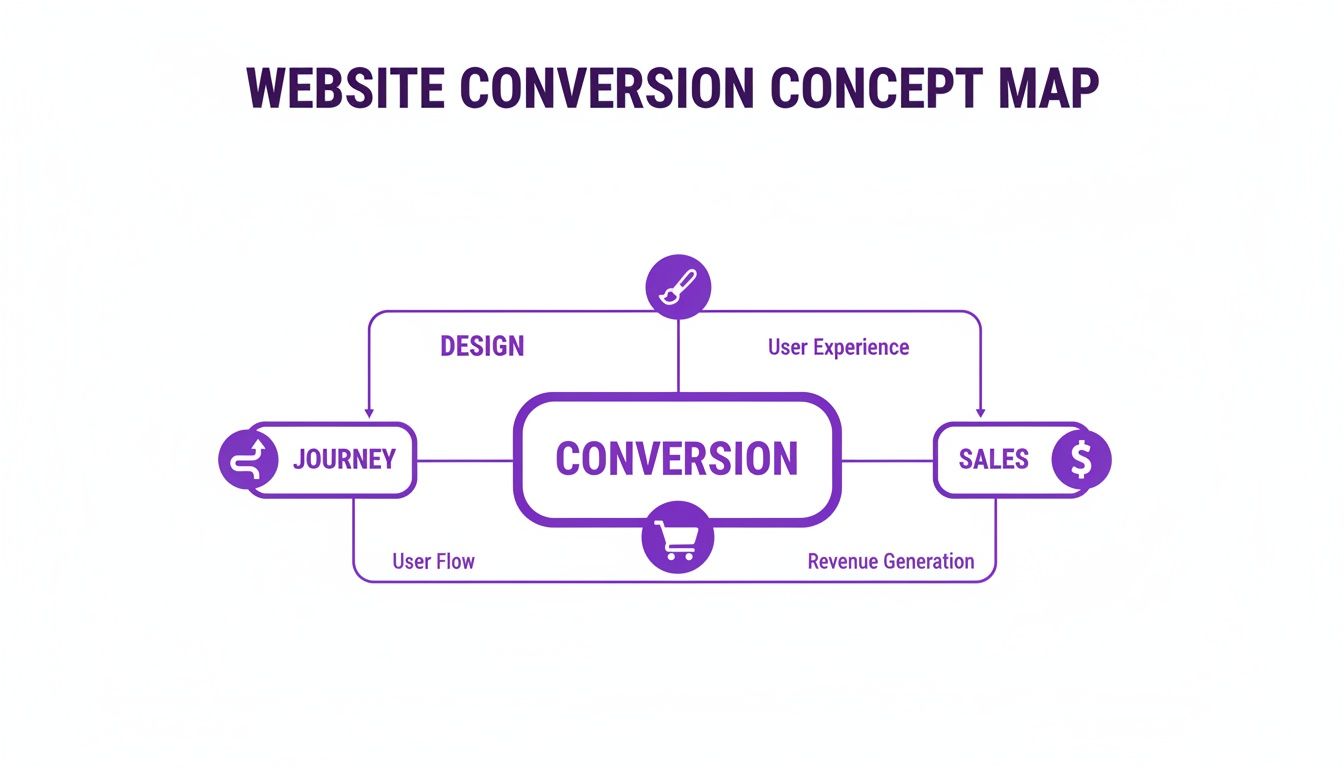
As you can see, a smooth user journey and thoughtful design aren't just "nice-to-haves"—they directly impact your bottom line.
Here's a quick look at the core pillars of a high-converting e-commerce store, comparing the control you had on Etsy versus the freedom you now have on Shopify.
Key Elements for a High-Converting Shopify Store
Ultimately, moving to Shopify puts the power to build a truly effective, sales-generating machine squarely in your hands.
If you're mapping out your journey to build an independent online brand, this guide on How to Start an Online Jewelry Store is an incredible resource, even if you don't sell jewelry. It covers the foundational steps from finding your niche to sourcing products, giving you a solid blueprint for a store that not only looks amazing but actually converts.
Designing a User Experience That Builds Trust
Think of your website's design as your brand-new digital storefront. For customers coming over from Etsy, you want it to feel just as welcoming and easy to explore. A great design isn’t just about looking pretty; it’s about creating a user experience (UX) that makes people feel comfortable and confident enough to pull out their wallets.
The whole point is to make your brand feel instantly professional and trustworthy, guiding visitors smoothly from browsing to buying.
This all starts with picking the right Shopify theme. Don't just go for looks. Dig into themes praised for their speed and mobile responsiveness. Nothing kills a sale faster than a clunky mobile site, especially when more than half of your shoppers are likely browsing on their phones. Your theme is the bedrock of your entire user experience, so choose wisely.
With a solid theme in place, your next job is to make your site ridiculously easy to navigate. A customer should never have to hunt for your bestsellers, your contact page, or your shipping info. Put yourself in their shoes: what’s the very first thing they’d look for? Make it obvious.
Create a Clear Visual Identity
Your brand’s personality needs to hit you the second the homepage loads. This is your big chance to carve out your own space and build an identity that’s way more memorable than a sea of Etsy listings.
- Consistent Branding: Stick to a defined color palette, a couple of core fonts, and a sharp, high-quality logo everywhere. This cohesion sends a powerful subconscious signal: you’re a serious, professional business.
- High-Quality Imagery: Let’s be real—your product photos are everything. They need to be top-notch, showing your items in their best light and telling a bit of a story. Blurry, poorly lit, or inconsistent photos scream "amateur" and can erode trust in a heartbeat.
- Clear Value Proposition: Your homepage needs to answer three questions in about five seconds: What do you sell? Who is it for? And why should I buy it from you? A punchy, clear headline can do all the heavy lifting.
This kind of visual consistency makes your brand feel intentional and reliable, which is a huge part of building a site that converts.
Strategically Place Trust Signals
Trust signals are those little visual cues that tell a shopper, "Hey, it's safe to buy here." Etsy has this trust built-in, but on your own site, you have to earn it from scratch. Sprinkling these signals throughout your site—especially on product pages and at checkout—can be the difference between an abandoned cart and a completed sale.
A study by the Baymard Institute revealed something pretty stark: 17% of shoppers ditched their cart in the last quarter just because they “didn’t trust the site with their credit card information.” That’s a lot of lost sales that could have been saved.
Weave these elements into your design to give shoppers peace of mind:
- Customer Reviews and Testimonials: Don't hide your glowing reviews! Showcase them right on your homepage and, of course, on every product page. Nothing builds confidence like seeing photos and hearing from other happy customers.
- Security Badges: Display those familiar logos like Shopify Secure, PayPal, or your credit card processor's badge. The footer and checkout page are perfect spots for these.
- Clear Policies: Your shipping, return, and privacy policies need to be super easy to find. Burying this stuff is a classic red flag for online shoppers.
By focusing on a clean, fast, and trustworthy experience, you make the leap from Etsy feel like a natural next step for your customers. To really get into the weeds of boosting your site's performance, check out this in-depth guide to improve ecommerce conversion rates. It’s often these small, thoughtful details that have the biggest impact, turning curious visitors into loyal buyers.
Crafting Product Pages That Compel Customers to Buy
If you’re coming from Etsy, you know the product page template is pretty rigid. Well, get ready for some good news. On your own Shopify store, you have complete creative freedom, and that’s a massive advantage for boosting sales. Think of your product pages as the heart of your conversion-optimized website—they are your 24/7 digital sales pitch for every single item you offer.
This is the exact moment a casual browser decides to become a paying customer. Your job is to get ahead of their questions, calm any hesitations, and make clicking that "Add to Cart" button feel like an easy, no-brainer decision. Every single element, from your photos right down to your return policy, has a role to play here.
Write Descriptions That Sell the Outcome
Back on Etsy, your descriptions were likely all about the features—dimensions, materials, and how long shipping would take. That information is still important, of course, but your new Shopify pages need to lead with the benefits.
Instead of just stating a necklace is "made with sterling silver," paint a picture of how its lightweight, hypoallergenic quality makes it "perfect for all-day wear without any irritation."
What problem does your product solve? What feeling does it create? Is it a handcrafted mug that turns a rushed morning coffee into a cozy ritual? Or is it a piece of art that makes a boring wall the new centerpiece of a room? You need to build your descriptions around those outcomes.
This isn’t just about adding a few flowery words; it’s about building trust by showing real value. It might seem counterintuitive, but long-form landing pages can actually generate up to 220% more leads than shorter versions. The same idea applies here. To dig deeper into how content length can affect conversions, you can discover more insights about conversion rate optimization statistics.
Showcase Your Product with Stunning Visuals
When a customer can't physically pick up your product, your photos and videos have to do all the heavy lifting. This is one area you absolutely cannot afford to skimp on.
- Invest in Pro-Level Photography: You need high-resolution images that show your product from every conceivable angle. Get close-ups of the details and texture. Most importantly, include "in-use" lifestyle shots that help customers see the product in their own lives.
- Embrace Short-Form Video: A quick 15-second clip of a piece of jewelry being worn or a vase being styled on a shelf can communicate more than a dozen static photos ever could. Video brings your product to life.
These visuals aren't just pretty decorations; they're essential conversion tools. They answer unspoken questions about size, scale, and feel, which helps eliminate the uncertainty that makes people hesitate to buy.
Build Unshakable Trust with Social Proof
Let’s be honest: nothing sells a product better than a happy customer. On Etsy, reviews were a built-in feature. On Shopify, you have to be deliberate about weaving them into your pages to build that same level of credibility.
Your product page is not complete without authentic social proof. It’s the digital equivalent of a friend’s recommendation, and it’s one of the most powerful persuasion tools you have.
Use a Shopify app to pull customer reviews directly onto your product pages. Go a step further and encourage customers to upload their own photos. This kind of user-generated content (UGC) is pure gold. Seeing your products in real homes, being used by real people, demolishes doubt and creates a powerful sense of community and desire.
For a shopper who's on the fence, a gallery of glowing customer photos is often the final nudge they need to confidently click "buy."
Optimizing Your Checkout to Prevent Abandoned Carts
You did it. You got a customer to find your product, fall in love with it, and click that glorious "Add to Cart" button. The sale is right there. This final step is the most critical part of your entire website, and it's also where an unbelievable number of sales simply vanish.
Even the tiniest bit of friction here can make a motivated buyer give up and leave.
I always tell people to think of their checkout like the express lane at the grocery store. If it’s confusing, slow, or asks for a bunch of unnecessary info, people will literally ditch their full cart and walk right out. Your job is to make this process as fast and painless as humanly possible.
Simplify the Path to Purchase
Long, complicated forms are the mortal enemy of a smooth checkout. Every single field you ask a customer to fill out is another chance for them to get annoyed and bounce. You have to be absolutely ruthless about cutting out anything that isn't essential for processing the order.
- Offer Guest Checkout: Never, ever force someone to create an account to buy from you. Data consistently shows that 24% of shoppers will abandon their cart if they’re forced to sign up. Let them buy as a guest, and then give them the option to save their details for next time. It’s a game-changer.
- Remove Optional Fields: Be honest with yourself. Do you really need their phone number? Are you actually going to call them? If not, get rid of that field. Every extra click is a risk.
- Use a Progress Bar: People like to know where they are in a process. A simple visual bar showing steps like "Shipping > Payment > Confirm" is a small thing that massively reduces checkout anxiety. It tells them the end is in sight.
These little adjustments create a feeling of speed and ease, which is exactly how you want customers to feel as they’re about to hand over their hard-earned money.
Eliminate Financial Surprises
Nothing kills a sale faster than an unexpected cost popping up at the last second. When a customer is ready to buy and suddenly sees the total jump because of high shipping fees or surprise taxes, you’ve broken their trust.
Surprise costs are the #1 reason for cart abandonment. Nearly 50% of shoppers point to extra fees like shipping and taxes as the main reason they bailed on a purchase.
Transparency isn't optional here; it's mandatory. Be upfront about every single cost, right from the beginning. Use Shopify’s built-in settings to show estimated shipping and tax costs directly on the cart page—long before they even click "Checkout." This simple act of honesty prevents that last-minute sticker shock and builds incredible trust.
Offer Familiar and Flexible Payment Options
Finally, make it incredibly easy for people to pay you in whatever way they prefer. The more trusted payment options you offer, the wider the net you cast. Not everyone feels comfortable typing in their credit card details on a new site, especially on a phone.
This is where integrating well-known, one-click payment gateways can seriously boost your conversion rate.
- Digital Wallets: I can't stress this enough. Enable Shop Pay, Apple Pay, and Google Pay. They let customers check out in seconds without having to dig a credit card out of their wallet.
- PayPal: A massive chunk of online shoppers live and breathe by PayPal. Just seeing that familiar blue button is a powerful trust signal that tells them your store is legitimate.
- Buy-Now-Pay-Later (BNPL): For higher-priced items, services like Klarna or Afterpay can be a huge win. They make bigger purchases feel more manageable and can push a hesitant customer over the finish line.
When you make your checkout fast, transparent, and flexible, you're not just improving a workflow. You’re showing respect for your customer's time and giving them the confidence they need to hit that "Complete Order" button.
Using Data to Continuously Improve Your Sales
Getting your Shopify store live is a huge milestone, but honestly, that's just the starting gun. Building a seriously high-performing, conversion optimized website isn’t a one-and-done task. The real magic happens when you start making small, continuous improvements based on what your customers are actually doing on your site. This data-driven mindset is what separates the stores that thrive from those that just get by.
Instead of just guessing what works, you can put your ideas to the test and let your audience tell you what they really want. This is where A/B testing becomes your new best friend.
Getting Started with Simple A/B Testing
A/B testing, also known as split testing, sounds super technical, but the core idea is incredibly simple. You just create two versions of the same page—we'll call them Version A and Version B—with one small difference between them. Then, you show each version to a different group of visitors to see which one performs better.
Think of it like a friendly competition between two ideas. Does a green "Buy Now" button get more clicks than a purple one? Does a product headline that shouts "Handcrafted Quality" convert better than one focused on "Free Shipping"?
Here are a few easy tests you can run right out of the gate:
- Headlines: Pit two different value propositions against each other on your homepage.
- Product Photos: Test a lifestyle photo versus a clean, white-background shot as your hero image.
- Button Text: See what happens when you compare "Add to Cart" against "Buy It Now."
Even tiny tweaks can deliver massive results. On average, just implementing A/B testing can boost landing page conversions by 12%. Some businesses have seen incredible gains, like one company that increased conversions by over 57% simply by simplifying their homepage to a single call-to-action. You can find more stats on these kinds of conversion wins over at Blogging Wizard.
Key Numbers to Watch in Your Analytics
Jumping into your analytics can feel like drinking from a firehose. The good news is you only need to focus on a handful of key metrics to get a clear picture of your store's health. Your Shopify Analytics and Google Analytics dashboards are about to become your command center.
Don't get lost in a sea of numbers. Your goal is to find the story behind the data. Ask yourself: "What is this metric telling me about my customers' experience?"
Get started by keeping a close eye on these essentials:
- Conversion Rate: This is the big one—the percentage of visitors who actually make a purchase. It's the ultimate report card for your store.
- Bounce Rate: The percentage of people who land on your site and leave after viewing just one page. If this number is high, it could be a red flag that your homepage isn't grabbing their attention.
- Average Session Duration: How long are people sticking around? Longer sessions usually mean they're engaged and digging through your products, which is exactly what you want.
- Conversion Rate by Traffic Source: This metric is gold. It tells you which channels (like Instagram, Google, or your email list) are sending you visitors who are ready to buy.
By checking these numbers regularly and running simple A/B tests, you’re no longer just guessing. You’re making smart, informed decisions and actively building a better, more profitable store based on real human behavior.
Common Questions About Moving to Shopify
Deciding to launch your own site is a huge, exciting step. It's also completely normal to have a ton of questions swirling around. Let's tackle some of the most common ones we hear from creators who are thinking about making the jump from Etsy.
Can I Keep My Etsy Shop Open?
Yes, you absolutely can! In fact, most sellers do, especially at the beginning. It's a smart strategy.
Think of your Etsy shop as one sales channel and your new Shopify store as your flagship. Etsy is great for discovery and can keep bringing in new customers who are browsing the marketplace. Your Shopify site, on the other hand, is your brand's home base—where you build a loyal community, control the entire customer experience, and ultimately, earn higher profit margins. The two can complement each other perfectly.
How Do I Get Traffic Without Etsy?
This is easily the biggest hurdle for sellers to wrap their heads around, but it’s also where the magic happens. Moving away from relying on Etsy's built-in traffic means you're now in the driver's seat. You get to build your own audience.
The traffic you generate yourself is far more valuable. These are visitors who are specifically seeking out your brand, not just browsing a crowded marketplace. This intent is a cornerstone of a conversion-optimized website.
You don't have to be a marketing genius overnight. Just start with a few key channels:
- Social Media: Get active where your customers are. Whether that’s creating beautiful pins on Pinterest, behind-the-scenes videos on TikTok, or building a community on Instagram, pick one or two and go deep.
- Email Marketing: This is non-negotiable. Start collecting email addresses from day one. An email list is an asset you own, and it will quickly become your most profitable way to drive sales and announce new products.
- Search Engine Optimization (SEO): Don't be intimidated by the acronym! Learning the basics of SEO helps your products show up in Google searches, bringing you free, high-intent traffic over time.
Is Moving to Shopify Expensive?
It's better to think of it as an investment rather than an expense. Yes, Shopify has a monthly subscription fee, and you might decide to buy a premium theme or a few apps to add special features.
But let's look at what you're already paying. Add up Etsy's transaction fees, listing fees, shipping fees, and those mandatory offsite ad fees. It can easily eat up a significant chunk of your revenue. On Shopify, while you have a fixed monthly cost, you keep a much bigger piece of every single sale. As you grow, this almost always works out to be more profitable. You're investing in your own brand and better margins.
We've put together a quick-reference table to answer a few more common questions we get all the time.
Hopefully, that clears a few things up! Making this move is all about taking control and building a brand that can grow with you for years to come.
Ready to build a brand that’s truly your own, without the stress of figuring it all out alone? At Wand Websites, we specialize in creating high-performing Shopify stores that turn your creative passion into a thriving business. Let us handle the technical details so you can focus on growth. Learn more about our services.
