
A Winning Content Strategy for Social Media to Boost Sales


A solid content strategy for social media is what separates the brands that sell from the ones that just scroll by. It's your game plan for turning casual viewers into paying customers. This isn't about posting randomly and hoping for the best; it's about being intentional with every single post to drive real traffic and revenue for your e-commerce store.
Laying the Groundwork for Social Media Success
So many e-commerce brands make the same mistake: they jump straight into creating content without a plan. They get excited about a new TikTok trend or a cool Instagram filter, but their feed ends up feeling scattered, and the sales just don't follow. I’ve seen it time and time again.
A powerful social media presence starts long before you ever hit "publish." It begins with some serious thinking about what you want to achieve and who you’re trying to reach.
This prep work isn't just busywork—it's the strategic foundation that sets successful brands apart. It's also smart to get a handle on the basics of targeted advertising in social media early on. Understanding how paid ads work will help you create organic content that can be easily amplified later, making your entire strategy more cohesive from day one.
Define Your Business-Focused Goals
Let's be honest: likes and comments are nice, but they don't keep the lights on. For any e-commerce brand, your social media goals have to be tied directly to your bottom line. Forget the vanity metrics and start focusing on KPIs that actually show you’re making progress toward sales.
Instead of a vague goal like "grow our following," get specific. Here are some real-world examples:
- Increase our website click-through rate (CTR) from Instagram Stories by 15% this quarter.
- Generate 50 "add-to-carts" each week from our TikTok Shop videos.
- Boost the conversion rate from our social media traffic by 2% within the next 60 days.
A goal without a measurement is just a wish. Tracking these concrete numbers tells you exactly what’s working, so you can stop guessing and start making smart, data-backed decisions.
This shift in focus turns your social media channels from a simple marketing task into a legitimate sales engine for your Shopify store.
This simple flow chart shows how these first few pieces fit together. It all starts with your goals, which then inform who you talk to and how you talk to them.
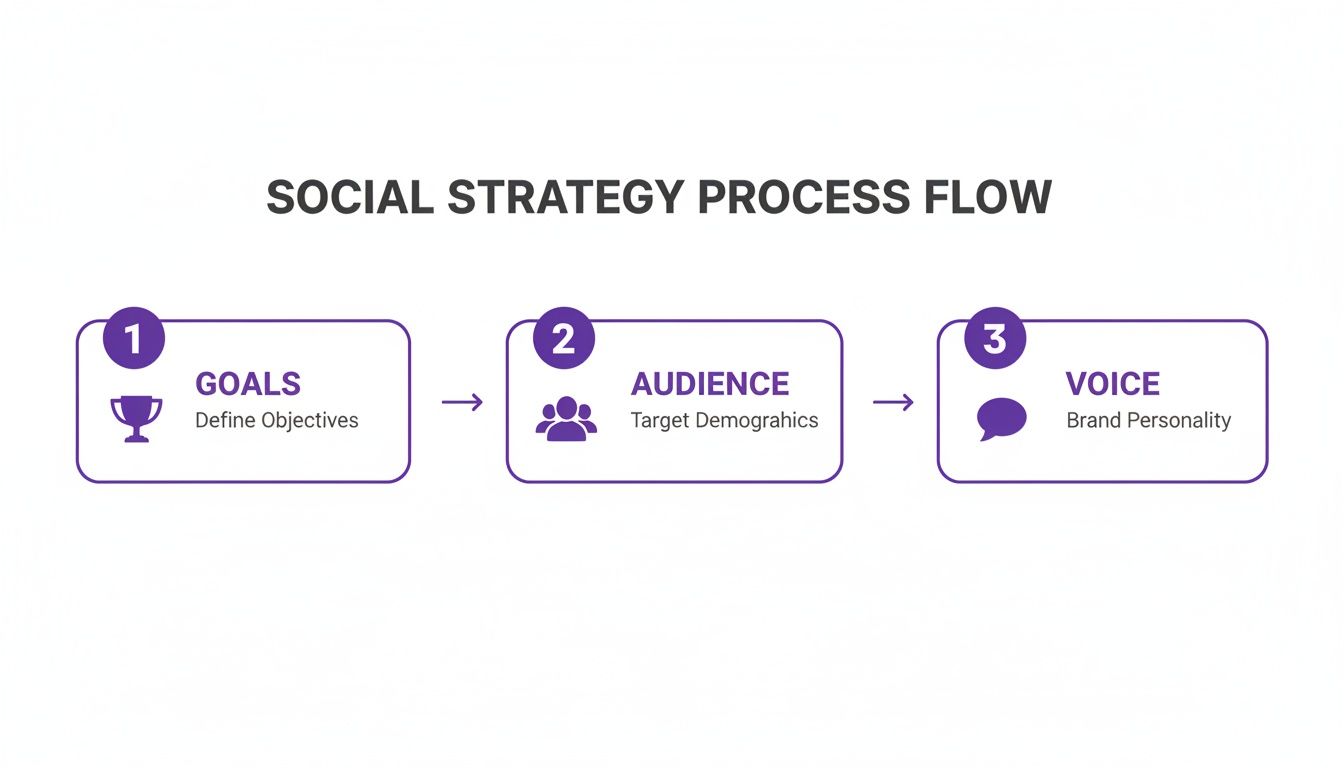
Think of these three elements—goals, audience, and voice—as the legs of the stool. If one is wobbly, the whole thing will fall over.
Understand Your Ideal Customer Deeply
Once you know what you want to achieve, you have to get crystal clear on who you're talking to. And I mean really clear. Going beyond basic demographics like age and location is non-negotiable if you want to create content that actually connects.
You need to get inside their head. Ask yourself:
- What are their real-world problems? How does your product make their day easier or better? If you sell ergonomic desk chairs, you need to feel the back pain of your customer who's been working from a dining chair for a year.
- What content do they actually consume? Are they watching quick, funny videos, or do they prefer beautifully shot, aspirational photos?
- Where do they hang out online? Are they scrolling TikTok on their lunch break or browsing Pinterest for home decor ideas on a Sunday night?
I always recommend creating a detailed customer persona. Give this person a name, a job, and some personality quirks. It might feel a little silly at first, but it makes the process so much more real. You're no longer creating content for a faceless "target market"—you're creating it for "Sarah," the 32-year-old graphic designer who loves sustainable products.
Craft an Authentic Brand Voice
Finally, let's talk about your brand voice. This is the personality your business shows the world through its captions, videos, and comments. It’s what makes you sound like you and not some faceless corporation.
Your voice should feel like a natural extension of your brand's values while also mirroring how your ideal customer communicates.
Are you witty and a little sarcastic, like a brand selling quirky graphic tees? Or are you calm and nurturing, like a company that sells all-natural baby products?
A consistent voice builds an incredible amount of trust and community. When your audience feels like they're talking to a real person, they’re so much more likely to listen, engage, and eventually, buy from you. That authenticity is the final, crucial piece that brings your entire strategy to life.
Choosing Platforms Where Your Customers Actually Shop

One of the fastest ways to burn out with social media is trying to be everywhere at once. I’ve seen so many passionate e-commerce owners spread themselves too thin across five different platforms, only to see their efforts fall flat.
A smart content strategy for social media isn't about blanketing the internet. It's about being strategic. The real goal is to show up where your ideal customers are already hanging out, ready to discover and buy products just like yours.
For most small brands, focusing on just one or two platforms is a game-changer. It lets you go deep, master the culture of that channel, and create content that genuinely connects instead of just checking a box.
Find Out Where People Are Actually Buying
The social media world changes in the blink of an eye. What worked last year is ancient history, so you have to look at what’s happening right now, especially through the lens of an e-commerce brand. Forget vanity metrics—where are people actually shopping?
The data tells a fascinating story. In 2026, TikTok's engagement rate exploded to 3.70%, a staggering 49% leap in just one year. Meanwhile, Instagram's rate was 0.48%, and Facebook's engagement dropped to a tiny 0.15%.
This is a huge deal for anyone moving from a marketplace like Etsy to their own Shopify store. You can learn more about these social media benchmarks and see how they apply to your own business, but the key takeaway is clear: each platform has its own rules for success.
To help you decide where to place your bets, here's a quick look at how the top platforms are performing for product-based businesses.
Platform Engagement Snapshot for E-Commerce in 2026
As you can see, simply posting the same photo everywhere won't work. The platform you choose dictates the kind of content you need to create to get results.
Match the Platform to Your Brand and Audience
Okay, let's get practical. The "right" platform isn't just about raw numbers—it’s about the perfect fit between your audience, your product, and the type of content you can realistically create.
Let's break down the major players.
TikTok is a goldmine for brands with a story to tell. Think behind-the-scenes, the making-of process, or fun product demos. The algorithm rewards authenticity and creativity, not a huge production budget. It's all about short, relatable videos.
Instagram is the home of visually stunning brands. If you're in fashion, home decor, beauty, or art, this is your playground. A mix of beautiful photos (Carousels are your best friend for showing off details), polished Reels, and interactive Stories works wonders here. Plus, its shopping features make it easy for users to buy directly.
Facebook, while having lower organic engagement, is still a powerhouse for specific goals. It's fantastic for brands targeting a slightly older demographic and for building tight-knit communities in Facebook Groups. Its ad platform also remains unmatched for pinpoint targeting.
A handmade jewelry brand, for instance, could go viral on TikTok by showing the intricate process of crafting a custom ring. The same brand could then use Instagram Carousels to showcase a finished collection with stunning, high-resolution photography. Each platform serves a different purpose in the customer's journey.
Think about these scenarios:
- Selling vintage clothing? Dive into Instagram and TikTok. Use Reels for stylish "lookbook" videos and TikTok to share the thrill of finding a rare piece.
- Selling custom pet portraits? Facebook and Instagram are perfect. Use Facebook Groups to connect with passionate pet owner communities and your Instagram feed as a beautiful portfolio of your work.
Choosing your core platforms is one of the most critical decisions you'll make. It sets the stage for everything that follows—your content, your tone, and ultimately, your sales. Choose wisely, focus your energy, and you'll build momentum so much faster than trying to do it all.
Designing Your Core Content Pillars and Calendar

Alright, let's get into the part of your content strategy for social media that really makes a difference. This is where you graduate from posting on a whim and start building a reliable system that actually works for you. No more staring at a blank screen wondering what to post today.
The foundation of this system is your content pillars. I recommend picking three to five core themes that feel true to your brand. These are the big-picture topics you'll talk about over and over again. Every post, Reel, or Story you create should fit neatly into one of these pillars, which is how you build a feed that feels cohesive and intentional.
This simple shift in thinking turns your social media from a digital product catalog into a genuine, multi-faceted brand experience your audience will love. Your pillars act as guardrails, keeping your content focused and always on-brand.
Building Your E-Commerce Content Pillars
For an e-commerce shop, you need a healthy mix of content that sells, educates, inspires, and builds a real community. If every single post is just yelling "buy now," people will tune you out. The right mix builds trust, and trust is what eventually leads to sales.
Let's say you run a Shopify store selling handmade, eco-friendly candles. What could your pillars look like?
Here's a breakdown I often suggest to brands like yours:
- Product in Action: This is all about showing your candles in beautiful, real-life settings. Picture them on a cozy living room mantel, next to a relaxing bubble bath, or on an elegant dinner table. You’re not just selling a candle; you're selling the vibe. This helps customers see your product in their own homes.
- Behind the Brand: People connect with people. This pillar is your chance to pull back the curtain and show the human side of your business. Film yourself pouring wax, introduce the founder (that’s you!), or share the real story of why you started. It builds an incredibly powerful bond.
- Educational Moments: Give your audience value that goes beyond the sale. You could post quick tips on how to properly care for a candle to make it last longer, explain the benefits of soy wax, or share ideas for creating a relaxing evening ritual. This instantly positions you as a trusted expert in your niche.
- Customer Spotlights & UGC: Let your happy customers do the selling for you! This is your social proof pillar, where you share glowing reviews and photos from real people using your products (always ask for permission!). User-generated content (UGC) is pure gold; it shows potential buyers that your brand is legit and loved.
These pillars give you a strategic rhythm. A stunning "Product in Action" shot on Monday, a raw "Behind the Brand" video on Wednesday, and a glowing "Customer Spotlight" on Friday creates a feed that's dynamic, not monotonous.
Suddenly, content creation isn't a daily guessing game anymore. It’s a repeatable process.
Mapping Pillars to a Sustainable Content Calendar
With your pillars defined, you can plug them into a content calendar. You don't need fancy software for this—a simple Google Sheet or a Trello board is perfect when you're just starting out.
The name of the game here is consistency, not intensity. Please, don't burn yourself out by committing to posting three times a day if you're a one-person show. It's far better to post three to five times a week consistently than to post intensely for one week and then disappear for two.
Here’s how our candle brand could map out a week:
Now, for the secret weapon that makes this all manageable: batch creation.
Don't try to come up with something new every day. That’s a recipe for burnout. Instead, block off one day every two weeks or once a month to create all your content in one go.
During this batch day, you'll:
- Brainstorm Ideas: Grab a coffee and list out a handful of post ideas for each of your pillars.
- Shoot Photos & Videos: Spend a few hours getting all your visuals done. Set up your shots, film your Reels, and get it all captured.
- Write Captions: Open a document and write all your captions at once, complete with calls-to-action and hashtags.
By front-loading the effort, you take the daily pressure off. Your social media runs on autopilot, freeing you up to focus on what you do best—running your business.
Creating Content That Genuinely Connects and Converts

This is where the real magic happens. Great content is what transforms your social media profile from a digital flyer into a place people actually want to hang out. It stops the endless scroll, sure, but more importantly, it builds a genuine relationship that makes people want to buy from you.
The core of a killer content strategy for social media is remembering you're talking to people, not just pushing products at them. They want to be entertained, they want to feel seen, and they want to connect. It’s time to drop the sterile, corporate-speak and just be human.
And it’s not just a gut feeling—the data says the same thing. A massive 90% of social media marketers agree that building an active community is essential for success. How are they doing it? They report that funny content is the most effective (66%), with relatable (63%) and trendy (59%) content right behind. The message is loud and clear: personality sells more than the hard sell.
Weave Authentic Storytelling Into Your Visuals
Your photos and videos are your most powerful storytelling tools. Ditch the boring, white-background product shots that look like they came from a catalog. Instead, show your product in a way that creates a feeling and sparks a little imagination.
Think about the emotion you want your customer to feel. Is it the cozy comfort of a lazy Sunday morning? The thrill of a new adventure? A touch of everyday luxury? Use lighting, props, and real-life settings to tell that story without saying a word.
For instance, if you sell artisanal coffee, don't just post a picture of the bag. Film a slow-motion reel of steam curling up from a freshly poured mug on a rainy day, with a great book lying next to it. You’re no longer just selling coffee; you’re selling a perfect, peaceful moment.
Show the People Behind the Products
One of the biggest advantages you have as a small brand is you. Behind-the-scenes content makes your business feel real and trustworthy. People are fascinated by the process and love cheering for the person who poured their heart and soul into creating something.
Don’t be afraid to show the work-in-progress, the little imperfections, or the organized chaos of your workspace.
- Try a time-lapse video of you making a product or packing up an order.
- Film a quick, casual video on your phone introducing yourself and sharing your "why."
- Post a "day in the life" Story that gives a peek into your creative process.
These unpolished moments are often what resonate most deeply. They turn your brand from a faceless logo into a business run by a real, passionate person that people can connect with and support.
If you're feeling stuck for ideas or just want to speed things up, modern tools can be a huge help. You can even explore AI-powered content creation to brainstorm concepts and captions, giving you more time to focus on the human side of your business.
Turn Happy Customers Into Your Best Salespeople
Nothing builds trust faster than seeing real customers loving and using your products. That’s the power of user-generated content (UGC), and it acts as powerful, undeniable social proof. When a potential buyer sees someone just like them raving about your brand, it's more convincing than any ad you could run.
Make it easy and exciting for your customers to share their photos and videos!
- Create a unique brand hashtag and put it everywhere—your bio, on your packaging inserts, and in your captions.
- Run a fun giveaway where people can enter by posting a photo with your product.
- Just ask! When you spot a customer's post you love, send them a message asking for permission to feature it. Always, always give them credit.
Write Captions That Spark Conversation
Your visuals make them stop, but your captions make them stay. The best captions feel like a mini-conversation and invite people to chime in. Go beyond just describing what’s in the photo—ask a question, tell a tiny story, or share a relatable thought.
A simple but effective structure I always come back to is Hook, Value, Call-to-Action.
- Hook: Open with a question or a bold statement that makes them curious.
- Value: Give them the good stuff—a story, a helpful tip, or a behind-the-scenes detail.
- Call-to-Action (CTA): Tell them what to do next. "Shop the link in bio" works, but tying it to the emotion is better. Try something like, "Tap the link in our bio to get your cozy weekend started!" It connects the action directly to the feeling you're selling.
Alright, let's talk about what happens after you've created all that amazing content. Hitting 'publish' is a great feeling, but it’s not the finish line. If no one sees your work, it can't drive sales.
Now we pivot from creator to marketer. This is where we get strategic about putting your content in front of the right people and—most importantly—making sure it’s actually helping your business grow. We'll cover getting more eyeballs on your posts and tracking the numbers that really matter.
Getting Started with Paid Ads (Without Breaking the Bank)
Let's be real: organic reach on social media has seen better days. Sometimes, even a viral-worthy post needs a little financial nudge to find the audience it deserves. This is where paid amplification comes in, and it's not nearly as intimidating or expensive as you might fear.
Think of it as putting a little fuel on your best-performing fire. You've already done the hard work of creating a post you know your audience loves. Instead of just letting it fizzle out in the feed, you can put a small budget behind it to introduce it to a whole new set of potential customers.
My advice? Start small. Find a post that did unusually well on its own—one that got a surprising number of genuine comments, shares, or saves. That's your golden ticket.
When you "boost" that post, platforms like Instagram and Facebook give you some fantastic targeting tools. You can show your ad to people based on:
- Interests: Think bigger than the obvious. If you sell hiking gear, you can target people interested in "national parks," "van life," or even competing outdoor brands.
- Behaviors: This is powerful stuff. You can target users who are tagged as "Engaged Shoppers," meaning the platform knows they frequently click "Shop Now" buttons.
- Lookalike Audiences: This is where the magic happens. You can upload a list of your past customers, and the platform will create a new audience of people who look and act just like them online. It's incredibly effective.
I always tell my clients to start with a budget of just $5-$10 per day on a single, proven post. The goal here isn't to spend a fortune; it's to collect data. You want to see exactly how a fresh audience responds to your best content before you even think about bigger campaigns.
The Metrics That Matter: Moving Past Likes and Follows
Likes are nice, but they don't keep the lights on. To truly know if your social media is a worthwhile investment, we have to track Key Performance Indicators (KPIs) that connect directly to your Shopify sales.
It’s time to get obsessed with the numbers that tell you if people are actually moving from your feed to your checkout.
For any e-commerce brand, these are the KPIs that matter most:
- Click-Through Rate (CTR): Of all the people who saw your post, what percentage actually clicked the link? This tells you how compelling your content and call-to-action are. A low CTR could signal that your caption is boring or your link is buried.
- Conversion Rate: This is the big one. What percentage of people who clicked through from social media actually bought something? You can track this easily in your Shopify analytics, and it's the ultimate report card for your entire strategy.
- Return on Ad Spend (ROAS): If you're running ads, this is your north star. It's the total revenue you earned for every dollar you spent. A 3:1 ROAS is a great starting benchmark—it means for every $1 you put in, you got $3 back in sales.
You can find all this data in the analytics sections of the social platforms themselves. I recommend pulling that up next to your Shopify dashboard to get a full picture of where your traffic and sales are coming from.
Your Dead-Simple Monthly Reporting Habit
Don't let reporting overwhelm you. You don't need fancy software—a simple spreadsheet is your best friend here.
At the end of every month, take 30 minutes to fill this out. It will be the most valuable 30 minutes you spend.
This simple ritual forces you to step back and see what's actually working. It's the feedback loop that separates the brands that are just guessing from the ones that are growing, month after month. This is how you build a social media machine that truly drives your business forward.
Got Social Media Questions? We've Got Answers.
Alright, you've got your plan mapped out, but let's be real—managing social media as a small e-commerce owner brings up a ton of questions. You’re spinning a dozen plates at once, and social can feel like a whole separate business.
We get it. We've been there. So, let's tackle some of the most common questions we hear from founders just like you. No fluff, just straight talk to help you move forward.
How Often Should I Be Posting?
This is the big one, isn't it? But the answer isn't a magic number. The single most important thing is consistency. Showing up reliably is so much more valuable than posting frantically one week and disappearing the next.
Think of it this way: it’s better to post three fantastic, well-thought-out pieces of content every single week than it is to scramble and post seven mediocre ones. Both your audience and the platform algorithms reward that kind of predictability.
Here's a realistic baseline to get you started:
- For fast-moving platforms like TikTok and Instagram Reels: Aim for 3-5 times per week. The goal here is to stay in the conversation and give yourself more chances to catch a trending wave.
- For your main Instagram and Facebook feeds: 2-4 high-quality posts per week is the sweet spot. This keeps you present without burning you out or flooding your followers' feeds.
The key is to find a rhythm you can actually stick with. Start there, see what your audience responds to, and adjust. Quality over quantity, always.
What's the Best Way to Get User-Generated Content?
Getting your first few customer photos can feel like a chicken-and-egg problem. You need social proof to get sales, but you need sales to get social proof. The trick is to be proactive and make it ridiculously easy for people to share.
Start with something simple: slip a small, beautifully designed card into every order. On it, ask customers to share a photo with your product using a specific brand hashtag. To make it a no-brainer, offer a 10% discount on their next purchase for doing it.
You're not just asking for a favor; you're inviting them to be part of your brand's story. A simple prompt and a small reward go a surprisingly long way.
Another fantastic way to kick things off is by reaching out to micro-influencers—creators with 1,000 to 10,000 followers who genuinely fit your brand's aesthetic. Offer them free products in exchange for an honest review and post. Their content is often authentic, high-quality, and gives you that initial batch of UGC to build momentum.
Should I Just Post the Same Thing on All My Channels?
Please don't! While it's tempting to "copy and paste" to save time, it's one of the most common mistakes we see. Every platform has its own language, culture, and user expectations. A post that sings on Instagram can fall completely flat on TikTok.
The smart move is to repurpose, not just cross-post. Take one core idea and adapt it to play to each platform's strengths.
Let's say you wrote a blog post called "Five Ways to Style Our New Linen Scarf." Here's how that single idea can be remixed:
- Instagram: Create a slick Carousel post showing five different high-quality photos, each one showcasing a unique way to wear the scarf.
- TikTok: Film a quick, 15-second video. Use a trending sound and fast cuts to transition between the five different styles.
- Facebook: Post the single best photo of the most popular style and spark a conversation by asking, "Which look is your favorite? Tell us in the comments!"
You’re still working from one piece of creative, but you're delivering it in a way that feels native and thoughtful everywhere you show up. That's how you build a community that truly connects with your brand.
At Wand Websites, we know that a great social strategy needs to lead somewhere: a high-performing Shopify store that turns all that hard-earned traffic into sales. If you're ready to grow, let us build the website that powers your business. You can learn more about how we help brands like yours at https://www.wandwebsites.com.
