
Best Subscription Management Software: Top Platforms for Automating Billing


Picking the right subscription management software really depends on how your business runs. For most e-commerce brands, especially those on Shopify, the best choice is usually a tool that plugs right in and handles all the tricky billing stuff automatically.
Platforms like Chargebee, Recurly, and Stripe Billing are definitely the big names you'll hear about, and for good reason.
Why Getting the Right Subscription Software Is a Game-Changer
Welcome to the subscription economy! Shifting to a recurring revenue model isn't just a small tweak; it’s a whole new way of thinking about customer relationships and building a financially stable future. The software you choose is more than a simple tool—it’s the foundation for your long-term growth.

This shift is powering some serious industry expansion. The global market for online subscription management software jumped from $2,444.56 million in 2021 and is on track to hit $4,163.2 million by 2025. That's a compound annual growth rate of about 14.3%, which shows just how many businesses are getting on board with predictable income.
Solving the Headaches You Actually Care About
Good subscription software does a lot more than just process payments. It’s built to solve the real operational headaches that can hold you back and annoy your customers.
Here’s what these platforms are designed to do:
- Automate Tricky Billing: They handle different billing cycles, prorated charges for plan changes, and even usage-based pricing, all without you lifting a finger.
- Manage the Full Customer Journey: From the moment someone signs up for a free trial to their renewals and potential cancellations, the software keeps everything running smoothly.
- Fight Customer Churn: Smart payment recovery tools (often called dunning management) are a lifesaver. They automatically retry failed payments and send gentle reminders to customers, saving revenue you’d otherwise lose.
- Give You Data You Can Use: You get a clear dashboard with the metrics that matter, like Monthly Recurring Revenue (MRR), Lifetime Value (LTV), and churn rates, so you can make smarter business decisions.
When you automate these tasks, you get rid of manual invoicing mistakes, create a more predictable cash flow, and let your team focus on growing the business—not chasing down payments.
A Quick Look at Top Subscription Management Platforms
Trying to figure out which platform to use can be a lot to take in. To make it easier, we've identified the main players and what they do best. This will set the stage for our deep dive comparison coming up next.
Here’s a summary of our top picks, highlighting their standout features and ideal use cases to help you find the right fit faster.
This table gives you a bird's-eye view, but the real magic is in the details. If you're looking for even more options, you might also find a comprehensive subscription management software guide helpful. Now, let’s get into the specifics of each one.
What to Look For: The Must-Have Features for Subscription Success
Before we jump into a side-by-side showdown of the top platforms, let’s talk about what actually makes a subscription tool great. It’s not just about a long checklist of features. It’s about finding a system that solves real problems and actively helps you grow. This is your cheat sheet for making a smart choice.

Think of your subscription platform as the engine driving all your recurring revenue. A good one automates billing. The best subscription management software goes further, working behind the scenes to keep your customers happy and your cash flow steady. Let's break down the components that really move the needle.
Intelligent Dunning Management
Involuntary churn is the silent killer of subscription businesses. This happens when a customer's payment fails—usually due to an expired card or insufficient funds—and they drop off without even meaning to. A basic system might retry the payment a couple of times and call it a day, but the best platforms use intelligent dunning management.
This is a game-changer. The software uses smart logic to retry failed payments at the best possible times, like just after payday. It also sends out automated, friendly email sequences that gently ask customers to update their billing info. A solid dunning process can easily recover 10-15% of otherwise lost revenue, all without you lifting a finger.
Flexible Billing and Invoicing
Your business is going to change, and your subscription model will probably change with it. That simple monthly box you start with might eventually become a multi-tiered offering or a "subscribe and save" program. Your software needs to keep up without forcing you to start from scratch.
Here are the billing features you can't live without:
- Proration Handling: When a customer upgrades or downgrades in the middle of a billing cycle, the system should automatically calculate the difference. This ensures fair, accurate billing and keeps customers happy.
- Tiered & Usage-Based Models: The platform must support different pricing structures, giving you the freedom to test what resonates most with your audience.
- Consolidated Invoicing: If a customer has multiple subscriptions with you, the system should be smart enough to combine them into one simple, clear invoice.
A platform that locks you into a single billing structure is a platform that limits your potential. The best subscription management software gives you the agility to pivot and scale your offers as you grow.
Robust Analytics and Reporting
You can't grow what you don't measure. Sure, most platforms have some kind of reporting, but the top-tier ones give you deep, actionable insights into the health of your entire subscription business. Vague stats are useless; you need real data to make smart decisions.
Your analytics dashboard should make it dead simple to track the essentials:
- Monthly Recurring Revenue (MRR): The predictable, lifeblood metric showing what you earn from active subscriptions each month.
- Customer Lifetime Value (LTV): A clear picture of the total revenue you can expect from a single customer over time.
- Churn Rate: The percentage of subscribers who cancel in a given period. Knowing this number is the first step to fixing it.
Beyond the numbers, the best platforms also help you automate customer service efficiently, freeing up your team to handle the more important conversations.
Seamless Integrations and API Access
Your subscription platform doesn’t live on an island. It has to play nicely with all the other tools you depend on, like your Shopify store, your accounting software (like QuickBooks), and your email service (like Klaviyo).
A powerful and well-documented API (Application Programming Interface) is also non-negotiable. This is what allows for custom tweaks and ensures that as your business gets more complex, your software can be adapted to your unique needs. It’s the foundation for building a truly standout subscriber experience and prevents you from ever outgrowing your platform.
Comparing the Leading Subscription Management Platforms
Picking the right subscription management software is a lot like hiring a key team member. The right one helps you grow faster and smarter, but the wrong one can cause endless operational headaches. To help you make the right call, we're taking a close look at four of the industry's heavy hitters: Chargebee, Recurly, Zuora, and Stripe Billing.
We're going to skip the generic pro-and-con lists. Instead, we’ll focus on how each platform performs in the real world. We'll explore how they handle critical tasks like recovering failed payments, managing complex discounts, and giving you the financial insights you actually need to run your business. This deep dive will help you see which tool is truly built for where you are now—and where you're headed.
Chargebee: The Flexible Growth Engine
Chargebee has built its reputation as the go-to platform for SaaS and e-commerce businesses that are ready to scale. Its greatest asset is its incredible flexibility. If you can dream up a pricing model—whether it's tiered, usage-based, flat-rate, or some creative hybrid—Chargebee can almost certainly handle it without needing a team of developers.
This adaptability makes it a fantastic choice for businesses with product lines that are likely to evolve. For instance, a Shopify store that starts with a simple "subscribe and save" option can easily add tiered subscription boxes with different perks down the road. Chargebee manages all the prorations and billing adjustments behind the scenes, preventing the kind of operational mess that often stalls growth.
Here’s a quick look at Chargebee’s clean, intuitive interface, which is designed to help businesses manage their subscription offerings with ease.
The dashboard gives you a clear, at-a-glance overview of key metrics, making it simple to track revenue and subscriber growth.
On top of that, its integration library is one of the most extensive you'll find. It connects smoothly with everything from Salesforce and HubSpot to Xero and NetSuite, making sure your subscription data flows exactly where it needs to go across your entire tech stack.
Recurly: The Churn-Fighting Specialist
While Chargebee wins on billing flexibility, Recurly has carved out its own space as the master of revenue recovery and churn reduction. Its secret weapon is a sophisticated dunning management system that uses machine learning to intelligently retry failed payments at the most optimal times. This data-driven approach consistently recovers more revenue than simpler, rule-based systems.
Key Differentiator: Recurly’s analytics are laser-focused on the subscriber lifecycle. It offers deep insights into why customers are churning, segmenting data to reveal patterns that other platforms might miss. This makes it a favorite among media companies and large-scale B2C subscription services where retaining every single subscriber is absolutely critical.
Imagine you run a popular subscription box. Recurly can help you pinpoint if customers who signed up with a particular discount code are more likely to churn after three months. With that insight, you can tweak your promotional strategy to attract more loyal, long-term subscribers—a small change that directly impacts your bottom line.
Stripe Billing: The Integrated Powerhouse
For anyone already operating within the Stripe ecosystem, Stripe Billing is usually the most logical and straightforward choice. Its biggest advantage is being native to Stripe Payments. You don't have to manage separate accounts or try to get two different systems to talk to each other; everything from payment processing to subscription logic lives under one roof.
This unified approach makes setup a breeze and cuts down on technical complexity, which is perfect for startups and businesses with lean development teams. It might not have the hyper-specific feature sets of Chargebee or Recurly, but it covers all the essentials with elegance and reliability.
- Ease of Setup: You can get Stripe Billing up and running in a fraction of the time it takes to implement more complex enterprise systems.
- Developer-Friendly API: Its API is famously well-documented and easy to work with, allowing for powerful customizations without a steep learning curve.
- Cost-Effective Start: The pricing model, often just a small percentage of revenue, is very accessible for businesses just starting their subscription journey.
The trade-off? Its reporting capabilities are less robust than the dedicated platforms. While it tracks core metrics like MRR and churn, you won’t find the deep, granular analysis provided by specialists like Recurly.
Zuora: The Enterprise-Grade Behemoth
Zuora is in a totally different league. It was built from the ground up for large enterprises managing complex, multi-faceted revenue streams. It’s not just a subscription management tool; it's a complete "quote-to-cash" platform designed to handle the entire monetization lifecycle, from initial sales quotes to revenue recognition and complex financial reporting.
Think of a global B2B SaaS company that negotiates unique contracts with thousands of clients, each with different usage terms, billing cycles, and currency requirements. That’s where Zuora shines. Its ability to manage complicated contract amendments, consumption-based billing, and multi-entity financial consolidation is simply unmatched.
Of course, all that power comes with a price—both in complexity and cost. Implementing Zuora is a major project that requires dedicated resources and a substantial budget, putting it well outside the needs of most small to medium-sized businesses. It’s the right tool for when your revenue model is so intricate that nothing else can handle the job.
Feature Deep Dive Subscription Software Comparison
Choosing the best subscription management software comes down to aligning a platform’s strengths with your business priorities. The market itself is growing rapidly, reflecting the diverse needs of businesses moving to recurring revenue. By 2032, the subscription management software market is set to balloon to $17.19 billion, a significant leap from $6.46 billion in 2024. This growth is driven by both large enterprises, which hold a 61% market share, and agile SMEs who are adopting SaaS solutions to fuel their expansion. You can explore more insights about this market expansion on Verified Market Research.
To help you compare these tools directly, here’s a detailed breakdown of how they stack up on key operational features. This table will help you evaluate which tool best fits your technical and business requirements.
Ultimately, the best platform is the one that not only solves today's problems but also gives you the room you need to grow tomorrow. Whether it's Chargebee's flexibility, Recurly's retention focus, Stripe's simplicity, or Zuora's enterprise power, one of these is likely the right fit for your unique business.
Choosing the Right Software for Your Business Model
Let's be honest, the "best" subscription management software is a myth. There isn't a single platform that works for everyone. What’s perfect for a B2B SaaS company managing complex contracts would be total overkill for a small Shopify store launching its first subscription box.
The real key is finding the platform whose strengths line up perfectly with what you actually do every day.
Making the right choice is more important than ever. The subscription billing software market is set to explode from $7.63 billion in 2024 to a staggering $9.13 billion in 2025—that's a 19.7% jump in just one year. Why the massive growth? These platforms are packed with automation that can slash manual errors by up to 90% and reduce churn by as much as 25% with smart payment recovery tools. You can dig into the full research on these market trends at Research and Markets to see the data for yourself.
So, how do you find your perfect match? It all starts with your business model.
Shopify Merchants and Subscription Boxes
If you're running an e-commerce brand, especially on Shopify, your world revolves around seamless integration and a smooth customer experience. You need a tool that feels like it’s part of your store, not some clunky app you have to wrestle with.
Your focus is on making it easy for customers to hit "subscribe and save," build their own curated boxes, or set up simple recurring orders. For this, you absolutely want a solution with deep Shopify integration. Look for platforms that sync customer data, inventory, and order management right inside your Shopify admin. Trust me, it saves you from the nightmare of juggling two different systems.
B2B SaaS and Complex Contracts
A B2B SaaS company is playing a completely different game. You aren’t shipping products; you're managing intricate, often heavily negotiated, contracts. Your platform needs to handle sales-assisted quoting, multi-year deals, and complex billing logic like usage-based tiers without breaking a sweat.
Think of it as a "quote-to-cash" machine. Your software must be able to manage:
- Customized contract terms that are unique to each client.
- Prorated billing for when customers upgrade or downgrade mid-cycle.
- Advanced revenue recognition to keep your accounting compliant.
- Powerful APIs that plug into your CRM (like Salesforce) to give your sales team the full picture.
For this kind of complexity, you’ll need an enterprise-grade platform like Zuora or a highly flexible system like Chargebee. A simple e-commerce tool just won’t have the horsepower.
The right software choice often comes down to a simple question: Are you managing physical product subscriptions or complex digital service contracts? Your answer will point you toward two very different categories of tools.
This handy decision tree can help you visualize that first big choice between a tool built for startups and one designed for enterprise needs.
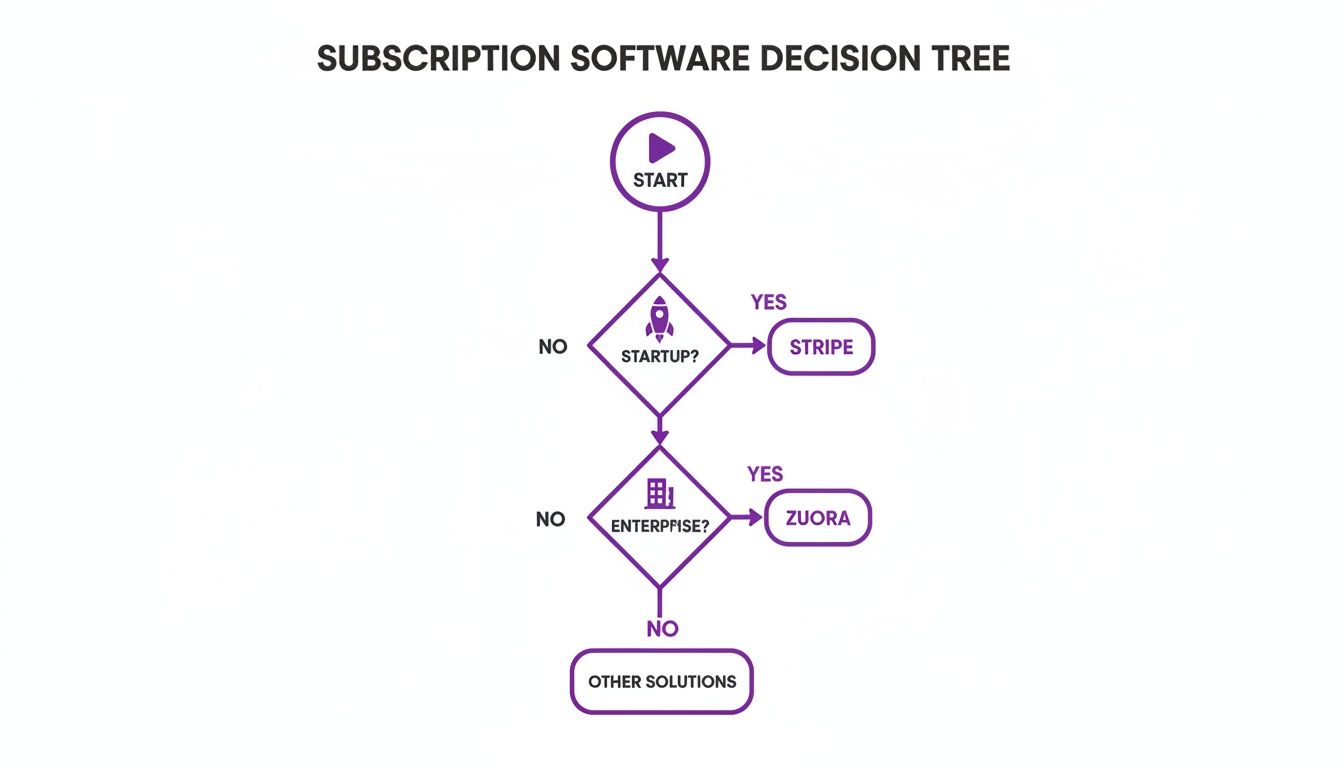
As you can see, your business size and the complexity of your offerings are the biggest factors in pointing you toward the right software.
Media Companies and Content Paywalls
Media and publishing businesses have their own set of unique challenges. Their entire model is built on offering different levels of access, from free trials and premium content tiers to group memberships. The name of the game is converting casual readers into loyal, paying subscribers.
For this, you need a platform that excels at metered access—letting users view a few articles before they hit a paywall. It also needs top-notch dunning management because recovering failed payments from a large subscriber base with low margins is absolutely critical. This is where tools with a heavy focus on churn analytics, like Recurly, really shine.
By matching your business model to a platform's core strengths, you'll find a tool that doesn't just automate your billing but actively helps you grow.
A Practical Guide to Implementing Your New Software
You've done the tough work of comparing platforms and finally chosen the best subscription management software for your business. Now for the fun part: bringing it to life. A successful rollout isn’t just about flipping a switch; it's about having a solid plan to make the changeover a breeze for you and your customers.

Think of this process as laying a strong foundation. Rushing into the technical side without a clear strategy is a surefire way to create headaches later on. Let’s walk through the key steps to get your new system running without a hitch.
Start with Strategic Planning
Before you even log into your new software, take some time to map out every single detail of your subscription offers. This first step is absolutely crucial and will make the actual setup process infinitely easier. It’s like creating a blueprint for your recurring revenue engine.
Here’s a pre-launch checklist to get you started:
- Define Your Subscription Plans: Clearly outline what each tier includes. What products or services do subscribers get? What makes one plan different from another?
- Map Out Billing Cycles: Decide on your billing frequencies. Will you offer monthly, quarterly, and annual options? Offering a small discount for longer commitments is a fantastic way to boost cash flow.
- Set Your Pricing Tiers: Lock in the price for each plan and billing cycle. This is also the perfect time to think about any free trials, introductory offers, or setup fees you might want to use.
A well-documented plan becomes your single source of truth during implementation. It ensures every setting you configure in the software aligns perfectly with your business goals, preventing costly mistakes and rework down the road.
The Technical Setup and Integration
With your strategy in hand, it’s time to roll up your sleeves and tackle the technical configuration. The goal here is to connect your new subscription platform with all your existing tools, creating a seamless flow of information across your entire business.
These are the core technical steps you'll take:
- Payment Gateway Integration: This is the most critical link in the chain. You’ll connect your software to your payment processor (like Stripe or PayPal) to handle every transaction securely.
- Website and Store Connection: Next, you'll integrate the software with your e-commerce platform, like Shopify. This makes sure subscription options show up correctly on your product pages and that customers have a smooth checkout experience.
- Connecting Essential Tools: Finally, link your subscription platform to other key software, such as your accounting system (QuickBooks, Xero) and email marketing service (Klaviyo), to automate financial reporting and customer communication.
Getting these integrations right is vital for a smooth workflow. When your systems can talk to each other, you get to skip all the manual data entry, which cuts down on errors and frees up your time for more important things.
Migrating Your Existing Subscribers
If you already have subscribers on another platform—or even managed in a spreadsheet—moving them to your new system is a delicate but essential task. Your top priority here is to transfer all their information securely without messing up their billing cycles.
The process usually involves exporting your current subscriber list, including their plan details, billing dates, and contact info. You'll then reformat this data to match the new platform's import template. Most importantly, you’ll work directly with your new software provider to securely migrate the vaulted payment details from your payment gateway.
Because of PCI compliance, you can't handle raw credit card data yourself. Your new software provider will walk you through their secure token migration process, ensuring a smooth and compliant transfer that keeps your customers’ sensitive information completely safe. Always double-check the migrated data before you go live to make sure every subscriber is on the right plan and billing schedule.
Frequently Asked Questions About Subscription Software
Diving into the world of subscription software can feel like learning a new language. You've got questions, and you need straight answers—no jargon, just practical advice. Here are the most common questions we get from merchants just like you, along with answers from our years of experience in the trenches.
What Is the Difference Between a Payment Gateway and Subscription Management Software?
It’s a common point of confusion, but the distinction is actually pretty simple. Think of a payment gateway, like Stripe or PayPal, as your digital cash register. Its one job is to securely process a single transaction, moving money from your customer’s account to yours.
Subscription management software, on the other hand, is the brains of the entire operation. It sits on top of the payment gateway and handles the entire customer relationship over time. It’s what lets you create different subscription plans, set up free trials, automate recurring invoices, manage upgrades or downgrades, and chase down failed payments.
In short, the gateway handles the transaction. The software manages the subscriber.
How Much Does Subscription Management Software Typically Cost?
There's no single answer here, as the cost almost always scales with your revenue. Most platforms are designed to grow with you, so you're not overpaying when you're just starting out.
Here’s a rough guide to what you can expect:
- For Startups: Some tools, like Stripe Billing, keep it simple. They charge a small percentage of transaction volume, usually somewhere between 0.5% and 0.8%. It's a fantastic, low-commitment way to get your subscription model off the ground.
- For Growing Businesses: Once you have some traction, you’ll likely look at platforms like Chargebee or Recurly. Their plans often start in the $249-$599 per month range. These plans usually come with a generous revenue allowance, and you'll only pay overage fees if you exceed it.
- For Large Enterprises: Big players like Zuora are built for complex, high-volume operations. They offer custom, quote-based pricing that can easily run into thousands per month, but you're paying for deep customization, dedicated support, and enterprise-level financial controls.
A quick pro-tip: Never just look at the monthly sticker price. Dig into the details—check the included revenue limit, the cost of overage fees, and any extra charges for features you might need down the road. That’s how you find the true cost.
Can I Migrate My Existing Subscribers to a New Platform?
Yes, absolutely! And it’s a process we’ve guided many clients through. But I'll be honest, it’s not as simple as exporting and importing a CSV file. The process involves moving highly sensitive payment information, which is locked down by strict PCI compliance rules.
You can't just move raw credit card numbers around. The migration has to be carefully choreographed between you, your old provider, your new platform, and your payment gateway. The good news is that every reputable software company has a dedicated team for this. They'll walk you through it, provide the right data templates, and handle the secure transfer of payment "tokens" on the back end. Just make sure to plan it carefully to avoid any hiccups in your customers' billing.
How Can This Software Help Reduce Customer Churn?
This is where these platforms really earn their keep. The best ones give you a powerful arsenal to fight both kinds of customer churn, which has a direct impact on your revenue and customer loyalty.
First, it helps you crush involuntary churn—the frustrating kind that happens when a customer's payment fails. The software automates a "dunning" process that intelligently retries failed cards at the best times. It also sends out customized email reminders asking customers to update their info before a subscription is cancelled, saving revenue you’d otherwise lose.
Second, it gives you tools to combat voluntary churn, which is when a customer actively decides to leave. Instead of just a "cancel" button, you can offer alternatives like pausing their subscription or giving them a one-time discount. It also lets you collect priceless feedback with exit surveys, so you can learn why people are leaving and fix the root cause.
Ready to turn your best products into a reliable recurring revenue stream? Wand Websites specializes in integrating powerful, user-friendly subscription solutions directly into Shopify stores. We help you build a subscription experience that drives growth and keeps your customers coming back for more.
Let's build a website that works as hard as you do. Find out how we can help.
