
Finding the Best Ecommerce Platform for SEO

So, you're ready to break free from the Etsy marketplace and build your own ecommerce empire. Fantastic. This is the single most important decision you'll make for your business's future. Getting it right means owning your traffic, your customers, and your growth.
For most ambitious sellers, Shopify hits the sweet spot—it packs powerful, built-in SEO features into a package that's incredibly easy to manage. On the other hand, if you crave total control and have the tech chops to back it up, WooCommerce offers unmatched customization. Your choice here will define how you attract customers and build a brand that lasts.
Choosing Your Best Ecommerce Platform for SEO
Welcome to the big leagues. If you're here, you've likely outgrown the "rented land" of marketplaces and are ready to plant your own flag. Choosing a platform isn't just a technical task; it's a strategic move that puts you in the driver's seat of your business.
The right platform becomes your engine for attracting customers directly from Google, building a brand people remember, and taking complete control over your bottom line. Forget generic feature lists. This guide is a real-world comparison of the top players, built for sellers like you.

Why Platform Choice Matters for Growth
Think of your ecommerce platform as the foundation of your online store's visibility. A good one makes it easy for search engines to find, understand, and rank your products. This means more free, organic traffic and, ultimately, more sales.
What really separates one platform from another? It boils down to a few key things:
- Technical SEO Foundation: How well does it handle the nuts and bolts like site speed, mobile-friendliness, and clean code right out of the box?
- On-Page SEO Control: Can you easily tweak meta titles, descriptions, URLs, and image alt text for every single page and product without a headache?
- Content Marketing Capabilities: Does it have a solid blogging system? This is non-negotiable for attracting shoppers who aren't quite ready to pull out their credit cards.
- Scalability: Will it grow with you? The platform needs to handle more products, more traffic, and more complex SEO needs down the road.
We'll be looking at each platform through this lens, so you can be confident your next move is the right one.
The core difference isn't about which platform is "better" in a vacuum, but which one best aligns with your technical comfort, growth ambitions, and desire for creative freedom.
At a Glance Comparing Top Ecommerce Platforms for SEO
To cut to the chase, here's a quick look at how the main contenders stack up. This table summarizes their core SEO strengths to help you see where your business might fit best.
This high-level view gives you a starting point. Now, let's dig into what makes each one tick.
For instance, Shopify is a giant in the ecommerce world for a reason. It holds 21% of the global market share and an impressive 27.5% of the platform market share. Its appeal for SEO-focused sellers comes from its increasingly powerful built-in tools and its dominance in the U.S., where it powers roughly 30% of websites using ecommerce tech. You can discover more insights about Shopify's market position to see why it's such a strong contender for businesses ready to scale.
The Core Pillars of Ecommerce SEO Success
Before we start comparing platforms, we need to get on the same page about what "good for SEO" actually means for an ecommerce store. It’s never about one magic feature. Instead, it’s about how well the platform helps you master three crucial areas. I like to think of it as a three-legged stool—if one leg is wobbly, the whole operation is unstable.
Picking the best ecommerce platform for SEO is all about finding one that gives you easy, direct control over these foundations. This is what separates a store that gets a lucky traffic spike from one that builds a reliable, growing sales engine from organic search.
Pillar 1: Technical SEO
This is the plumbing and foundation of your entire store. Technical SEO is all about making sure search engines like Google can easily find, crawl, and understand your website without running into walls. A platform that nails this handles most of the heavy lifting for you, often without you even noticing.
Here are the non-negotiables:
- Site Speed: Pages need to load fast. Period. Search engines reward speed, and so do impatient customers. A good platform is built for performance right out of the box.
- Mobile-Friendliness: More than half of all online shopping happens on a phone. Your site has to look and work perfectly on every screen size.
- Clean URL Structures: You want simple, readable URLs (like
yourstore.com/products/blue-widget). They help both people and search engine bots understand your site's hierarchy. - XML Sitemaps: This is basically a roadmap for Google that the platform should create for you automatically, ensuring all your important pages get discovered.
When we look at each platform, we’ll ask real-world questions. How fast is it without any fancy tweaks? Can you easily set up a redirect when you delete a product? These technical details are absolutely critical.
Pillar 2: On-Page SEO
Once your site’s technical foundation is solid, it's time to optimize what people actually see. On-Page SEO is how you signal to Google exactly what each page is about, making it the perfect match for what a customer is searching for.
This is where you'll be spending most of your hands-on SEO time. A great platform gives you simple fields and settings to control these elements on every single product, category, and blog page:
- Meta Titles and Descriptions: The headline and sales pitch that shows up in Google search results.
- Header Tags (H1, H2, H3): These organize your content and tell Google what’s most important on the page.
- Image Alt Text: Simple descriptions for your product photos that help you show up in Google Images.
- Internal Linking: The art of linking between your own pages to guide customers and pass SEO authority.
Pillar 3: Content SEO
This is your secret weapon for long-term growth. While the first two pillars optimize your store for people ready to buy, content SEO is what attracts customers at every other stage of their journey.
Content is what turns a simple online store into a go-to brand authority. It answers customer questions, solves their problems, and builds trust long before they ever add a product to their cart.
This is why a platform’s blogging engine is so important. You need a solid system for publishing helpful guides, lookbooks, and articles that bring in traffic from people who aren't just searching for product names. To really dive deep into this, you might find this ultimate guide to ecommerce SEO incredibly helpful.
We'll be using these three pillars as our scorecard to see how each platform stacks up. This way, our recommendations are grounded in what actually moves the needle for traffic and sales.
Shopify SEO: Powerful Simplicity for Growing Your Brand
For Etsy sellers hitting that $10k/month milestone, Shopify often feels like the most natural next step. It’s built to take the heavy lifting of technical e-commerce off your plate, so you can pour your energy back into what you’re brilliant at—creating and selling your products. This blend of powerful features wrapped in a simple package is exactly why it’s a top contender for the best e-commerce platform for SEO.
Out of the box, Shopify gives you a really solid SEO foundation. Your store gets a serious speed boost from its global CDN, Google can easily find your products thanks to automatically generated XML sitemaps, and editing things like meta titles and descriptions is incredibly intuitive. You can get your store optimized and ready to rank without needing a web development degree.
But that simplicity does come with a few trade-offs, and it's important to know what they are.
Understanding Shopify's SEO Trade-Offs
To make things so user-friendly, Shopify makes certain structural decisions for you. The most talked-about one is its URL structure. Every product page will have /products/ in the URL, and every category page will have /collections/. You can change the very end of the URL (the "slug"), but those prefixes are locked in.
Is this a deal-breaker? For most stores, absolutely not. Some hardcore SEO pros might grumble about wanting complete control for shorter, "cleaner" URLs. But for a high-growth seller moving off Etsy, it's a tiny constraint that’s easily outweighed by the platform's incredible stability and speed.
Another point to consider is the built-in blog. It’s perfectly fine for publishing articles, lookbooks, and company news. It just doesn't have the same deep customization options or massive plugin library you’d get from a dedicated blogging platform like WordPress.
This screenshot from Shopify's own guide shows just how simple they make managing basic on-page SEO.
You can see exactly how your page will look in Google and edit the title and description right there in the product editor. For a busy entrepreneur, that kind of clarity is a massive time-saver.
Where Shopify's SEO Shines for Growing Brands
Despite a few minor constraints, Shopify is an SEO powerhouse for good reason. Its entire architecture is engineered for speed and reliability, two things Google absolutely loves. You never have to think about server maintenance, security updates, or performance tweaks—Shopify handles it all.
This managed approach gives you some huge advantages:
- Wicked-Fast Page Speed: Shopify sites are consistently fast, which is critical for both search rankings and user experience. Remember, studies show that even a one-second delay in load time can slash conversions by 7%.
- Mobile-First, by Default: Every Shopify theme is automatically mobile-responsive. With mobile commerce set to account for nearly 60% of all e-commerce sales, this isn't just a nice-to-have; it's essential.
- Automatic SEO Fixes: Shopify automatically handles things like canonical tags, which prevents the duplicate content issues that often pop up on e-commerce sites with product variants.
For a seller moving from a marketplace, Shopify’s biggest SEO gift is stability. You get a fast, secure, and reliable foundation without the technical headaches. This lets you focus 100% on your marketing and product strategy.
Extending SEO with the App Ecosystem
The real magic of Shopify is its massive app ecosystem. While the core SEO features are strong, you can bolt on almost any advanced function you can dream of with a third-party app. This lets you build an SEO toolkit that grows right alongside your business.
Need to add advanced schema for those eye-catching rich snippets in search results? There are apps for that. Want to automatically find and fix broken links? There’s an app for that, too.
This flexibility means that while Shopify's core is simple, its potential is nearly limitless. You can layer in sophisticated tools for image optimization, keyword research, and structured data without ever having to write a line of code. This makes Shopify the perfect platform to take you from $10k a month to $100k a month and beyond.
WooCommerce SEO: Ultimate Flexibility and Control
If you're the kind of entrepreneur who wants the final say on every single SEO variable, then WooCommerce isn't just an option—it's the only real choice. As an open-source plugin for WordPress, it’s built on the back of a world-class content management system, making it an absolute powerhouse for SEO right out of the gate. This setup gives you total freedom to build the exact digital storefront you envision, from custom URL structures to sophisticated content marketing hubs.
Unlike hosted platforms that put guardrails on what you can change, WooCommerce hands you the keys to the entire engine. By adding industry-leading plugins like Yoast SEO or Rank Math, you can fine-tune every page, product, and blog post to perfection. This is the kind of granular control that attracts sellers who refuse to leave any ranking opportunity on the table.
Of course, with great power comes great responsibility.
The Double-Edged Sword of Complete Control
Choosing WooCommerce means you’re in the driver's seat for everything. You’ll be the one picking the hosting, managing security, and running performance updates. This is a huge deal, because even the most brilliantly optimized site can be crippled by a slow, cheap server. Think about it: a one-second delay in page load time can slash conversions by 7%. Your hosting choice is a critical SEO decision.
This responsibility touches every technical detail. You can directly edit your robots.txt file to tell search engine crawlers exactly where to go—a level of access Shopify simply doesn't allow. Need to implement a complex redirect strategy? You can do it without an app. But be warned: a small mistake in these areas can cause big problems if you're not careful.
WooCommerce is all about freedom. It’s built for people who want total control and are comfortable enough with the technical side to use it well. For those users, the SEO potential is practically limitless.
The platform's massive adoption speaks for itself. WooCommerce powers a staggering 37% of the global e-commerce market, running on over 6.5 million websites as of 2025. This dominance stems from its open-source WordPress foundation, which gives store owners direct control over SEO elements that other platforms lock down. You can dig deeper into the numbers in this in-depth analysis of e-commerce platform distribution.
A Tale of Two Platforms: SEO in Practice
To really understand the difference, let’s look at how a crucial SEO task is handled on WooCommerce versus a platform like Shopify. This comparison gets to the heart of the trade-off between complete flexibility and guided ease of use.

With a plugin like Yoast, you get an interface like the one above, giving you immediate control over titles, meta descriptions, and even how your content appears on social media. But the real magic is what you can do beyond these basic fields.
The table below breaks down how each platform approaches specific SEO tasks, making the differences crystal clear.
Comparing SEO Control Between Shopify and WooCommerce
A side-by-side look at how critical SEO tasks are managed on each platform, clarifying the trade-offs between ease of use and granular control.
This comparison really highlights the fundamental difference between the two. Shopify gives you a fast, stable, and highly effective SEO foundation that works beautifully for 90% of sellers. But for the other 10%—those with the technical skill and the desire to build a completely custom SEO machine—WooCommerce offers a blank canvas with unparalleled potential.
What About Other Platforms Like BigCommerce?
While Shopify and WooCommerce get most of the attention, it’s worth looking at the other players in the game, especially if you're serious about finding the best ecommerce platform for SEO. One platform that often gets overlooked is BigCommerce, which cleverly positions itself right between the two big dogs.
BigCommerce runs on a hosted model just like Shopify, meaning they handle all the tricky stuff like servers, security, and updates for you. Where it really stands out, though, is by baking more powerful SEO tools directly into the platform from day one, so you're not immediately reaching for your wallet to pay for apps.
The BigCommerce Edge: More Control, Less Hassle
If you've ever been frustrated by Shopify's rigid URL structure, BigCommerce will feel like a breath of fresh air. It gives you fully customizable URLs without forcing prefixes like /products/ on you. This is a huge win for creating clean, keyword-focused URLs that both people and search engines love.
On top of that, BigCommerce lets you edit your robots.txt file right from the dashboard. This is a level of control you usually only see on open-source platforms like WooCommerce, and it lets you give very specific instructions to search engine crawlers without having to mess with code or server files.
BigCommerce is perfect for the seller who wants Shopify's "it just works" simplicity but secretly craves the kind of deep SEO control you get with WooCommerce. It’s a fantastic middle-ground option.
Here’s a quick look at where BigCommerce really shines:
- Total URL Freedom: No more forced prefixes. You get to decide exactly how your product and category URLs are structured.
- Direct Robots.txt Editing: Get granular with crawler instructions without needing a developer on speed dial.
- Built-in Rich Snippets: It comes ready with solid schema markup support, helping your products pop in search results right out of the box.
And What About the Heavyweights Like Adobe Commerce?
At the other end of the spectrum, you have monsters like Adobe Commerce (which you might remember as Magento). This is a true enterprise-level platform built for massive businesses with their own teams of developers and big budgets. It's incredibly powerful and you can customize literally anything, but the learning curve is a vertical cliff and the costs are astronomical.
For a successful Etsy seller looking to grow, Adobe Commerce is just way too much. The time, money, and headaches involved in running it would pull you away from what you do best: creating and selling your products. Yes, its SEO power is immense, but you absolutely do not need that level of complexity to get top-tier results.
When it comes down to it, for most brands scaling up from Etsy, the real choice is between Shopify's elegant simplicity and WooCommerce's total freedom. BigCommerce sits right in the middle as a compelling alternative for those who want the best of both worlds.
Making the Right Choice for Your Business
So, what's the final verdict? When it comes to the best e-commerce platform for SEO, our recommendation for ambitious sellers scaling their business is crystal clear. You need a platform that helps you grow without forcing you to become a part-time web developer.
For most entrepreneurs, Shopify strikes the perfect balance between powerful, built-in SEO features and day-to-day simplicity. It frees you up to focus on what actually moves the needle—like product development and marketing—rather than getting stuck in the weeds of server maintenance and security patches.
While a platform like WooCommerce offers incredible control, the reality of managing hosting, performance, and security can quickly become a massive distraction from actually growing your sales. This is a huge factor that often gets glossed over in purely technical comparisons.
The Strategic Advantage of a Managed Platform
Shopify takes all those operational headaches off your plate. It gives you a fast, secure, and reliable foundation that search engines already love. Its global Content Delivery Network (CDN) makes sure your pages load in a flash for customers anywhere in the world, which is a massive ranking factor.
This managed environment means your store is always on, always secure, and always performing at its best. That frees up your most valuable resource: your time. Instead of troubleshooting a random plugin conflict or dealing with a hosting meltdown, you can be planning your next product launch or refining your content strategy.
Shopify's biggest advantage is that it handles the complex, technical SEO foundation for you. This lets you build your brand on a stable, high-performing platform without needing to become a systems administrator on the side.
When you're picking a platform, it's not just about SEO in a vacuum. You have to think about how it works with all your other marketing channels. For a deeper dive into creating a connected customer experience, exploring comprehensive e-commerce marketing automation strategies can show you how to tie everything together for maximum growth.
Visualizing Your Decision Path
To make this even simpler, think of it like this. The decision tree below boils the choice down to one core question you need to ask about your SEO priorities.
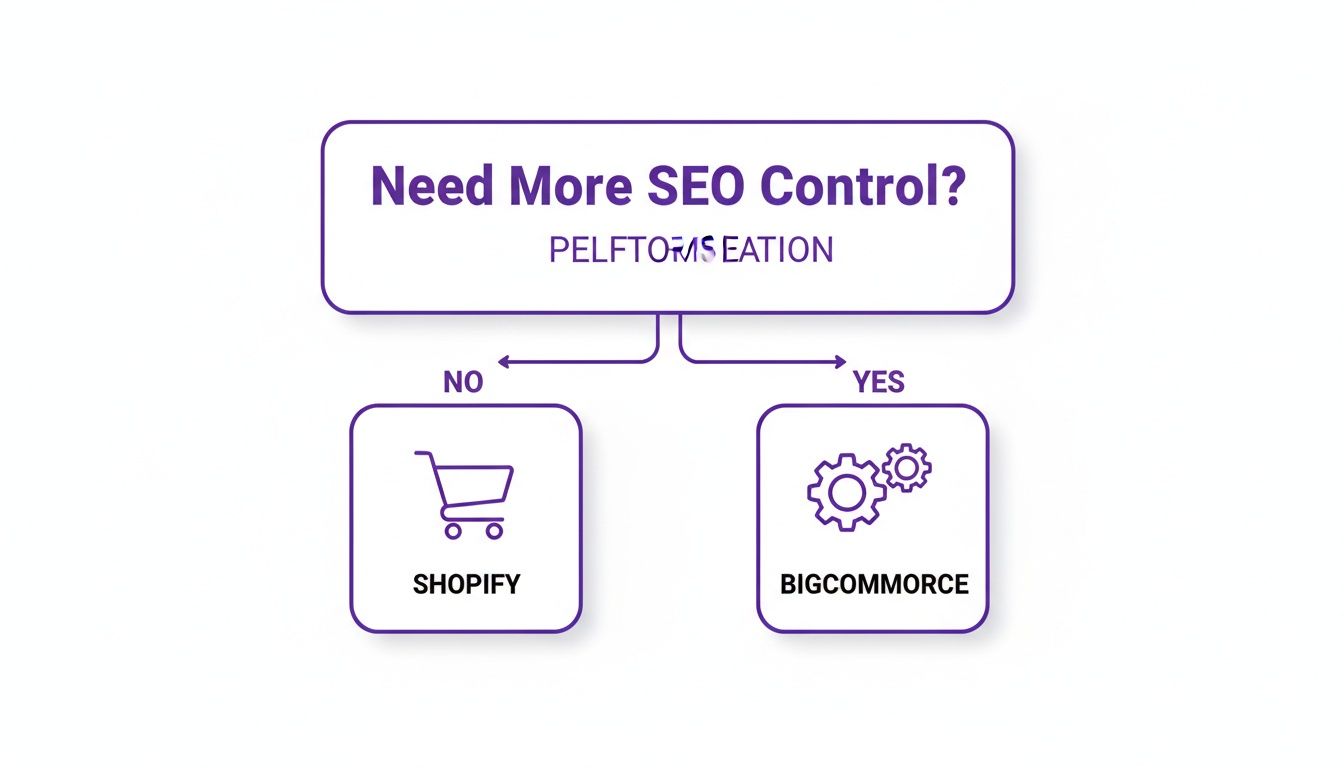
The flowchart really brings it home. While platforms like BigCommerce offer more out-of-the-box control, Shopify’s streamlined approach is almost always the more practical path for sellers who care more about growth than granular technical tinkering.
Final Recommendation for High-Growth Sellers
At the end of the day, Shopify’s massive app ecosystem means you can easily add advanced SEO functionality as your business grows and your needs change. It’s the platform that best supports a smooth transition from a marketplace like Etsy to full, independent brand ownership.
It gives you the tools you need to scale effectively, build a powerful online presence, and drive organic traffic—all without the steep learning curve or technical overhead of self-hosted solutions. For the Etsy seller who’s ready to own their growth, Shopify is the most direct path to a profitable and scalable future.
Got Questions About Ecommerce SEO? We've Got Answers.
Jumping into the world of ecommerce platforms and SEO can feel like learning a new language. Let's clear up some of the most common questions we hear from business owners who are ready to grow. Think of this as your cheat sheet for making a confident choice.
Choosing the right platform is a massive first step, but it's just as important to understand what it can and can't do for your search rankings.
How Much Does Your Platform Really Matter for SEO?
Think of your ecommerce platform as the foundation of your house. It’s absolutely critical, but it's not the entire house. A solid platform takes care of the technical heavy lifting—things like site speed, mobile-friendliness, and clean code—so you don't have to wrestle with it. It should make basic on-page SEO a breeze and give you the tools you need for content marketing.
But here’s the thing: the best ecommerce platform for seo won't magically get you to the top of Google on its own. Your success still hinges on your strategy. That means your keyword research, the quality of your product descriptions, the content you create, and your ability to earn backlinks are what truly move the needle.
The platform is the enabler, not a magic bullet. It’s there to clear the technical hurdles so you can pour your energy into the marketing that actually drives growth.
Can You Rank on Google With Any Ecommerce Platform?
Technically, yes. You can get a store ranking on Google using almost any modern platform out there, whether it's Shopify, WooCommerce, or BigCommerce. Most reputable options today have the SEO basics covered, letting you edit meta titles, descriptions, and image alt text. They provide a decent enough launchpad for a new store.
The real difference shows up when you start to scale. A cheaper or less powerful platform might start to drag its feet on site speed as your product catalog grows. It might not have the flexibility for more advanced SEO tasks, like adding custom schema markup or managing tricky redirect patterns after a site redesign.
So while you can rank with any of them, a top-tier platform makes it so much easier to compete and win in a crowded market.
A great platform doesn't just let you do SEO; it actively supports and simplifies your efforts. It's the difference between having the wind at your back versus constantly fighting a technical headwind.
Is Shopify or WooCommerce Better for SEO?
This is the classic question, and the honest answer is: it completely depends on you. Neither one is universally "better," but they are definitely better for different types of people.
Shopify is the winner for anyone who values stability and simplicity. It gives you an incredibly fast, secure, and well-optimized foundation right out of the box. You trade a bit of granular control for the peace of mind that comes from knowing the core technical SEO is expertly handled for you.
WooCommerce is built for those who crave absolute control. If you want to customize every single URL, dig into server files, and build a completely unique SEO setup from the ground up, WooCommerce gives you that freedom. Just remember, that power comes with the responsibility of managing your own hosting, security, and maintenance.
For most sellers graduating from a marketplace like Etsy, Shopify's blend of power and simplicity is the smarter move. It lets you focus on growing your business instead of becoming a part-time web developer.
When Does It Make Sense to Switch Platforms for SEO Reasons?
You should start seriously thinking about a switch when your current platform becomes a roadblock. This usually happens when your ambitions outgrow what your platform can deliver.
Here are a few tell-tale signs it might be time for a change:
- Slow Site Speed: Your site is sluggish, and you've already tried every optimization trick in the book.
- Can't Implement Fixes: You know what technical SEO issues you have (like crawl errors or duplicate content), but your platform literally won't let you fix them.
- Weak Content Tools: Your blog or content management system feels like it's from 2005 and can't support the kind of content you want to create.
- "App Hell": You're paying a small fortune every month for third-party apps just to plug basic SEO gaps that a better platform would have built-in.
Migrating your store is a big project, so it shouldn’t be a gut decision. It should be a strategic one, based on clear evidence that your platform is the main thing holding back your organic growth.
Ready to build a website that not only looks incredible but also works as a powerful engine for your growth? At Wand Websites, we specialize in crafting high-performing Shopify stores that turn ambitious Etsy sellers into independent brand powerhouses. Let us handle the technical complexities so you can focus on what you do best. Start your journey to brand ownership with Wand Websites today.
