
Automated Lead Nurturing for Your Shopify Store

If you've built a successful Etsy shop, you already know how to make a sale. But let's be honest, scaling on Shopify is a whole different ballgame. It demands a new way of thinking—one where you're not just making one-off sales, but building lasting customer relationships automatically.
Think of automated lead nurturing as your secret weapon for turning curious browsers into loyal fans. It's about creating personalized conversations that guide potential customers from their very first visit to their first purchase, and hopefully, many more after that.
Why Automated Nurturing Is Your E-commerce Growth Engine
Moving from Etsy to your own Shopify store means you're no longer just renting a stall in a crowded marketplace; you're building your own brand from the ground up. While Etsy brings a built-in audience to you, Shopify requires you to attract and convert your own traffic.
This is where automated lead nurturing becomes absolutely essential. It’s not about blasting everyone with the same generic email. Instead, you're creating a smart, systematic journey for every single person who shows interest in your products.
By setting up these automated sequences, you can make sure no potential customer falls through the cracks. This consistent, relevant communication builds a ton of trust and keeps your brand top-of-mind, freeing you up to focus on what you do best: creating amazing products.
The Tangible Impact on Your Bottom Line
Getting these automated workflows up and running isn't just a "nice-to-have" marketing tactic; it delivers real, measurable results that can make or break a growing e-commerce brand. Businesses that get good at nurturing their leads see huge gains across the board. The data paints a pretty clear picture of how powerful this is.
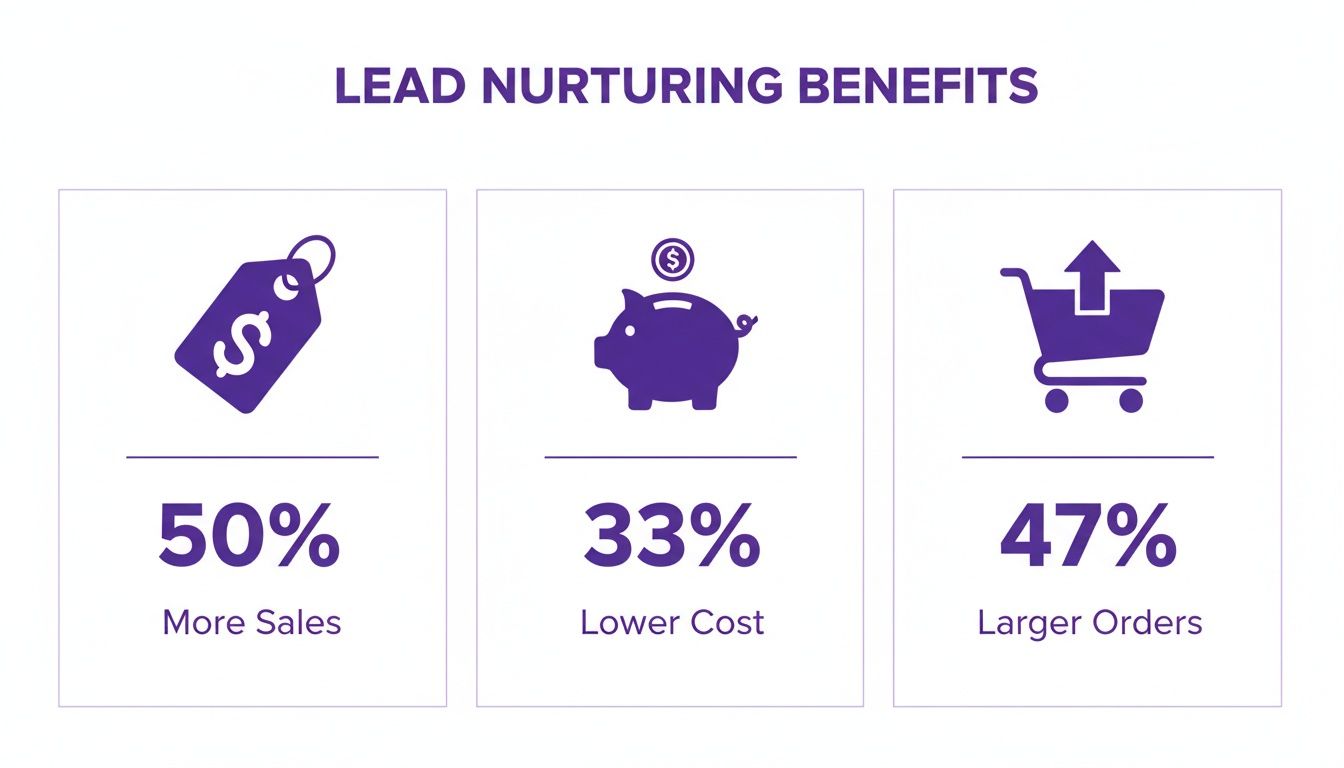
The message here is simple: a solid nurturing strategy directly leads to more profitable customers. It stops your marketing from being just another expense and turns it into a powerful revenue-generating machine.
Here's a quick look at the kind of real-world results we're talking about.
Key Benefits of Automated Nurturing for E-Commerce
Simply put, these aren't small gains. They are the kinds of numbers that transform a side-hustle into a sustainable, thriving brand.
For Etsy sellers hitting that $10k+/month mark and looking ahead to 2026, these automated sequences are game-changers. The numbers don't lie: 77% of businesses using marketing automation see their conversions go up. If you want to dive deeper, you can explore more about these powerful B2B lead nurturing strategies to see just how much potential is there.
Key Takeaway: Automated nurturing does way more than just keep you in touch with people. It actively builds relationships that lead to higher-value customers who come back again and again. It’s the essential bridge between a curious first-time visitor and a long-term, loyal fan.
Alright, let's get into the good stuff. It's time to take all that strategy and turn it into an automated system that works for you around the clock. We're going to build the three most important email flows that every Shopify store needs to convert new leads and keep customers coming back.
Think of these flows not as spammy emails, but as helpful, automated conversations that kick in right when your customers take a specific action. They're like having the perfect salesperson on staff 24/7, ready to welcome, assist, and build relationships.
The Welcome Series: Making a Killer First Impression
Your welcome series is, without a doubt, the most critical automation you'll set up. It's your one shot to make a great first impression when a new subscriber is at their peak interest level. The goal is simple: introduce who you are, build some trust, and nudge them toward that first purchase.
A solid welcome series usually has about 3-4 emails that go out over the first week. Here’s a simple but effective game plan:
- Email 1 (Right Away): Give them what they came for. If they signed up for a discount code, don't make them wait. This first email should be friendly, focused, and make it super easy to start shopping.
- Email 2 (Day 2): Share your story. What’s the "why" behind your brand? What makes your products different? This is your chance to forge an emotional connection that goes far beyond just a simple transaction.
- Email 3 (Day 4): Bring in the social proof. Show off your best-sellers, feature glowing customer reviews, or share some awesome user-generated content. This helps any hesitant shoppers feel confident they're making a great choice.
Don't sleep on this. The average open rate for welcome emails is a massive 82%. You'll never have a more engaged audience, so make this opportunity count.
The Abandoned Cart Flow: Your Revenue Recovery Machine
We’ve all felt the sting of an abandoned cart. Someone was so close to buying, and then...poof. The great news is that a smart, automated flow can win back a huge chunk of that lost revenue. These emails are just timely, gentle reminders to help customers finish what they started.
Look, they added something to their cart for a reason. Your job is to remind them of that reason and make it dead simple to complete their purchase. This is all about overcoming that last-minute hesitation. To really get a handle on what these systems can do, understanding the basics of AI marketing automation is a huge help when setting up these core flows.
For instance, here's what a classic abandoned cart trigger looks like in a platform like Klaviyo.
See how it works? The flow starts when someone "Started Checkout" but is filtered to exclude anyone who actually "Placed Order." It's this kind of precision that makes automation so powerful—you're only talking to the people who truly left their cart behind.
The Post-Purchase Follow-Up: Your Loyalty Builder
The relationship doesn't end at the checkout. The time right after a purchase is a golden opportunity to turn a first-time buyer into a loyal fan and brand advocate. This flow isn't about the hard sell; it's about nurturing the relationship for the long haul.
Here's what you want to accomplish with this series:
- Be Genuinely Helpful: Send them tips on how to get the most out of the product they just bought.
- Ask for Their Opinion: Once they’ve had time to use the product, ask for a review.
- Invite Them Back: Offer a little something special for their next order to encourage repeat business.
A simple yet effective post-purchase flow could be structured like this:
By putting these three core flows in place, you’ve built a solid foundation for your lead nurturing. This system will automatically capture new leads, recover sales, and build the kind of customer loyalty that truly grows a brand.
Choosing Your Tools and Setting Up Triggers
The right technology is what makes a great lead nurturing strategy feel like magic. But with a million and one tools out there, it's easy to fall down a rabbit hole of features and pricing plans. For a growing Shopify store, though, the choice usually comes down to a few key players that are built from the ground up to play nicely with e-commerce.
Let’s cut through the noise. We'll focus on the platforms that work best with Shopify, so you can pick the perfect fit without needing a degree in computer science.
Klaviyo vs. Omnisend: Which Is Right for You?
For most Shopify store owners, the conversation pretty much starts and ends with two platforms: Klaviyo and Omnisend. Both are absolute powerhouses with deep Shopify integrations, but they're built for slightly different needs and business stages.
Don't think of it as a cage match. It's more about finding the right partner for where your brand is right now and where you want it to go.
Here’s a quick-and-dirty breakdown to help you decide:
Klaviyo is the industry heavyweight for a reason. Its ability to slice and dice customer data is legendary. If you've ever wanted to create a segment of customers who bought a specific product twice but haven't visited in the last 60 days, Klaviyo is your tool.
Omnisend, on the other hand, wins on its simplicity and multi-channel muscle. It makes adding SMS and push notifications to your automated flows incredibly easy, helping you create a unified customer experience right out of the box.
My Two Cents: If you're just getting started and want a powerful tool that covers all the bases without a steep learning curve, Omnisend is a fantastic choice. If your business is scaling fast and you need that nitty-gritty control over customer data for next-level personalization, investing in Klaviyo will pay for itself many times over.
Getting Connected and Setting Your Triggers
Once you've picked your platform, the next job is hooking it up to Shopify and telling it when to spring into action. This is where triggers come in. A trigger is just a fancy word for a customer action that kicks off one of your automated sequences.
Nailing this part is the foundation of your entire setup.
The good news? Platforms like Klaviyo and Omnisend have made this ridiculously easy. The integration is usually just a one-click install from the Shopify App Store. Once you’re connected, all your store's data—products, customers, and orders—starts flowing into your new marketing hub automatically.
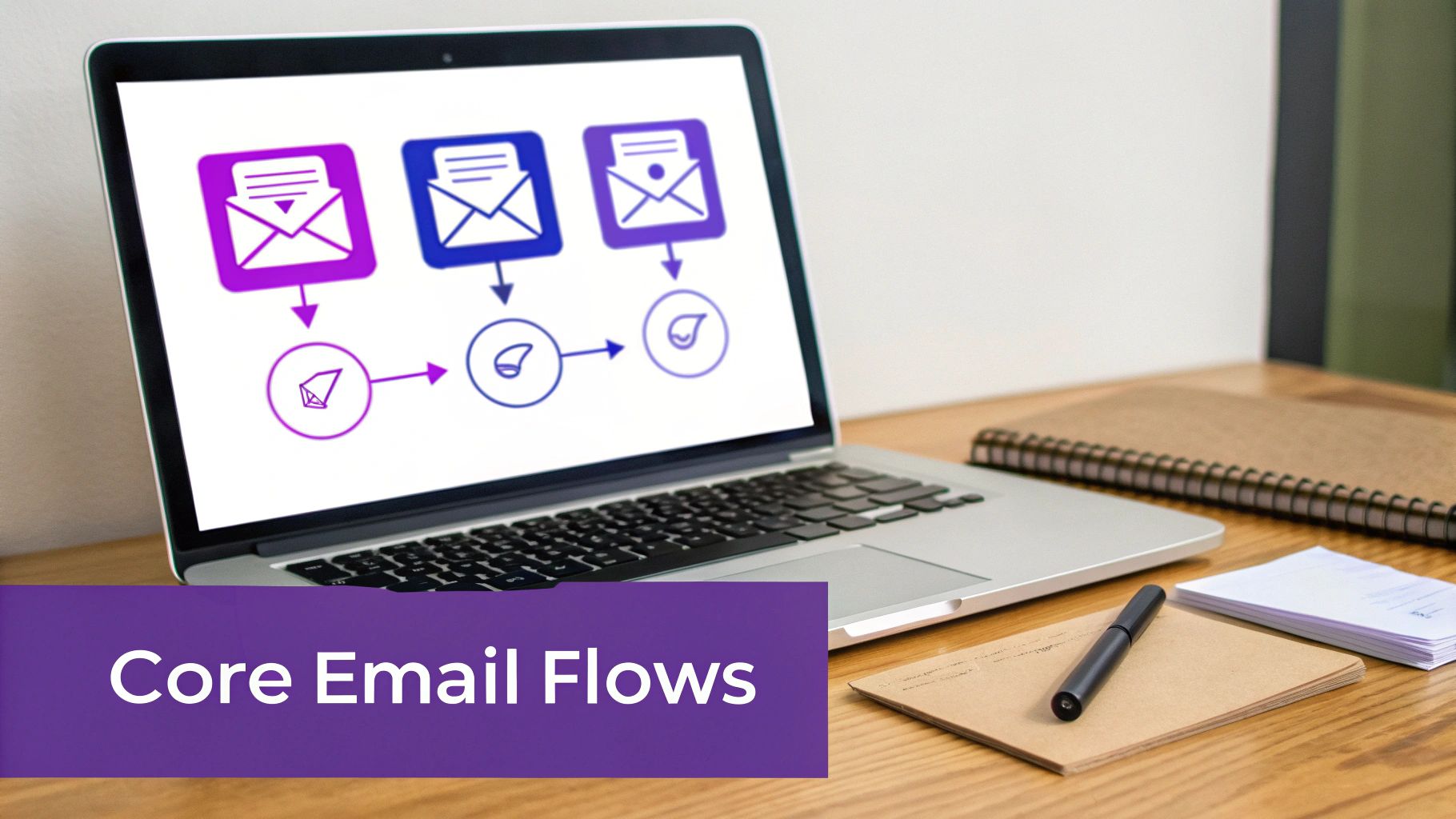
Now, you just have to set up the most crucial triggers to power the flows we've been talking about:
- Subscribed to List: This is your Welcome Series trigger. It fires the second someone signs up for your newsletter or uses a pop-up form.
- Started Checkout: The classic trigger for any Abandoned Cart flow. It snags anyone who enters their email at checkout but bails before buying.
- Placed Order: This is what kicks off your Post-Purchase flow. It activates the moment a customer's payment goes through.
Setting these up is the "set it and forget it" part of automation that will give you back hours of your week.
Never underestimate the impact of a well-oiled nurturing machine. One supplier I know of implemented automated sequences across email, social, and even direct mail. In just one year, they generated $2.3 million in qualified pipeline and brought back 43% of leads that had gone completely cold. You can dig into more lead nurturing automation strategies to see what's possible. It just goes to show that acting on these simple triggers is where real, sustainable growth comes from.
Writing Emails That Actually Convert
Look, you can build the most sophisticated, data-driven automated flow on the planet, but if the emails themselves are boring, robotic, or pushy, you've wasted your time. It’s the actual words in those emails that do the heavy lifting.
This is where the magic happens—turning a simple automated message into a genuine conversation that guides people toward becoming happy customers.
You don't need to be a world-class copywriter to pull this off. It's really about understanding what makes people tick and applying a few core principles to everything from the subject line that gets the click to the final call-to-action that closes the loop. Let's break down how to write emails that don’t just get opened—they get results.
First Things First: Nailing the Subject Line
Your subject line has one job: to cut through the noise of a packed inbox and earn that open. If it fails, nothing else matters. The best subject lines walk a fine line between sparking curiosity and being crystal clear about what's inside.
Think about it from your own perspective. What was the last marketing email you actually opened? I bet it wasn’t something generic like "New Products Now Available!" It was probably something that made you pause, wonder, or feel like it was meant specifically for you.
Here are a few approaches I’ve seen work time and time again for e-commerce brands:
- Spark some curiosity: "Is this your new favorite mug...?"
- Get personal: "A special offer just for you, Sarah."
- Focus on the benefit: "Your solution to dull home decor is here."
- Use friendly urgency: "Quick heads-up! Your cart is about to expire."
The key is to sound helpful and intriguing, not spammy or desperate. Don't be afraid to test different styles to see what resonates with your audience.
Crafting Body Copy That Truly Connects
Once you’ve earned the open, the body of the email has to deliver on the promise of your subject line. This is your chance to build a real connection, tell your brand’s story, and show off what makes your products special.
Instead of just listing features, talk about the benefits. Paint a picture of how your product fits into their life.
Your tone of voice is absolutely critical here. Are you a fun, witty brand or more of a warm, comforting one? Whatever your style, let it shine through. Write like a real person who’s passionate about what they do—that's how you stand out from the faceless retail giants.
I see so many brands make the mistake of selling too hard, too soon. A good rule of thumb for nurturing emails is the 80/20 rule: 80% of your content should provide value, and only 20% should be a direct sales pitch.
Build trust first. Offer tips, share customer stories, or link to a helpful blog post. For example, in a welcome email, instead of just shoving a discount code in their face, tell the short, heartfelt story of why you started your business. A handmade candle company could share the inspiration behind their signature scent, creating an emotional hook that a generic "Shop Now" email could never replicate.
Proven Email Templates You Can Steal
No need to start from a blank page every single time. Having a few solid, go-to templates for your core nurturing flows will save you a ton of mental energy and keep your messaging on point.
Here are a couple of classic examples you can adapt for your own brand.
Abandoned Cart Email (Sent ~2 Hours After Abandonment)
- Subject: Did you forget something?
- Body: Hi [First Name],
It looks like you left a few great things in your cart! We know life gets busy, so we saved them for you.
That [Product Name] is one of our best-sellers, and we’d hate for you to miss out on it.
[Clear picture of the item(s) in the cart]
Ready to make them yours? Just click the button below to go straight back to your cart.
[CTA Button: Take Me Back to My Cart]
Post-Purchase Review Request (Sent ~14 Days After Delivery)
- Subject: How are you loving your new [Product Category]?
- Body: Hi [First Name],
It's been a couple of weeks since your order arrived, and the whole team here is dying to know what you think!
Your feedback means the world to us and helps other shoppers make great decisions. If you have a minute, would you be willing to share a quick review?
[CTA Button: Leave a Review]
Thanks again for being such an awesome customer!
See the pattern? Both emails are friendly, helpful, and make it incredibly easy for the customer to take the next step. That's the real secret to writing emails that people actually want to read.
Measuring Success and Optimizing Your Flows
Getting your automated lead nurturing flows live is a massive win, but it’s really just the starting line. The true power comes from treating these automations not as "set it and forget it" campaigns, but as dynamic parts of your business that you can constantly refine. This is where you move from just having automations to making them truly profitable.
Don't worry, this isn’t about drowning in spreadsheets. It’s about zeroing in on a few key performance indicators (KPIs) that give you a clear picture of what’s working and what’s falling flat. By keeping an eye on the right numbers, you can turn guesswork into a reliable system for boosting your revenue.
Identifying Your Core Nurturing Metrics
You can't improve what you don't measure. Each of your automated flows has a specific job, and that means each one has its own primary KPI. Dive into your email platform’s dashboard—that’s where you’ll find the analytics breaking down the performance of every single email and the flow as a whole.
Here are the essential metrics you should be tracking for your core e-commerce automations:
- Welcome Series: This flow is all about making a great first impression and driving that initial purchase. The metrics that matter most are open rate and click-through rate (CTR). A high open rate tells you your subject line grabbed their attention, while a strong CTR means your content was compelling enough to make them click.
- Abandoned Cart Flow: This one is pure revenue recovery. The number one metric to obsess over is the recovery rate—what percentage of abandoned carts did this flow successfully bring back to life? You should also watch the revenue per recipient to see the direct cash value each email is generating.
- Post-Purchase Flow: With this flow, you’re building loyalty and sparking repeat business. Keep a close eye on your repeat customer rate from this segment and the review submission rate if you're asking for feedback. These numbers tell you if you’re actually turning one-time buyers into loyal fans.
Think of your analytics dashboard as your mission control. Make it a habit to check these core metrics at least once a month. This simple routine is what separates the stores that plateau from the ones that scale consistently.
Nurturing Flow KPI Tracking Sheet
To make this even easier, here’s a quick-glance table to help you monitor the health of your most important flows.
Tracking these benchmarks gives you a clear target to aim for and helps you pinpoint exactly where your optimization efforts will have the biggest impact.
The Power of Simple A/B Testing
Once you have your baseline numbers, it’s time to start improving them. The most straightforward and effective way to do this is through A/B testing, sometimes called split testing. It might sound technical, but the concept is beautifully simple: you test one change at a time to see what your audience prefers.
Nearly every modern email marketing platform has A/B testing built-in. You can create two versions of an email (Version A and Version B), and the system will send each one to a small slice of your audience. The version that "wins" based on a metric you choose (like open rate or clicks) is then automatically sent to everyone else. Easy.
What Should You Be Testing?
You can test just about anything in your emails, but you'll see the biggest results by focusing on the elements that have the most direct impact on customer action.
Start with these simple but powerful tests:
- Subject Lines: This is the lowest-hanging fruit and often yields the biggest wins. Try a question versus a statement. An emoji versus no emoji. For your welcome series, you could test "Welcome! Your 10% off code is inside" against something more personal like "A little welcome gift just for you."
- Call-to-Action (CTA): Tweak the words on your buttons. Does a direct "Shop Now" get more clicks than a benefit-driven "Claim My Discount"? You'd be surprised how small language changes can produce big swings in CTR.
- Offers: For an abandoned cart flow, this is huge. See if a 15% discount converts better than a free shipping offer. This test will tell you what truly motivates your hesitant buyers to finally click "complete purchase."
This ongoing cycle of measuring, testing, and tweaking is the engine of sustainable growth for your Shopify store. Small, data-backed improvements compound over time, leading to major long-term gains. Ultimately, the success of these flows comes down to their return on investment. If you want to get serious about measuring your success, learn exactly how to calculate marketing ROI to prove the value you're creating.
Got Questions About Lead Nurturing on Shopify? We've Got Answers.
Jumping into automated lead nurturing can bring up a lot of questions. That’s a good thing! It means you’re thinking critically about how you talk to your customers. After all, you’re setting up a system that will be your voice, day in and day out.
Let's walk through some of the most common questions I hear from Shopify owners when they’re moving from the drawing board to the real world. Getting these cleared up will help you build your flows with a lot more confidence.
How Many Emails Should I Actually Send in a Sequence?
This is the big one, and the honest answer is… it depends on what you’re trying to achieve. There’s no magic number, but my go-to starting point for most Shopify flows is somewhere between three and five emails. Any more than that, and you start to get on people's nerves. Any less, and you might not have enough runway to make your case.
Here are a couple of real-world scenarios:
- For a Welcome Series: Three emails spread over five to seven days is a fantastic baseline. This gives you enough room to introduce your brand, flash some social proof, and then present a compelling offer without totally overwhelming a new subscriber.
- For an Abandoned Cart Flow: Here, speed and simplicity win. Two emails within the first 24 hours is usually the sweet spot. You might be able to get away with a third email a day or two later, but keep a close eye on your unsubscribe rates. If they spike, dial it back.
The golden rule is to make every single email count. If a message doesn't add new value or offer a fresh angle, just leave it out.
How Can I Stop My Automated Emails from Sounding… Robotic?
The fear of sounding like a soulless marketing bot is real, but you can absolutely avoid it. Personalization is so much more than just dropping [First Name] into the subject line. The real secret is to use the data your Shopify store is already collecting to make your emails feel like they were written for one person.
You have a ton of information at your fingertips. For instance, you can use dynamic content blocks in your emails to show customers the exact products they were just looking at or left in their cart. That simple act of recognition makes the email instantly relevant.
The most powerful personalization tool you have is your own voice. Write like a human. Share your brand's story, talk about what you believe in, and let your personality shine through. People connect with that, not with corporate-speak.
Segmentation is another game-changer. You wouldn't talk to a brand-new visitor the same way you'd talk to a loyal customer who has purchased five times, right? So don't email them the same way. Create segments based on purchase history and send them different messages. A simple "Welcome back! Here's a little something for being one of our regulars" can do amazing things for customer loyalty.
Is This All Just About Email, or Can I Do More?
Absolutely, you can do more—and you should! While email is the backbone of e-commerce nurturing, the real magic happens when you take a multi-channel approach. Your customers hang out in more places than just their inbox, and your marketing should, too.
Many of the top email platforms, like Klaviyo and Omnisend, have SMS marketing built right in. Sending a quick text for a flash sale reminder or a final abandoned cart nudge can be incredibly effective. Just make sure you have explicit permission to text your customers and use it sparingly—nobody likes a spammy texter.
You can also sync your customer segments with your ad platforms. Imagine being able to run hyper-targeted retargeting campaigns on Facebook and Instagram, showing people ads for the exact products they were just browsing on your store. This creates a seamless experience that keeps your brand top-of-mind, no matter where they are online.
What's the Single Biggest Mistake I Should Avoid?
Easy. The biggest blunder is treating your automations as a "set it and forget it" project. These flows aren't static. They're living, breathing parts of your business that need a check-up every now and then to perform their best.
Customer behavior shifts, your product catalog changes, and what worked like a charm six months ago might be falling flat today. Get into the habit of reviewing the performance of your key flows at least once a quarter. Are open rates still strong? Are your offers still hitting the mark? Small, consistent tweaks can lead to massive gains over time. Think of your automated system as a powerful engine—it still needs a regular tune-up to keep running smoothly.
At Wand Websites, we help you build the powerful, high-converting Shopify store that makes these automated strategies possible. If you're ready to grow your e-commerce business and turn your traffic into loyal customers, let's talk. Learn more about how we can help you thrive.
