
Your Winning Amazon Marketing Strategy for 2026

A winning Amazon marketing strategy is about more than just running ads. It’s a complete game plan that blends marketplace SEO, smart Pay-Per-Click (PPC) campaigns, and solid brand-building to get your products seen and sold on the world's biggest online store. The goal is to tap into Amazon's massive river of customers by perfecting how they find you and what they see when they do.
Building Your Foundation for Amazon Success
So many sellers think the secret to Amazon is a huge advertising budget. They're wrong. The real work begins long before you spend a single cent on a PPC campaign. It starts with building a rock-solid foundation that makes shopping with you feel effortless and intuitive.
Think of it like building a house. You wouldn't hang pictures on the walls before you've poured the concrete and put up the frame, right? Your product listing is your house, and optimizing it is the construction process. Getting this right ensures your ad spend actually leads to sales, not just empty clicks.
The Cornerstone of Visibility: Amazon SEO
The absolute bedrock of your foundation is Amazon SEO. This is simply the process of getting your products to show up at the top of Amazon's search results when people look for things you sell. With millions of other products out there, if you’re not on the first page, you’re practically invisible.
A well-executed Amazon SEO strategy is like setting up your shop on the busiest street corner in a bustling city. It maximizes organic foot traffic without you having to shout for every single passerby.
This all starts with some good old-fashioned keyword research. You need to get inside your customer's head and figure out the exact words and phrases they're typing into that search bar. Once you have that list, you'll weave those keywords into your product listing.
Crafting a High-Converting Product Listing
A truly optimized listing does two jobs at once: it speaks the language of Amazon's A9 search algorithm and it convinces a human shopper to click "Add to Cart." Every piece has a role to play.
- Product Title: This is your most valuable SEO real estate. Pack in your top keywords, but keep it clear and easy for a real person to read.
- Bullet Points: Use these to highlight the best features and benefits. Think about the questions a customer might have and answer them here before they even have to ask.
- Product Description and A+ Content: This is where you tell your story and close the sale. A+ Content is like bringing in an interior designer for your "house"—it uses sharp images and great copy to make your product look irresistible.
Now, it's easy to wonder if all this optimization is really that different from what you'd do for your own website. While the goals are similar (more visibility, more sales), the tactics are quite distinct.
Amazon SEO vs. Website SEO At a Glance
Here’s a quick breakdown of how optimizing for a marketplace like Amazon differs from optimizing for a search engine like Google.
| Factor | Amazon SEO (The Marketplace) | Website SEO (Your Owned Store) |
|---|---|---|
| Primary Goal | Drive sales within the Amazon ecosystem. | Drive organic traffic from search engines like Google. |
| Algorithm | Amazon's A9 Algorithm | Google's Algorithm (and others like Bing) |
| Key Ranking Factors | Sales velocity, conversion rate, reviews, keyword relevance in listing. | Backlinks, site authority, technical SEO, content quality. |
| Content Focus | Product-centric: titles, bullets, descriptions, A+ Content. | Broader content: blog posts, articles, landing pages, guides. |
| Off-Page Signals | Customer reviews, ratings, seller feedback. | Inbound links from other reputable websites. |
Understanding this distinction is key. You're not just trying to get found; you're trying to win the "buy box" on a platform designed for immediate transactions.
This entire approach is really just a page from Amazon's own playbook. The company grew from a simple online bookstore in 1994 to a behemoth projected to hit $717 billion in revenue by 2025 by obsessing over data and the customer experience. Today, third-party sellers, who now make up over 60% of all sales, are doing the same thing—using the platform's tools to grab that prime digital shelf space. You can find more data on Amazon's growth over at Statista.
To get your own foundation right from the start, it's worth digging into comprehensive performance-first Amazon marketing strategies. These methods ensure every part of your presence is built for one thing: results.
Mastering Amazon PPC and Advertising
So, you’ve built a fantastic, fully optimized product listing. That’s your foundation. But now what? Now, it's time to fire up the engine with Amazon Pay-Per-Click (PPC). Think of your listing as a beautifully designed race car; PPC is the high-octane fuel that lets you roar past the competition and grab that checkered flag. A smart PPC plan simply isn't optional in a modern Amazon marketing strategy.
PPC is how you get your product in front of shoppers who are actively searching for what you sell. With Amazon’s ad platform raking in over $46 billion in 2024, it's crystal clear that you have to pay to play. Without a solid ad strategy, even the most amazing products can get buried on page five of the search results, where they’ll never see the light of day.
This all starts with the work you've already done. Your keywords, images, and content are the bedrock that makes your advertising spend actually work.
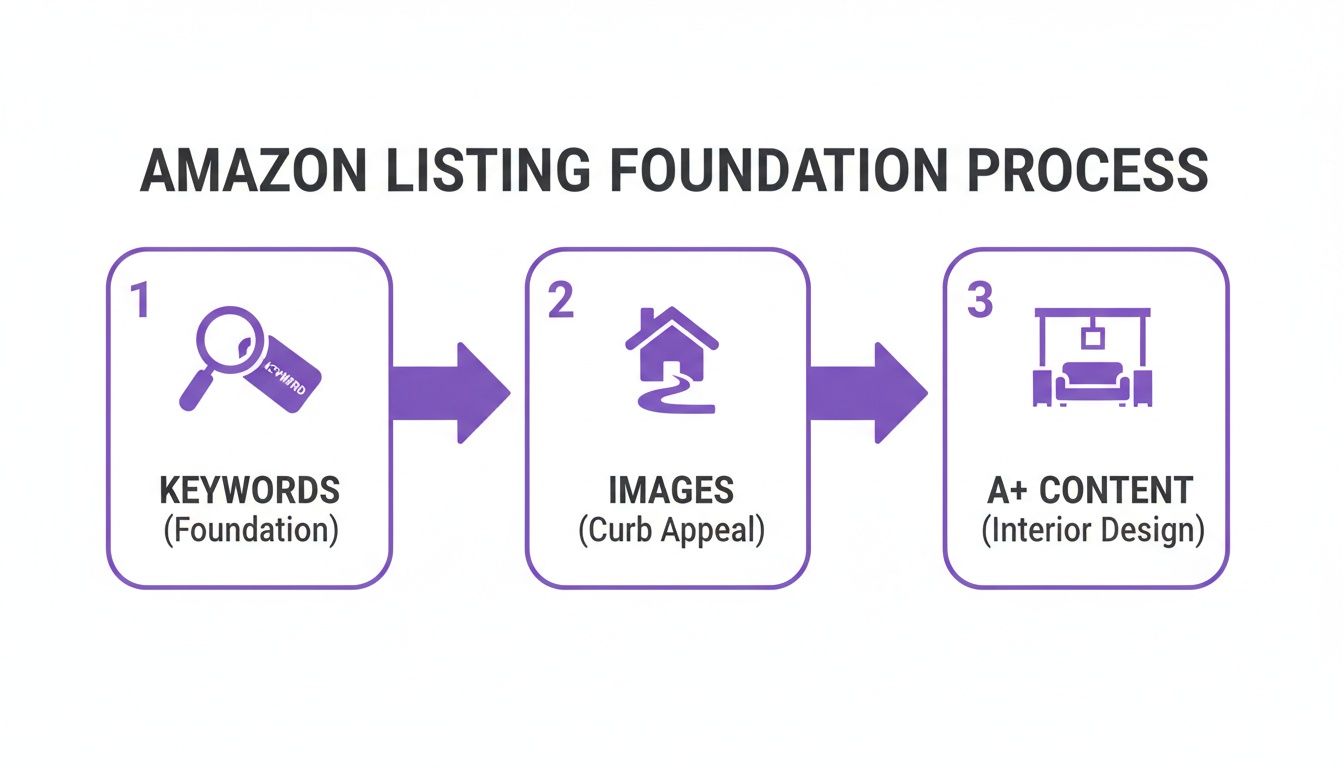
As you can see, without a solid keyword strategy, eye-catching images, and persuasive A+ Content, you're just throwing money away on ads that won't convert.
The Main Types of Amazon Ads
At first glance, Amazon’s ad world can feel a little overwhelming. But really, it all boils down to three main ad types, and each one has a specific job to do.
- Sponsored Products: These are the ads you see everywhere—right in the search results and on other product pages. They’re targeted by keywords and products, making them perfect for snagging high-intent shoppers right when they're ready to buy.
- Sponsored Brands: Think of these as your brand's billboard at the top of the search results. They show off your logo, a custom headline, and a few of your products. They’re fantastic for building brand recognition and funneling shoppers to your Amazon Storefront.
- Sponsored Display: This is your retargeting powerhouse. These ads follow shoppers who’ve looked at your products but didn't buy, reminding them of what they're missing—both on and off Amazon. It's a great way to stay top-of-mind with an already-warm audience.
Knowing when to deploy each one is key. Sponsored Products are your sales workhorses, Sponsored Brands tell your brand’s story, and Sponsored Display brings interested shoppers back into the fold.
Structuring Your Campaigns for Success
One of the biggest mistakes I see sellers make is just throwing all their keywords into one giant, messy campaign. A structured, methodical approach will always win. The best place to start is with a two-part strategy: an automatic campaign and a manual one.
Think of an automatic campaign as casting a wide fishing net. You're letting Amazon’s algorithm do the heavy lifting, testing out all sorts of search terms to see what bites. A manual campaign is like spear fishing. You take the winning keywords you discovered and target them with precision for the best results.
This creates a brilliant feedback loop. Your auto campaign is a discovery tool, constantly finding new, profitable keywords you hadn't thought of. You then take those proven winners and move them into a manual campaign, where you have tight control over your bids and budget. This data-first approach keeps your Amazon marketing strategy sharp and constantly improving.
Of course, there's a lot more to it. To really get this right, you’ll want to dive deep into the whole process. We highly recommend this Ultimate Guide to Amazon PPC for a full breakdown from the ground up.
Measuring What Matters Most
How do you know if your ads are actually working? You have to track the right metrics. Don't get distracted by vanity numbers like impressions; focus on the data that directly affects your profit.
| Metric | What It Measures | Why It Matters |
|---|---|---|
| ACoS (Advertising Cost of Sale) | The percentage of your sales revenue that you spent on ads. | This is your core efficiency metric. A lower ACoS means your ads are more profitable. |
| ROAS (Return on Ad Spend) | How much revenue you earn for every single dollar you spend on ads. | This shows you the direct return on your investment. A ROAS of 5 means you made $5 for every $1 spent. |
| Conversion Rate | The percentage of people who clicked your ad and then actually bought the product. | A high conversion rate tells you that your listing is doing a great job of closing the deal. |
By keeping a close eye on these key numbers, you can make smart, informed decisions. You’ll know when to adjust bids, tweak your targeting, and put your money where it will make the biggest difference. This cycle of continuous optimization is the real secret to scaling an Amazon brand profitably.
Elevating Your Brand with A+ Content and Stores

Okay, so you've nailed the basics. Your listings are optimized, and your ads are bringing in shoppers. What's next? It's time to graduate from simply selling a product to building a true brand experience on Amazon.
This is where your Amazon marketing strategy gets a serious upgrade with A+ Content and Amazon Stores.
Think of a standard product listing like a black-and-white classified ad. It's functional, sure. It has a title, some bullet points, and a few photos. It gets the basic information across, but it’s not exactly inspiring. A+ Content, on the other hand, is your product's full-color, glossy magazine spread.
From Classified Ad to Magazine Feature
A+ Content, which used to be called Enhanced Brand Content (EBC), is a feature available to all sellers in the Amazon Brand Registry. It lets you swap out that plain-text product description at the bottom of the page for a beautiful, modular layout packed with rich media.
Suddenly, you have the space to tell a real story. You can use stunning images, helpful comparison charts, and persuasive copy to show off your product in a way that simple bullet points never could. This is your chance to visually answer your customers' biggest questions before they even have to ask.
Think of A+ Content as your best salesperson, working around the clock to close the deal. In fact, Amazon’s own data shows that adding it can lift sales by an average of 3-10%, all by giving your conversion rate a healthy boost.
So, why is it so effective? It all comes down to trust. When a shopper sees a professionally designed page with detailed visuals and clear explanations, it gives them the confidence they need to click "Add to Cart." You're reducing their uncertainty and making them feel good about their purchase.
Best Practices for A+ Content
Just throwing a few pretty pictures up won't cut it. Your A+ Content needs a strategy behind it to really work.
- Show, Don't Just Tell: Instead of just listing features, show the benefits. A picture of your product is good; a picture of someone happily using your product is a game-changer. Help customers see how it fits into their life.
- Invest in High-Quality Visuals: Your photos and graphics are a direct reflection of your brand. Make sure they're crisp, professional, and on-brand. No blurry phone pictures allowed!
- Make it Scannable: Let's be honest, people skim online. Use short sentences, bolded text, and clear headlines in your modules. Make your most important points pop right off the page.
- Use Comparison Charts: These are pure gold. They make it incredibly easy for a shopper to see how your product stacks up against another model or even a competitor, guiding them to a quick, confident decision.
When you put these pieces together, you're not just decorating your page—you're creating a more helpful and engaging experience that naturally leads to more sales.
Building Your Brand's Headquarters with Amazon Stores
While A+ Content elevates your individual product pages, an Amazon Store gives your entire brand a dedicated home on the platform. If A+ Content is the magazine feature, your Store is the whole magazine.
For any seller with more than a handful of products, a Storefront is an absolute must-have. It’s a custom, multi-page microsite right on Amazon where you can:
- Display Your Full Catalog: Neatly organize all your products into categories, just like you would on your own website. This encourages browsing and cross-selling.
- Tell Your Brand Story: Use a dedicated "About Us" page to connect with customers on a deeper level. Share your mission, your values, and what makes you different.
- Launch and Promote Products: Create special landing pages to highlight new arrivals, seasonal collections, or bestsellers.
- Drive Traffic from Everywhere: Your Store gives you a single, clean URL (e.g., amazon.com/yourbrand) that you can use in social media bios, email newsletters, and other off-Amazon campaigns.
A Storefront helps you turn a single transaction into brand discovery. A customer might come for one product, but then click over to your Store and find three more things they love. It’s one of the most powerful tools for building loyalty and increasing customer lifetime value, all without them ever having to leave Amazon.
How to Build Trust with Reviews and Reputation
On Amazon, your reputation is everything. That little star rating and the number next to it are often the first—and sometimes only—things a shopper looks at. It’s your digital handshake, and it can either draw people in or send them straight to your competitor. A solid review profile isn't just a "nice to have"; it's a critical piece of any Amazon marketing strategy because it directly impacts sales and how you rank in search.
Think of it this way: reviews are the social proof that gives shoppers confidence. In a sea of endless options, people look to the experiences of others to feel good about their purchase. It's why a product with a 4.7-star rating and 500 reviews will almost always beat out a similar one with 4.2 stars and just 50 reviews. The first one just feels like a safer bet.
Earning Reviews the Right Way
Let's be crystal clear: Amazon is incredibly strict about how you get reviews. Trying to game the system with shady tactics is the fastest way to get your account suspended. The only sustainable approach is to play by their rules, using the tools they provide and, most importantly, delivering a great customer experience that makes people want to leave a good review.
Forget the black-hat stuff. Your energy is much better spent on two legitimate, Amazon-approved methods.
- The 'Request a Review' Button: This is your bread and butter. Inside your Seller Central order details, you'll find this button. Clicking it sends a standard Amazon email asking the customer for both a product review and seller feedback. You can do this for any order between 5 and 30 days after it's been delivered.
- The Amazon Vine Program: If you're in the Brand Registry program, this is a must-use tool. Vine lets you send free products to a hand-picked group of trusted reviewers called "Vine Voices." These folks are known for giving honest, detailed feedback, which is pure gold for launching a new product and getting some initial traction.
While the 'Request a Review' button is a fantastic free tool for day-to-day use, the Vine program is your launchpad. Getting those first 10-15 honest reviews can give a new product the momentum it needs to start showing up in searches and making early sales.
Managing Your Reputation Proactively
Getting good reviews is one thing, but what you do with the bad ones is just as important. A smart Amazon marketing strategy includes actively managing your reputation, especially when a one-star review inevitably pops up. How you respond to that unhappy customer can say more about your brand than a hundred five-star ratings.
Don't see a negative review as a crisis. See it as a public stage to show off just how great your customer service is.
- Respond Publicly and Professionally: Jump on that review. Acknowledge their problem, apologize that they had a bad experience, and offer to make things right. This shows every other shopper reading it that you stand behind your products.
- Take the Conversation Offline: In your public reply, invite them to contact you directly through Amazon's messaging system so you can solve their specific issue. Sometimes, a great resolution can even inspire a customer to go back and update their negative review.
- Learn from the Feedback: Negative reviews are free, if sometimes painful, market research. If you see the same complaint over and over, that's a flashing red light telling you something about your product or process needs to be fixed.
By actively managing your reviews—the good and the bad—you're not just trying to win one sale. You're building a brand that people trust for the long haul.
Using Promotions and External Traffic to Drive Growth
Alright, once your listings are solid and you’ve got a healthy stream of reviews coming in, it’s time to pull out the big guns. This is where we get into two of the most effective growth levers for your Amazon marketing strategy: smart promotions and external traffic.
These tactics are what separate the amateurs from the pros. They help you orchestrate big sales spikes, launch new products with serious momentum, and build a real brand that doesn’t live and die by Amazon’s algorithm alone.
Think of on-Amazon promotions as your accelerator. They’re like putting a giant, flashing "SALE" sign in your digital shop window. You grab the attention of bargain-hunters and create a powerful sense of urgency that can really move the needle on sales velocity, which Amazon’s algorithm absolutely loves.
Choosing the Right Amazon Promotion
Not all promotions work the same way. Each one has a specific job to do, and the real secret is knowing which tool to use for the task at hand. You wouldn't use a sledgehammer to hang a picture, right? Same idea here.
Coupons: These are your everyday workhorse. A digital coupon (like "$5 off" or "10% off") shows up as a bright orange badge right on the search results page, making your product stand out. They are fantastic for giving a steady boost to your conversion rate on almost any product.
Deals (e.g., Lightning Deals, 7-Day Deals): These are the heavy hitters. They’re time-sensitive promotions that get you featured on Amazon’s highly-trafficked Deals page. A Lightning Deal is a flash sale that lasts just a few hours—perfect for generating a massive, short-term sales surge for a new product launch or clearing out old inventory. A 7-Day Deal, on the other hand, gives you a longer promotional runway.
Prime Exclusive Discounts: This is a fantastic way to zero in on Amazon's most valuable customers. It offers a special discount available only to Prime members, making it an incredibly powerful tool around major shopping holidays like Prime Day.
Think of these as a complete toolkit for managing your product’s journey. A Lightning Deal can give a new launch the explosive start it needs, while a simple coupon can provide the consistent push required for long-term, sustainable growth.
The Power of External Traffic
While on-platform promotions are essential, one of the most under-appreciated parts of a truly sophisticated Amazon marketing strategy is driving traffic from outside of Amazon. This simply means sending people from your social media accounts, blog, or email list directly to your Amazon product page.
So why is this so powerful? Because Amazon's algorithm loves it. When Amazon sees you actively bringing new shoppers onto its platform, it often rewards you with a nice little bump in your organic search rankings. It’s a huge signal that your brand has pulling power beyond the Amazon ecosystem.
This creates a beautiful flywheel effect. You drive external traffic, which results in more sales. Those sales improve your organic rank, which brings in even more organic sales. It’s a self-perpetuating cycle of growth.
This is exactly where having your own off-Amazon assets—like a blog or a Shopify store—becomes a massive advantage. You can use marketing channels you actually own to directly fuel your performance on Amazon. Imagine running a targeted Instagram ad that sends shoppers straight to your Amazon listing to buy.
To actually see if these efforts are paying off, you absolutely have to use Amazon Attribution. This is Amazon's free tool that gives you a special tracking link. When you use that link in your campaigns, you can see exactly how many clicks, sales, and add-to-carts came from a specific TikTok video or email newsletter. This data shows you your true ROI and tells you precisely where to double down.
By blending smart promotions with a steady flow of external traffic, you stop just competing on Amazon and start building a genuine brand that has a life of its own.
How Amazon Fuels Your Off-Platform Brand
For smart, ambitious brands, Amazon isn't the end goal—it's the most powerful customer acquisition engine you'll ever find. A truly effective Amazon marketing strategy sees the platform as a launchpad, not a final destination. It's the fuel for growing your own independent e-commerce brand, like a Shopify store.
This mindset shift is what separates a simple marketplace seller from a durable, long-term business. You stop just renting customers from Amazon and start building a real path to owning that relationship yourself.
Using Amazon as Your Ultimate Testing Ground
Think of Amazon as the world's biggest and most honest focus group. With its staggering amount of traffic, you can get instant feedback on new products, pricing experiments, and marketing messages with a speed and accuracy you could only dream of on a brand-new website.
Before you go all-in on a massive inventory order for your own store, launch it on Amazon first to see if anyone actually wants it. If it flies off the virtual shelves, you've got a proven winner. If it flops, you've learned an invaluable lesson with minimal risk.
Amazon is your brand's laboratory. It's where you can experiment, gather data, and perfect your offering before scaling it on your own terms. This takes the guesswork out of growth and makes sure you're investing in what customers truly want.
This approach gives you a treasure trove of insights. The search terms people use to find your products are pure gold for your website's SEO. The questions they post in the Q&A section become the perfect blueprint for your site's FAQ page. Every piece of data is a breadcrumb leading you toward a stronger off-platform strategy.
Transitioning Buyers into Brand Loyalists
The real end game is to turn those one-time Amazon buyers into direct, loyal customers of your brand. While Amazon's rules are strict about directly marketing to its customers, you can absolutely build a bridge between the two worlds with some clever, subtle branding.
Your product packaging is your best brand ambassador here. Slip in an insert that tells your brand story, shares your social media handles, and gives people a great reason to visit your website—like registering a product warranty or unlocking exclusive "how-to" content. It's a gentle nudge from Amazon's ecosystem into your own.
You can learn a lot from Amazon's own playbook. The Prime program, with over 200 million members who spend nearly 2.3 times more than non-members, is a masterclass in building a loyal, habit-forming community. For sellers branching out to Shopify, this just proves how valuable it is to create your own loyalty loop and turn one-time shoppers into repeat fans. You can get more great ideas for building customer loyalty on BlankBoard Studio.
Building a Defensible Business
Let's be honest: relying 100% on Amazon is risky. A sudden algorithm change, a flood of new competitors, or an unexpected policy update can rock your business overnight. By using your Amazon marketing strategy to power your off-platform growth, you're building a much more resilient and defensible brand.
Here’s how the two platforms should work in harmony:
- Amazon for Acquisition: Use its massive, ready-to-buy audience to attract new customers and validate your product ideas at scale.
- Shopify for Retention: Use your own website to build direct relationships, control the entire customer experience, and maximize lifetime value with things like email marketing and loyalty programs.
This dual-platform strategy creates a powerful flywheel. The profits and data you generate on Amazon fund and inform your direct-to-consumer efforts on Shopify. In turn, having a strong brand presence off-Amazon can actually boost your credibility and sales back on the marketplace. You're no longer just selling a product; you're building a real, lasting asset.
Frequently Asked Questions
When you're knee-deep in building an Amazon marketing strategy, questions are bound to pop up. It’s a complex world with a lot of moving parts, so let's tackle a few of the most common ones we hear from sellers.
How Much Should I Budget for My Amazon Marketing Strategy?
This is the million-dollar question, isn't it? While there’s no single right answer, a good rule of thumb is to set aside around 10% of your total revenue as an initial test budget. This gives you enough runway to collect real data without betting the farm.
When it comes to your PPC ads, the most important metric to watch is your ACoS (Advertising Cost of Sale). You’ll want to set a target ACoS that still leaves you with a healthy profit margin on each sale. For products that are already selling, an ACoS between 20-30% is a very healthy and realistic benchmark to aim for.
Which Tools Are Essential for Amazon Marketing?
You can actually get a ton of value from the tools Amazon gives you right out of the box. Before you spend a dime, make sure you’re taking full advantage of these two:
- Brand Analytics: This is an absolute goldmine for any Brand Registered seller. It shows you top search terms, customer demographics, and even what your competitors are up to.
- Search Query Performance Reports: These reports tell you the exact phrases shoppers are typing to find your products. It's like a cheat sheet for perfecting your keyword strategy.
While Amazon's free reports are powerful, investing in a specialized tool is like upgrading from a basic map to a full-blown GPS. You'll get where you're going much faster.
To really get an edge, you'll want to layer in a third-party platform. Tools like Helium 10 or Jungle Scout are the industry standard for a reason—they offer deep keyword research, competitor tracking, and performance insights that Amazon alone can't provide.
Can I Drive Traffic from My Social Media to Amazon?
Yes, and you absolutely should! Amazon loves it when you bring new shoppers to their platform from outside sources like Instagram, TikTok, or your email list. It signals that your product has real-world demand, and Amazon’s algorithm often rewards you for it with a nice little boost in organic rankings.
The only way this works, though, is if you track it properly. You have to use Amazon Attribution links for these campaigns. It’s a free tool that measures the ROI from your off-Amazon marketing, showing you exactly which channels and posts are driving clicks, adds-to-cart, and sales. Without it, you're just flying blind.
At Wand Websites, our specialty is helping successful e-commerce businesses build their own powerful headquarters outside of marketplaces. If you’re ready for a professional Shopify store that will help you grow your traffic, increase your order value, and build a loyal customer base, we’re ready to help. Let's build your brand's future together.
