
Mastering Amazon Ad Campaigns in 2026

If you're an ambitious ecommerce seller—maybe you’ve outgrown Etsy or are scaling your Shopify brand—it’s time we talked about Amazon Ads. Think of them as your secret weapon for serious growth and market validation. This isn't just about finding another sales channel; it’s about plugging into a massive audience of shoppers who are ready to buy right now.
You get sales, yes, but you also get priceless data that can inform your entire business strategy.
Why Amazon Ads Are Your Growth Engine
If you’re pulling in around $10k-$60k a month, getting a handle on Amazon PPC is one of the smartest moves you can make. It’s more than just selling products; it’s about building a brand on the world’s largest product search engine. You’re not just hoping people see your ads—you’re putting your products right in front of them at the exact moment they’re searching.
That's the key difference. While social media ads build awareness, Amazon ads capture intent. Your customers are already looking for what you sell.
Before you dive in, let's quickly break down the main ad types. Use this table to match your business goals to the perfect campaign format.
Which Amazon Ad Campaign Is Right for You
Each type has its place, but for most sellers starting out, Sponsored Products is where you’ll get the most immediate traction.
Meet Customers Where They Shop
The magic of Amazon is its scale and the mindset of its users. People don't just browse Amazon for fun; they go with a purpose. They need something, and your product can be the first solution they see.
An Amazon ad campaign lets you skip the line and land on the first page of the search results—which is critical when you learn that 70% of shoppers never click past page one. Without ads, you’re just hoping your organic SEO does the heavy lifting, a process that can take months, if not years.
The real win isn’t just the sale. It’s the data. Every click, every search term, every conversion is a clue that tells you exactly what your customers want.
A Powerful Data-Gathering Tool
Honestly, your first few ad campaigns are your best investment in market research. An automatic campaign, for instance, acts like a scout, discovering all the search terms real customers are using to find products like yours. You might think your "biodegradable dish scrubber" is a winner, but the data could show that people are actually searching for an "eco-friendly kitchen sponge."
That kind of insight is pure gold. It helps you refine your ad targeting, your product listings, your website SEO, and even your next product idea. You're learning your customer's language straight from the source. This is why many experienced sellers view their Amazon ad campaign as your most powerful growth lever.
The Scale of the Opportunity
The advertising world on Amazon is huge and getting bigger every day. In fact, Amazon's ad revenue hit a massive $68.63 billion in 2025, which was a 22% jump from the previous year. That growth is powered by sophisticated AI that uses trillions of shopping signals to show people the right ads at the right time.
For a growing business like yours, this means a few things:
- Competition is fierce, so a smart strategy is a must.
- The platform is smart, and Amazon wants its ad tools to work for you.
- The audience is gigantic, with millions of active shoppers waiting.
By getting into Amazon Ads, you’re not just another seller in a crowded market. You’re using a world-class marketing platform built to connect hungry buyers with the right products. For a brand looking to scale, there's simply no better opportunity.
Building Your Campaign Foundation
A successful Amazon ad campaign isn't built in the ad console. It's built long before you spend your first dollar on a click. Think of this early stage as laying the groundwork for a house—if you skimp on the foundation, the whole structure will eventually come crashing down.
So many sellers get this wrong. They jump straight into creating campaigns, throwing money at Amazon and just hoping something sticks. That's not a strategy; it's a gamble. We need to start with a simple, powerful question: what are you actually trying to accomplish?
Defining Your Campaign Objectives
The answer to that question changes everything. It dictates the campaign types you’ll use, the keywords you’ll target, and how aggressively you’ll bid.
Are you launching a brand-new product? Or are you trying to steal market share from a well-entrenched competitor? Maybe you just need to clear out last season's inventory. Each of these scenarios demands a completely different game plan.
- For a Product Launch: Your main objective is visibility and data, not immediate profit. You'll likely need to accept a higher Advertising Cost of Sale (ACoS) at first. The goal is to get in front of as many relevant shoppers as possible and collect crucial keyword data for later.
- For Brand Dominance: This is an offensive play. You're going to bid aggressively for those top-of-search placements on your most important keywords. The idea is to own that digital shelf and push your competitors below the fold.
- For Liquidation: Here, it’s all about speed. You'll want to run aggressive promotions and target broader keywords to move units fast, even if it means sacrificing some profit on each sale.
Defining your objective is the most critical part of this process. It becomes your North Star, guiding every decision you make and telling you whether you're actually succeeding or just spending money.
Preparing Your Product Listing for Paid Traffic
Let me be blunt: sending paid traffic to a poorly optimized product listing is the fastest way to burn through your ad budget. It’s like pouring water into a leaky bucket. Before you even think about launching your Amazon ad campaigns, your product page has to be ready to convert.
We call this being "retail-ready," and it's non-negotiable. At a minimum, your listing needs:
- High-Quality Imagery: At least 5-7 professional photos. You need clean product shots on a white background, lifestyle images showing the product in use, and infographics that spell out the key benefits.
- Compelling Copy: This means a keyword-optimized title, benefit-focused bullet points, and A+ Content that tells your brand story and answers customer questions before they even ask.
- Sufficient Reviews: Social proof is everything on Amazon. You should aim for at least 15 customer reviews with an average rating of 4.0 stars or higher. Anything less, and you'll struggle with conversions.
Getting this foundation right is a massive topic on its own. If you want to dig deeper, you can master your Amazon Ads campaign with a more detailed breakdown that will set you up for long-term growth.
Planning Your Initial Budget
Budgeting can feel like a shot in the dark, but there's a simple way to approach it. In the beginning, your budget isn't about hitting a specific profit target. It's about buying data.
A good rule of thumb is to allocate 10% of your total revenue toward advertising.
Let's look at a quick example. Say you sell artisanal candles and your monthly revenue is around $15,000.
- Total Monthly Ad Budget: 10% of $15,000 = $1,500
- Starting Daily Budget: $1,500 / 30 days = $50 per day
That $50 a day is your data-gathering fund. It's more than enough to run an automatic Sponsored Products campaign, which will act as your research tool. Amazon will start showing your ads for all sorts of search terms, and within a few weeks, you'll have a goldmine of data showing you exactly what customers are searching for to find and buy your product. That's when you can start building out manual campaigns with confidence.
Choosing Your Targeting Strategy
Alright, you've got your foundation in place. Now for the fun part: deciding exactly how you’re going to get your ads in front of the right shoppers. This is where your campaign goes from a good idea to a real plan for grabbing customer attention and, more importantly, their dollars.
The choices you make here—about campaign types and targeting methods—will have a direct impact on how efficiently you spend your budget and how profitable you ultimately are.
We touched on Sponsored Products, Brands, and Display earlier, but now that you have clear goals, the right choice should be much easier. For most sellers just starting out, if your goal is to drive sales for a specific product, the answer is almost always Sponsored Products. It’s the workhorse of Amazon ads.
This simple visual breaks down how we get from big-picture goals to a smart, well-funded campaign.
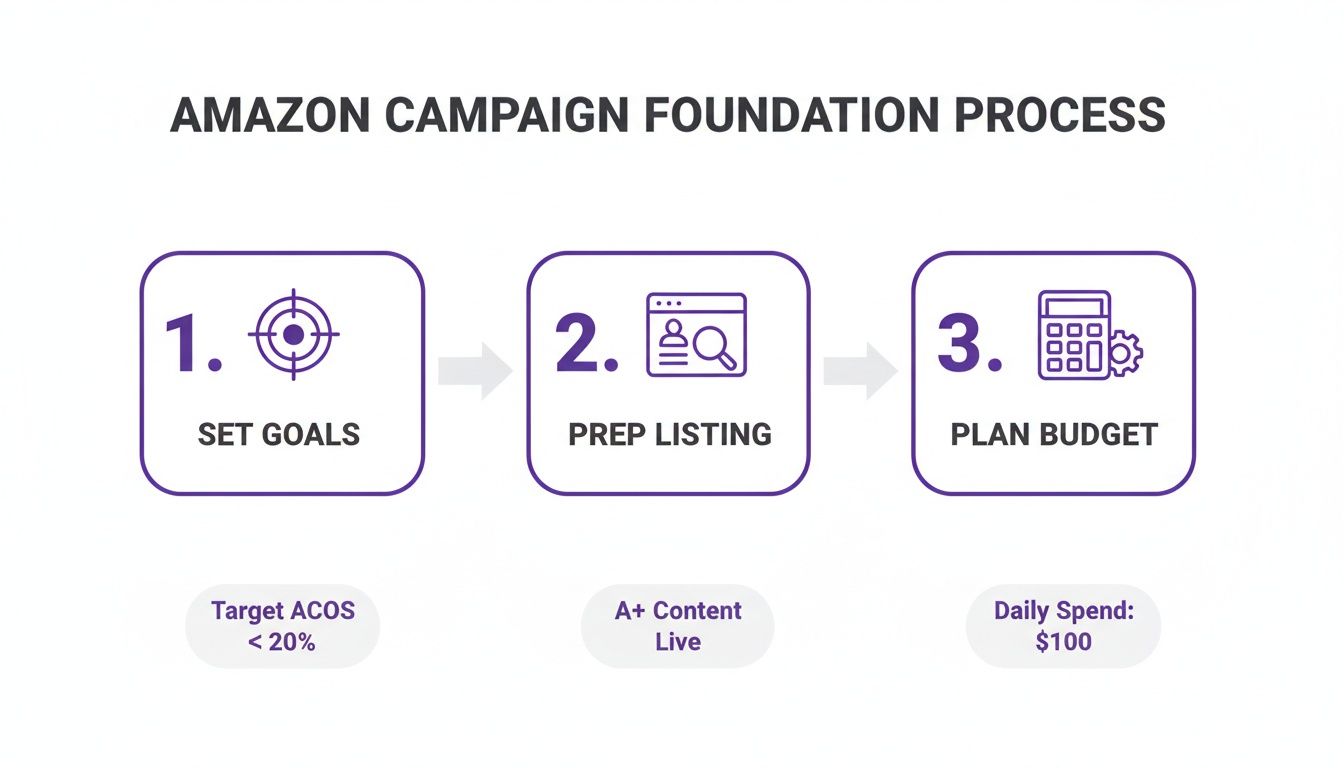
As you can see, targeting isn't a random decision. It's the logical next step after you've set your goals and made sure your product is ready for the spotlight. So, let's dig into the specifics of how you'll find your audience.
Automatic vs. Manual Targeting: The Two-Campaign System
The biggest targeting decision you'll face is whether to go with an automatic or manual campaign. New sellers always ask me which one is better, but honestly, that’s the wrong question. You need to use both. They work together, each playing a completely different but vital role.
Here’s how I think about it:
- Automatic Campaigns are your reconnaissance team.
- Manual Campaigns are your elite special forces.
You send out the recon team first to map out the battlefield and find the enemy's weak spots. Once you have that critical intelligence, you send in your special forces for a precise, efficient strike.
Start with an Automatic Campaign for Data Mining
Your very first move should be to launch a Sponsored Products campaign using automatic targeting. It’s simple: you give Amazon your product, set a budget, and let its algorithm take the wheel. Amazon will start showing your ad for search terms and even on product pages it thinks are a good match.
This is your data-gathering phase. You're not aiming for perfection or mind-blowing profits just yet. Think of it as paying Amazon a small fee to tell you exactly how real people are searching for products just like yours. After a couple of weeks, you'll be sitting on a goldmine of data in your Search Term Report.
Getting this data is more important than ever. The competition on Amazon is fierce—in 2025, over 300,000 sellers worldwide blew past $100,000 in annual sales, a huge jump from 2019. This has driven the average CPC up to $1.12 and pushed the average ACOS into the 25-36% range. Flying blind isn’t an option anymore; you need a smart, data-backed strategy to win. You can explore more data on how Amazon's ad ecosystem is growing and what it means for sellers.
Harvest Keywords for Your Manual Campaign
After your automatic campaign has run for at least two or three weeks, it’s time to put on your miner’s helmet and dig into your Search Term Report. This report is a direct log of every customer search term that triggered a click on your ad. Your job is to find the "gold nuggets"—the search terms that are actually converting into sales.
Your Search Term Report is the most valuable market research document you have. It's a direct transcript of your customers' buying language. Don't just glance at it; study it.
Pinpoint every search term that has led to one or more sales. These are your proven winners. This list of keywords is the ammunition you're about to load into a highly profitable manual campaign.
Launch a Manual Campaign for Precision and Control
Armed with your list of converting keywords, you're ready to build a manual campaign. This is where you take the controls back from the algorithm. You tell Amazon exactly which keywords you want to bid on and how much you're willing to pay.
To do this effectively, you have to understand match types:
- Broad Match: The widest net. Your ad might show for synonyms, misspellings, or related searches. Great for reach, but you have very little control.
- Phrase Match: A nice middle ground. Your ad appears when someone searches for your exact keyword phrase, but they can have words before or after it. It balances reach with relevance.
- Exact Match: The sniper rifle. Your ad only shows for searches of that exact keyword (or super close variations). This gives you maximum control and usually the highest conversion rates.
By taking your proven keywords and putting them into a manual campaign, you can bid aggressively on your best-performing exact match terms. Meanwhile, you can use phrase and broad match to keep discovering new search queries. This two-step process—discovery (automatic) followed by precision (manual)—is the engine that will drive your Amazon ads toward scalable, long-term profitability.
Getting a Handle on Your Bids and Budget
Alright, you’ve got your targeting figured out. Now, let's talk about the money—the fuel for your Amazon ad campaigns. This is where many sellers get tripped up. Effectively managing your bids and budget is what separates those who burn through cash with nothing to show for it from those who build a profitable, scalable advertising engine.
It’s less about making wild guesses and more about making a series of small, smart adjustments over time. The first big decision you have to make is how much you trust Amazon's algorithm with your wallet. This comes down to your bidding strategy.
Dynamic Bidding vs. Fixed Bids: Who’s in Control?
Amazon gives you three ways to handle your bids, and knowing which one to use (and when) is key to hitting your goals without overspending.
Dynamic Bids - Down Only: This is my go-to for any new campaign, and I strongly recommend you start here, too. It’s the safest route. Amazon will automatically lower your bid if it thinks a click is unlikely to turn into a sale, but it will never raise it. Think of it as a safety net that prevents you from wasting money while you’re just gathering your first bits of data.
Dynamic Bids - Up and Down: This one gives Amazon a lot more leeway. It can crank your bid up by as much as 100% for placements at the top of the search results and up to 50% everywhere else if it smells a likely sale. It's fantastic for getting aggressive during a launch or scaling a proven winner, but be warned—it can chew through your budget in a hurry if you're not watching it closely.
Fixed Bids: Here, you’re the boss. You tell Amazon exactly what to bid, and it won't adjust for you. If your bid is $1.00, Amazon bids $1.00. This offers total control, but it's really for seasoned pros who have a mountain of their own data and know the precise value of a click for their products.
For any new campaign, just stick with Dynamic Bids - Down Only. It protects your budget while you learn the ropes. Once a campaign is humming along profitably, you can test "Up and Down" to see if you can pour some gas on the fire and scale up.
Finding Your North Star: Break-Even ACoS
Before you can even think about setting a smart bid, you have to know your numbers—specifically, your profit margin. This brings us to the single most important metric in your Amazon PPC world: break-even ACoS (Advertising Cost of Sale).
This is simply the highest ACoS you can have on a product before you start losing money on each ad-driven sale. The calculation couldn't be easier: your break-even ACoS is your profit margin before ad spend.
Profit Margin = Break-Even ACoS
Let's say your product sells for $50. After all your costs—manufacturing, shipping, and Amazon’s fees—you’re left with $20 in profit. Your profit margin is $20 divided by $50, which is 40%. That means your break-even ACoS is 40%. Any campaign running with an ACoS below 40% is putting money back in your pocket.
Knowing this number changes everything. It turns a confusing dashboard of metrics into a clear guide. When you see a campaign running at 25% ACoS, you’ll know you're solidly profitable and can confidently raise bids to chase more sales, instead of just guessing.
A Smart Tactic for Setting Your First Bids
So, what should you actually bid on day one? Don't fall into the trap of using Amazon’s suggested bids; they’re often way too high. I always teach a more patient, data-led method.
Start low. And I mean, really low—maybe $0.75 or even $0.55. Let that run for a few days.
What you're looking for are keywords that get plenty of impressions but zero clicks. That’s a crystal-clear sign your bid is too low to get a good ad spot. Shoppers are searching, but they aren't seeing you.
From there, you can start inching up your bid on just that keyword. Bump it by $0.10 or $0.15 and wait another couple of days. Keep repeating this until you start seeing clicks. Once those clicks start coming in, you can use your break-even ACoS to decide if the cost is profitable. This slow and steady approach is how you find the bidding sweet spot without setting your budget on fire.
How to Analyze and Optimize Your Campaigns
Getting your amazon ad campaigns live is one thing, but the real work—and the real profit—begins now. The top sellers I know aren't wizards who magically guess what works. They’ve just gotten really good at listening to what their ad reports are telling them and turning that data into their next move.
It’s all about looking at the whole story, not just isolated numbers. Don't get fixated on a single metric like your Click-Through Rate (CTR) or Advertising Cost of Sale (ACoS) without seeing how it connects to everything else.
For instance, I see this all the time: a seller has a fantastic CTR but a terrible conversion rate. They think the ad is failing. It's not! It's a clue. It means your ad creative is doing its job and earning the click, but the product page isn't closing the deal. That’s your cue to go optimize your listing, not shut down a perfectly good ad.
Decoding Your Key Performance Indicators
To make smart moves, you have to know what the numbers are really saying. Let's get past the textbook definitions and talk about what these KPIs actually mean for your bottom line.
- Impressions: This is simply how many times your ad was shown. High impressions are a good start—it means you're in the game—but it's just the first step.
- Click-Through Rate (CTR): The percentage of shoppers who see your ad and actually click it. If your CTR is dipping below 0.4%, it's often a sign that your main image or title isn't resonating with the search term. Your ad just isn't cutting through the noise.
- Cost-Per-Click (CPC): What you pay Amazon every time someone clicks. Your CPC is a huge factor in your ad's profitability, so keeping an eye on it is non-negotiable.
- Conversion Rate (CVR): The magic number. This is the percentage of clicks that turn into a sale. A low CVR usually points to a problem on the product detail page itself—think price, reviews, bullet points, or images.
Think of it like a relay race. Your ad’s job is to get the click (CTR) and hand the baton to your product page. Your product page’s job is to run it across the finish line (CVR). If either one fumbles, you lose the race.
The Weekly Optimization Rhythm
Consistency is everything. Don’t panic and make changes based on one bad day of sales. The best approach is to build a simple, weekly routine to keep your campaigns healthy and improving over time.
Here's what that weekly check-in should look like.
Mine for Gold in Your Search Term Reports
This is your number one job. Dig into your automatic and broad match campaigns to find the exact customer search terms that are leading to sales. Pull those winning terms out and plug them into a manual campaign as exact match keywords. This is how you take control.
Cut the Waste with Negative Keywords
Just as important is finding what’s burning your cash. If you see irrelevant search terms or ones that get clicks but never convert, add them as negative keywords. This simple step immediately stops you from spending money on clicks that will never turn into sales, which is one of the fastest ways to improve your ACoS.
Fine-Tune Your Bids and Budgets
Take a look at your keyword performance.
- Is a keyword profitable and hitting your target ACoS? Nudge the bid up a little to gain more impression share and capture more sales.
- Is another keyword way over your target ACoS? Lower the bid to reduce its spend and bring it back in line.
- Are your best campaigns running out of budget by noon? If they're profitable, give them more fuel! Increase the daily budget so you don't miss out on sales later in the day.
Understanding Industry Benchmarks
It’s tough to know if your numbers are "good" without some context. Knowing the platform averages helps you see where you stand. For example, in 2025, Amazon's average cost-per-click (CPC) climbed to $1.12, which was a $0.15 jump from the year before.
Meanwhile, well-optimized campaigns were seeing conversion rates around 10-15%, with ACoS settling in the 25-36% range. You can dig into more of these numbers by checking out these Amazon advertising stats on AdBadger.com.
If your CPC is consistently hitting $2.50 when the average is closer to $1.12, that’s a flashing red light. It tells you to either tighten up your keyword targeting or improve your listing’s quality to get more efficient clicks.
This cycle—analyze, hypothesize, tweak, and measure—is the heart of successful advertising on Amazon. Over time, these small, smart adjustments add up, turning your ad spend from a necessary evil into your most powerful growth engine.
Answering Your Top Amazon Ad Questions
When you're just getting started with Amazon ads, it's easy to feel a bit overwhelmed. A few key questions seem to pop up for almost every seller, so let's clear the air and tackle them head-on.
Think of this as a conversation with someone who's been in the trenches. No fluff, just straight answers to help you get moving with confidence.
How Much Should I Really Spend on Ads When I'm Starting Out?
There isn't a single magic number here, but I always tell new sellers to start by earmarking about 10% of your total monthly revenue for your ad budget. So, if you're pulling in $10,000 a month, that's a $1,000 ad spend, which breaks down to about $33 per day.
Your goal for the first 30 days isn't profit. It's data. Pour that initial budget into an automatic campaign. This is your reconnaissance mission—it will show you exactly how real customers are searching for your products and give you a goldmine of proven keywords to build on later.
What's a Good ACoS for My Campaigns?
A "good" Advertising Cost of Sale (ACoS) is different for every single product. It all comes down to your profit margin. Before you even think about what's "good," you need to calculate your break-even ACoS. This is simply your profit margin before you spend a dime on ads.
Here’s a quick example:
- Your product sells for $100.
- Your total costs (making it, shipping it, Amazon's fees) add up to $65.
- That leaves you with $35 in profit, so your profit margin is 35%.
In this case, your break-even ACoS is 35%. Any campaign running below that number is putting money back in your pocket. You might be willing to run at a higher ACoS when launching a new product just to get eyeballs and sales, but for your established best-sellers, you'll want to aim for a much lower ACoS to maximize your profits.
Should I Run Ads if I Also Have a Shopify Store?
Absolutely, yes. In fact, not doing so is a missed opportunity. It’s one of the best ways to grow your brand if you think about your channels strategically.
Here's the playbook:
- Amazon is where you find new customers.
- Shopify is where you keep them.
Use Amazon's massive audience of ready-to-buy shoppers to get your brand discovered. Once someone buys from you on Amazon, they know your name. A great product and some thoughtful packaging (like an insert with a thank-you note) can be enough to encourage them to find your Shopify store for their next purchase. That's where your margins are way better and you actually own the customer relationship.
By using both platforms, you create a powerful growth engine. Amazon brings you a steady stream of new customers, and your Shopify store turns them into a loyal community that buys from you again and again.
How Long Until My Amazon Ads Actually Become Profitable?
Patience is probably the hardest, but most important, part of running ads. You’ll see impressions and clicks almost immediately—sometimes within hours of launching a campaign. But it takes around two to four weeks to collect enough real data to start making smart decisions.
Don't panic and make huge changes after one bad day. Advertising is about trends, not daily snapshots. Wait until you have at least a week of data before you start tweaking things. For most sellers, it takes a solid 60 to 90 days of consistent management and optimization to get their campaigns to a place of stable, predictable profitability.
Ready to stop relying on marketplaces and build a powerful e-commerce brand you truly own? At Wand Websites, we create high-performing, conversion-focused Shopify stores that turn your hard work into more traffic, bigger orders, and loyal customers. Let us handle the technical heavy lifting so you can focus on what you do best—creating amazing products.
