
Advantages of Subscription Business Model: Key Benefits


The Power of Recurring Revenue: Why Subscriptions Are Transforming Businesses
Want to build a more predictable and profitable business? A subscription model might be the answer. This listicle dives deep into the advantages of subscription business models, offering actionable insights specifically for thriving e-commerce businesses like yours. We'll explore how recurring revenue can fuel growth and cultivate stronger customer relationships. This isn't just theory - we'll provide practical examples and specific strategies you can implement.
If your Etsy shop or e-commerce store is generating $10k-$60k per month, you're in the perfect position to leverage subscriptions. This article will show you how to:
- Create consistent monthly revenue streams
- Increase the lifetime value of each customer
- Build a loyal customer base
- Streamline your growth strategy
We'll cover eight key advantages of the subscription business model:
- Predictable Recurring Revenue
- Enhanced Customer Lifetime Value (CLV)
- Improved Customer Retention and Loyalty
- Scalable and Efficient Growth
- Continuous Product Development and Innovation
- Better Cash Flow Management
- Data-Driven Customer Insights
- Market Expansion and Flexibility
Ready to unlock the power of recurring revenue? Let's dive in.
1. Predictable Recurring Revenue
One of the most compelling advantages of the subscription business model is the generation of predictable recurring revenue. Instead of relying on inconsistent one-time purchases, subscriptions provide a steady, foreseeable income stream. This predictability is a game-changer for businesses, enabling more effective financial planning, resource allocation, and strategic decision-making. Knowing how much revenue to expect each month empowers you to invest confidently in growth initiatives, marketing campaigns, and product development. This stability also boosts investor confidence, making it easier to secure funding and scale your business.
Why Recurring Revenue Matters
Unlike one-time sales, recurring revenue compounds over time as your customer base expands. Each new subscriber adds to your monthly or annual recurring revenue (MRR/ARR), creating a snowball effect that drives sustainable growth. This allows you to shift your focus from constantly acquiring new customers to nurturing existing relationships and increasing customer lifetime value. A predictable revenue stream offers a sense of financial security, enabling you to weather market fluctuations and economic downturns more effectively. This consistency is invaluable for long-term planning and building a resilient business.
Real-World Examples
Consider the success of subscription giants like Netflix, which boasts over $31.6 billion in annual subscription revenue. Or Microsoft Office 365, which successfully transitioned from a one-time purchase model to a highly profitable subscription service. Adobe Creative Cloud, generating over $12 billion annually, and Salesforce, with 95% of its revenue stemming from subscriptions, further demonstrate the power of this model. These examples underscore the potential of subscription models to generate substantial and sustainable revenue streams.
The following infographic compares Monthly Recurring Revenue (MRR) and Annual Recurring Revenue (ARR) for a hypothetical subscription business.
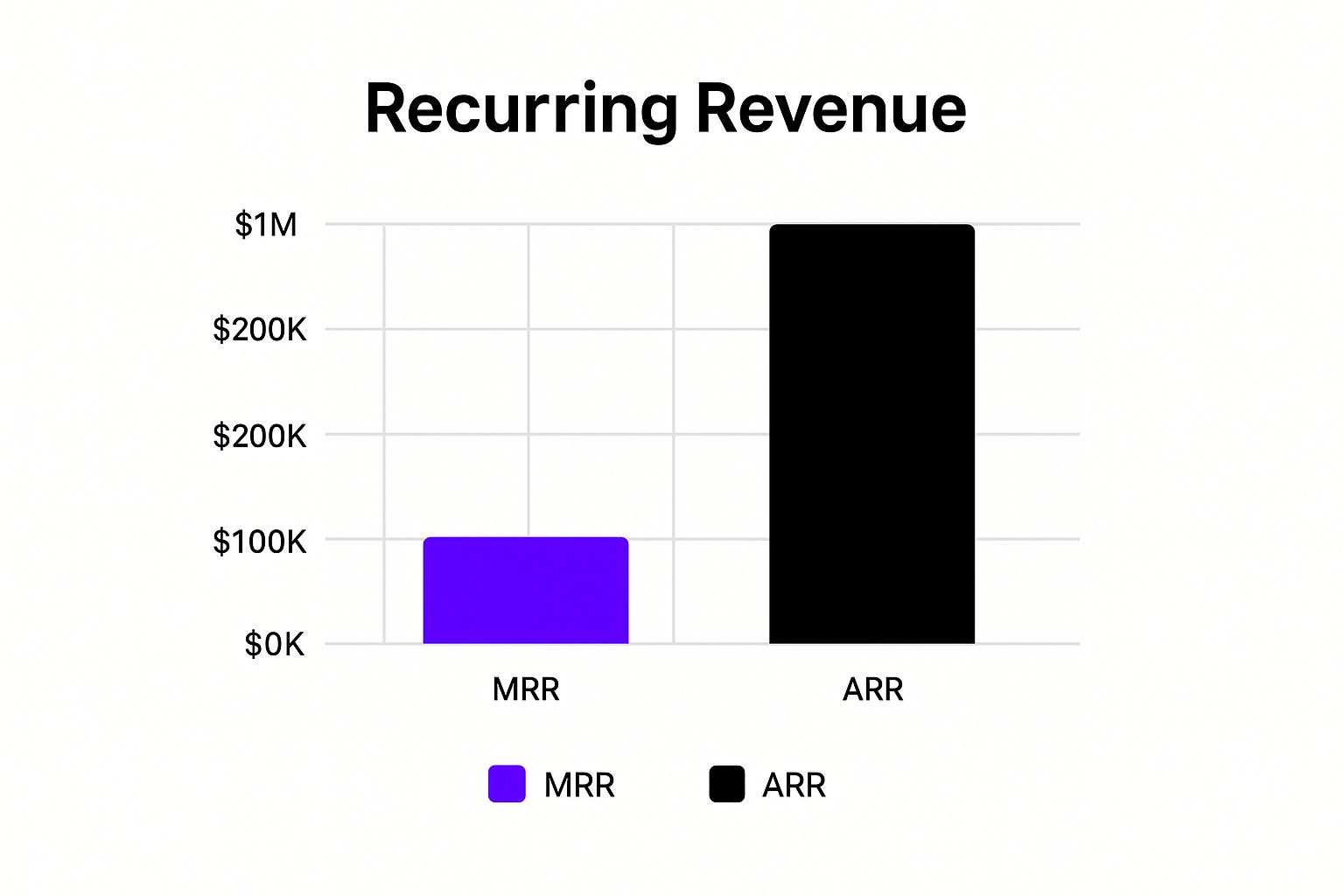
As the bar chart illustrates, while MRR provides a snapshot of monthly performance, ARR offers a broader perspective on annual revenue generation, highlighting the cumulative impact of recurring subscriptions.
Actionable Tips for Implementing Subscriptions
- Track Key Metrics: Monitor key performance indicators like MRR, churn rate (the percentage of subscribers who cancel), and customer lifetime value (the total revenue generated from a single customer over their subscription period). These metrics provide crucial insights into the health of your subscription business.
- Tiered Pricing: Implement a tiered pricing strategy offering various subscription levels with different features and benefits. This allows you to cater to diverse customer needs and maximize revenue per customer.
- Minimize Churn: Focus on reducing monthly churn. A churn rate below 5% is generally considered healthy for sustainable growth. Strategies for reducing churn include exceptional customer service, proactive engagement, and continuous value delivery.
- Cohort Analysis: Employ cohort analysis to understand revenue trends over time. By grouping customers who subscribed during the same period, you can identify patterns, optimize retention efforts, and forecast future revenue more accurately.
2. Enhanced Customer Lifetime Value (CLV)
One of the most significant advantages of subscription business models is the potential to dramatically enhance customer lifetime value (CLV). Instead of relying on single transactions, subscriptions foster ongoing relationships with customers who provide recurring revenue. This recurring revenue stream allows businesses to extract more value from each customer over the long term, leading to greater profitability and sustainable growth. This fundamentally shifts the focus from acquisition to retention and building lasting customer relationships.
Why Enhanced CLV Matters
By focusing on CLV, businesses can prioritize strategies that nurture customer loyalty and encourage long-term engagement. This allows for more efficient allocation of resources, as investments in customer retention often yield higher returns than constantly acquiring new customers. A high CLV indicates a healthy business model, demonstrating customer satisfaction and the effectiveness of retention strategies. It also provides a more predictable revenue stream, enabling better financial planning and forecasting. This predictability is crucial for making informed business decisions and driving sustainable growth.
Real-World Examples
Several successful companies illustrate the power of high CLV within subscription models. Amazon Prime members, for instance, spend an average of $1,400 annually, compared to $600 for non-members. Spotify boasts an average CLV of $136 over a 3-year average lifespan. The Dollar Shave Club, with a CLV of $120+, justified its $1 billion acquisition. Even in the B2B space, companies like HubSpot see enterprise customer CLVs exceeding $10,000. These examples demonstrate the potential for subscriptions to generate significantly higher CLV compared to traditional one-time purchase models.
Actionable Tips for Increasing CLV
- Calculate and Track CLV: Regularly calculate your CLV using the formula: (Average Revenue Per User × Gross Margin) ÷ Churn Rate. Tracking this metric over time allows you to measure the effectiveness of your retention strategies.
- Invest in Onboarding: A strong onboarding experience is crucial for early retention and sets the stage for a high CLV. Guide new subscribers through your product or service, highlighting key features and benefits.
- Implement Usage-Based Upselling: Offer opportunities for customers to upgrade their subscriptions based on their usage patterns. This allows you to grow individual CLV and cater to evolving customer needs.
- Segment Customers by CLV: Group customers based on their CLV to optimize retention efforts. Focus on high-value customers with personalized communication and exclusive offers.
3. Improved Customer Retention and Loyalty
One of the most significant advantages of subscription business models is the potential for drastically improved customer retention and loyalty. Unlike one-time purchases, subscriptions foster ongoing relationships. These relationships encourage deeper customer engagement. Businesses are incentivized to continuously deliver value, cultivating customer habits and dependencies around their service. This creates inherent switching costs and strengthens emotional connections, leading to significantly higher retention rates.

Why Customer Retention Matters
Retaining existing customers is significantly more cost-effective than acquiring new ones. High retention rates contribute directly to a healthier bottom line and sustainable growth. Loyal customers are also more likely to become brand advocates, driving organic growth through word-of-mouth referrals. Increased customer lifetime value (CLTV) further amplifies the advantages of a subscription business model, as each retained subscriber continues to generate revenue over an extended period. This predictable income stream, fueled by loyal customers, provides stability and allows for better long-term planning.
Real-World Examples
The success of subscription-based businesses hinges on high retention rates. Netflix boasts an impressive 93% annual retention rate in mature markets, highlighting the stickiness of their service. Peloton's community-driven approach, fostered through social features within their app, creates significant switching costs, boosting customer loyalty. Adobe achieved a remarkable 99% retention rate after transitioning to a subscription model for its Creative Cloud suite. Zoom’s impressive 130% net revenue retention rate demonstrates how existing customers can contribute to significant growth within the subscription model through upgrades and add-ons. These examples showcase the power of subscriptions in building a loyal customer base.
Actionable Tips for Implementing Subscriptions
- Robust Onboarding: Implement a comprehensive onboarding process to ensure customers quickly realize the value of your subscription. Early success with your product or service is crucial for long-term retention.
- Community Building: Create community features within your platform to foster a sense of belonging and increase switching costs. This can be achieved through forums, social groups, or exclusive content for subscribers.
- Data-Driven Retention: Utilize data analytics to predict and prevent churn. Identify at-risk customers and proactively engage them with personalized offers or support.
- Loyalty Programs: Develop loyalty programs that reward long-term subscribers with exclusive benefits, discounts, or early access to new features. Tenure-based rewards incentivize continued subscriptions.
4. Scalable and Efficient Growth
One of the most compelling advantages of the subscription business model is its inherent scalability and efficiency. Subscription businesses can achieve significant growth with proportionally lower increases in operational costs. The marginal cost of serving an additional subscriber is often significantly less than the recurring revenue they generate, especially for digital products and services. This dynamic creates operating leverage, where profitability improves as the business scales.
Why Scalable Growth Matters
This efficiency stems from the nature of recurring revenue and the ability to leverage technology for automated service delivery. Digital subscriptions, in particular, benefit from network effects and economies of scale. Infrastructure costs don't increase proportionally with customer growth, unlike traditional businesses where each new customer often requires additional resources. This inherent scalability allows subscription businesses to reinvest profits back into growth initiatives, further fueling expansion. Advantages of subscription business model include the ability to adapt to evolving customer needs and maintain a competitive edge in a dynamic market.
Real-World Examples
The rapid growth of companies like Zoom exemplifies this advantage. During the pandemic, Zoom scaled from 10 million to over 300 million daily users with minimal infrastructure changes. Canva, a design platform, grew from 1 million to over 100 million users while maintaining high margins. Slack's viral growth through team invitations and organic expansion within organizations demonstrates the network effect inherent in some subscription models. Similarly, Shopify’s merchant growth leveraged their existing payment and logistics network, enabling scalable expansion. These examples illustrate how a subscription model fosters efficient and sustainable growth.
Actionable Tips for Implementing Scalable Subscriptions
- Invest in Scalable Infrastructure: Prepare for rapid growth by investing early in robust and scalable infrastructure. This includes cloud-based solutions, automated billing systems, and customer support platforms.
- Automate Customer Success: Implement automation tools for onboarding, support, and engagement to maintain service quality as your subscriber base expands. This frees up your team to focus on strategic initiatives.
- Leverage Freemium Models: Consider using freemium models to drive viral acquisition and organic growth. Offering a free tier can attract a wider audience and encourage upgrades to paid subscriptions.
- Focus on Product-Led Growth: Prioritize product development and user experience to reduce customer acquisition costs. A compelling product that organically attracts users is essential for sustainable, scalable growth.
5. Continuous Product Development and Innovation
One of the most significant advantages of the subscription business model is its inherent support for continuous product development and innovation. The steady stream of recurring revenue provides the financial fuel to invest in ongoing improvements, new features, and enhanced customer experiences. Unlike the one-time purchase model where development often stalls after the sale, subscriptions incentivize constant evolution. This focus on improvement is essential for reducing churn, enhancing customer satisfaction, and maintaining a competitive edge.

Why Continuous Innovation Matters
In today's rapidly evolving market, staying ahead of the curve is crucial. Subscription businesses are uniquely positioned to adapt and innovate, thanks to their predictable revenue streams. This allows them to respond quickly to changing customer needs and market trends. By continuously iterating and enhancing their offerings, subscription businesses build stronger customer loyalty and create a significant barrier to entry for competitors.
Real-World Examples
Several successful subscription businesses exemplify the power of continuous innovation. Figma, a collaborative design tool, releases new features monthly based on customer feedback. Notion evolved from a simple note-taking app to a comprehensive all-in-one workspace. Spotify continuously refines its music recommendation algorithms and introduces innovative features like "Wrapped". Slack regularly adds workflow automation and integrations to enhance team collaboration. These examples demonstrate how a commitment to ongoing development translates into market leadership and customer delight.
Actionable Tips for Implementing Continuous Innovation
- Establish Regular Release Cycles: Maintain momentum and manage customer expectations by implementing consistent release schedules for new features and updates.
- Data-Driven Development: Leverage customer usage data to prioritize feature development and ensure you're building what your subscribers truly need.
- Beta Testing: Engage your subscribers in beta testing programs. This provides valuable feedback and allows you to identify and address potential issues before wider release.
- Balance Innovation with Stability: While pushing the boundaries with new features is essential, ensure core product stability is maintained to avoid disrupting the user experience. This balance between innovation and reliability is key to long-term success in the subscription model.
6. Better Cash Flow Management
One of the most significant advantages of the subscription business model is improved cash flow management. Unlike traditional businesses that rely on unpredictable one-time purchases, subscription models provide consistent and predictable recurring payments. Crucially, these payments often arrive before the services are fully delivered, creating a positive working capital situation. This means businesses collect payment upfront, especially with annual subscriptions, and then deliver value over time.
Why Upfront Payment Matters
This upfront cash infusion is a game-changer for businesses. It provides a significant advantage by enabling better financial planning, reducing the need for external financing, and offering flexibility for strategic investments. Having predictable cash flow allows businesses to accurately forecast revenue, manage expenses more effectively, and invest in growth initiatives with confidence. This financial stability reduces dependence on loans or other forms of external capital, allowing for greater control and autonomy.
Real-World Examples
Several businesses demonstrate the cash flow benefits of subscription models. Adobe's shift to subscriptions significantly improved its cash conversion cycle by over 30 days. Costco's annual membership fees provide a substantial upfront cash injection, enabling the company to invest heavily in inventory. SaaS companies like Salesforce consistently maintain a positive cash conversion cycle exceeding 20 days, demonstrating the model's effectiveness. Even companies like Peloton utilize subscription revenue to smooth out the volatility of hardware sales, showcasing the power of recurring payments.
Actionable Tips for Optimizing Cash Flow
- Offer Annual Discounts: Incentivize customers to choose annual subscriptions by offering attractive discounts. This significantly improves upfront cash collection and strengthens your financial position.
- Automate Billing: Implement automated billing systems to streamline the payment process and reduce collection delays. This ensures timely payments and minimizes administrative overhead.
- Monitor Key Metrics: Track key cash flow metrics such as Days Sales Outstanding (DSO) to understand how quickly your business collects payments. This provides insights into the efficiency of your billing and collection processes.
- Forecast with Cohorts: Use cash flow forecasting tools based on subscription cohorts. By analyzing the behavior of different customer groups, you can project future cash flow more accurately and make informed financial decisions.
7. Data-Driven Customer Insights
One of the most powerful advantages of the subscription business model is the wealth of data-driven customer insights it provides. Unlike one-time purchases, subscriptions create an ongoing relationship with your customers, generating a continuous stream of valuable data. This data encompasses customer behavior, usage patterns, engagement metrics, and more, offering a deep understanding of customer preferences and needs. This ongoing data flow allows for robust analytics, personalized experiences, and predictive modeling that simply isn't possible with sporadic transactional data.
Why Data-Driven Insights Matter
These insights are crucial for making informed business decisions. You can leverage this data to refine product development, segment your customer base effectively, and optimize your overall business strategy. By understanding what features customers use most, what content they engage with, and how they interact with your platform, you can tailor your offerings to meet their specific needs, driving customer satisfaction and loyalty. This data-driven approach empowers you to anticipate customer needs and proactively address potential issues, leading to increased retention and higher customer lifetime value. Advantages of subscription business model include a constant feedback loop that informs product development and business strategy.
Real-World Examples
Numerous successful subscription businesses leverage data-driven insights. Netflix's recommendation algorithm, responsible for 80% of viewing choices, is a prime example of using data to personalize the user experience. Spotify's Discover Weekly playlist utilizes listening data to curate personalized music recommendations. HubSpot analyzes usage data to identify expansion opportunities and tailor customer success strategies. Peloton uses workout data to drive content creation and personalize instructor recommendations. These examples demonstrate how data can enhance the customer experience and drive business growth within a subscription model.
Actionable Tips for Leveraging Data
- Implement Customer Health Scoring: Use engagement and usage patterns to create a customer health score. This helps identify at-risk customers and proactively intervene to prevent churn.
- Cohort Analysis: Group customers who subscribed during the same period and analyze their behavior trends over time. This reveals valuable insights into customer lifecycle stages and informs retention strategies.
- Feedback Loops: Establish clear feedback loops between data insights and product development. Use customer data to inform product roadmaps and ensure continuous improvement.
- Invest in CDPs: Customer Data Platforms (CDPs) provide a unified view of customer data, enabling more sophisticated analytics and personalized marketing campaigns. These platforms centralize customer data for comprehensive analysis and action.
8. Market Expansion and Flexibility
One of the often-overlooked advantages of the subscription business model is the inherent flexibility it offers for market expansion and business model adaptation. Subscriptions enable testing different pricing strategies, market segments, and product configurations with significantly lower risk than traditional business models. This adaptability is a crucial advantage in today's dynamic global market.
Why Flexibility Matters
The recurring customer relationship inherent in a subscription model allows for gradual market education, feature expansion, and geographic scaling. You can maintain direct customer relationships across different markets, gathering valuable feedback and iterating on your offerings based on real-time data. This direct line to your customer base is invaluable for informed decision-making and successful market penetration.
Real-World Examples
Consider Spotify's localized content and pricing strategies across 180+ countries, demonstrating the power of tailored offerings. Zoom's rapid global expansion during the pandemic, facilitated by strategically placed localized data centers, highlights the scalability of subscription services. Canva’s market-specific templates and language support further illustrate the adaptability of this model. Slack's expansion from serving small startup teams to supporting large enterprise organizations showcases the versatility of subscription-based growth.
Actionable Tips for Implementing Subscriptions
- Freemium Models for Testing: Use freemium models to test market demand and acquire initial users in new regions before introducing paid tiers. This allows for organic growth and minimizes upfront investment.
- Flexible Pricing Strategies: Implement flexible pricing strategies tailored to the economic realities of different markets. This ensures affordability and maximizes market penetration.
- Local Payment Providers: Partner with local payment providers to streamline the subscription process and cater to regional preferences. This simplifies onboarding and improves customer experience.
- Market-Specific Content: Create market-specific content and features based on local customer data and feedback. This personalized approach fosters stronger customer relationships and increases retention. This demonstrates a commitment to understanding and serving diverse customer needs.
Advantages Comparison of 8 Subscription Model Benefits
Embrace the Subscription Advantage: Building a Business for the Future
The advantages of the subscription business model are undeniable. From predictable recurring revenue streams to enhanced customer lifetime value, the benefits ripple through every facet of a business. This article has explored eight key advantages, each offering a unique pathway to sustainable growth and stronger customer relationships. Let's recap the most crucial takeaways.
Key Takeaways for E-commerce Businesses
- Predictability is Power: Recurring revenue provides a stable foundation for forecasting, budgeting, and long-term planning, allowing for smarter investments and strategic decision-making.
- Customer Relationships are Gold: Subscription models foster deeper connections with customers, increasing loyalty and driving valuable feedback for continuous improvement.
- Growth Becomes Scalable: Efficient and sustainable scaling is within reach thanks to predictable revenue and streamlined operations inherent in the subscription model.
From Insight to Action: Your Next Steps
Understanding the advantages of subscription models is just the first step. The real power comes from implementing these insights within your own business. Here are some actionable next steps you can take today:
- Analyze Your Products: Identify which products or services lend themselves to a subscription model. Consider offering tiered subscriptions with varying levels of access or benefits.
- Understand Your Customer: Survey your current customer base. Discover their needs and preferences to craft compelling subscription offers that resonate.
- Start Small and Iterate: Begin with a pilot program to test your subscription offering. Gather data and refine your strategy based on real-world results.
The Future of Business is Subscription-Based
Mastering the subscription model isn't just about increasing revenue; it's about building a resilient, customer-centric business prepared for the future. By focusing on consistent value delivery and fostering long-term customer relationships, you can unlock the true potential of your business. The stability and growth opportunities provided by recurring revenue are transformative, positioning your brand for sustained success in the dynamic e-commerce landscape.
Ready to transform your e-commerce business with the power of subscriptions? Wand Websites specializes in building and optimizing subscription services for businesses like yours, helping you unlock recurring revenue and build lasting customer relationships. Visit Wand Websites today to explore how we can help you implement a subscription model tailored to your specific needs and maximize the advantages of this powerful business model.
